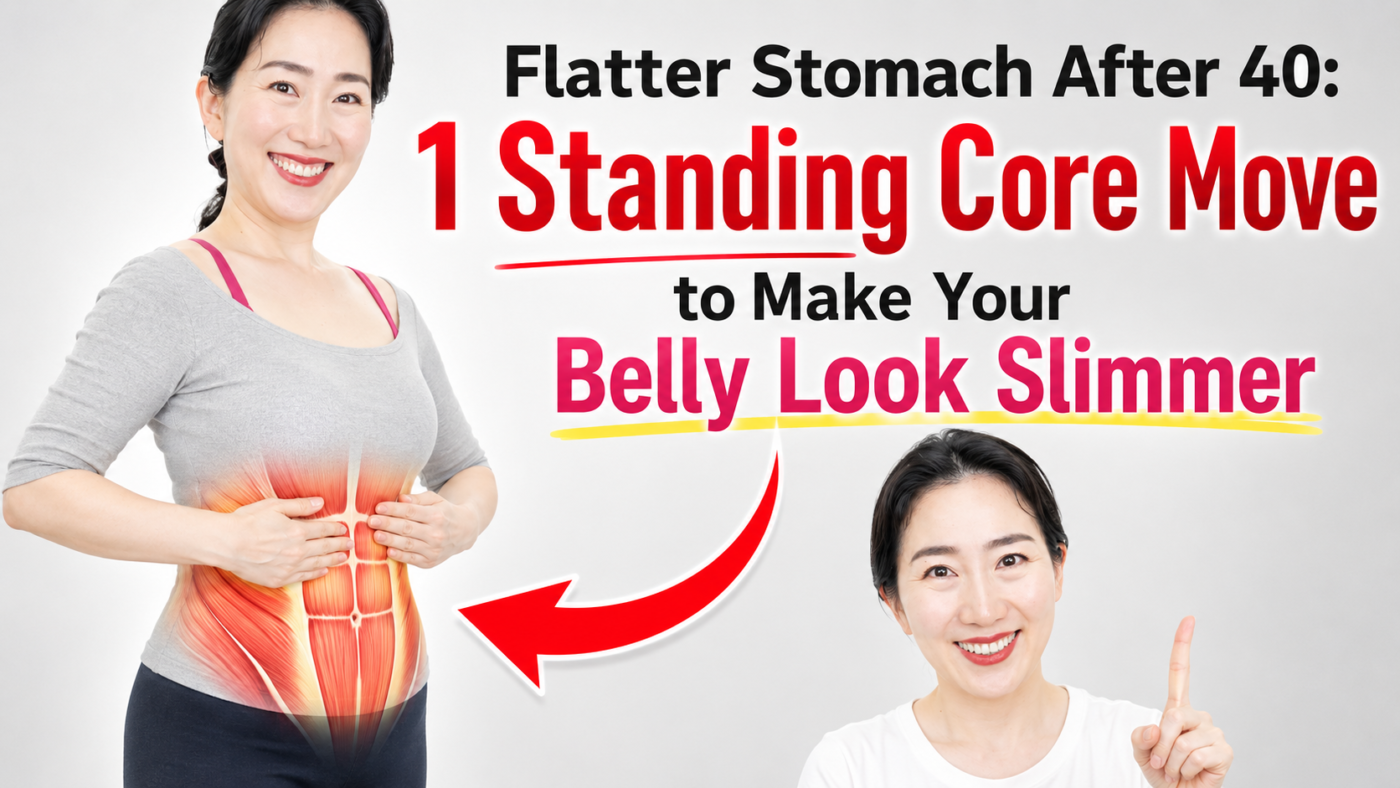
Many people want a flatter-looking stomach without doing hundreds of crunches or exhausting workouts.
That is especially true after 40, when changes in muscle mass, body-fat distribution, posture, activity level and hormonal status can make the abdomen look different from earlier adulthood.
A popular exercise trend claims that one simple standing movement—combined with deep exhalation and abdominal contraction—can instantly flatten the stomach and permanently shrink the waist over time.
There is a small piece of truth inside that claim.
Activating the abdominal muscles and changing your posture can make the stomach look flatter immediately.
But that temporary visual change is not the same as losing abdominal fat.
A standing core exercise can improve awareness and muscular control.
It cannot magically melt belly fat.
Understanding that distinction allows you to use the exercise for what it actually does well.
Why Your Stomach Can Look Different Without Losing Fat
Your abdominal appearance can change dramatically even when body fat has not changed.
Factors include:
- Posture
- Pelvic position
- Abdominal muscle activation
- Bloating
- Digestive fullness
- Breathing pattern
- Spinal position
- Water retention
That is why your stomach may look flatter when you stand taller, exhale fully and gently engage your core.
You have not suddenly lost fat.
You have simply changed how your torso is positioned and how firmly the abdominal wall is being held.
What Happens When You Exhale and Draw In Your Stomach?
During a strong but controlled exhalation, several muscles can become active.
These include:
- Rectus abdominis
- Transversus abdominis
- Internal obliques
- External obliques
- Pelvic floor muscles
- Respiratory muscles
The transversus abdominis is especially important because it wraps around the abdomen like a corset.
When it contracts, it helps increase abdominal wall tension and support the trunk.
This can make your waist look temporarily narrower.
That is a real mechanical effect.
But it is not fat loss.
Can You Train the “Upper Abs” to Lift the Lower Belly?
Not exactly.
The rectus abdominis runs from the rib cage toward the pelvis.
Although different regions can experience different levels of activation depending on the movement, the muscle does not function as two completely independent “upper” and “lower” units.
You cannot simply activate the upper rectus abdominis and permanently pull lower-abdominal fat upward.
The appearance of the lower abdomen depends on many factors, including:
- Body fat
- Skin elasticity
- Pelvic posture
- Abdominal wall strength
- Bloating
- Genetics
- Pregnancy history
- Age
A core exercise may improve control.
It cannot physically relocate fat or loose skin.
Why Your Belly May Look Flatter Immediately
There are several reasons.
1. Abdominal Muscle Contraction
When the abdominal wall tightens, it becomes firmer.
2. Full Exhalation
Exhaling reduces the volume of air in the lungs and can slightly change rib-cage position.
3. Pelvic Position
Changing from a relaxed posture to a more controlled neutral position can alter abdominal projection.
4. Spinal Flexion
Slight trunk flexion can temporarily compress the abdominal area.
5. Reduced Relaxation of the Abdominal Wall
When people stop completely relaxing their midsection, the stomach may appear flatter.
These are visual and mechanical effects.
They do not represent immediate fat loss.
Can This Exercise Permanently Reduce Waist Size?
Only indirectly.
If a person consistently strengthens the core, improves posture and becomes more physically active, their body shape may change over time.
But the exercise itself does not guarantee permanent waist reduction.
Lasting changes in waist circumference are more strongly influenced by:
- Overall fat loss
- Muscle development
- Diet
- Physical activity
- Genetics
- Hormones
- Sleep
- Stress
- Age
A few standing contractions each day may improve muscle control.
They cannot replace a complete weight-management strategy.
Can You Spot-Reduce Belly Fat?
No.
You cannot force your body to burn fat specifically from the abdomen by repeatedly contracting that area.
This is known as the spot-reduction myth.
Abdominal exercises strengthen abdominal muscles.
They do not selectively remove the fat lying above them.
If your goal is lower abdominal fat reduction, the more effective approach involves:
- Sustainable calorie control when appropriate
- Regular aerobic activity
- Resistance training
- Adequate protein
- Sleep
- Long-term consistency
Why the Lower Belly Is Often Stubborn
Lower-abdominal fat distribution is strongly influenced by genetics and hormones.
Many people naturally store more fat around the abdomen.
For women, body-fat distribution may change through perimenopause and menopause.
For men, abdominal fat accumulation can also become more noticeable with age.
This does not mean your core has “stopped working.”
It means body composition is influenced by many factors beyond exercise selection.
Can Core Training Improve Posture?
Yes, to a degree.
Core muscles help control the spine and pelvis.
Strengthening them can improve trunk control.
But posture is not determined by one muscle.
Your hips, back, shoulders, legs and habitual movement patterns all contribute.
The goal should not be to “suck your stomach in” all day.
Constant bracing can create unnecessary tension.
Instead, learn to activate the core when needed and relax it when you do not.
What Is Posterior Pelvic Tilt?
Posterior pelvic tilt occurs when the pelvis rotates backward.
This can reduce the natural curve of the lower back.
Some people habitually stand or sit this way.
Others move between many pelvic positions throughout the day.
Posterior pelvic tilt is not automatically harmful.
Nor does everyone with lower-back pain need to “correct” it.
A more useful goal is having the ability to move the pelvis comfortably in both directions.
Can Core Exercises Help Lower-Back Pain?
Sometimes.
Core strengthening and motor-control exercises are commonly included in rehabilitation programs for certain types of non-specific lower-back pain.
But no single abdominal exercise is a universal cure.
Back pain can involve:
- Muscles
- Joints
- Nerves
- Discs
- Stress
- Sleep
- Work demands
- Previous injury
If pain is persistent, severe, radiating, associated with weakness or numbness, or accompanied by bowel or bladder changes, seek medical care.
Does Abdominal Massage Improve Organ Function?
There is no strong evidence that rubbing or pressing the upper abdomen dramatically improves internal organ function.
Gentle touch may feel relaxing.
Breathing exercises may also influence stress and autonomic regulation.
But statements like:
“This exercise massages your organs and significantly improves their function”
go beyond what the evidence supports.
The liver, stomach, kidneys and intestines are not strengthened by simply pressing on the abdominal wall.
Can Stress Make the Upper Abdomen Feel Tight?
Yes.
Stress can influence breathing patterns, muscle tension and gastrointestinal symptoms.
Some people hold tension around the rib cage, upper abdomen or diaphragm region.
Slow breathing and gentle movement may help that area feel more relaxed.
That is a reasonable benefit to describe.
There is no need to claim that the “solar plexus becomes hardened” as a medical diagnosis.
What Is the Solar Plexus?
The solar plexus is a network of nerves located deep in the upper abdomen.
You cannot directly “massage the solar plexus” through the skin in the same way you massage a superficial muscle.
What you are actually touching is the skin, abdominal wall and surrounding soft tissue over that region.
Gentle rubbing can still be relaxing.
The anatomical explanation simply needs to be accurate.
A Safer Standing Core Routine
The original exercise can be adapted into a useful beginner core-control routine.
The key is avoiding extreme breath holding or excessive straining.
Step 1: Stand Comfortably
Stand with your feet approximately hip-width apart.
Keep the knees relaxed.
Do not lock them.
Let your shoulders drop naturally.
Step 2: Place a Hand on Your Upper Abdomen
Place one hand lightly over the upper abdomen.
Do not press hard.
Take several slow breaths.
Feel the abdominal wall move.
Step 3: Exhale Slowly
Breathe in gently through the nose.
Then exhale slowly through the mouth.
As you exhale, gently draw the lower abdomen inward.
Think:
“Narrow the waist slightly.”
Do not suck in as hard as possible.
Step 4: Activate the Deep Core
During the exhale, imagine tightening a wide belt around your waist.
Keep your spine comfortable.
Avoid holding your breath.
Hold the gentle contraction for two or three seconds.
Then relax.
Repeat 5 times.
Step 5: Add a Small Forward Hinge
Stand tall.
Inhale.
As you exhale, hinge forward slightly from the hips while keeping the knees soft.
Gently engage the abdominal wall.
Return to standing.
Repeat 5 times.
There is no need to fold deeply.
Step 6: Add Gentle Spinal Flexion
If comfortable, allow a small amount of upper-spine rounding during the exhale.
Think of bringing the ribs slightly toward the pelvis.
Do not force your chin aggressively toward the pubic bone.
Keep the neck relaxed.
Repeat 3–5 times.
Step 7: Return to Neutral
Stand upright.
Take several normal breaths.
Relax the abdomen completely.
This relaxation phase is important.
The core should not remain permanently clenched.
A Beginner Breathing Pattern
Try:
Inhale for 3 seconds
Exhale for 5 seconds
During the exhale, gently activate the abdominal wall.
Avoid prolonged breath holding.
This is usually more comfortable than forceful maximal exhalation.
What Should Core Activation Feel Like?
You may feel:
- Mild abdominal tension
- A narrowing sensation around the waist
- Greater trunk stability
- Slight warmth
- Improved posture awareness
You should not feel:
- Sharp abdominal pain
- Dizziness
- Pelvic pressure
- Breathlessness
- Chest pain
- Strong back pain
Stop if these symptoms occur.
Why You Should Not Hold Your Breath Too Long
Forceful breath holding can substantially increase internal pressure.
This may be inappropriate for some people, particularly those with certain cardiovascular conditions, pelvic floor problems or hernias.
Keep breathing naturally.
Core training does not require maximal straining.
What About Pelvic Floor Pressure?
Heavy bracing combined with breath holding can increase downward pressure through the abdomen.
People with pelvic floor symptoms should be cautious.
If you experience:
- Pelvic heaviness
- Vaginal bulging
- Urinary leakage
- Pelvic pressure
- Pain
consider working with a pelvic-health physiotherapist.
Can This Exercise Help With Bloating?
Not directly.
Bloating can be caused by:
- Gas
- Constipation
- Food intolerance
- Menstrual cycle changes
- Irritable bowel syndrome
- Large meals
- Other gastrointestinal conditions
Changing posture may make the abdomen look slightly different.
But core contraction does not eliminate the underlying cause of bloating.
What Actually Helps Reduce Belly Fat?
For most people, the key components are straightforward.
1. Walk More
Walking increases daily energy expenditure.
2. Strength Train
Resistance training helps maintain or build muscle.
3. Eat Adequate Protein
Protein supports muscle maintenance and satiety.
4. Manage Total Calorie Intake
Fat loss requires a sustained energy deficit.
5. Sleep Enough
Poor sleep can make appetite regulation and exercise recovery more difficult.
6. Manage Stress
Stress does not magically create abdominal fat overnight, but it can affect eating, sleep and activity.
The Best Core Exercises After 40
Standing abdominal contractions can be one option.
Other useful exercises include:
- Dead bugs
- Bird dogs
- Glute bridges
- Side planks
- Pallof presses
- Farmer carries
- Modified planks
These train the core in different ways.
A strong core is not just about visible abs.
It is about controlling the trunk during everyday movement.
How Often Should You Train Your Core?
Two to four short sessions per week is enough for many people.
Your core is also trained during:
- Squats
- Rows
- Push-ups
- Deadlifts
- Carries
- Walking
- Climbing stairs
You do not need hundreds of crunches.
Is Five Repetitions a Day Enough?
Five gentle contractions per day can be a useful habit for learning core activation.
But it is not enough to guarantee permanent fat loss or major waist reduction.
Think of it as a movement skill.
For meaningful body-composition change, your overall activity and nutrition matter far more.
What If Your Waist Looks Smaller Immediately?
That is normal.
A smaller-looking waist after the exercise may reflect:
- Muscle contraction
- Improved posture
- Full exhalation
- Less abdominal relaxation
- Changes in measurement position
It does not mean abdominal fat disappeared.
For meaningful tracking, measure your waist:
- At the same time of day
- Under similar conditions
- Every few weeks, not every few minutes
Core Strength and Healthy Aging
Core strength becomes increasingly useful with age.
It contributes to:
- Balance
- Lifting
- Walking
- Carrying
- Getting out of bed
- Standing from a chair
- Maintaining independence
This is a much better reason to train your abdomen than chasing an instant flat-belly promise.
A Better Goal Than “Flat Stomach Now”
Instead of asking:
“How can I flatten my stomach instantly?”
Ask:
“How can I build a stronger core and improve my waistline over the next few months?”
That leads to better decisions.
A strong plan combines:
core training + full-body strength + walking + nutrition + sleep
The Bottom Line
You can make your stomach look flatter immediately by changing posture, exhaling and activating the abdominal wall.
That effect is real.
But it is temporary.
A standing core exercise cannot permanently melt abdominal fat.
It cannot guarantee irreversible waist reduction.
It cannot dramatically improve internal organ function.
And there is no anatomical trick that allows one part of the rectus abdominis to pull all lower-abdominal tissue upward permanently.
What the exercise can do is much more realistic:
- Improve core awareness
- Strengthen abdominal control
- Help you practice breathing with movement
- Improve posture awareness
- Make the waist look temporarily more controlled
For lasting changes, combine core training with overall physical activity, strength training and appropriate nutrition.
The goal after 40 should not simply be a flatter stomach.
It should be a stronger body.
Frequently Asked Questions
Can I make my stomach look flatter immediately?
Yes. Exhaling and activating the abdominal wall can temporarily make the stomach look flatter.
Does drawing in the stomach burn belly fat?
No. Abdominal contraction does not selectively burn fat from the stomach.
Can core exercises permanently reduce waist size?
Core exercises can strengthen muscles and improve trunk control, but fat loss and lasting waist reduction depend largely on overall body composition.
Does upper-ab training lift the lower belly?
Not permanently. The rectus abdominis works as one muscle, and lower-abdominal appearance depends on many factors.
Can abdominal exercises improve posture?
They may improve trunk control and posture awareness, but posture depends on the entire musculoskeletal system.
Can this exercise relieve lower-back pain?
It may help some people by improving core control, but it is not a universal treatment for back pain.
Does abdominal massage improve organ function?
There is not strong evidence that simple abdominal rubbing significantly improves internal organ function.
Is it safe to hold my breath while tightening my stomach?
Long or forceful breath holding is unnecessary. Gentle exhalation while activating the core is safer for most people.
How often should I train my core?
Two to four short sessions per week is enough for many adults.
What really helps reduce belly fat after 40?
Overall fat loss through sustainable nutrition, physical activity, strength training, adequate sleep and long-term consistency.
Medical Disclaimer:
This article is for educational and informational purposes only and is not medical advice. Stop any exercise that causes sharp abdominal pain, dizziness, chest pain, pelvic pressure or severe back pain. People with hernias, recent abdominal surgery, pregnancy, pelvic floor disorders, cardiovascular conditions or persistent abdominal symptoms should consult a qualified healthcare professional before beginning a new core exercise routine.
References
- American College of Sports Medicine. Guidance on core training, resistance exercise and physical activity.
- World Health Organization. Physical activity recommendations for adults.
- National Institute on Aging. Strength and balance exercise guidance for healthy aging.
- Research literature on transversus abdominis activation and trunk stabilization.
- Research on abdominal exercise, spot reduction and body-fat distribution.
- Clinical literature on motor-control exercise and non-specific lower-back pain.
This article is for general education and does not replace individualized care from a qualified health professional. Seek appropriate advice for persistent, severe, or concerning symptoms.
Read the full medical disclaimer