Gentle Hip Mobility Can Feel Surprisingly Good
Stiff hips can make everyday movements such as walking, sitting, getting out of a chair, bending and changing direction feel less comfortable.
That does not mean your hips determine your biological age or that opening them can literally make you 20 years younger.
What gentle hip movement can do is much more practical.
Regular mobility work may help you explore a comfortable range of motion, reduce the feeling of stiffness after prolonged sitting and become more aware of how your hips, pelvis and lower back move together.
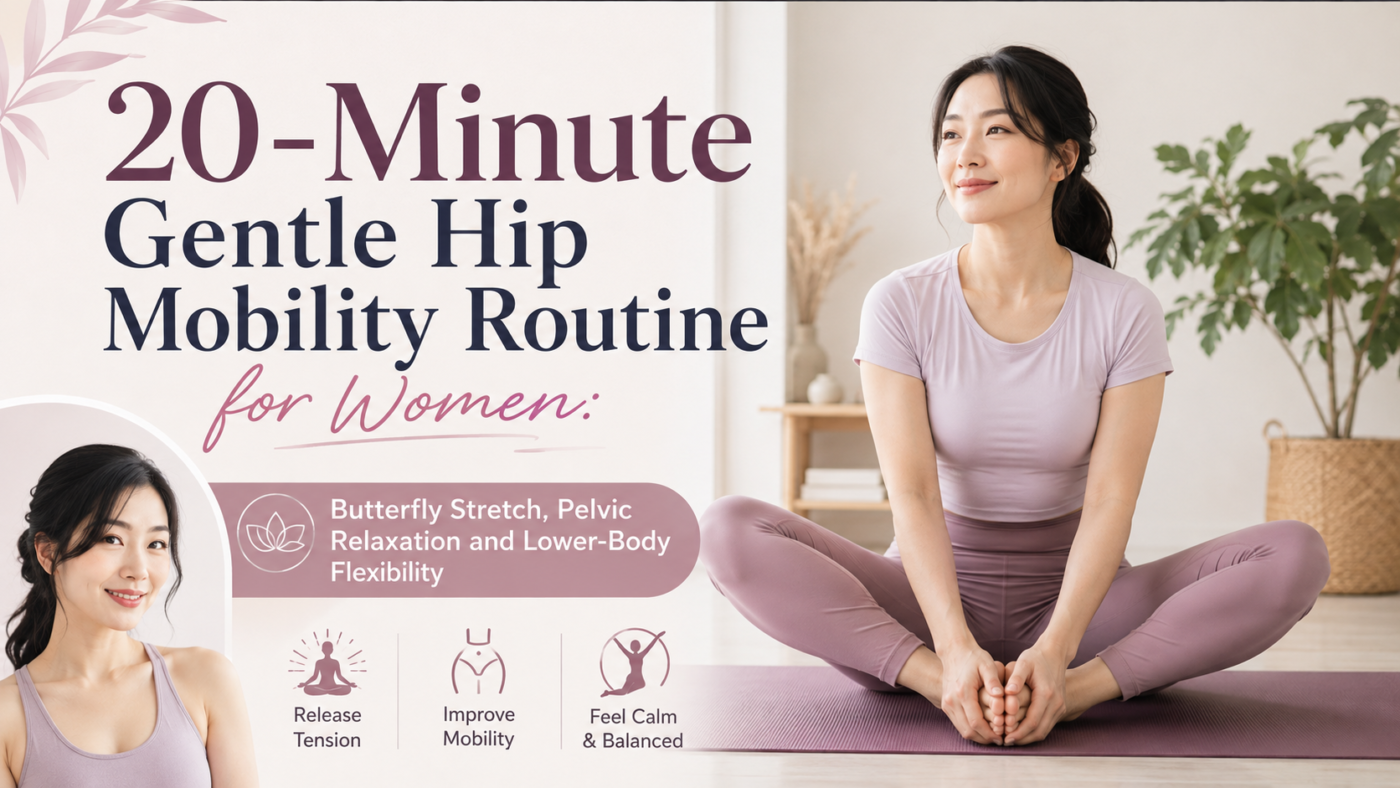
This approximately 20-minute routine centers on one of the simplest seated hip positions: bringing the soles of the feet together and allowing the knees to move outward.
Often called the butterfly position, it is commonly used to gently stretch the inner thighs and explore hip mobility.
The routine then progresses through relaxed floor movements, gentle rocking, knee-to-chest positions and comfortable breathing.
You do not need exceptional flexibility.
You do not need to force your knees toward the floor.
And you do not need to believe that discomfort is a sign that the exercise is working.
The goal is comfortable, controlled movement.
What This Routine Actually Does
This routine should primarily be understood as a gentle mobility and relaxation session.
Its most realistic goals include improving awareness of hip movement, gently stretching tissues around the inner thighs and hips, exploring a comfortable range of motion, encouraging relaxation after prolonged sitting and providing a short period of low-intensity physical activity.
It should not be promoted as a cure for urinary symptoms, pelvic organ prolapse, infertility, hormonal problems, inflammation, digestive disease or aging.
Those conditions are considerably more complex.
The First Movement: Butterfly Position
Begin seated comfortably on the floor, bed or another stable surface.
Bring the soles of your feet together.
Allow your knees to move outward.
Hold your feet or ankles only if doing so feels comfortable.
Before going farther, notice your starting position.
How far do your knees naturally fall?
Does one hip feel tighter than the other?
Can you sit comfortably without aggressively rounding your lower back?
Do you feel gentle tension, or do you feel actual pain?
This initial check gives you something useful to compare with how your body feels later in the routine.
There is no ideal distance between your knees and the floor.
Your anatomy, mobility, training history and current level of stiffness all influence the position.
Gentle Butterfly Movement
From the butterfly position, allow the knees to move gently upward and downward.
Keep the motion comfortable.
You do not need to push the knees toward the ground with your hands.
You also do not need fast bouncing.
Think of the movement as a way of gradually exploring the hip joint rather than forcing it open.
Breathe normally.
Keep your shoulders relaxed.
If the position feels too intense, move your feet farther away from your pelvis.
You can also sit on a folded towel or cushion to make the position more comfortable.
Should You Push Your Knees Toward the Floor?
No.
A common mistake during hip stretching is believing that greater range always means better results.
It does not.
Forcing your knees downward can create unnecessary stress and may aggravate sensitive hips, knees or groin tissues.
Allow gravity and relaxed movement to do most of the work.
Mobility usually responds better to repeated comfortable practice than aggressive stretching.
Add Slow Breathing
Once you have found a comfortable position, slow your breathing.
You do not need a complicated breathing technique.
Simply breathe in comfortably and allow a relaxed exhale.
Try not to hold your breath while stretching.
Slow breathing may also help you notice whether you are unconsciously tightening your abdomen, shoulders, jaw or legs.
When the body feels safe and supported, many people find it easier to relax into a comfortable stretch.
The Role of the Pelvis
Your hips and pelvis work closely together, but hip mobility should not be confused with pelvic floor treatment.
The pelvic floor is a group of muscles and supportive tissues associated with bladder, bowel and pelvic organ function.
Some people have pelvic floor weakness.
Others may have muscles that are overly tense or poorly coordinated.
That distinction matters.
A general hip-opening video cannot determine which situation applies to an individual.
If you experience urinary leakage, persistent urinary urgency, pelvic pressure, vaginal bulging, significant pelvic pain or a sensation that something is dropping downward, those symptoms deserve professional evaluation rather than simply more stretching.
ACOG notes that pelvic floor problems can involve bladder, bowel and pelvic-organ symptoms, and pelvic floor physical therapists can provide individualized treatment when appropriate.
Relaxing on the Floor
The routine later moves into a lying position.
Lie on a comfortable surface and allow your legs to relax.
A yoga mat, carpeted floor or other supportive surface may be more comfortable than a hard floor.
Gently shake or move your legs if it feels pleasant.
The purpose is not to create a dramatic physiological effect.
It is simply a transition from active movement into relaxation.
Notice whether your thighs, hips and lower back feel different after the earlier movements.
Knees Toward the Chest
Another portion of the routine involves bringing the knees toward the body.
This position may create a gentle stretch through the lower back, buttocks or hips depending on your anatomy.
Hold your legs comfortably rather than pulling aggressively.
Keep your neck relaxed.
Continue breathing.
If bringing both knees toward the chest feels uncomfortable, try one leg at a time.
People with recent hip surgery, significant hip arthritis, abdominal surgery or other relevant medical conditions should follow individualized professional advice rather than forcing this position.
Gentle Rocking
The routine also includes a small rocking motion while lying down.
When performed comfortably, this can simply provide a gentle change of pressure along the back.
Keep the movement small.
Do not roll onto your neck.
Do not create momentum.
If rocking causes dizziness, back pain or neck discomfort, skip it.
Comfort matters more than completing every movement shown in a video.
What About Rubbing the Hips and Lower Abdomen?
The routine includes placing the hands around the hips, lower abdomen and pelvic region.
Gentle self-touch or rubbing can produce a temporary sensation of warmth because of friction and increased superficial skin temperature.
Some people also find self-massage relaxing.
However, this should not be interpreted as proof that toxins are leaving the body, lymphatic blockages are being removed or reproductive organs are being rejuvenated.
If gentle massage feels comfortable, treat it as a relaxation practice rather than a medical treatment.
What Is Tanden?
The video also uses the Japanese term Tanden.
In traditional Japanese body practices, Tanden commonly refers to an area of the lower abdomen that is treated as a center of balance, breathing or awareness.
This is a traditional mind-body concept.
It should not be confused with a specific anatomical organ or medically demonstrated energy reservoir.
You can still use the idea practically.
Resting your hands over the lower abdomen and paying attention to slow breathing can serve as a simple body-awareness exercise without making unsupported biological claims.
Can Hip Stretching Improve Circulation?
Muscle movement naturally changes local blood flow, and regular physical activity is important for cardiovascular health.
However, statements such as unlocking the hips dramatically increasing circulation throughout the entire lower body are too strong.
Gentle mobility should be valued for what it actually provides: movement.
Getting up after prolonged sitting, walking regularly and using different comfortable ranges of motion are all useful ways of avoiding complete physical inactivity.
Does Hip Opening Detox the Body?
No special hip stretch is required to detox your body.
Your liver, kidneys, lungs, gastrointestinal system and other physiological systems continuously process and eliminate waste products.
Stretching can be a healthy activity without needing a detox explanation.
For a trustworthy health website, it is better to describe stretching in terms of mobility, flexibility, comfort, movement and relaxation.
Can It Make You Look 20 Years Younger?
No exercise can literally reverse chronological age by 20 years.
That phrase is marketing language.
However, regular physical activity may influence some of the things people associate with feeling younger, such as movement confidence, physical function, strength, balance, energy and the ability to perform daily activities.
A person who moves more comfortably may feel more youthful.
That is very different from claiming that a hip exercise reverses aging.
Can Hip Mobility Change the Appearance of Your Face or Skin?
There is no good basis for claiming that opening the hips directly lifts the face or makes facial skin younger.
Skin appearance depends on many factors including genetics, age, sun exposure, smoking, hydration, sleep, nutrition and skin care.
Movement and exercise can form part of an overall healthy lifestyle, but hip stretching should not be advertised as a facial rejuvenation treatment.
What About Feminine Energy?
Some people enjoy describing movement, breathing and body awareness through concepts such as feminine energy, life energy or inner radiance.
These ideas can have personal, cultural or spiritual meaning.
They are not measurable medical diagnoses.
If this language helps someone feel more connected with movement, it can be treated as a personal wellness metaphor.
It should not replace evidence-based explanations of anatomy, hormones, pelvic health or medical treatment.
Repeat the Butterfly Movement
Near the end of the routine, return to the butterfly position.
Bring the soles of your feet together again.
Allow the knees to move comfortably.
Compare the movement with your starting position.
You may notice that the motion feels easier.
That short-term change does not necessarily mean the structure of your hips has changed.
Warm tissues, repeated movement and greater familiarity with the position can make a stretch feel more comfortable during the same session.
That is still a useful observation.
Progress does not need to be dramatic to matter.
How Often Can You Practice?
Many healthy adults can include gentle mobility exercises regularly.
You might begin with two or three sessions per week and see how your body responds.
Shorter practice is also fine.
You do not have to complete the full routine every time.
For example, five to ten minutes of comfortable mobility after prolonged sitting may be more realistic on a busy day.
Consistency is more useful than forcing an intense stretch occasionally.
Hip Mobility and Healthy Aging
Maintaining movement as we get older matters.
But no single joint determines how old your body is.
Healthy aging depends on numerous factors including cardiovascular fitness, muscular strength, balance, nutrition, sleep, medical care, social connection and regular physical activity.
Hip mobility can be one small part of that larger picture.
Rather than trying to make your body 20 years younger, a more realistic goal is to preserve the ability to move comfortably and confidently for as long as possible.
Who Should Be More Cautious?
Modify or avoid this routine if a movement creates sharp hip, knee, groin, pelvic or back pain.
Extra caution may be appropriate for people recovering from hip or pelvic surgery, people with known joint disease, people with significant osteoporosis, people who are pregnant or recently postpartum, or anyone being treated for a pelvic floor disorder.
Individual circumstances matter.
Pelvic floor symptoms also deserve particular attention.
Urinary leakage, persistent urinary urgency, bowel-control changes, pelvic pressure, vaginal bulging or persistent pelvic pain should not simply be accepted as normal aging.
Qualified clinicians and pelvic health physical therapists can assess these problems and recommend appropriate treatment.
A Better Goal Than Trying to Become Younger
The most useful lesson from this routine is not that your younger self is hidden inside your hips.
It is that gentle movement can provide an opportunity to reconnect with parts of the body that may not move very much during an ordinary day.
Sit comfortably.
Move slowly.
Breathe.
Explore your current range rather than competing with someone else’s.
Stop when something hurts.
Repeat regularly if it feels good.
Healthy movement does not need exaggerated promises to be worthwhile.
Sometimes feeling a little less stiff, a little more comfortable and a little more confident in your own body is already a meaningful result.
Frequently Asked Questions
Does the butterfly stretch open the hips?
The butterfly position places the hips in an outwardly rotated position and commonly produces a stretch through the inner thighs and groin. How far the knees move toward the floor varies considerably between individuals.
Should I bounce my knees during the butterfly stretch?
Gentle controlled movement may be comfortable for some people, but forceful bouncing is unnecessary. Avoid pushing through pain or aggressively forcing the knees downward.
Can hip stretches treat pelvic organ prolapse?
No. General hip stretching should not be considered treatment for pelvic organ prolapse. Pelvic floor exercises, pelvic floor physical therapy, pessaries and other treatments may be used depending on the individual situation.
Can hip exercises stop urinary leakage?
Urinary leakage has different causes. Pelvic floor exercises and pelvic health physical therapy can help some forms of urinary incontinence, but a general hip-opening routine is not the same as pelvic floor rehabilitation.
Can this routine improve flexibility?
Repeated comfortable stretching and mobility practice may help improve tolerance and range of movement over time, although results vary between individuals.
Does rubbing the lower abdomen detox the body?
There is no established evidence that rubbing the lower abdomen removes toxins. Gentle rubbing may feel warm and relaxing, but detoxification is primarily performed by organs such as the liver and kidneys.
What is the Tanden?
Tanden is a traditional Japanese concept referring broadly to a center in the lower abdomen associated with breathing, posture and body awareness in some traditional practices. It should be understood as a traditional concept rather than a distinct anatomical organ.
Can this make me 20 years younger?
No. Hip stretching cannot literally reverse age by 20 years. Regular physical activity can support mobility and function, which may help people feel more capable as they age.
Medical Disclaimer
This article is for general educational and informational purposes only and is not medical advice, diagnosis or treatment. Hip, pelvic and urinary symptoms can have many causes. Anyone experiencing persistent pain, urinary or bowel changes, pelvic pressure, vaginal bulging, unexplained bleeding or other concerning symptoms should seek appropriate medical evaluation. Stop any exercise that causes sharp or worsening pain.
This article is for general education and does not replace individualized care from a qualified health professional. Seek appropriate advice for persistent, severe, or concerning symptoms.
Read the full medical disclaimer