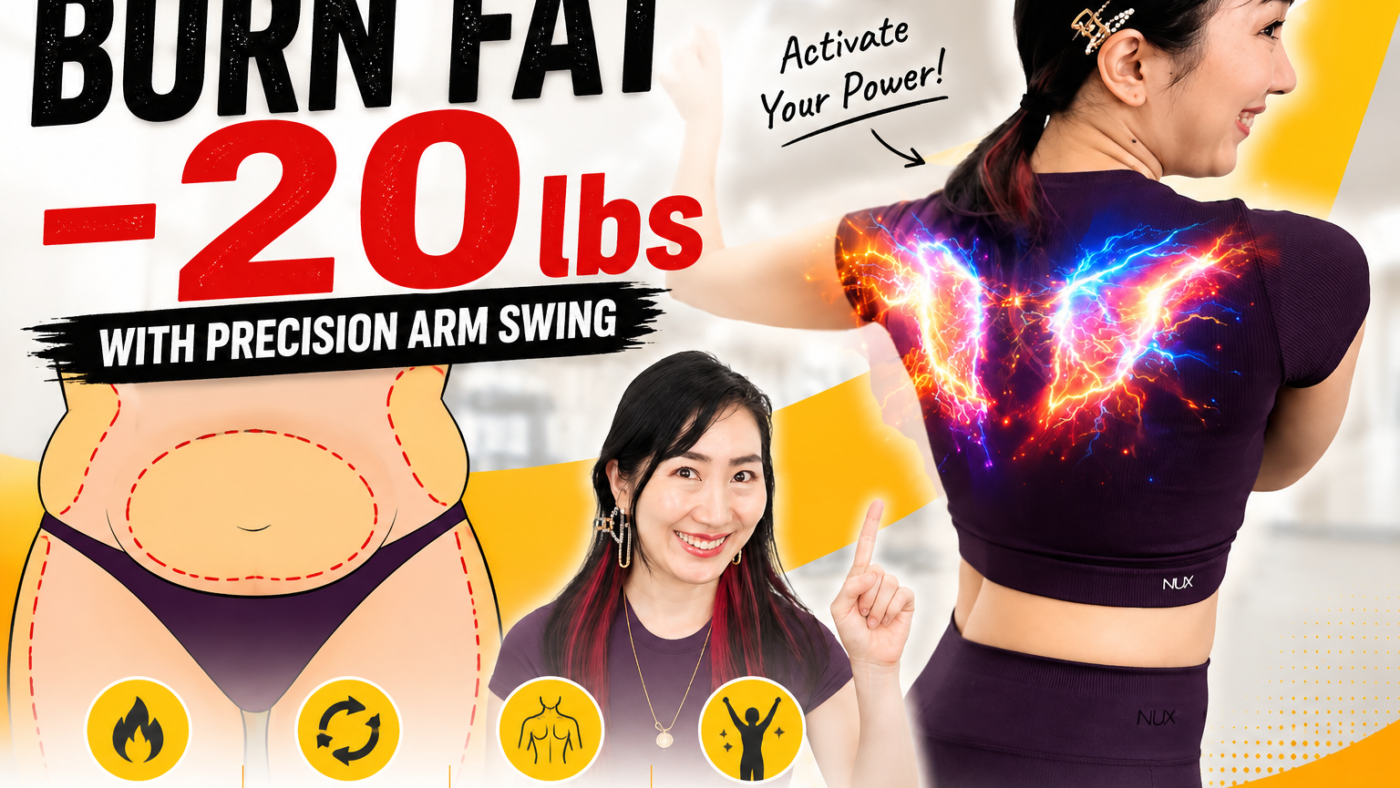
You do not always need complicated equipment or an exhausting workout to get your body moving. Sometimes a simple movement—performed consistently and with good technique—can help break up sedentary time, mobilize stiff joints and make exercise feel more approachable.
Arm swinging is a good example.
Variations of relaxed arm-swinging movements appear in warm-ups, mobility routines and traditional movement practices. Although dramatic claims about arm swings “restarting metabolism” or producing rapid weight loss are not supported by strong scientific evidence, the movement can still be useful.
When combined with gentle knee bending and torso rotation, arm swings involve much more than the arms. Your shoulders move, your shoulder blades glide across the rib cage, your trunk rotates, your hips and knees participate, and your heart rate may gradually rise.
For people who sit for long periods or simply want an easy way to become more active, this can make arm swings a surprisingly practical addition to the day.
Why Your Body Adapts to Exercise
Have you ever started a workout program, noticed rapid improvements and then reached a plateau?
That is normal.
The human body continually adapts to repeated demands. With consistent exercise, muscles become more efficient, cardiovascular fitness improves and movements that once felt difficult may eventually require less effort.
This does not mean that homeostasis is deliberately preventing weight loss. Weight regulation is considerably more complex and involves energy intake and expenditure, appetite, hormones, sleep, genetics, physical activity and other physiological factors.
It also does not mean that a particular exercise can “outsmart” homeostasis.
Instead, exercise programs often need gradual progression and variety if your goal is continued improvement.
Arm swings can provide one form of low-barrier movement within that larger strategy.
What Is an Arm Swing Exercise?
The basic version is extremely simple.
Stand comfortably with your feet approximately hip- to shoulder-width apart. Keep your knees relaxed rather than locked.
Allow both arms to hang naturally.
Then gently swing your arms forward and backward while keeping your shoulders relaxed.
Your torso can participate slightly, but avoid aggressively twisting your spine. Breathe normally and maintain a comfortable rhythm.
You can begin slowly and increase the range of motion as your body warms up.
The exercise should feel fluid rather than forced.
1. Arm Swings Mobilize the Shoulders and Shoulder Blades
The shoulder is designed for movement.
Unfortunately, modern daily life often keeps the arms in relatively limited positions—typing at a computer, holding a phone, driving or sitting at a desk.
Arm swings move the shoulder joints repeatedly through a comfortable range while encouraging movement of the scapulae, or shoulder blades.
The shoulder blades naturally glide and rotate as the arms move. Maintaining comfortable movement around this region is useful for everyday activities involving reaching, lifting and carrying.
Arm swings should not be described as a treatment for shoulder disease, however. Persistent shoulder pain, weakness or restricted motion deserves appropriate medical or physical-therapy assessment.
2. They Can Break Up Long Periods of Sitting
One of the most practical benefits of this exercise has nothing to do with “fat-burning secrets.”
It gets you out of your chair.
Long periods of uninterrupted sitting are common in modern life. Brief activity breaks can help increase total daily movement and interrupt sedentary time.
An arm-swing routine is particularly convenient because it requires almost no preparation.
Stand up.
Give yourself enough space.
Move for a few minutes.
Then return to your day.
That simplicity can make movement easier to repeat consistently.
3. Adding Torso Rotation Creates a More Full-Body Movement
Once the basic swing feels comfortable, you can introduce gentle trunk rotation.
Stand with relaxed knees and allow your torso to rotate slightly from side to side. Your arms should follow naturally rather than being thrown aggressively.
Think of the movement as flowing through your body.
Your feet, knees, hips, trunk, shoulders and arms should cooperate.
This transforms a simple shoulder movement into a more coordinated whole-body mobility exercise.
Avoid forcing the rotation, especially if you have back problems or experience pain when twisting.
4. Arm Swings Can Be Used as a Dynamic Warm-Up
Arm swings are also useful before more demanding exercise.
A gradual warm-up increases movement and prepares the body for the activity ahead. Arm swings can be combined with walking in place, shoulder circles, gentle squats and other dynamic movements.
For example, begin with small relaxed swings and gradually increase their amplitude.
Then add gentle torso movement.
Finally, if appropriate for your fitness level, introduce shallow knee bends.
The objective is to feel warmer and more mobile—not exhausted before your actual workout begins.
5. They May Help You Feel Less Stiff
If you spend hours sitting relatively still, standing up and moving through several joints can simply feel good.
Some people notice that their shoulders, upper back and trunk feel less stiff after a few minutes of gentle movement.
This does not mean arm swinging “flushes toxins” or permanently removes muscular tension.
The more straightforward explanation is that you have temporarily changed position and moved tissues that had remained relatively stationary.
That alone can be valuable.
6. Faster Arm Swings Can Increase Exercise Intensity
Arm swinging does not have to remain extremely gentle.
When appropriate, increasing the speed and incorporating controlled knee and hip movement can turn the exercise into a more energetic activity.
Your heart rate and breathing may increase because more muscles are working and the movement requires additional energy.
This is where an important distinction needs to be made.
Feeling warmer or noticing a faster heartbeat does not prove that brown adipose tissue has suddenly been activated or that your metabolism has been “rebooted.”
Brown adipose tissue does participate in thermogenesis, and researchers continue to study its role in human metabolism. But there is not good evidence that ordinary shoulder-blade movements produce dramatic fat loss by specifically switching on brown fat.
The benefits of moving your body do not require that extraordinary explanation.
7. Simple Movements Can Make Exercise Easier to Maintain
Perhaps the biggest advantage of arm swings is accessibility.
No gym membership is required.
There is no machine to learn.
You do not need a large room.
And the movement can be adjusted according to your mobility and fitness level.
That matters because the “best” exercise is not necessarily the exercise that burns the most calories in a laboratory.
A movement you can perform safely and repeatedly may be more useful than an intense program you abandon after a week.
Consistency remains one of the foundations of physical fitness.
A Simple 5-Minute Arm Swing Routine
Try this sequence at a comfortable pace:
Minute 1: Relaxed forward-and-back arm swings.
Keep the knees soft and shoulders relaxed.
Minute 2: Gentle alternating swings with mild torso rotation.
Allow your body to rotate naturally without forcing the spine.
Minute 3: Shoulder circles and scapular movement.
Make controlled circles while breathing normally.
Minute 4: Arm swings with shallow knee bends.
Lower only as far as feels comfortable and keep the knees tracking naturally.
Minute 5: Return to relaxed swinging.
Gradually slow the movement and allow your breathing to settle.
Beginners can perform shorter intervals or take breaks whenever necessary.
Can Arm Swings Activate Brown Fat?
This deserves special attention because it is a common online claim.
Brown adipose tissue, commonly called brown fat, is metabolically active tissue involved in heat production. Adults can have brown fat deposits in regions including the neck and upper torso.
However, this does not establish that swinging the arms or stimulating the shoulder blades causes meaningful weight loss through brown-fat activation.
Human brown-fat metabolism is an active area of scientific research, and factors such as cold exposure have received considerable attention. Translating laboratory findings into practical weight-loss treatments is much more complicated.
Therefore, it would be misleading to promise that an arm-swing routine “turns on brown fat” and melts body fat.
Use arm swings because they provide movement—not because of an unproven metabolic shortcut.
Can Arm Swing Exercise Help With Weight Loss?
Potentially—but only as one component of a larger lifestyle.
Any physical activity contributes to overall energy expenditure. More importantly, regular movement can support cardiovascular health, physical function and fitness.
But no single arm movement selectively burns substantial amounts of abdominal fat or guarantees large weight loss.
Long-term weight management depends on many interacting factors, including nutrition, overall activity, resistance and aerobic exercise, sleep, medications, medical conditions and individual physiology.
If fat loss is your goal, think of arm swings as a way to increase movement rather than as a replacement for a comprehensive exercise and nutrition strategy.
How to Progress Safely
Once the basic movement becomes easy, progression does not require making the exercise violent.
You can gradually increase the duration, slightly increase the speed, add comfortable torso rotation or incorporate controlled knee bends.
You could also alternate arm swings with walking, bodyweight exercises or other forms of aerobic activity.
Progress should be gradual.
Exercise does not need to hurt to be effective.
Who Should Be Careful?
Stop if the movement causes sharp pain, dizziness, chest pain, unusual shortness of breath or loss of balance.
People with significant shoulder, neck, spine, hip or knee problems may need modifications. Those recovering from surgery or managing cardiovascular, neurological or other medical conditions should obtain appropriate professional guidance before beginning unfamiliar exercise.
If you have balance difficulties, perform the movement near a stable support or choose an appropriate seated alternative.
The Bottom Line
Arm swings are not a metabolic hack, and there is no convincing evidence that swinging your arms can independently “reboot” metabolism or produce dramatic weight loss by activating brown fat.
But they do not need to perform miracles to be worthwhile.
Arm swings can mobilize your shoulders and upper body, involve the trunk and lower body, break up sedentary time, serve as a dynamic warm-up and provide an easy way to add movement to your day.
Start gently, stay relaxed and progress gradually.
Sometimes improving your health begins not with finding the perfect exercise—but simply with finding a movement easy enough to do again tomorrow.
Frequently Asked Questions
Can arm swing exercise help with weight loss?
Arm swings contribute to physical activity and energy expenditure, but they should not be expected to cause major weight loss on their own. Sustainable weight management generally requires broader nutrition, activity and lifestyle strategies.
Do arm swings activate brown fat?
Brown fat is involved in thermogenesis, but there is insufficient evidence that ordinary arm swings meaningfully activate brown fat in a way that produces substantial fat loss.
Can arm swings reduce belly fat?
No exercise can reliably target fat loss from one specific body area. Arm swings can contribute to overall activity, but abdominal fat loss depends on broader changes in energy balance and health behaviors.
Are arm swings good for stiff shoulders?
Gentle arm movements may help some people feel more mobile after prolonged inactivity. Persistent pain, weakness or limited range of motion should be professionally evaluated.
How long should I do arm swings?
Beginners can start with one to five minutes at a comfortable intensity. Duration can gradually increase according to fitness level and tolerance.
Medical DisclaimerThis article is for educational and informational purposes only and is not intended to diagnose, treat, cure, or prevent any disease or medical condition. Exercise needs vary according to individual health and physical ability. Stop exercising if you experience pain, dizziness, chest discomfort or unusual symptoms, and seek professional medical advice when appropriate.
This article is for general education and does not replace individualized care from a qualified health professional. Seek appropriate advice for persistent, severe, or concerning symptoms.
Read the full medical disclaimer