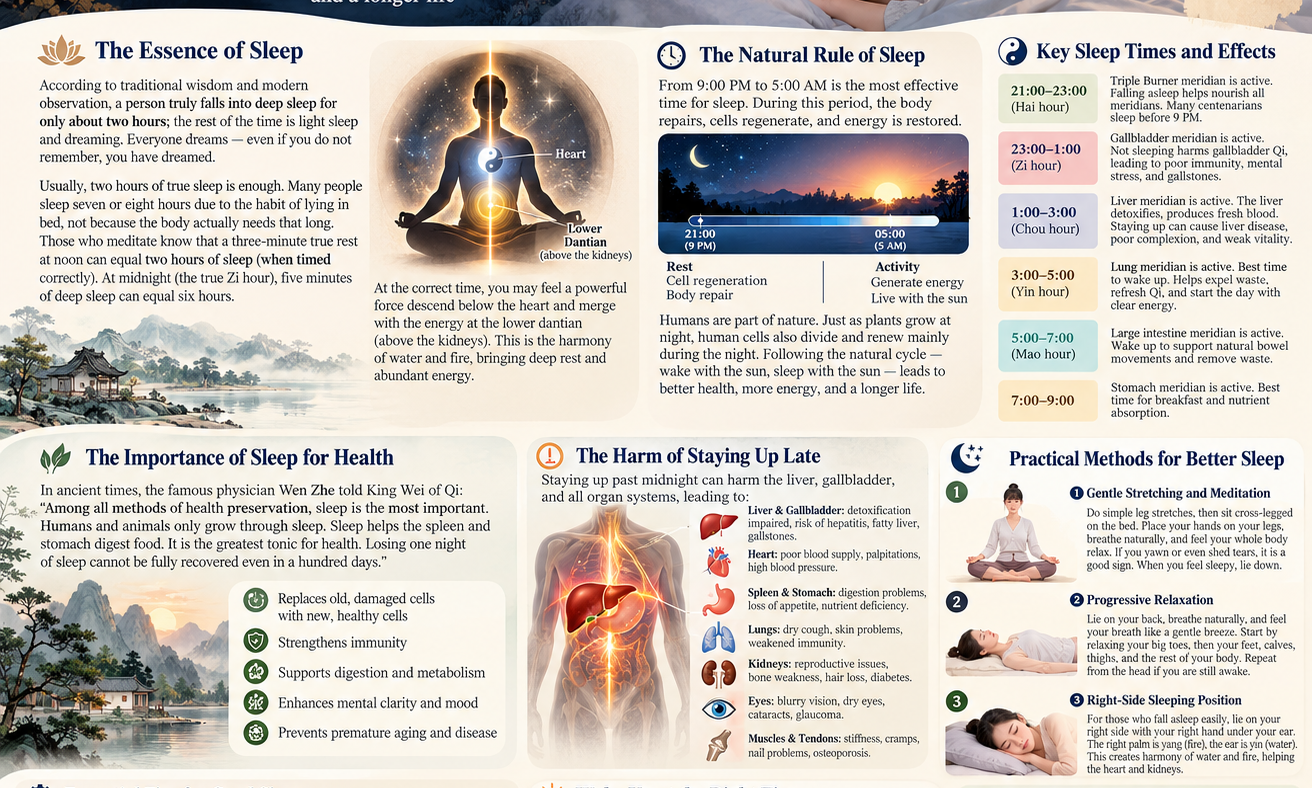
Chinese sleep wisdom has long emphasized the importance of timing, rhythm, and deep relaxation. One of its most striking traditional claims suggests that five minutes of well-timed sleep may feel as restorative as several hours of ordinary rest. But can five minutes of sleep really equal six hours? Modern sleep science offers a very different explanation.For generations, traditional Chinese wellness teachings have emphasized that the quality and timing of sleep matter just as much as the act of going to bed.
One particularly striking teaching claims that a few minutes of deeply timed sleep around midnight may provide an extraordinary sense of restoration—sometimes expressed dramatically as the idea that five minutes of sleep can equal six hours of ordinary rest.
Modern sleep science does not support this claim literally.
Five minutes of sleep cannot physiologically replace a full night of healthy sleep.
Yet the traditional saying raises a much more interesting question:
Why can a short period of well-timed rest sometimes feel surprisingly refreshing, while a long night in bed can still leave us tired?
The answer involves sleep quality, circadian rhythm, sleep stages, regularity, mental arousal, light exposure, and the difference between simply lying in bed and experiencing genuinely restorative sleep.
Traditional Chinese philosophy described these ideas through yin and yang, qi, meridians, the Heart and Kidney, and the daily body clock.
Modern sleep science uses different language.
This article explores where traditional wisdom remains practically useful, where historical explanations differ from modern physiology, and how both perspectives can inspire healthier sleep habits.For generations, traditional Chinese wellness teachings have contained a striking idea: a few minutes of deeply timed sleep may sometimes feel more restorative than hours spent tossing and turning in bed.
One of the most dramatic versions of this teaching claims that falling asleep for only five minutes around midnight may provide a restorative effect comparable to six hours of ordinary sleep.
Taken literally, this is not supported by modern sleep science.
Five minutes of sleep cannot physiologically replace a full night of sleep.
Yet hidden inside this exaggerated traditional claim is a much more interesting question:
Why can some short periods of rest feel remarkably refreshing, while a long night in bed can sometimes leave us exhausted?
The answer lies in the difference between time spent in bed and truly restorative sleep, the importance of circadian timing, the quality and continuity of sleep, and the way the nervous system responds to regular rhythms.
Traditional Chinese wellness approached these questions through ideas such as yin and yang, the meridian clock, qi, the relationship between the Heart and Kidney, and the principle of shui huo ji ji—the harmonious interaction of water and fire.
Modern sleep medicine uses a completely different vocabulary.
It speaks of circadian rhythms, sleep pressure, REM and non-REM sleep, light exposure, hormones, autonomic activity, sleep fragmentation, and sleep architecture.
The explanations are different.
But both traditions recognize something fundamental:
Sleep quality depends on more than simply lying in bed for a certain number of hours.
The Traditional Claim: Five Minutes at Midnight, Six Hours of Restoration
Some traditional teachings suggest that the most valuable periods of sleep occur at particular times of day.
They describe midday and midnight as especially important transitional points.
At midday, the balance between yang and yin is traditionally believed to begin shifting.
Around midnight, yin is considered to have reached its deepest point while yang begins to emerge again.
Within this worldview, sleeping during these transitions was believed to harmonize the body’s internal rhythm.
This gave rise to statements such as:
A few minutes of genuine sleep at noon may feel like hours of ordinary rest.
And even more dramatically:
Five minutes of sleep at the correct midnight hour may equal six hours of sleep.
These statements should be understood as traditional expressions emphasizing the perceived importance of timing—not as mathematical or medical formulas.
Modern sleep research does not show that five minutes of sleep can replace six hours.
Healthy sleep depends on repeated cycles of non-REM and REM sleep across the night, and these cycles cannot normally be compressed into a few minutes.
Still, the traditional observation points toward something real: when we sleep matters, and so does how deeply and continuously we sleep.
Sleep Is Not Simply Time Spent With Your Eyes Closed
A person may spend eight hours in bed and still wake feeling exhausted.
Another person may take a brief nap and feel noticeably more alert.
This does not mean the nap has replaced a full night of sleep.
It means that sleep has different depths, stages, and functions.
During a typical night, the brain repeatedly moves through several stages of non-REM and REM sleep.
Deep sleep is generally more prominent during the earlier part of the night, while REM sleep tends to become more abundant later.
These stages are not wasted time.
They are part of a normal biological process involved in memory, learning, emotional regulation, metabolism, immune function, and physical restoration.
Modern sleep medicine therefore does not support the belief that only the first one or two hours of sleep are “real” and everything after that is unnecessary dreaming.
Dreaming itself is a normal component of sleep.
The fact that a person does not remember a dream does not mean dreaming did not occur.
Why Traditional Teachings Emphasized Midnight
Traditional Chinese Medicine divides the 24-hour day into twelve two-hour periods.
Each period is traditionally associated with a particular meridian system.
The period from approximately 11:00 p.m. to 1:00 a.m. is associated with the Gallbladder Meridian.
The period from approximately 1:00 a.m. to 3:00 a.m. is associated with the Liver Meridian.
Historically, this led to the idea that being asleep during these hours allows the body to withdraw from outward activity and enter a deeper phase of restoration.
Traditional practitioners sometimes described this process poetically as the body’s energy descending inward, with the forces associated with the Heart and Kidney meeting and harmonizing.
This state was described as water and fire in harmony.
These concepts belong to traditional Chinese medical philosophy.
They should not be interpreted as proof that the gallbladder literally activates only at 11:00 p.m., that the liver cleanses the blood only between 1:00 and 3:00 a.m., or that missing these hours automatically causes disease.
Modern physiology shows that the liver, cardiovascular system, kidneys, brain, endocrine system, and other organs remain active throughout the day and night.
What does change across the 24-hour cycle is their regulation.
Human physiology follows circadian rhythms, and sleep timing interacts with those rhythms.
That gives the old advice a useful modern interpretation:
Habitually staying awake deep into the biological night may disrupt normal sleep-wake rhythms, even if the traditional explanation for that effect is different from the modern one.
Circadian Rhythm: The Modern Version of Living With Day and Night
Human beings possess an internal timing system that operates on an approximately 24-hour rhythm.
Light and darkness are among its strongest environmental signals.
Daylight helps reinforce wakefulness.
Darkness helps prepare the body for sleep.
Modern life can interfere with this distinction.
Bright indoor lighting, smartphones, computers, televisions, late-night work, irregular schedules, stimulants, and social activity can extend “daytime” far into the night.
Traditional Chinese philosophy would describe this as failing to respect the natural transition from yang toward yin.
Modern sleep science describes it as circadian disruption.
The language differs, but the behavioral lesson is similar:
Night should gradually become quieter, darker, and less stimulating than day.
Do Adults Really Need Only Two Hours of Sleep?
No.
The idea that people need only two hours of genuine sleep is not supported by modern sleep medicine.
For most healthy adults, regular sleep of roughly seven hours or more is recommended, although individual needs vary.
Sleep needs also change across the lifespan.
Children and teenagers generally need considerably more sleep than adults.
Older adults may experience lighter or more fragmented sleep, but aging does not mean that the body suddenly requires only a few hours of rest.
A person may occasionally function after a very short night.
That is not evidence that the body has fully recovered.
People can become accustomed to the sensation of insufficient sleep while still experiencing impaired attention, reaction time, mood, judgment, or physical performance.
The goal should therefore not be:
How little sleep can I survive on?
A better question is:
How can I make the sleep I need more regular and restorative?
Why a Short Nap Can Feel Powerful
Traditional wellness teachings often praise a short midday rest.
In Chinese timekeeping, the period around noon is known as Wu Shi, roughly 11:00 a.m. to 1:00 p.m.
Traditional philosophy views this as another important transition between yang and yin.
A brief nap can indeed improve alertness in some people.
Even closing the eyes, reducing stimulation, relaxing the muscles, and stepping away from demanding mental activity may feel restorative.
But a short nap does not reproduce all of the sleep stages normally experienced throughout an entire night.
Therefore, “three minutes equals two hours” should be understood as a traditional expression about the perceived value of well-timed rest, not as a literal biological conversion.
Sleep and the Liver: Separating Tradition From Physiology
Traditional Chinese Medicine assigns the Liver a central role in the smooth movement of qi, emotional balance, the storage of blood, and many other functions.
For this reason, classical wellness teachings often connect late nights with “Liver Blood deficiency,” “Liver Qi stagnation,” or disturbance of the Liver Meridian.
Some modern popular versions of these teachings go much further.
They claim that staying awake after midnight prevents the liver from cleaning the blood, causes toxic substances to accumulate, produces hepatitis, creates gallstones, damages eyesight, causes infertility, produces osteoporosis, or directly leads to psychiatric illness.
These conclusions are not supported by modern medicine.
Viral hepatitis is caused by hepatitis viruses, not simply by going to bed late.
Gallstones have multiple recognized risk factors.
Depression, cardiovascular disease, diabetes, infertility, osteoporosis, eye disease, and neurological conditions are complex disorders with multiple possible causes.
Sleep is important to health, but it should not be turned into a universal explanation for unrelated diseases.
A more responsible modern interpretation is:
Chronic insufficient or irregular sleep can place stress on many physiological systems, while adequate sleep supports normal metabolic, cardiovascular, neurological, and immune regulation.
Sleep and the Heart
Traditional Chinese thought describes the Heart as closely connected with the Shen—a concept encompassing consciousness, emotional balance, mental activity, and spirit.
A restless Shen is traditionally associated with disturbed sleep.
Modern sleep medicine again uses different language, but the practical connection remains recognizable.
When the nervous system remains highly activated, falling asleep can become more difficult.
Stress, worry, emotional conflict, constant information, and mental overactivity can all maintain wakefulness.
Normal sleep also produces changes in heart rate, blood pressure, autonomic activity, and other physiological processes.
For this reason, a calm transition into sleep may benefit both subjective relaxation and overall sleep quality.
The Stomach and the Sleepless Night
Traditional Chinese wellness contains an old principle often summarized as:
When the Stomach is not harmonious, sleep is not peaceful.
This may be one of the most immediately recognizable traditional observations.
A very heavy dinner can make lying down uncomfortable.
Reflux can become more noticeable in bed.
Alcohol may initially create drowsiness yet fragment sleep later in the night.
Too much caffeine can delay sleep.
Excessive hunger can also keep some people awake.
Traditional language may describe these experiences as Stomach Heat, Stomach Cold, dryness, stagnation, or weakness.
Modern explanations are different, but the practical advice remains useful:
Eat in a way that leaves the body comfortable before bedtime.
For many people, a moderate evening meal is easier on sleep than an extremely heavy late-night meal.
The Half Hour Before Sleep Matters
Some traditional instructions recommend reducing conversation during the final half hour before bed.
The original explanation may involve the Lung, Heart, or movement of qi.
A modern interpretation is simpler.
Talking intensely, working, arguing, checking messages, reading upsetting news, planning finances, or watching highly stimulating entertainment can keep the brain in an activated state.
The purpose of a bedtime routine is not to perform a perfect ritual.
It is to create a transition.
The nervous system benefits from predictable signals that the active portion of the day is ending.
A good evening wind-down may include:
gentle stretching,
washing or bathing,
dim lighting,
quiet reading,
soft music,
slow breathing,
meditation,
or several minutes of simply doing nothing.
The exact ritual matters less than consistency.
Do Not Take Tomorrow to Bed With You
One of the strongest teachings in the original material is the warning against lying on the pillow calculating the future.
This remains excellent practical advice.
Many people lie down physically while continuing to work mentally.
The mind begins reviewing conversations.
Then tomorrow’s schedule.
Then money.
Then unfinished work.
Then future problems.
Then things that happened years ago.
Soon the bed becomes a workplace for the mind.
Traditional teachings encourage allowing the breath to become quiet and gradually letting the sense of the body soften.
A useful visualization compares the body to sugar dissolving in water.
Instead of forcing sleep, allow the feeling of physical effort to dissolve.
The goal is not to “make” yourself sleep.
The goal is to stop repeatedly waking yourself with effort.
Three Gentle Traditional-Inspired Sleep Practices
1. Gentle Stretching and Quiet Sitting
Before bed, perform a few easy stretches.
Avoid forcing the legs or joints.
Then sit comfortably on the bed or a cushion.
Allow the hands to rest naturally.
Breathe without trying to control the breath.
As the body settles, notice whether the shoulders, face, abdomen, and hands can soften.
When genuine sleepiness appears, go to bed.
Do not turn relaxation into another task that must be completed perfectly.
2. The Melting-Body Exercise
Lie comfortably.
Allow breathing to remain natural.
Bring attention to the big toe.
Imagine the muscles becoming softer and heavier.
Move slowly through the other toes, feet, ankles, calves, thighs, abdomen, hands, shoulders, jaw, and face.
There is no need to create any special sensation.
The purpose is simply to reduce muscular tension and mental vigilance.
If the mind wanders, gently return to the body.
3. Comfortable Side Sleeping
Traditional teachings sometimes recommend sleeping on the right side, occasionally using symbolism involving the palm, ear, Heart, Kidney, fire, and water.
The symbolic explanation belongs to traditional philosophy.
From a practical perspective, the best sleeping position depends on comfort, breathing, pregnancy, reflux, pain, musculoskeletal problems, and individual medical needs.
There is no need to force one position simply because it appears in an old text.
Should You Close the Window and Never Use Air Conditioning?
Some traditional wellness teachings strongly warn against sleeping with windows open, using fans, or sleeping under air conditioning.
These teachings often explain illness through the concepts of Wind, Cold, and the protection of yang qi.
Modern medicine does not support an absolute rule that air conditioning or fans cause disease by driving “cold into the bones.”
A better principle is comfort.
The bedroom should ideally be:
dark,
quiet,
well ventilated,
comfortable,
and cool enough for restful sleep.
Avoid being excessively cold.
Avoid overheating.
Avoid strong airflow if it makes you uncomfortable.
The goal is not to obey a rigid environmental rule.
The goal is to create conditions in which the body can sleep without repeatedly responding to temperature, noise, light, or discomfort.
Warm Hands and Feet
Traditional Chinese wellness places particular importance on keeping the extremities warm.
This can be practically useful for some sleepers.
Cold feet may make it harder to feel comfortable in bed.
Warm socks, appropriate bedding, or a comfortably warm environment may help people who naturally feel cold.
However, persistent cold extremities, unexplained numbness, pain, color changes, or other recurring symptoms should not automatically be attributed to “Kidney Yang deficiency.”
They may deserve medical evaluation.
Early Rising: Wisdom or Extremism?
Traditional texts often praise people who rise very early.
Some accounts recommend getting up before 5:00 a.m., even suggesting that people who remain in bed later miss the opportunity for the body’s yang qi to rise.
Early rising can be helpful when it fits a person’s natural schedule and allows exposure to morning light.
But waking early is not automatically healthy.
A person who sleeps at midnight and forces himself to wake at 4:00 a.m. is not necessarily practicing superior wellness.
He may simply be sleep deprived.
The more useful rule is:
Wake at a reasonably consistent time after allowing enough opportunity for sleep.
Someone who sleeps at 9:30 p.m. may naturally rise very early.
Someone whose schedule requires a later bedtime may need a later waking time.
Discipline is useful.
Sleep deprivation is not.
Morning Light May Be More Important Than an Arbitrary Clock Time
Traditional culture often encourages rising with the sun.
This idea fits remarkably well with modern understanding of circadian rhythm.
Morning daylight provides a powerful environmental signal that helps reinforce the biological distinction between day and night.
After waking, opening curtains, going outside when practical, walking, stretching, or practicing gentle Tai Chi or Qigong can help mark the transition into daytime activity.
The traditional recommendation does not need to be interpreted as an order to exercise outdoors before dawn.
Safety, weather, temperature, air quality, personal health, and visibility should all be considered.
Sleep, Digestion, and Daily Rhythm
Traditional Chinese health philosophy often identifies three foundations of daily wellbeing:
sleep, elimination, and nourishment.
Modern health science would describe these systems differently, but the broader lesson remains useful.
Sleep does not exist in isolation.
Late meals can influence sleep.
Poor sleep can affect appetite and food choices.
Stress may affect digestion.
Exercise can influence both mood and sleep.
Light exposure affects circadian timing.
Caffeine and alcohol influence sleep architecture.
The human body works as an interconnected system.
That may be the most important idea traditional wellness was trying to express.
Should Sleeping Pills Always Be Avoided?
Traditional texts sometimes issue absolute warnings against sleeping medication.
That advice is too broad.
Sleep medicines are not appropriate for everyone and may have side effects or risks.
But certain medications can be appropriate in particular situations when prescribed and monitored appropriately.
People taking prescription sleep medication should not abruptly stop it solely because an article or traditional health text says medication is harmful.
Persistent insomnia can also respond to non-drug approaches.
Evidence-based behavioral treatment, including cognitive behavioral therapy for insomnia, may help many people with chronic insomnia.
What to Do When You Cannot Sleep
If you have been lying awake for a long time, repeatedly thinking:
“I must sleep now,”
you may unintentionally increase arousal.
Instead:
Keep the room dim.
Avoid constantly checking the clock.
Relax the jaw and shoulders.
Let breathing remain comfortable.
Allow thoughts to pass without trying to solve them.
If frustration keeps building, briefly getting out of bed and doing something quiet in low light may be more helpful than continuing to struggle.
Return to bed when genuine sleepiness returns.
The goal is to rebuild the association between bed and sleep rather than bed and frustration.
When Sleep Problems May Need More Attention
Poor sleep is common.
Persistent sleep problems should not always be dismissed as weak qi, excessive thinking, Liver imbalance, or failure to follow traditional hours.
Professional evaluation may be appropriate when a person regularly experiences:
persistent difficulty falling asleep,
repeated waking during the night,
severe daytime sleepiness,
loud habitual snoring,
choking or gasping during sleep,
morning headaches,
unusual movements or behaviors during sleep,
or sleep problems that significantly affect daily functioning.
Good wellness practice includes knowing when self-care is enough—and when something deserves further investigation.
What the “Five Minutes Equals Six Hours” Teaching Is Really Trying to Say
The literal claim is not scientifically correct.
Five minutes of sleep does not equal six hours of sleep.
Yet throwing away the entire traditional teaching would also miss its deeper meaning.
The old statement can be understood as an emphatic way of saying:
Timing matters.
Quality matters.
Regularity matters.
Deep relaxation matters.
The transition between activity and rest matters.
A quiet mind may sleep more efficiently than an agitated one.
And perhaps most importantly:
Do not treat sleep as leftover time.
For modern people, that may be more relevant than ever.
The Deeper Principle of Yang Sheng
Traditional Chinese culture uses the term Yang Sheng to describe the cultivation or nourishment of life.
It does not refer to one miracle food, one exercise, one meridian, or one perfect bedtime.
At its best, Yang Sheng is the art of arranging everyday life so the body is not constantly forced to work against its own rhythms.
Eat with moderation.
Move regularly.
Rest adequately.
Allow the mind to become quiet.
Respond to seasonal and environmental changes.
Do not repeatedly exhaust the body and then expect one remedy to repair everything.
Seen this way, sleep is not simply an eight-hour block on a schedule.
It is one of the central rhythms around which the rest of daily life is organized.
Ancient Language, Modern Lesson
Ancient Chinese wellness teachings describe sleep through yin and yang, meridians, qi, Heart, Kidney, Liver, Gallbladder, and the harmony of water and fire.
Modern sleep science describes brain activity, circadian clocks, sleep pressure, REM sleep, non-REM sleep, hormones, metabolism, and nervous-system regulation.
These systems should not be presented as scientifically identical.
They emerged from different eras and different ways of understanding the human body.
But they can still meet at the level of practical wisdom.
Night should not simply become an extension of daytime.
The mind needs a transition.
The body benefits from rhythm.
Sleep requires enough time.
Rest cannot always be postponed without consequence.
And the quality of life during the day is deeply connected with the quality of rest at night.
So perhaps the real secret is not learning how to make five minutes equal six hours.
It is learning how to make the hours you actually sleep more regular, peaceful, and restorative.
There is no shortcut that turns five minutes into a full night’s sleep.
But there is wisdom in protecting the night.
And sometimes that is the sleep secret we actually need.
FAQ
Can five minutes of sleep really equal six hours?
No. Modern sleep science does not support the idea that five minutes of sleep can physiologically replace six hours of normal sleep. The traditional saying is better understood as emphasizing the perceived value of well-timed, high-quality rest.
Is sleeping before midnight healthier?
There is no single universal bedtime that is best for everyone. Adequate total sleep and a reasonably consistent schedule are more important. For people who wake early, an earlier bedtime may make it easier to obtain enough sleep.
What is the traditional Chinese body clock?
The traditional Chinese body clock is a historical medical framework that associates different two-hour periods with different meridian systems. It is not the same as the modern scientific concept of circadian rhythm.
What time is associated with the Liver Meridian?
Traditional Chinese Medicine associates approximately 1:00–3:00 a.m. with the Liver Meridian. This does not mean that the liver only performs detoxification during those hours.
What time is associated with the Gallbladder Meridian?
Traditional Chinese Medicine associates approximately 11:00 p.m.–1:00 a.m. with the Gallbladder Meridian.
Can a short midday nap replace nighttime sleep?
No. A short nap may improve alertness and reduce temporary sleepiness, but it cannot reproduce all the stages and biological functions of a complete night of sleep.
Does staying up after midnight cause liver disease?
Staying up late does not directly cause viral hepatitis or other liver diseases. Chronic sleep deprivation and circadian disruption may affect overall metabolic health, but liver diseases have specific and often complex causes.
Can meditation help with sleep?
Relaxation, mindfulness, gentle breathing, and meditation may help some people reduce pre-sleep arousal and create a calmer transition into sleep.
Should I avoid air conditioning while sleeping?
Air conditioning is not inherently harmful during sleep. The goal is to maintain a comfortable, appropriately cool sleeping environment without excessive cold or uncomfortable airflow.
Is waking at 4 or 5 a.m. healthier?
Not automatically. Early waking is only helpful when it still allows enough total sleep. Chronically reducing sleep in order to wake extremely early can lead to sleep deprivation.
What should I do if I cannot fall asleep?
Reduce stimulation, avoid repeatedly checking the clock, relax the body, and allow thoughts to pass without trying to solve them. If frustration continues, briefly getting out of bed for a quiet activity in dim light may help until sleepiness returns.
When should sleep problems be evaluated?
Persistent insomnia, severe daytime sleepiness, loud habitual snoring, choking or gasping during sleep, unusual nighttime behavior, or sleep problems that significantly affect daily functioning deserve professional evaluation.
Medical Disclaimer
This article is intended for general educational and cultural purposes only. Traditional Chinese Medicine concepts discussed here represent historical wellness frameworks and should not be interpreted as established biomedical mechanisms or as substitutes for medical diagnosis or treatment. Sleep needs vary between individuals. Persistent insomnia, excessive daytime sleepiness, breathing problems during sleep, or other concerning symptoms should be evaluated by an appropriately qualified healthcare professional.
This article is for general education and does not replace individualized care from a qualified health professional. Seek appropriate advice for persistent, severe, or concerning symptoms.
Read the full medical disclaimer

