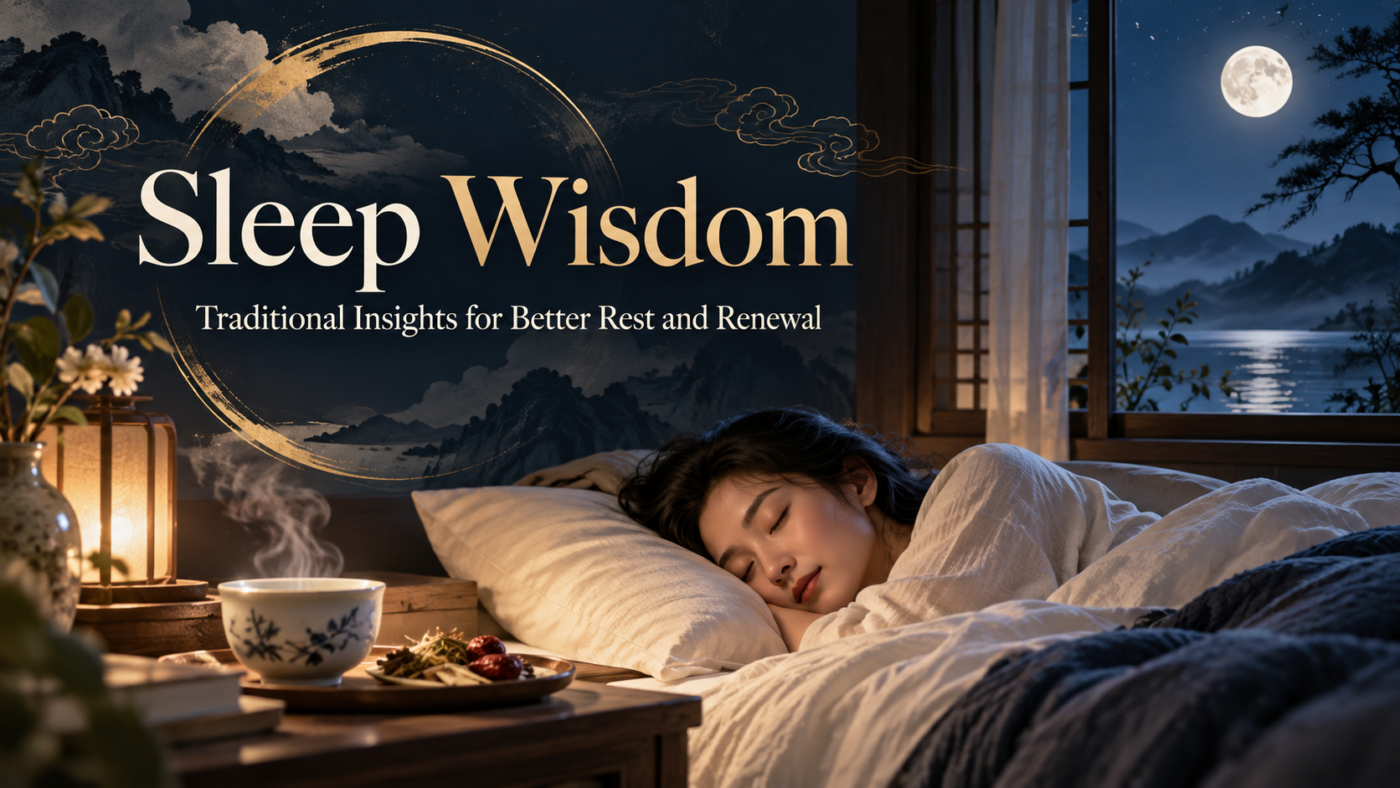
Sleep is one of the most fundamental rhythms of human life.
Long before modern sleep laboratories measured brain waves, hormones, breathing patterns, and circadian rhythms, traditional wellness systems observed that the timing and quality of rest could influence energy, mood, digestion, mental clarity, and resilience.
Traditional Chinese wellness viewed sleep as more than simply switching off at night. It represented a daily transition from activity to stillness—from outward effort toward inward restoration.
Modern sleep science uses a very different language, yet it reaches an important conclusion that echoes this ancient intuition:
Sleep is not wasted time. It is an active biological state essential to physical and mental health.
Some historical sleep teachings contain practical wisdom that remains useful today. Others make claims that should be understood as traditional theory rather than established medical fact.
The goal of this guide is therefore not to treat ancient Chinese medicine and modern sleep science as interchangeable. Instead, it explores what traditional sleep wisdom can still teach us about rhythm, relaxation, consistency, environment, and the art of allowing the body to rest.Sleep is one of the most fundamental rhythms of human life. Long before modern sleep laboratories measured brain waves, hormones, breathing patterns, and circadian rhythms, traditional wellness systems observed that the timing and quality of rest profoundly influenced energy, mood, digestion, mental clarity, and resilience.
Traditional Chinese wellness philosophy approached sleep as more than simply “switching off” at night. Sleep represented a daily return from activity to stillness—a period in which the body could withdraw from outward effort and restore its internal balance.
Modern sleep science describes this process differently, yet it reaches an important conclusion that echoes traditional wisdom: sleep is not wasted time. It is an active biological state essential to physical and mental health.
The most useful approach is therefore not to treat traditional explanations and modern medicine as identical, but to understand what practical wisdom can be preserved while distinguishing it from claims that have not been scientifically established.
Sleep Is More Than the Absence of Wakefulness
It is sometimes claimed in traditional or popular wellness teachings that humans need only a very small amount of “true sleep,” while the rest of the night consists largely of dreaming or unnecessary time in bed.
Modern sleep research does not support this idea.
During a normal night, the brain moves repeatedly through several stages of non-rapid eye movement (NREM) and rapid eye movement (REM) sleep. Deep sleep tends to be more prominent earlier in the night, while REM periods generally become longer toward morning.
Each stage contributes to the overall architecture of healthy sleep.
During sleep, the brain and body remain biologically active. Sleep supports memory, learning, emotional regulation, immune function, metabolism, cardiovascular regulation, tissue maintenance, and daytime alertness.
For most healthy adults, two hours of sleep is therefore not an adequate substitute for a full night of rest. Although individual requirements vary, most adults function best when they regularly receive roughly seven or more hours of sleep.
The traditional insight worth preserving is not that a few minutes of sleep can magically replace an entire night, but that well-timed, high-quality rest can be remarkably restorative.
A brief nap or period of quiet relaxation may improve alertness temporarily, but it should complement rather than routinely replace adequate nighttime sleep.
The Ancient Idea of Living With Natural Rhythms
Traditional Chinese thought placed great emphasis on living in harmony with the changing rhythm of day and night.
Daytime was associated with activity, movement, outward engagement, and yang. Night was associated with quietness, inward restoration, and yin.
From this perspective, constantly extending daytime activity deep into the night was considered a disruption of natural rhythm.
Modern circadian biology provides a different explanation but supports part of this ancient observation.
Human beings possess internal circadian clocks that help coordinate sleep and wakefulness over approximately 24 hours. Light is one of the most powerful signals influencing this system.
Bright light during the day—particularly earlier in the day—helps reinforce wakefulness and circadian timing. Darkness in the evening encourages the biological transition toward sleep.
Modern artificial lighting, smartphones, televisions, computers, irregular work schedules, late meals, stimulants, and nighttime social activity can all push sleep later than the body’s preferred rhythm.
For this reason, one of the simplest forms of sleep care is also one of the oldest:
Allow night to become quieter than day.
Why Regularity Matters
The exact bedtime does not have to be identical for every person.
Traditional texts often prescribe very specific hours, sometimes suggesting that everyone should fall asleep before 9:00 or 10:00 p.m. Modern research does not establish one universally correct bedtime for all adults.
Chronotype, age, work schedules, daylight exposure, family responsibilities, health, and individual biology all influence sleep timing.
What appears particularly important is consistency.
Going to bed and waking at approximately similar times each day helps stabilize the body’s sleep-wake rhythm.
A person who regularly sleeps from 10:30 p.m. to 6:30 a.m., for example, may adapt more comfortably than someone who goes to bed at 10:00 p.m. one night, 1:30 a.m. the next, and 3:00 a.m. on the weekend.
Regularity gives the nervous system predictable signals.
Over time, the body begins to recognize when it is time to become alert and when it is time to become quiet.
The Traditional Chinese Body Clock
Traditional Chinese Medicine describes a 24-hour cycle in which different meridian systems are considered more prominent during particular two-hour periods.
For example, traditional theory associates:
11:00 p.m.–1:00 a.m. with the Gallbladder Meridian
and
1:00–3:00 a.m. with the Liver Meridian.
Within the traditional framework, sleeping during these hours was believed to support the body’s transition from outward activity toward internal restoration.
These ideas remain an important part of traditional Chinese medical philosophy, but they should not be interpreted as proof that the liver literally “detoxifies only between 1:00 and 3:00 a.m.” or that staying awake during these hours directly causes liver disease, gallstones, hepatitis, or psychiatric illness.
The liver performs metabolic and detoxification functions continuously.
Viral hepatitis is caused by specific viruses and is not caused simply by going to bed late.
Likewise, depression, schizophrenia, obsessive-compulsive disorder, cardiovascular disease, diabetes, infertility, osteoporosis, and other complex diseases cannot be attributed to missing a particular meridian hour.
Yet traditional body-clock theory contains a broader lifestyle lesson that remains valuable:
repeatedly sacrificing sleep has consequences.
Chronic inadequate or irregular sleep can influence mood, attention, metabolic health, cardiovascular health, immune function, and daytime performance.
That is a more scientifically defensible way to understand the ancient warning against habitually staying awake deep into the night.
Sleep, the Liver, and the Myth of “Nighttime Detox”
Traditional wellness literature frequently connects sleep with liver restoration.
The language sometimes becomes very literal: the liver is said to “collect blood” when a person lies down, cleanse toxic blood at night, and manufacture new blood before morning.
These statements should be understood as traditional explanatory models rather than modern anatomical descriptions.
The liver is continuously involved in metabolism, nutrient processing, chemical transformation, bile production, and many other essential functions whether a person is awake or asleep.
However, sleep and circadian rhythms do influence metabolism throughout the body.
The more useful conclusion is therefore simple:
good sleep supports healthy physiological regulation, but sleep should not be presented as a magical detoxification procedure.
The Relationship Between Sleep and the Heart
Traditional Chinese philosophy often describes the Heart as the residence of the Shen—a concept encompassing aspects of consciousness, mental activity, emotional stability, and spirit.
From this perspective, a restless mind can disturb sleep, while poor sleep can disturb the mind.
Modern science reaches a comparable practical conclusion through different mechanisms.
During normal sleep, particularly during portions of NREM sleep, heart rate and blood pressure generally decrease. The cardiovascular system therefore participates in the night’s alternating rhythm of activity and recovery.
Persistent sleep deficiency is associated with poorer cardiovascular health.
This does not mean that one late night automatically causes heart disease. Rather, sleep is one component of a larger pattern involving physical activity, nutrition, stress, smoking, alcohol consumption, body weight, genetics, medical conditions, and many other factors.
The Digestive System and Restless Sleep
One of the more practical observations in traditional sleep teachings concerns digestion.
Traditional Chinese medicine has long expressed the idea that when the Stomach is not harmonious, sleep may also be disturbed.
Many people recognize this experience without needing any traditional terminology.
A very large meal shortly before bed may cause fullness or discomfort. Reflux may become more noticeable when lying down. Excessive alcohol can fragment sleep. Large amounts of caffeine later in the day may delay sleep onset. Hunger can also make some people restless.
The useful principle is moderation.
An evening meal should ideally leave the body comfortable rather than excessively full.
People who experience persistent reflux, abdominal discomfort, night sweats, unexplained pain, or other recurring symptoms should not simply label them as an imbalance of “cold,” “heat,” or qi. Persistent symptoms deserve appropriate medical evaluation.
Create a Quiet Transition Before Bed
One of the strongest ideas in the original traditional teachings is beautifully simple:
do not carry the entire day into bed with you.
The period before sleep should gradually reduce stimulation.
This does not require absolute silence or complicated ritual. It means allowing the nervous system to shift from doing to resting.
Arguments, intense work, emotionally charged conversations, constant news consumption, and endless scrolling can all keep the mind activated.
A calmer transition may include dimmer lighting, washing, gentle stretching, quiet reading, meditation, breathing practice, or simply sitting without stimulation for several minutes.
The exact ritual matters less than repeating it consistently.
Eventually the ritual itself becomes a cue:
the day is ending; nothing more needs to be solved tonight.
Do Not Solve Tomorrow’s Problems on the Pillow
Traditional instructions often warn against lying in bed calculating future plans.
This is remarkably practical advice.
Many people become physically tired while remaining mentally active. The body lies down, but the mind continues holding conversations, reviewing mistakes, planning tomorrow, calculating money, imagining future problems, or replaying past events.
Trying harder to force sleep often makes the situation worse.
Instead, allow breathing to become quiet and natural.
Notice the sensation of the breath without attempting to control every inhalation.
Allow thoughts to appear and disappear rather than arguing with them.
Sleep is rarely improved by turning it into a performance test.
Three Gentle Traditional-Inspired Ways to Settle the Body
The original teachings describe several relaxation practices. They can be adapted into simple, low-risk bedtime exercises.
- Gentle stretching followed by quiet sitting. Perform a few comfortable leg and hip stretches without pushing into pain. Sit comfortably for several minutes, rest the hands naturally, and allow the breath to settle. When genuine sleepiness appears, go to bed rather than continuing to stimulate yourself.
- Progressive body-softening visualization. Lie comfortably and breathe naturally. Begin with the toes and imagine unnecessary muscular tension softening. Gradually move through the feet, calves, thighs, abdomen, shoulders, hands, jaw, and face. The purpose is not to create a mystical sensation but to reduce unnecessary muscular effort and mental vigilance.
- Comfortable side sleeping. Some traditional instructions favor the right side and attach symbolic explanations involving fire, water, Heart, and Kidney. The symbolic interpretation belongs to traditional philosophy. From a practical standpoint, people should choose a comfortable sleeping position appropriate to their individual needs and medical conditions.
None of these techniques needs to be performed perfectly.
Their common purpose is to create less effort, less stimulation, and less mental resistance.
The Midday Pause
Traditional Chinese wellness places special significance on Wu Shi, approximately 11:00 a.m. to 1:00 p.m.
Some teachings recommend a brief nap or a period of closed-eye rest during this part of the day.
A short daytime nap can indeed help some people restore alertness, especially after inadequate sleep or during a natural afternoon dip in alertness.
But claims that three minutes of sleep at noon literally equals two hours of nighttime sleep should not be interpreted medically.
A short rest can be refreshing.
It does not reproduce all the physiological stages and cycles of a full night of sleep.
People who struggle with nighttime insomnia should also be cautious about long or late naps because they can reduce nighttime sleep pressure.
Keeping the Body Comfortable at Night
Traditional teaching often emphasizes keeping the limbs warm.
Comfort matters.
Cold feet, excessive heat, uncomfortable bedding, noise, bright light, or poor ventilation can interfere with sleep.
However, the claim that people must always close the windows and never use air conditioning or fans is not supported by modern medical evidence.
The goal should be a comfortable sleeping environment, not adherence to an absolute rule.
A bedroom that is dark, quiet, comfortable, and appropriately cool generally supports sleep.
Air conditioning or a fan can be used when necessary, provided the temperature and airflow remain comfortable.
People differ greatly in temperature preference.
The body should neither be shivering from cold nor struggling with excessive heat.
Why Dreaming Is Normal
Nearly everyone dreams, although dreams are not always remembered.
Dreaming is especially associated with REM sleep, although dream-like mental activity can occur during other sleep stages as well.
Forgetting a dream does not mean that dreaming did not occur.
But dreaming should not be interpreted as proof that most of the night was “wasted sleep.”
REM sleep is a normal component of healthy sleep architecture.
The body repeatedly moves between REM and NREM sleep throughout the night, and the complete pattern contributes to restoration.
Early Rising: Useful, but Not a Competition
Traditional wellness literature strongly praises early rising.
There are genuine advantages to maintaining a consistent wake time and receiving natural light earlier in the day.
Morning light is one of the most powerful environmental signals helping synchronize circadian rhythms.
However, waking at 3:00, 4:00, or 5:00 a.m. is not inherently healthier if it reduces total sleep.
An individual who goes to bed at midnight and forces himself to wake at 4:30 a.m. in the name of discipline may simply become sleep deprived.
The healthier principle is:
wake consistently after obtaining sufficient sleep.
For one person that may mean 5:30 a.m.
For another it may mean 7:00 a.m.
Age, occupation, chronotype, family life, health, and seasonal daylight can all influence the most practical schedule.
Morning Light and Movement
After waking, exposure to daylight can help signal the beginning of the biological day.
Gentle movement, walking, stretching, Tai Chi, or Qigong can also provide a calm transition into daytime activity.
Traditional texts sometimes warn against exercising before sunrise because of harmful vapors or “turbid qi” rising from the earth.
That explanation should not be treated as modern environmental science.
The practical question is instead whether outdoor conditions are safe.
Air pollution, extreme cold, extreme heat, poor visibility, traffic conditions, and individual health circumstances should determine whether early outdoor exercise is appropriate.
Sleep Changes With Age
Sleep requirements are not identical throughout life.
Children and teenagers generally require more sleep than adults because of rapid growth and development.
Adults usually require around seven or more hours, although individual needs vary.
Older adults still require meaningful amounts of sleep. The widespread idea that older people need only a few hours is misleading.
What often changes with age is sleep architecture: sleep may become lighter and more fragmented, and the timing of sleep may shift earlier.
The goal at every age should be sufficient, restorative sleep rather than deliberately restricting sleep in pursuit of an arbitrary number.
If You Cannot Fall Asleep
An occasional difficult night is common.
When sleep does not come, repeatedly checking the clock and worrying about the consequences can increase arousal.
Instead of fighting with sleep, create conditions in which sleep can return.
Keep the environment quiet and dim.
Let the breath remain natural.
Relax the jaw, shoulders, hands, abdomen, and legs.
If lying awake becomes increasingly frustrating, getting out of bed briefly for a quiet activity in dim light may be more helpful than spending a long time tossing and turning.
Return to bed when sleepiness increases.
Most importantly, do not interpret a single bad night as a catastrophe.
Sleep naturally varies from night to night.
Sleeping Pills Are Not Simply “Good” or “Bad”
Some traditional writings advise people never to use sleeping medication.
That is too absolute.
Sleep medicines are not appropriate for everyone, and some can cause side effects, tolerance, dependence, next-day impairment, or interactions with other medications.
At the same time, certain prescription medicines may be appropriate in particular circumstances when evaluated and monitored by a qualified healthcare professional.
People experiencing persistent insomnia should not automatically self-medicate, but neither should they stop prescribed medication abruptly based on general wellness advice.
Chronic insomnia can often be treated effectively, and evidence-based behavioral approaches such as cognitive behavioral therapy for insomnia may be recommended.
When Poor Sleep Deserves Attention
Occasional sleeplessness is different from persistent sleep disturbance.
Consider seeking professional evaluation when sleep problems continue for weeks or months, significantly impair daytime functioning, or are accompanied by symptoms such as loud habitual snoring, repeated choking or gasping during sleep, unusual nighttime movements, persistent excessive daytime sleepiness, morning headaches, unexplained breathing difficulty, severe mood changes, or episodes of falling asleep unintentionally.
These symptoms may point to insomnia, sleep apnea, circadian rhythm disorders, movement disorders, medication effects, medical conditions, or other causes that require more than a bedtime routine.
The Deeper Meaning of “Nourishing Life”
Traditional Chinese culture uses the concept of Yang Sheng—“nourishing life”—to describe the cultivation of health through everyday habits.
Sleep belongs naturally within this philosophy.
But nourishing life does not require accepting every historical explanation literally.
Its deeper principle is remarkably modern:
health is shaped by repeated rhythms.
One night matters less than what happens night after night.
One meal matters less than the pattern of eating.
One stressful day matters less than whether the body is repeatedly denied opportunities to recover.
Sleep is therefore not an isolated technique.
It sits alongside movement, nourishment, emotional regulation, daylight exposure, relationships, and meaningful activity.
A Modern Interpretation of Ancient Sleep Wisdom
Traditional Chinese sleep teachings contain poetry, symbolism, observation, philosophy, and medical concepts developed long before contemporary physiology.
Some statements remain useful as behavioral wisdom.
Others should be regarded as historical or cultural theories rather than scientific facts.
The most enduring principles are surprisingly simple:
Respect the difference between day and night.
Allow evening to become quieter.
Keep a reasonably regular sleep schedule.
Do not carry endless mental calculation into bed.
Create a comfortable sleeping environment.
Avoid routinely sacrificing sleep.
Use gentle relaxation rather than force.
Wake consistently and seek daylight after waking.
Pay attention when persistent sleep problems signal that something deserves further evaluation.
Sleep does not need to become another complicated wellness project.
The body already knows how to sleep.
Our task is often to stop interfering with it.
In the language of traditional Chinese philosophy, night invites yin: quietness, withdrawal, softness, and restoration.
Modern sleep science may use different words, but its message is compatible with that central insight.
Rest is not an interruption of life. Rest is part of the rhythm that makes life possible.
FAQ
- How many hours of sleep do adults generally need?
Most healthy adults require approximately seven or more hours of sleep on a regular basis, although individual needs vary with age, health, genetics, activity, and lifestyle.
Extremely short sleep should not be treated as a wellness goal simply because someone feels temporarily functional.
- Is two hours of sleep enough if the sleep is very deep?
For most adults, no.
Deep sleep is important, but healthy sleep also includes lighter NREM sleep and REM sleep. These stages repeat in cycles throughout the night and contribute to different aspects of physical and mental functioning.
A short period of deep sleep cannot routinely replace an adequate night of sleep.
- Can five minutes of sleep at midnight replace several hours of sleep?
There is no established medical evidence that five minutes of sleep at a particular clock time provides the same physiological benefits as several hours of normal sleep.
A short nap may temporarily improve alertness, but it should not be considered a substitute for adequate nighttime sleep.
- What is the traditional Chinese body clock?
Traditional Chinese Medicine describes a 24-hour cycle in which different organ-meridian systems are associated with different two-hour periods.
For example, traditional theory associates 11:00 p.m.–1:00 a.m. with the Gallbladder Meridian and 1:00–3:00 a.m. with the Liver Meridian.
These concepts belong to traditional Chinese medical theory and should not be interpreted as proof that organs function exclusively during those hours.
- Does staying awake after midnight damage the liver?
One late night does not directly cause liver disease.
Chronic sleep deprivation and circadian disruption may influence metabolism and overall health, but hepatitis, liver disease, gallstones, and other medical conditions have specific and often complex causes.
- Is it healthier to go to sleep before 10 p.m.?
There is no single bedtime that is ideal for every person.
What matters greatly is obtaining enough sleep and maintaining a reasonably consistent schedule that fits an individual’s circadian rhythm and responsibilities.
For many people, an earlier bedtime can make it easier to obtain sufficient sleep when they must wake early.
- Is a midday nap healthy?
A short nap can improve alertness and reduce temporary sleepiness for some people.
Long or late naps, however, may make nighttime sleep more difficult, particularly for people with insomnia.
- Should the bedroom be warm or cool?
Most people sleep well in a comfortably cool environment.
The room should not be so cold that the sleeper shivers or so hot that sleep becomes restless.
Personal comfort, bedding, humidity, health conditions, and climate all matter.
- Is sleeping with air conditioning or a fan harmful?
Air conditioning and fans are not inherently harmful during sleep.
They may help create a comfortable environment in warm climates. Excessive cold, strong airflow directly toward the body, dryness, or poor maintenance may cause discomfort for some people, so settings should be adjusted individually.
- What should I do if my mind will not stop thinking at night?
Try reducing stimulation before bed, dimming lights, putting away demanding work, relaxing the body, and allowing breathing to remain slow and natural.
If lying awake becomes frustrating, briefly leaving the bed for a quiet activity in dim light may help until sleepiness returns.
Persistent insomnia may benefit from professional evaluation and evidence-based approaches such as cognitive behavioral therapy for insomnia.
- Does everyone dream?
Dreaming is common and particularly associated with REM sleep, although dream-like experiences can also occur during other sleep stages.
Not remembering dreams does not necessarily mean that no dreaming occurred.
- Is waking at 4 or 5 a.m. automatically healthier?
No.
Early rising is beneficial only if the person is also obtaining sufficient sleep.
Consistently waking very early while going to bed too late can simply create chronic sleep deprivation.
Medical Disclaimer
This article is for general educational and cultural information only and is not medical advice. Traditional Chinese Medicine concepts discussed here reflect a historical wellness framework and should not be interpreted as established biomedical mechanisms. Persistent insomnia, excessive daytime sleepiness, breathing problems during sleep, or other concerning symptoms should be evaluated by an appropriately qualified healthcare professional.
This article is for general education and does not replace individualized care from a qualified health professional. Seek appropriate advice for persistent, severe, or concerning symptoms.
Read the full medical disclaimer

