When your mind feels busy, your shoulders are tense, or your body seems unable to fully settle, the answer does not always have to be a long workout or an intense yoga session.
Sometimes, a few minutes of slow breathing, gentle movement, and focused body awareness can be enough to create a meaningful shift in how you feel.
This short nervous system reset is designed as a quiet, accessible practice that combines mindful breathing, simple seated movements, restorative floor work, gentle spinal rotation, and sensory awareness. It requires very little space and can be adapted for many different levels of mobility.
The goal is not to force yourself to become calm.
Instead, the practice invites you to notice where you are, breathe more deliberately, and gradually give your body permission to soften.
Begin Exactly Where You Are
Start in a comfortable seated position.
You can sit cross-legged on the floor, elevate your hips on a folded blanket or yoga block, or sit upright in a chair if that feels better for your body.
Lengthen gently through the spine without becoming rigid. Allow the shoulders to settle away from the ears.
Before changing anything about your breathing, take a moment to look around.
Notice the room.
Notice the light, the walls, the floor, the sounds around you, or the outdoor environment if you are practicing outside.
This simple act of orienting yourself to your surroundings can help shift attention away from racing thoughts and back toward the present moment.
You do not need to arrive feeling peaceful.
You simply need to arrive.
Place Your Hands Over the Heart
Bring both hands gently toward the center of the chest. You may stack one palm over the other.
Rather than pressing your hands downward, imagine subtly lifting the chest upward toward your hands.
Keep the spine tall and relaxed.
Take a slow breath in.
Then breathe out gradually.
Repeat several times.
Notice the warmth of your hands and the movement beneath them.
This is not about achieving a perfect breathing pattern. It is about reconnecting with physical sensation and becoming aware of the rhythm already present inside your body.
Try Slow Pursed-Lip Breathing
Now gently shape the lips as though you were breathing through a narrow straw.
Slowly inhale through the pursed lips.
Then exhale through the same small opening.
Keep the breath smooth rather than forceful.
Repeat for several rounds.
If the technique feels uncomfortable, return to normal nasal breathing.
The important part is not the shape of the lips. The useful element is slowing down enough to notice the beginning, middle, and end of each breath.
Keep your chest gently lifted and your posture easy.
Add Slow Overhead Arm Sweeps
Release the hands from the chest.
On an inhale, sweep both arms outward and upward.
Reach toward the ceiling without straining the shoulders.
On the exhale, slowly lower the arms as though you were pressing the air downward.
Repeat this movement several times.
Let the arms follow the breath rather than rushing ahead of it.
As the arms rise, notice the length created through the sides of the waist and rib cage.
As the arms lower, allow the shoulders and upper body to soften.
The movement should feel spacious rather than demanding.
Transition to the Floor
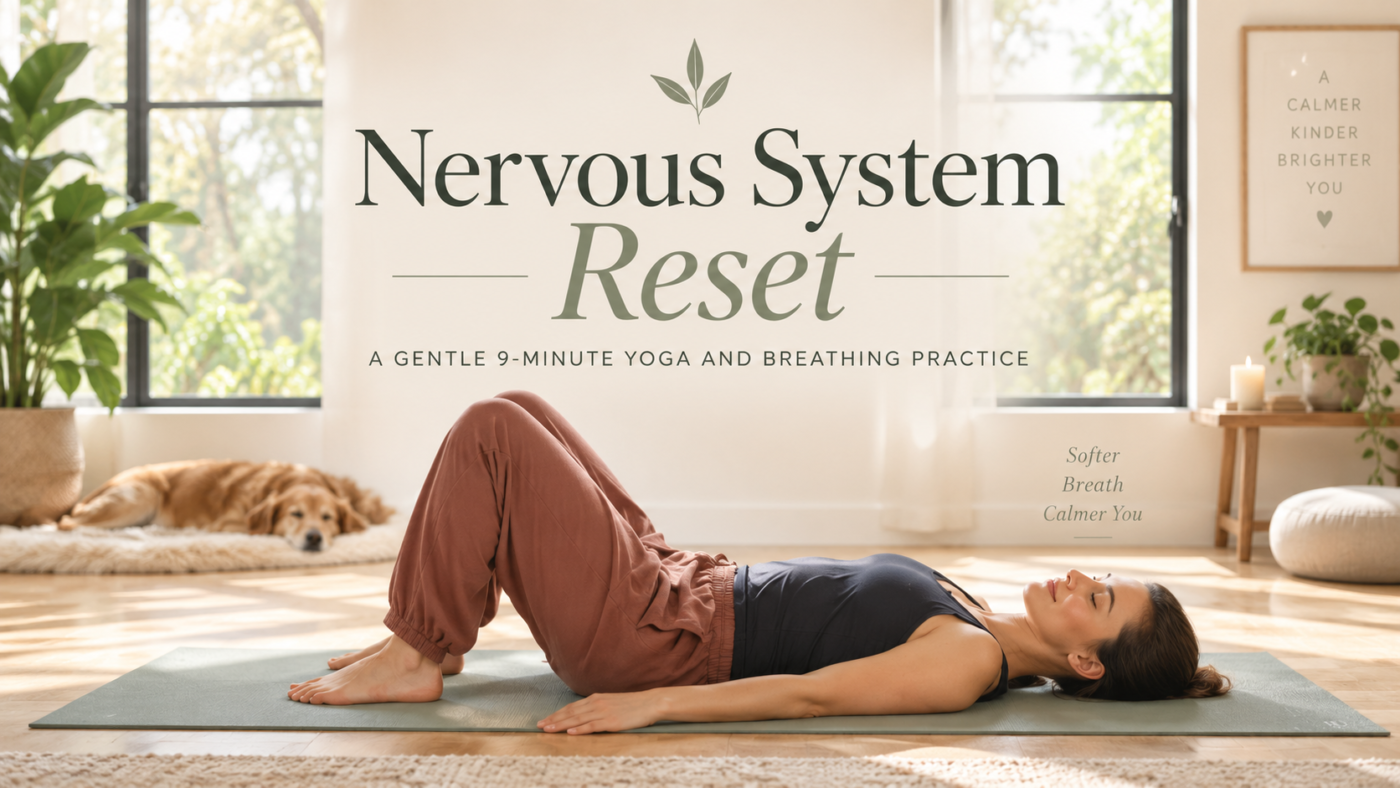
Slowly come onto your back.
Take your time.
Once your back reaches the floor, allow the weight of your body to settle into the mat.
Imagine the ground rising upward to support you.
Bend both knees and place the feet comfortably on the floor.
Let the face soften.
Unclench the jaw.
Allow the shoulders to become heavy.
You may close your eyes if that feels comfortable.
Explore Three-Part Breathing
Place both hands over the lower abdomen.
As you inhale, notice whether the belly gently expands beneath your hands.
As you exhale, allow it to soften again.
Do not push the stomach outward deliberately. Simply observe the natural movement created by the breath.
After several breaths, move your hands to the sides of the rib cage.
Breathe into the ribs.
Notice whether the rib cage gently expands outward as you inhale and softens as you exhale.
Next, move the hands higher toward the upper chest and collarbone area.
Notice the subtle movement here.
Finally, allow the arms to rest beside you and imagine the inhale traveling gradually through three regions:
Lower belly.
Rib cage.
Upper chest.
Then breathe out slowly and comfortably.
Repeat this sequence several times.
The goal is not maximum lung volume. The goal is relaxed awareness.
Hug the Knees In
Bring both knees gently toward the chest.
Hold the legs wherever it feels comfortable.
Rock slowly from side to side.
Think of this as a soft massage for the lower back rather than a stretch that needs to go deeply.
Keep the movement small and easy.
If bringing both knees toward the chest feels uncomfortable, work with one leg at a time.
Practice a Gentle Reclined Twist
Return the feet to the floor with the knees bent.
Open the arms into a cactus-like position with the elbows bent, or place the hands behind the head if that is more comfortable.
Slowly allow both knees to move toward the right.
The twist does not need to be large.
Keep the movement controlled and stop before you feel strain in the lower back.
Breathe naturally.
Use the abdominal muscles gently to bring the knees back toward the center.
Then repeat on the opposite side.
Afterward, allow the knees to move slowly from side to side like windshield wipers.
Keep the movement fluid.
This part of the practice should feel soothing, not intense.
Add Gentle Collarbone Tapping
Extend the legs if comfortable.
Bring the fingertips toward the collarbone area.
Using very light pressure, gently tap along the collarbones.
Move slowly inward and outward.
Continue breathing steadily.
There is no need to tap hard.
The purpose is simply to introduce another form of sensory awareness and give your attention something physical and immediate to follow.
After several moments, stop tapping and rest the hands somewhere comfortably on the body.
Notice What Has Changed
Remain still for several breaths.
Notice your breathing.
Notice the contact between your body and the floor.
Notice your face, jaw, shoulders, chest, abdomen, hips, hands, and feet.
You are not looking for a dramatic transformation.
Simply observe.
Does your breathing feel different?
Do your shoulders feel slightly heavier?
Does the mind feel less scattered?
Do you feel exactly the same?
All of these experiences are valid.
Mindful movement is not a performance.
The practice is the noticing itself.
Finish With Gentle Whole-Body Movement
Begin to move the toes forward and back, allowing the movement to create a very subtle rocking sensation through the body.
If comfortable, bring the palms together and take one final slow breath.
Then allow the body to become still.
Open the eyes when you are ready.
Take a moment before immediately reaching for your phone, standing up, or returning to the rest of your day.
Give yourself a few seconds to notice the transition.
Why Slow Practices Can Feel So Different
Fast exercise has an important place in a healthy lifestyle, but restorative movement serves a different purpose.
Slow practices give you time to notice breathing, muscle tension, posture, and bodily sensations that can be easy to overlook during a busy day.
They can also be useful when you are tired, overstimulated, returning to movement after a demanding day, or simply looking for something gentler than a conventional workout.
The key is not to chase relaxation.
Trying too hard to relax can become another form of effort.
Instead, use the breath and movement as anchors for attention.
Allow calmness to emerge if it does.
When to Use This Nervous System Reset
This short sequence can fit naturally into many parts of the day.
You might practice it after work when your body still feels mentally “switched on.”
You might use it after traveling, prolonged computer work, or a stressful meeting.
It can also become part of a quiet evening routine before bed.
Some people may prefer it in the morning as a gentle way to reconnect with the body before beginning a busy day.
There is no single ideal time.
Consistency matters more than timing.
Make the Practice Your Own
You do not need to complete every movement.
If sitting on the floor is uncomfortable, use a chair.
If lying flat does not feel good, support the head or knees with pillows.
If deep breathing makes you feel lightheaded, return immediately to your normal breathing pattern.
If a twist causes pain, reduce the range of motion or skip it entirely.
A restorative practice should leave you feeling supported rather than challenged.
The best version is the one that respects your body today.
A Quiet Reset Does Not Have to Be Complicated
You do not need sophisticated equipment, extreme flexibility, or a long block of free time to reconnect with your body.
A comfortable seat.
A few slower breaths.
Gentle arm movements.
A supported position on the floor.
A little spinal movement.
A moment of stillness.
Sometimes that is enough.
Instead of asking yourself to become calm immediately, begin with something simpler:
Notice where you are.
Notice how you are breathing.
Notice what your body is telling you.
Then allow the next breath to come.
And begin again.
FAQ
What is a nervous system reset?
A nervous system reset is an informal wellness term commonly used to describe calming practices that combine slower breathing, gentle movement, sensory awareness, relaxation, or mindfulness. It does not literally “reset” the nervous system like restarting a machine. Instead, the goal is to create conditions that may help the body and mind feel more settled.
How long does this practice take?
This routine takes approximately nine minutes, making it suitable for a short morning practice, an afternoon pause, or an evening wind-down.
Is this practice suitable for beginners?
Yes. The movements are gentle and can be modified. You can sit in a chair instead of on the floor, support your body with cushions, and reduce the range of movement whenever necessary.
Can I do this nervous system reset before bed?
Yes. Because the practice emphasizes slower breathing, gentle movement, and relaxation rather than vigorous exercise, many people may find it suitable as part of an evening routine.
What if deep breathing makes me dizzy?
Stop the breathing technique and return to your normal, comfortable breathing pattern. Breathwork should never feel forced. If dizziness, shortness of breath, chest discomfort, or other concerning symptoms continue, seek appropriate medical advice.
Do I need yoga equipment?
No special equipment is required. A yoga mat or comfortable floor surface is helpful, and a folded blanket, cushion, or yoga block can provide additional support.
How often can I practice this routine?
A gentle routine like this can be practiced regularly if it feels comfortable for you. Frequency should depend on your individual health, mobility, and response to the exercises.
Medical Disclaimer
This content is provided for general educational and wellness purposes only and is not medical advice, diagnosis, or treatment. Gentle yoga and breathing exercises may not be appropriate for everyone. Stop any movement or breathing technique that causes pain, dizziness, shortness of breath, numbness, or other unusual symptoms. People who are pregnant, recovering from surgery or injury, or living with cardiovascular, respiratory, neurological, musculoskeletal, or other medical conditions should seek individualized guidance from a qualified healthcare professional before beginning a new exercise or breathwork routine.
This article is for general education and does not replace individualized care from a qualified health professional. Seek appropriate advice for persistent, severe, or concerning symptoms.
Read the full medical disclaimer