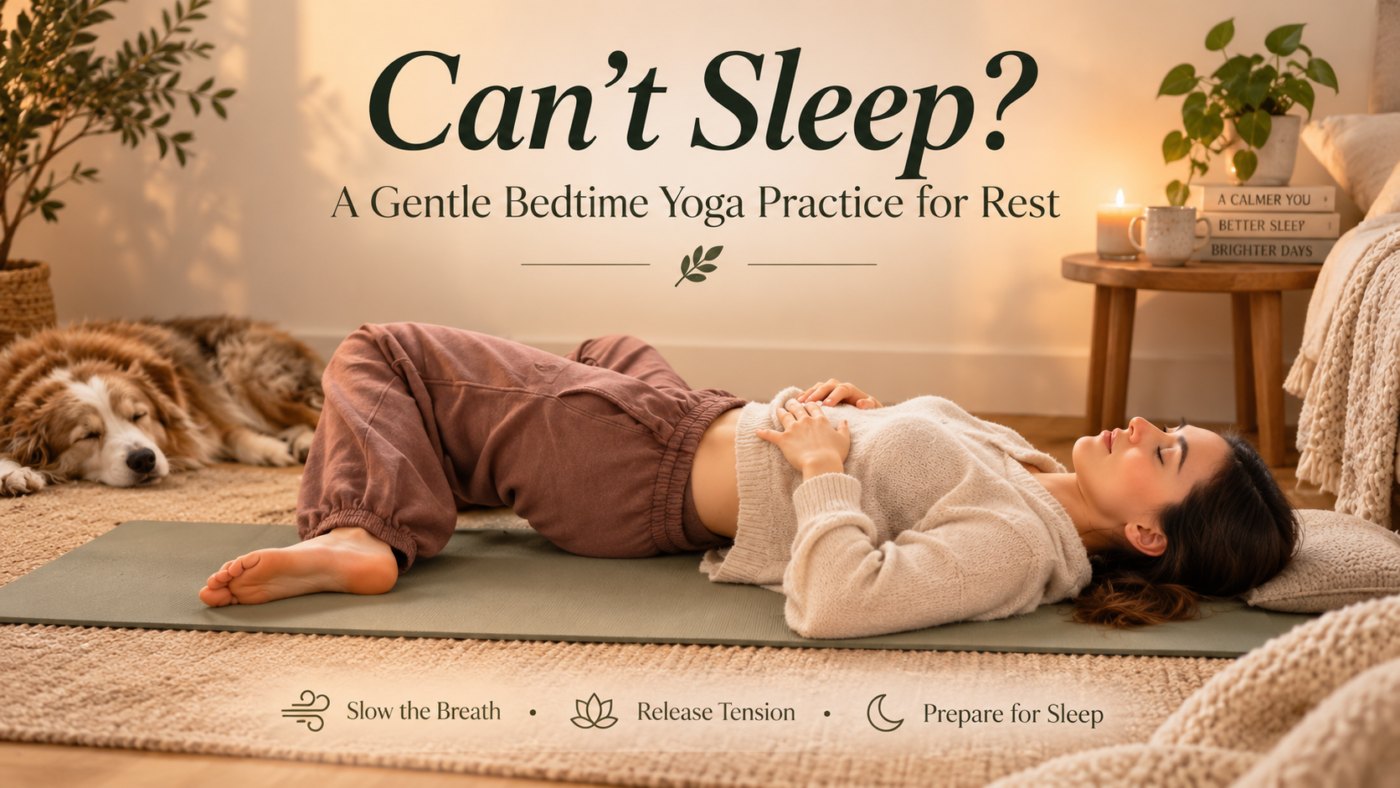
10-minute bedtime yoga can be a simple way to reduce physical effort and create a quieter transition toward rest. This gentle wind-down practice combines slow breathing, soft spinal movement, hip mobility, a supported forward fold, reclining twists, and stillness without demanding flexibility or an intense workout.
The goal is not to force yourself to fall asleep. Instead, the practice encourages slower movement, a comfortable longer exhale, and gradually decreasing activity as the body settles.
If sleep feels far away, a demanding workout is usually not what the body needs. A quieter approach may be more appropriate: gentle movement, slow breathing, soft stretches, and enough stillness to help the body transition toward rest.
This 10-minute bedtime yoga practice begins with the hands and wrists, moves into long-exhale breathing and gentle seated spinal motion, then continues through hip rotation, a supported forward fold, reclining twists, and a final resting position. The original sequence is explicitly designed for times when you cannot sleep and emphasizes connecting mind, body, and breath in preparation for rest.
The goal is not to force sleep. It is to reduce effort, soften the body, and create conditions that feel more compatible with rest.
Begin With the Hands
Start seated or standing in a comfortable position.
Clasp the hands together and gently massage the palms, fingers, and wrists.
Move slowly.
You do not need a long warm-up.
Interlace the fingers, turn the palms away from you, and gently press outward.
Take a deep breath in.
As you exhale, allow the hands and fingers to lengthen without straining.
This is a simple way to begin bringing attention away from the day and toward physical sensation.
Use a Longer Exhale
Bring the palms together near the chest.
Close or soften the eyes.
Take a natural breath in through the nose.
Then exhale slowly and smoothly for longer than the inhale.
Repeat.
The source routine makes the exhale deliberately longer and more prominent than the inhale, using it as the central breathing pattern throughout the practice.
You do not need to count.
The aim is simply to make the exhale unhurried and comfortable.
If extending the breath creates tension, return to normal breathing.
Add Gentle Seated Spinal Movement
Place the hands on the shins or knees.
As you inhale, gently lift the chest.
As you exhale, round through the spine.
Keep the movement small.
This is not an intense Cat-Cow variation.
The practice uses a softer rhythm, with a relatively easy inhale and a slower, more extended exhale as the spine rounds.
Move for several cycles.
Let the breath determine the pace.
Relax the Neck, Face, and Jaw
Return to an upright seated position.
Begin drawing small circles with the nose.
Let the circles gradually become a little larger if that feels comfortable.
Reverse direction.
Keep the jaw relaxed.
Allow the muscles around the eyes and forehead to soften.
You can keep the eyes closed.
Many people carry unnoticed tension through the face and jaw late in the day. This part of the practice is simply an invitation to notice and reduce unnecessary effort.
Add Gentle Hip Rotation
Place the hands behind you and bring the feet to the floor.
Allow both knees to fall gently to the right.
Stay there for a breath or two.
Then return to center and let the knees move to the left.
This windshield-wiper motion creates gentle rotation through the hips.
The practice specifically emphasizes that there is no need to push, maximize, or “fix” anything. Instead, it encourages softness, surrender, and a longer exhale.
That principle is useful for the entire routine.
If a position feels demanding, make it smaller.
Move Into a Supported Forward Fold
Extend the legs forward.
You may use a pillow, folded blanket, or bolster on top of the legs if that helps you relax.
Bend the knees as much as needed.
Slowly slide the hands down the legs.
Stop wherever your body naturally allows you to stop.
There is no correct depth.
Take an easy inhale.
Then use a long exhale to soften into the fold.
Remain here for several breaths.
The original sequence explicitly allows bent knees and optional support, and it emphasizes that where the hands land depends entirely on the individual body.
This is not a flexibility test.
The useful position is the one in which you can remain relatively comfortable and continue breathing easily.
Think of the Breath Like a Wave
While remaining in the forward fold, return to the longer-exhale pattern.
Let the inhale arrive naturally.
Then allow the exhale to lengthen.
The source practice compares this rhythm to ocean waves moving in and out.
You do not need to visualize anything if that does not help.
The main idea is rhythmic breathing without force.
Slowly Transition Onto Your Back
Release the fold gradually.
Move slowly enough that the transition itself remains part of the wind-down.
Come onto your back.
Draw both knees toward the chest.
Let the weight of the back settle into the floor, bed, or couch.
Take a breath.
There is no need to pull the knees tightly toward the body.
Simply allow the position to feel supported.
Add a Reclining Twist
Bring both feet down.
Place the hands behind the head or rest them gently on the ribcage.
Allow both knees to move to the right.
Keep the movement easy.
Take a soft inhale.
Then let the exhale become long and relaxed.
Return through center.
Repeat on the other side.
The original practice again uses the longer exhale here while inviting the entire body to relax.
If the twist feels too strong, reduce the range of motion.
Finish in Complete Rest
Bring the knees back to center.
Slowly extend one leg and then the other.
Place your hands somewhere comfortable on the body.
Let everything become quiet.
There is no final movement to accomplish.
Stay here for as long as feels appropriate.
The closing portion of the routine is intentionally simple: extend the legs, let the hands rest, release effort, and remain still in preparation for rest.
Why This Practice Is Different
This routine is not built around deep stretching, strength, or complicated poses.
Instead, it repeatedly uses a few simple principles:
Slow transitions
Gentle movement
Longer exhales
Relaxed facial muscles
Soft hip and spinal mobility
Supported forward folding
Reclining twists
Stillness at the end
The overall structure is designed to reduce effort as the practice progresses.
You begin with small movements and gradually move toward less and less activity.
What If You Still Can’t Sleep?
Do not treat the practice as a test.
The goal is not to make yourself fall asleep on command.
If you still feel awake after the routine, you can remain lying down and continue with normal, quiet breathing.
Avoid turning the breathing into a performance.
If a longer exhale feels comfortable, continue.
If not, return to your natural breathing rhythm.
Sleep often becomes more difficult when there is too much pressure to achieve it.
A better goal for this practice is simply:
become more comfortable
reduce physical effort
slow the pace of movement
allow the body to rest
Final Thoughts
When you cannot sleep, doing more is not always the answer.
Sometimes the most useful response is to reduce stimulation and simplify.
Massage the hands.
Lengthen the exhale.
Move the spine gently.
Let the hips rotate without force.
Fold forward with support.
Lie down.
Twist softly.
Then stop moving.
This 10-minute bedtime yoga practice is less about achieving a pose and more about creating a gradual transition from activity toward rest.
Medical Disclaimer
This article is provided for educational and informational purposes only and is not intended as medical advice, diagnosis, or treatment. Yoga and breathing practices should be adapted to your individual comfort, mobility, and health status. Stop if you experience pain, dizziness, numbness, shortness of breath, panic, or unusual discomfort. If difficulty sleeping is persistent, severe, or significantly affecting daytime function, seek appropriate medical evaluation rather than relying on yoga alone.
This article is for general education and does not replace individualized care from a qualified health professional. Seek appropriate advice for persistent, severe, or concerning symptoms.
Read the full medical disclaimer

