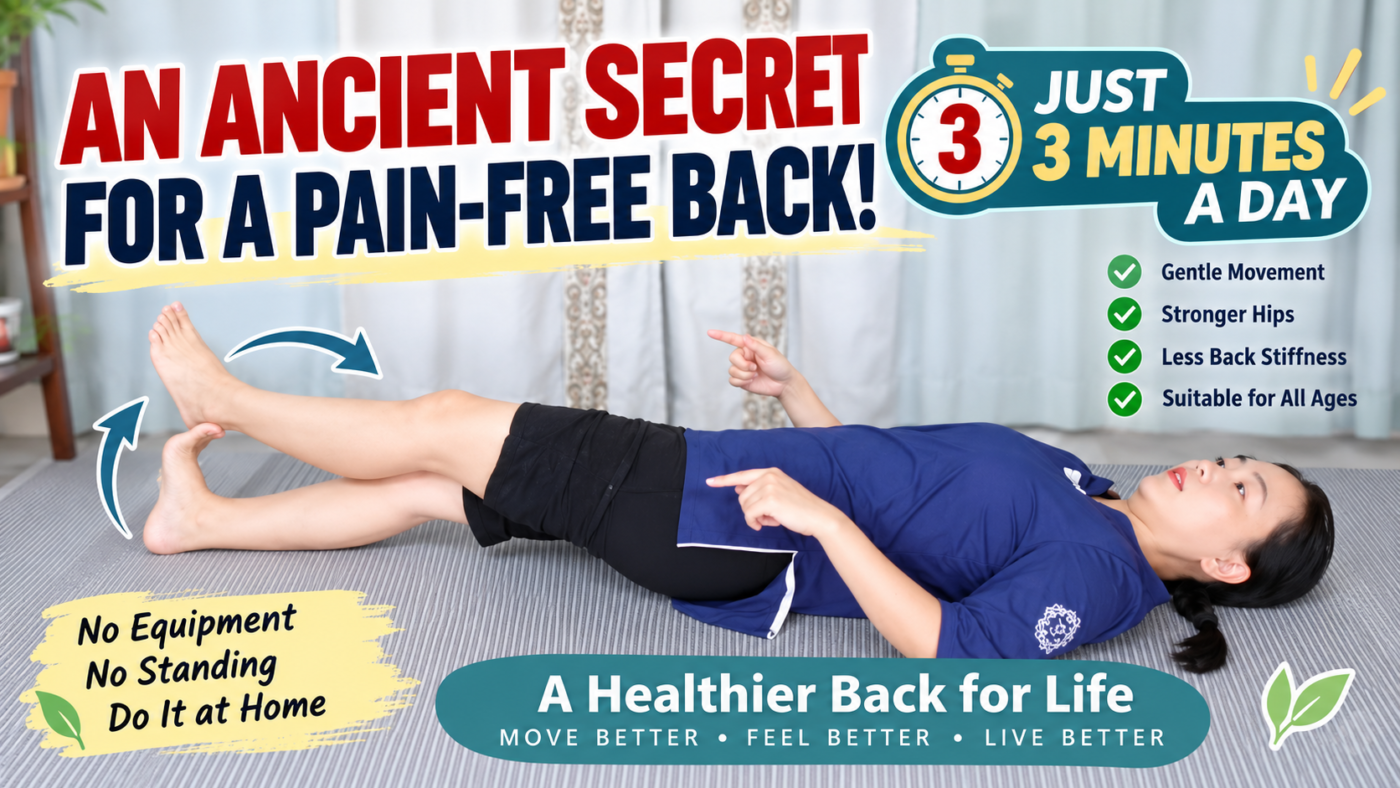
Bed exercise for lower back pain can be a practical option for people who want to stay gently active without standing, lifting weights, or performing demanding movements. This simple lying-down routine focuses on controlled hip movement while allowing the upper body and lower back to remain supported.
Lower back stiffness can make everyday activities such as getting out of bed, bending forward, turning around, or walking for long periods feel uncomfortable. For some people, improving hip mobility and gradually re-engaging the muscles around the hips, thighs, glutes, and pelvis may support more comfortable movement.Lower back stiffness can make even simple movements such as getting out of bed, bending forward, turning around, or walking for long periods feel uncomfortable. When the back feels sensitive, many people instinctively avoid movement altogether.
But complete inactivity is not always the best long-term strategy.
For some people, gentle movement that improves hip mobility and gradually re-engages the muscles around the hips, thighs, and pelvis may help the body move more comfortably without placing unnecessary strain on the lower back.
One particularly accessible option is a simple side-to-side hip movement performed while lying on a bed or other supportive surface.
It requires no equipment, involves no standing or lifting, and can be adjusted to suit different mobility levels.
Why Hip Mobility Matters for the Lower Back
The hips form an important connection between the upper and lower body.
During walking, turning, bending, climbing stairs, and many other everyday activities, movement should be shared among several areas of the body, including the hips, pelvis, and spine.
When the hips become stiff or the surrounding muscles are poorly coordinated, the lower back may sometimes compensate by performing more movement than it comfortably tolerates.
That does not mean that every case of back pain originates in the hips. Lower back pain can have many different causes.
However, maintaining comfortable hip movement and strengthening the muscles around the pelvis can be a useful part of a broader mobility and conditioning routine.
The exercise below focuses on gentle hip-driven movement while the upper body remains supported.
Bed Exercise for Lower Back Pain: How to Do the Hip Sway
Begin by lying comfortably on your back.
Allow your head, shoulders, back, and arms to relax.
Place both arms alongside your body.
Your upper body should remain relatively quiet throughout the exercise.
Step 1: Position the Legs
Keep the left leg extended comfortably.
Point the left toes upward.
Place the heel of your right foot gently over the front portion of the left foot so that the left foot helps support the right heel.
Do not force the feet into an uncomfortable position.
If coordinating both legs feels difficult, use the simplified single-leg version described later in this guide.
Step 2: Initiate the Movement From the Hip
The most important part of the exercise is where the movement begins.
Do not simply twist the ankle from side to side.
Instead, gently initiate the movement from the hip and upper thigh.
Allow this motion to travel through the leg so that the heel moves gradually from one side to the other.
The pelvis may move slightly as the hip rotates.
The motion should feel smooth rather than forceful.
Step 3: Keep the Lower Back Relaxed
Avoid deliberately swinging or twisting the lower back.
The upper body should remain supported by the bed while the movement comes mainly from the hip region.
You can even place a hand lightly over the abdomen or lower back to help monitor unnecessary tension.
If you notice yourself forcefully twisting your torso to create a larger movement, reduce the range and concentrate again on the hip.
Step 4: Move Slowly
This is not a speed exercise.
Move slowly enough to notice what is happening around the hip, thigh, and buttock.
A controlled movement is generally more useful than rapidly swinging the legs from side to side.
Start with a comfortable range.
There is no need to force the leg toward its maximum possible rotation.
Comfortable, controlled movement is the priority.
For some people, this bed exercise for lower back pain may offer a gentle way to practice hip movement.
The goal of this bed exercise for lower back pain is not to cure a spinal condition.
When performing a bed exercise for lower back pain, comfort and control matter more than range of motion.
A bed exercise for lower back pain should never cause sharp or increasing symptoms.
Switch Sides
After completing one side, reverse the leg position.
Use the opposite foot for support and initiate the movement from the opposite hip.
The original routine suggests working toward approximately 30 controlled repetitions on each side.
However, beginners do not need to start with 30 repetitions.
Five to ten slow repetitions may be enough initially.
Increase gradually only when the movement feels comfortable.
What Should You Feel?
During the exercise, you may notice activity around the:
Hip muscles
Outer upper thigh
Buttocks
Lower abdominal and pelvic region
Some people may also notice mild muscular fatigue or warmth after several repetitions.
This is different from sharp, radiating, electric, burning, or rapidly increasing pain.
Muscular effort can be expected when muscles are being used.
Pain should not be treated as something that must be pushed through.
The Most Common Mistake: Moving the Ankle Instead of the Hip
One of the easiest mistakes is to move only the foot.
When this happens, the ankle rotates from side to side but very little movement reaches the hip or pelvis.
Think about the movement beginning near the top of the thigh.
The leg and foot then follow the motion created by the hip.
The movement should feel as though the entire leg participates rather than only the ankle.
Another Common Mistake: Forcing the Lower Back
Avoid deliberately using the waist to produce the side-to-side motion.
If the entire upper body is rocking strongly, the movement may be coming from the wrong area.
Reduce the range.
Relax.
Then try again while concentrating on the hip joint.
The lower back may naturally move slightly with the pelvis, but it should not feel as though you are aggressively twisting the spine.
A Simpler Version for Beginners
If crossing or supporting one foot over the other feels difficult, simplify the exercise.
Lie on your back with the legs relaxed.
Practice gently rotating or swaying one leg from side to side using movement from the hip.
Keep the upper body relaxed.
Once you can clearly feel the motion originating from the hip rather than the ankle, you can gradually experiment with the two-leg version.
There is no need to progress if the simpler version already provides comfortable movement.
Why a Lying Position Can Be Useful
One advantage of exercising while lying down is that the body is supported.
You are not simultaneously trying to maintain upright balance.
This may make gentle movement easier for people who are uncomfortable standing for long periods or who are gradually returning to activity.
A lying position can also make it easier to concentrate on specific movement patterns.
However, lying down does not automatically make every exercise safe for every back condition.
Individual symptoms and medical conditions still matter.
How Often Should You Practice?
A practical starting routine might be:
Begin with 5 to 10 slow repetitions per side.
Practice once daily.
Keep the movement within a comfortable range.
Breathe normally throughout the exercise.
If the exercise continues to feel comfortable, gradually increase the repetitions.
Some people may eventually perform around 20 to 30 repetitions per side.
More repetitions are not automatically better.
Movement quality matters more than completing a particular number.
Do Not Hold Your Breath
It is common to unconsciously hold the breath when concentrating on a new movement.
Try to maintain relaxed, natural breathing.
Inhale and exhale normally while the legs move.
The exercise should feel controlled rather than strenuous.
What If One Side Feels Different?
It is common for the two sides of the body to feel somewhat different.
One hip may feel stiffer.
One side may fatigue sooner.
The range of motion may also differ.
This does not automatically mean that something is damaged or that the weaker-feeling side requires aggressive stretching.
Use a comfortable range on each side and allow mobility to improve gradually.
Avoid forcing the tighter side to match the easier side immediately.
When to Stop
Stop the exercise if it causes significant or increasing lower back pain.
You should also stop if you develop symptoms such as:
Sharp or severe pain
Pain shooting strongly into the leg
Increasing numbness or tingling
New weakness
Loss of coordination
Dizziness or feeling unwell
People experiencing a severe acute flare of back pain should generally avoid experimenting with unfamiliar exercises until their condition has been appropriately assessed.
Seek prompt medical care for back pain accompanied by new bowel or bladder problems, numbness around the groin or saddle area, major leg weakness, fever, significant trauma, or other concerning symptoms.
Gentle Movement Is About Gradual Capacity, Not Forcing the Body
A common reaction to back pain is to become afraid of movement.
During an acute injury or severe flare, temporary activity modification may certainly be necessary.
But over longer periods, appropriate movement and progressive activity are often important parts of maintaining mobility and physical capacity.
The goal is not to force a painful back through increasingly difficult movements.
It is to find tolerable movement, build confidence gradually, and strengthen the surrounding muscles over time.
A simple bed-based hip exercise can be one small part of that process.
Gentle mobility work can also be combined with other low-impact exercises that support balance, flexibility, and healthy aging.
The Bottom Line
This gentle hip-sway exercise is simple enough to perform while lying down and requires no equipment.
Its main purpose is not to “cure” a spinal condition.
Instead, it provides a low-complexity way to practice hip movement while engaging muscles around the hips, thighs, buttocks, and pelvis.
For people who tolerate the exercise comfortably, regular practice may help maintain hip mobility and improve awareness of how the hips and pelvis move.
Start slowly.
Let the movement come from the hip.
Keep the upper body relaxed.
Never force the range.
And if an exercise consistently increases your symptoms rather than helping you move comfortably, stop and seek appropriate professional advice.
FAQ
Can this exercise cure lower back pain?
No single exercise can be guaranteed to cure lower back pain. Back pain has many possible causes. This movement may be useful as a gentle mobility exercise for some people, but it should not replace appropriate medical evaluation when symptoms are severe, persistent, or worsening.
Can people with a herniated disc perform this exercise?
A diagnosis such as a lumbar disc herniation does not produce identical symptoms in every person. Whether a particular exercise is appropriate depends on the individual’s symptoms and condition. If movement increases leg pain, numbness, weakness, or severe back pain, stop and seek professional guidance.
How many repetitions should beginners perform?
Start conservatively. Around 5 to 10 slow repetitions per side may be sufficient. The number can gradually increase if the exercise remains comfortable.
Should I feel my lower back working?
The movement should primarily come from the hip and upper thigh rather than forceful twisting of the lower back.
What if my hips are too stiff to perform the full movement?
Reduce the range or perform the simplified single-leg version. Comfortable movement is more important than achieving a large range.
Can older adults perform this exercise?
Some older adults may find lying exercises easier than standing exercises because the body is supported. However, individual health conditions, mobility limitations, osteoporosis risk, recent surgery, neurological symptoms, and other factors should be considered.
Medical Disclaimer
This article is for educational purposes only and is not medical advice, diagnosis, or treatment. Lower back pain can result from many different conditions. Stop exercising if symptoms worsen and seek appropriate medical evaluation for severe, persistent, progressive, or neurologically associated symptoms.
This article is for general education and does not replace individualized care from a qualified health professional. Seek appropriate advice for persistent, severe, or concerning symptoms.
Read the full medical disclaimer