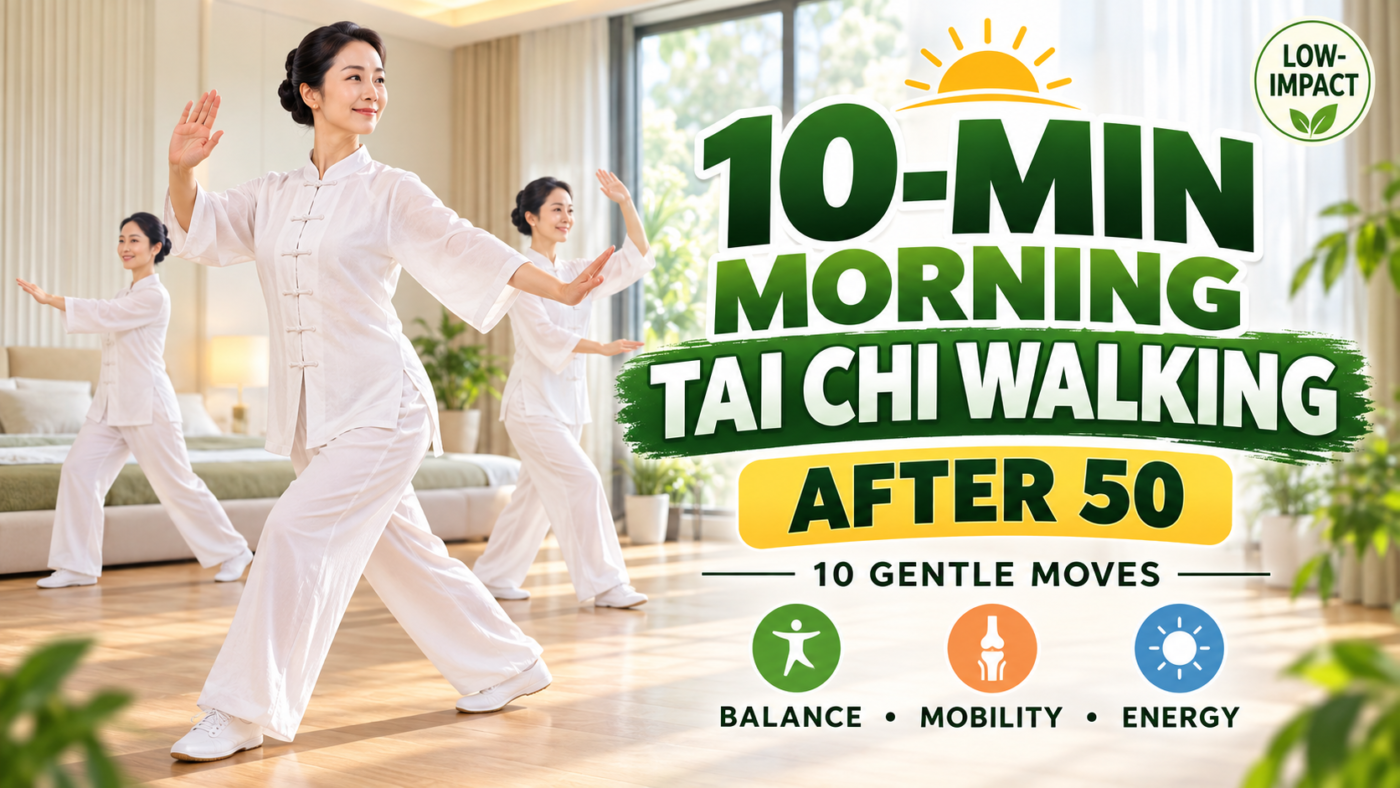
Morning tai chi walking after 50 can be a simple way to start the day with gentle, low-impact movement. This 10-minute standing routine combines marching, knee lifts, side steps, controlled squats, reaching patterns, weight shifts, and balance work to help wake up the whole body.
Rather than focusing on intense calorie burning, the routine is designed to support mobility, coordination, balance, posture, and a consistent daily movement habit.
Starting the day with movement does not have to mean an intense workout.
For adults over 50, a short routine that gently challenges balance, coordination, mobility, and lower-body control can be a practical way to transition from sleep into an active day.
This 10-minute morning Tai Chi walking routine combines simple standing movements with controlled stepping, knee lifts, arm swings, side reaches, squats, and gentle weight shifts.
There is no jumping.
The goal is not exhaustion.
Instead, the routine is designed to help you wake up the whole body, practice balance, move through several directions, and build a consistent morning movement habit.
Why Morning Tai Chi Walking Can Be Useful After 50
As we age, staying active becomes about much more than burning calories.
Everyday activities depend on being able to:
Lift a foot confidently
Shift weight from side to side
Step backward
Rotate the torso
Reach overhead
Stand briefly on one leg
Change direction safely
Maintain an upright posture
This routine incorporates all of those patterns in a simple sequence.
Regular movement can also contribute to overall energy expenditure and long-term weight management, but no 10-minute routine can guarantee weight loss by itself.
Nutrition, total weekly activity, sleep, recovery, medications, health conditions, and other individual factors also matter.
Exercise 1: March in Place
Begin by standing tall with your shoulders relaxed.
March gently in place.
Lift each knee only as high as feels comfortable and allow the arms to swing naturally.
Keep your breathing easy.
This simple rhythm warms the legs and hips while introducing repeated weight transfer from one foot to the other.
The original routine uses marching as the opening movement and connects it with balance and staying active after 50.
You do not need to march quickly.
Focus instead on smooth, controlled steps.
Exercise 2: Knee Lift With Arm Swing
Lift one knee while swinging both arms downward toward the same side.
Lower the leg.
Repeat on the opposite side.
Continue alternating.
This movement adds a coordination challenge because the arms and legs must move together while your body briefly balances on one leg.
The abdominal and back muscles also help stabilize the torso.
The original sequence describes this steady full-body rhythm as increasing energy use and supporting healthy weight management.
Exercise 3: Side Step With Overhead Reach
Step one foot gently to the side.
At the same time, reach the same-side arm overhead.
Return to the center and switch sides.
Keep the movement comfortable rather than stretching as far as possible.
This pattern introduces lateral movement, which is useful because everyday walking mainly takes place in a forward direction.
Side stepping can challenge balance while the overhead reach mobilizes the shoulders and side body.
Exercise 4: Crossed-Arm Squat
Stand tall.
Raise and cross the arms overhead within a comfortable shoulder range.
Bend the knees into a shallow squat as the arms move downward and cross in front of the torso.
Stand again.
Keep the knees aligned comfortably with the direction of the feet.
A deep squat is unnecessary.
The purpose is to recruit the thighs and hips while maintaining control.
This combination also keeps the upper and lower body moving together.
Exercise 5: Side Turn Squat
Stand with the feet somewhat wider than hip-width.
Turn the torso and arms gently toward one side while bending the knees slightly.
Return toward the center and repeat toward the other side.
The movement combines:
Lower-body strength
Weight shifting
Torso rotation
Balance
Coordination
Avoid twisting aggressively through the knees.
Allow the feet and hips to move naturally with the rotation when needed.
The source describes this as a balance and body-control exercise combined with continuous full-body activity.
Exercise 6: Side Leg and Elbow Extension
Shift your weight onto one leg.
Extend the other leg toward the side while opening the elbow on the same side.
Keep a slight bend in the standing knee.
Return and switch.
This is one of the stronger balance challenges in the routine because your weight is primarily supported by one leg.
Use a wall, chair, or countertop if necessary.
The movement can help train hip control and single-leg stability that are relevant to everyday walking.
Exercise 7: Step and Circle
Begin with the hands near the waist.
Step one foot forward while circling both hands smoothly.
Return and alternate legs.
This creates a flowing combination of stepping and coordinated upper-body movement.
Focus on deliberate foot placement.
There is no need to take a large step.
The exercise provides a useful opportunity to practice forward weight transfer while keeping the body relaxed.
Exercise 8: Turn and Lean
Interlace the fingers gently behind the head if shoulder mobility allows.
Turn the face and upper body toward one side while leaning slightly in the opposite direction.
Return and switch.
Keep the range small.
This movement challenges the trunk to coordinate rotation and lateral movement at the same time.
The original sequence uses it to improve waist mobility for everyday turning and reaching.
If placing the hands behind the head is uncomfortable, simply keep the hands near the shoulders or chest.
Exercise 9: Back Step Reach
Extend one leg behind you while reaching the opposite arm overhead.
Return to the starting position.
Repeat with the opposite leg and arm.
This cross-body pattern is especially useful because it combines backward stepping with opposite-arm coordination.
Backward movement deserves attention because it appears in many everyday situations but is rarely trained during ordinary forward walking.
The source specifically links the opposite arm-and-leg pattern with smoother walking coordination and upright posture.
Keep the backward step short until you feel stable.
Exercise 10: Swing and Reach
Finish with a slower flowing movement.
Swing both arms toward one side, with one hand slightly higher than the other.
Allow the body to reach gently in the same direction.
Return through the center and repeat to the opposite side.
This final exercise provides a comfortable stretch through the upper body and sides while gradually reducing the intensity of the session.
The original workout intentionally uses this movement to help the body relax at the end.
What This 10-Minute Routine Trains
Although the session is short, it includes several important movement qualities.
Balance
Knee lifts, side leg extensions, stepping, and weight shifts repeatedly challenge stability.
Mobility
Overhead reaches, side movements, torso turns, and arm swings move the body beyond a simple forward walking pattern.
Lower-Body Strength
Squats and repeated stepping recruit the thighs, hips, calves, and stabilizing muscles.
Coordination
Opposite-arm and leg patterns require the upper and lower body to work together.
Posture
Reaching patterns encourage the body to move out of the rounded position associated with prolonged sitting.
Daily Activity
Ten minutes of movement is still ten minutes more activity than remaining sedentary.
Is 10 Minutes Really Enough?
Ten minutes can be enough to create a useful morning movement habit.
It is not necessarily enough to meet all of your exercise needs.
Think of this routine as one component of a larger weekly plan.
Depending on your health and fitness level, that plan may also include:
Regular walking
Strength training
Additional balance work
Longer aerobic activity
Mobility exercises
Rest and recovery
The advantage of a 10-minute routine is accessibility.
It is easier to repeat consistently than a workout that feels overwhelming.Morning tai chi walking after 50 can contribute to healthy weight management by increasing daily physical activity, but lasting weight change depends on overall nutrition, exercise, sleep, recovery, and individual factors.
Can This Routine Help With Weight Management?
Potentially, as part of a broader lifestyle.
Exercises such as marching, knee lifts, squats, and continuous stepping increase physical activity and require energy.
However, a 10-minute Tai Chi walking session should not be presented as a standalone weight-loss treatment.
Long-term weight management depends on the relationship between food intake, physical activity, metabolism, sleep, recovery, and individual health factors.
The most realistic benefit of this routine is that it gives you another simple way to move every day.
Why Balance Deserves Special Attention After 50
Several exercises in this routine repeatedly transfer body weight from one leg to the other.
That matters.
Walking itself is essentially a repeated transition between brief periods of single-leg support.
Exercises such as knee lifts, side leg extensions, backward steps, and side stepping can therefore provide useful practice for the balance and coordination involved in everyday movement.
You can make these exercises safer by standing near a stable support.
There is no benefit in deliberately making yourself unstable.
How to Make the Routine Easier
Use a chair or countertop for balance.
Keep knee lifts low.
Make side steps shorter.
Perform shallower squats.
Reduce overhead reaching.
Keep the feet closer to the floor.
Move more slowly.
Skip any movement that causes pain.
You can also perform only five movements initially and gradually build toward the full routine.
How to Make It More Challenging
Once the exercises feel comfortable, increase the challenge gradually.
You might:
Lift the knees slightly higher.
Use a slightly larger but controlled step.
Increase squat depth modestly.
Move through a fuller comfortable arm range.
Reduce unnecessary pauses.
Focus on slower, more controlled single-leg transitions.
The goal is not maximum speed.
Control is more important.Morning tai chi walking after 50 works best as a consistent daily habit alongside regular walking, strength training, mobility work, adequate recovery, and healthy nutrition.
Who Should Be More Cautious?
People with significant balance problems, recent surgery or injury, severe joint pain, unstable cardiovascular symptoms, or neurological conditions affecting movement should obtain individualized guidance before beginning unfamiliar exercise.
Stop if you experience:
Chest pain
Faintness
Severe shortness of breath
Sudden weakness
Sharp joint pain
Severe dizziness
Loss of balance that does not quickly resolve
FAQ
Is morning Tai Chi walking good after 50?
Morning Tai Chi walking can be a useful low-impact activity after 50 because it combines controlled stepping, weight shifting, mobility, coordination, and balance without requiring jumping.
Is 10 minutes of Tai Chi walking enough?
Ten minutes can provide meaningful daily movement and may be an effective way to build a consistent morning habit. It should usually be viewed as part of a broader activity routine rather than the only exercise you do.
Can Tai Chi walking improve balance after 50?
Yes, many Tai Chi walking movements challenge balance through knee lifts, side steps, backward steps, single-leg support, and controlled weight shifting.
The original routine specifically uses side-leg support to develop strength for steadier walking.
Can Tai Chi walking help with weight loss?
Tai Chi walking can increase physical activity and energy expenditure, which may contribute to long-term weight management. Weight loss still depends on overall energy balance, nutrition, activity, recovery, and individual factors.
Is this routine suitable for beginners?
Many generally healthy beginners can modify the routine by using smaller steps, lower knee lifts, shallower squats, slower movements, and a chair or countertop for support.
Should I do Tai Chi walking every morning?
A gentle routine can often be incorporated regularly when it feels comfortable, but frequency should depend on your health, fitness level, recovery, and other physical activity.
Is Tai Chi walking better than regular walking?
They provide different benefits. Regular walking is an accessible form of aerobic activity, while Tai Chi walking adds multidirectional movement, reaching, balance challenges, coordination, and controlled weight shifts.
The Bottom Line
You do not need a long or intense workout to start your morning with meaningful movement.
This 10-minute Tai Chi walking routine uses 10 simple standing exercises to train:
Balance
Mobility
Lower-body strength
Coordination
Posture
Weight shifting
Whole-body movement
The workout closes by encouraging continued practice to move better, improve balance, and stay energized.
That is a sensible way to view the routine.
Not as a miracle workout.
Not as a shortcut to targeted fat loss.
But as a practical daily habit that can help adults over 50 keep moving, practicing balance, and maintaining confidence in everyday movement.
Medical Disclaimer
This content is for general educational and informational purposes only and is not intended to diagnose, treat, cure, or prevent any disease or medical condition. Exercise tolerance and mobility vary between individuals. Modify or stop any movement that causes pain, dizziness, loss of balance, chest discomfort, or unusual shortness of breath, and seek appropriate professional guidance when needed.
This article is for general education and does not replace individualized care from a qualified health professional. Seek appropriate advice for persistent, severe, or concerning symptoms.
Read the full medical disclaimer

