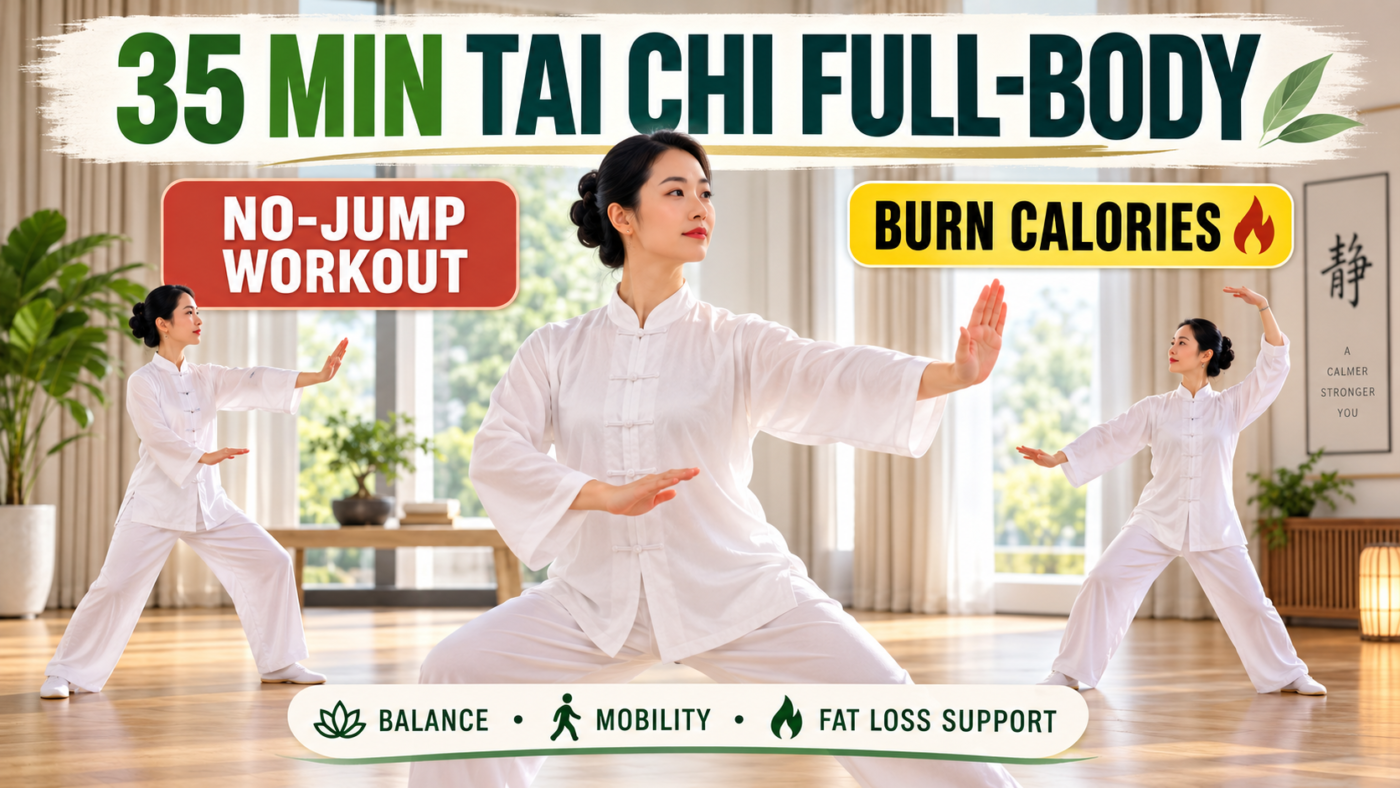
Tai chi workout for weight loss can be an excellent low-impact option for people who want to increase daily activity without running or jumping. This 35-minute full-body routine combines controlled knee lifts, squats, reaching patterns, torso rotations, balance exercises, and mobility work to keep the whole body moving.
Walking remains valuable for overall health, but reducing abdominal fat ultimately depends on overall fat loss rather than performing one specific “belly-burning” exercise. Regular physical activity, appropriate nutrition, recovery, and a sustainable energy balance all matter.
If you have been walking regularly but still feel frustrated by stubborn belly fat, the problem may not be that walking “doesn’t work.”
Walking is one of the most accessible forms of physical activity and can support cardiovascular health, daily energy expenditure, mobility, and long-term weight management. But body fat cannot be selectively burned from the lower belly simply by choosing a particular exercise.
Reducing abdominal fat ultimately depends on reducing overall body fat over time. That usually means combining regular physical activity with appropriate nutrition, adequate recovery, and an overall energy balance that supports your goal.
If you want something more dynamic than walking without adding jumping or high-impact exercise, this 35-minute Tai Chi-inspired standing workout offers another option.
It combines controlled knee lifts, squats, reaching patterns, torso rotations, balance exercises, arm movements, calf raises, hip mobility, and gentle stretching into one continuous full-body session.
There are no jumps.
Instead, the challenge comes from keeping the body moving, using large muscle groups, controlling your balance, and maintaining a steady rhythm.
Why a No-Jump Full-Body Workout Can Still Be Challenging
Low impact does not necessarily mean low effort.
A workout can raise energy expenditure without running or jumping when it repeatedly uses the legs, hips, trunk, shoulders, and arms together.
Movements such as squats, knee drives, heel raises, punches, wide stances, leg lifts, and cross-body reaches require multiple muscle groups to work at the same time.
That can help:
Increase daily physical activity
Challenge cardiovascular endurance
Strengthen the legs and hips
Improve coordination
Train balance
Mobilize the shoulders and spine
Engage the abdominal and back muscles
Reduce stiffness associated with prolonged sitting
Support overall weight-management efforts
The important distinction is that these movements do not selectively remove belly fat. They contribute to total activity and energy expenditure, which may support overall fat loss when combined with appropriate nutrition.
The 38-Movement Workout
The original routine progresses through 38 standing movements, beginning with simple mobility and gradually introducing more demanding balance, squat, knee-lift, and whole-body patterns before finishing with slower stretching. The final section includes single-leg balance, lunging and a gentle side stretch before cooling down.
Movement 1: Overhead Knee Lift
Raise one arm overhead while lifting the opposite knee toward your chest.
Switch sides with control.
This cross-body pattern warms the hips, shoulders, and trunk while introducing gentle cardiovascular movement.
Keep your torso tall and avoid pulling the knee higher than your comfortable range.
Movement 2: Side Waist Reach
Reach one arm overhead and gently lean toward the opposite side.
Return to center and switch.
Rather than trying to “burn side fat,” think of this as a mobility exercise for the side body, ribs, shoulders, and trunk.
Movement 3: Front and Back Leg Swing
Stand tall and swing one leg gently forward and backward.
Keep the movement controlled rather than using momentum.
Switch legs after several repetitions.
This movement mobilizes the hip while challenging the standing leg to stabilize the body.
Movement 4: Arm Circle Flow
Circle both arms slowly through a comfortable range.
Reverse direction.
Large controlled arm circles can help warm the shoulder joints and reduce the feeling of stiffness across the upper back.
Movement 5: Cross Reach Step
Step one foot outward while reaching the opposite arm diagonally upward.
Allow a gentle rotation through the torso.
Return and alternate sides.
The combination trains coordination while introducing spinal rotation and lateral movement.
Movement 6: Overhead Knee Drive
Reach one arm upward while lifting the opposite knee.
Continue alternating at a steady rhythm.
Compared with the earlier knee lift, this variation can be performed more continuously, increasing the cardiovascular demand while challenging cross-body coordination.
Movement 7: Heel Raise Pull Back
Extend both arms forward.
Rise onto the balls of your feet while drawing the elbows or hands backward.
Lower the heels and repeat.
This combines calf strengthening with upper-back activation.
Heel raises can also challenge ankle control and standing balance.
Movement 8: Side Palm Sweep
Stand with the feet approximately shoulder-width apart.
Sweep the hands smoothly from side to side while allowing the upper torso to rotate naturally.
Keep the knees soft.
The goal is comfortable thoracic rotation rather than forcing the lower back.
Movement 9: Cross Back, Chest Open
Step one foot diagonally behind you.
At the same time, draw the elbows backward and gently open the chest.
Return and switch sides.
This combines balance with hip movement and upper-body posture work.
Movement 10: Overhead Side Stretch
Place one hand behind the body or around the lower back while reaching the other arm overhead.
Gently lean sideways.
Return and change sides.
You should feel a comfortable stretch through the side of the torso rather than compression in the lower back.
Movement 11: Back Leg Kick
Place the hands on the hips.
Shift your weight onto one leg and extend the opposite leg gently backward.
Switch sides.
The movement recruits the glutes and requires the trunk to stabilize the pelvis.
Avoid arching aggressively through the lower back.
Movement 12: Squat and Reach
Take a comfortable wide stance.
Lower into a shallow squat or horse-stance position.
Stand smoothly and raise the arms overhead.
Repeat.
Because the thighs and glutes are among the body’s larger muscle groups, repeated squatting can make a low-impact workout considerably more demanding.
Movement 13: Alternating Punch
Hold light fists near the chest.
Punch one arm forward and return it.
Alternate sides.
Keep the shoulders relaxed and allow the trunk to remain controlled rather than twisting excessively.
The faster rhythm can increase the cardiovascular challenge without requiring impact.
Movement 14: Side Bend Arm Circle
Lean slightly toward one side as the arms make a broad circular movement.
Return through the center and repeat toward the other side.
This combines shoulder mobility with lateral trunk movement.
Movement 15: Heel Raise Chest Opener
Raise your arms in front of the chest.
Sweep them backward while rising onto your toes.
Lower and repeat.
The heel raise challenges the calves and balance while the arm motion encourages chest opening after long periods of sitting.
Movement 16: Overhead Open Flow
Bring the hands together in front of your body.
Raise them overhead.
Open the arms outward and lower them smoothly.
Move slowly enough that the shoulders remain comfortable.
Use the opening phase as an opportunity to breathe naturally and expand through the chest.
Movement 17: Alternating Arm Pump
Make relaxed fists.
Raise one arm while lowering the other, alternating continuously.
Add a gentle side-to-side shift through the hips if comfortable.
Maintaining continuous movement helps keep the body warm and adds to total activity during the session.
Movement 18: Overhead Back Leg Lift
Interlace or bring the hands together and reach upward.
At the same time, extend one leg behind you.
Return and switch sides.
This exercise challenges the glutes, trunk stability, shoulder mobility, and balance simultaneously.
Movement 19: Back Kick Toe Touch
Lift one leg behind you while reaching the hands toward the foot as mobility allows.
Return, then continue the pattern before changing sides.
Do not force the reach.
Balance is more important than touching the foot.
Movement 20: Side Toe Reach
Take a wide stance.
Turn one set of toes upward and reach toward that foot while keeping the movement comfortable.
Return and switch.
This introduces a stretch through the hamstrings, calves, hips, and side body.
Movement 21: Heel Raise Elbow Pull
Begin in a shallow squat.
As you stand, rise onto the toes while pulling one elbow backward.
Alternate sides.
The movement links the thighs, calves, upper back, and balance system into one coordinated pattern.
Movement 22: Forward Reach Press
Stand tall and extend both arms forward.
Hinge slightly from the hips while keeping the spine long.
Return upright.
This can provide a comfortable stretch through the upper back and shoulders when performed without rounding aggressively through the spine.
Movement 23: Waist Twist Squat
Take a wide stance and lower into a comfortable partial squat.
While maintaining control through the legs, rotate the torso gently from side to side.
The abdominal and back muscles help stabilize and rotate the trunk, while the thighs remain active throughout the movement.
Movement 24: Cross-Arm Swing
Open both arms wide.
Swing them inward so they cross in front of the chest.
Open again and repeat.
This alternates between opening the chest and stretching across the upper back.
Keep the movement fluid rather than forceful.
Movement 25: Front Kick Arm Pull
Draw the hands upward toward the chest as one leg kicks gently forward.
Return and change sides.
This whole-body pattern requires coordination between the hip flexors, trunk, arms, and standing leg.
Keep the kick low if necessary.
Movement 26: Elbow-Knee Crunch
Raise the arms and then draw one elbow downward as the same-side knee rises.
Return and alternate.
This movement strongly engages the abdominal muscles, but that muscular engagement should not be confused with directly burning abdominal fat.
Core exercises strengthen and train the muscles beneath the abdominal fat; overall fat loss determines whether the waist becomes leaner over time.
Movement 27: Wide Squat
Stand with your feet wider than hip-width apart.
Slowly bend the knees into a comfortable squat.
Rise with control.
Use whatever depth allows you to keep the knees and hips comfortable.
A deeper squat is not automatically better.
Movement 28: Shoulder Touch Reach
Place one hand lightly on the opposite shoulder while extending the other arm forward.
Switch arm positions smoothly.
This movement combines shoulder mobility with coordination and gentle upper-body rotation.
Movement 29: Twisting Squat Flow
Take a wide stance.
Bend the knees while rotating gently from side to side.
Allow the arms to move naturally with the rotation.
This combines lower-body muscular work with trunk rotation and therefore recruits more of the body than an isolated arm movement.
Movement 30: Cross-Arm Knee Lift
Open both arms wide.
Bring the hands toward one another as one knee rises.
Return to the starting position and alternate legs.
The standing leg must stabilize the body while the trunk controls the knee lift.
This makes the movement useful for both coordination and balance.
Movement 31: Heel Raise Cross Reach
Sweep the arms behind the body to open the chest.
Then bring them forward and cross them while rising onto the toes.
Lower and repeat.
The source combines calf loading, shoulder movement and balance in this exercise.
Movement 32: Open and Fold Reach
Open the arms wide and gently lift through the chest.
Then hinge forward slightly and bring the hands together.
Alternate between the open and folded positions.
This creates a flowing contrast between chest opening and upper-back lengthening.
Movement 33: Rear Leg Reach
Keep the hands near the waist.
Extend one leg backward while both arms press forward.
Return and change sides.
The exercise challenges the standing leg, glutes, trunk stability and coordination between the arms and legs.
Movement 34: Shoulder Lift Reset
Stand comfortably with the hands on the hips.
Lift the shoulders gently toward the ears and then allow them to relax downward.
Do not forcefully shrug or drop the shoulders.
Use this as a brief reset after the more demanding movements.
Movement 35: Wide Squat Sweep
Take a wide stance.
Bend the knees while sliding the hands downward toward the thighs or knees.
Return to standing.
This keeps the large muscles of the thighs and hips working continuously and can make the latter part of the workout surprisingly demanding.
Movement 36: Single-Leg Reach Fold
Stand on one leg.
Lean forward carefully while extending the opposite leg behind you and moving the arms backward.
Your torso and lifted leg may form a long line, depending on your mobility and balance.
This is one of the most difficult balance movements in the routine.
Beginners should perform it beside a wall, countertop, or sturdy chair.
Movement 37: Side Lunge Knee Press
Turn toward one side and take a wide stance.
Bend the front knee and place the hands lightly on the thigh or knee for support.
Return and switch sides.
This introduces a deeper range through the hips and inner thighs while maintaining a controlled standing position.
Movement 38: Overhead Side Stretch
Finish in a tall standing position.
Place one hand behind the head and the other near the lower back.
Gently bend to one side.
Change the arm position and repeat toward the other side.
This final movement slows the session down and stretches the waist, side ribs and shoulders before the workout ends.
What Makes This Routine Different From Walking?
Walking and this workout do not need to compete with one another.
They can serve different purposes.
Walking provides rhythmic, repetitive aerobic activity and can be performed for long periods with relatively little complexity.
This routine adds movement in directions that ordinary walking rarely emphasizes:
Side bending
Torso rotation
Single-leg balance
Squatting
Overhead reaching
Chest opening
Calf raises
Backward leg extension
Cross-body coordination
Wide-stance hip mobility
That makes the routine particularly useful for people who want a broader range of movement while remaining low impact.
A practical weekly program could include both walking and strength or mobility-based movement rather than replacing one with the other.
A tai chi workout for weight loss works best when it contributes to a consistent weekly activity routine rather than being treated as a quick fix for one specific area of body fat.
Can This Workout Reduce Belly Fat?
Potentially, as part of an overall fat-loss strategy.
But not because the movements specifically “target” belly fat.
Body fat is reduced systemically. Your genetics, hormones, age, sex, energy intake, activity level and other factors influence where fat is stored and where it is lost first.
Exercises involving the waist and abdominal muscles can strengthen those muscles, improve control and increase total physical activity, but they cannot determine where your body removes stored fat.
The original workout actually begins with this important principle: overall fat loss requires combining regular exercise with healthy eating and an appropriate calorie deficit.
That is a much more useful way to think about abdominal fat than searching for a single “belly-burning” movement.A tai chi workout for weight loss can be particularly useful for people who want a full-body, low-impact alternative to jumping, running, or more aggressive cardio workouts.
How Hard Should You Work?
Aim for a pace that feels purposeful but sustainable.
You should be able to control every repetition.
Reduce the range of motion if you experience discomfort.
You can also:
Use a chair for balance.
Keep knee lifts lower.
Perform shallower squats.
Reduce the speed.
Skip single-leg movements that feel unstable.
Take additional rest breaks.
The routine does not need to look identical for every person.
Consistency matters more than forcing the deepest squat, highest knee lift, or largest range of motion.
Who Should Be More Cautious?
Take particular care if you have significant balance problems, uncontrolled joint pain, a recent injury or surgery, cardiovascular symptoms during exercise, or another condition that affects your ability to exercise safely.
Stop if you experience chest pain, severe shortness of breath, faintness, sudden weakness, or sharp joint pain.
People who are unsure whether this intensity or range of motion is appropriate for them should seek individualized professional guidance.
The Bottom Line
You do not need to jump to make a workout challenging.
This 35-minute Tai Chi-inspired routine uses 38 standing movements to combine low-impact cardiovascular activity, balance, mobility, coordination and muscular work.
Squats and knee lifts challenge the lower body.
Heel raises strengthen the calves and ankles.
Cross-body patterns challenge coordination.
Arm circles and chest-opening movements mobilize the upper body.
Single-leg exercises train balance.
Side bends and lunges restore movement in directions that are often neglected during everyday walking.
Most importantly, the routine should be viewed as part of an overall approach to body composition rather than a shortcut for targeted belly-fat loss.
Walking is still valuable.
Healthy eating still matters.
Strength and mobility still matter.
And long-term consistency matters more than any single workout.
The original session closes by emphasizing that the entire body has been kept moving without jumping and encourages continued regular practice.
Medical Disclaimer
This article is for general educational purposes only and is not intended to diagnose, treat, cure, or prevent any disease or medical condition. Exercise tolerance and mobility vary between individuals. Stop exercising if you experience significant pain, dizziness, chest discomfort or other concerning symptoms, and seek appropriate professional advice when needed.
This article is for general education and does not replace individualized care from a qualified health professional. Seek appropriate advice for persistent, severe, or concerning symptoms.
Read the full medical disclaimer

