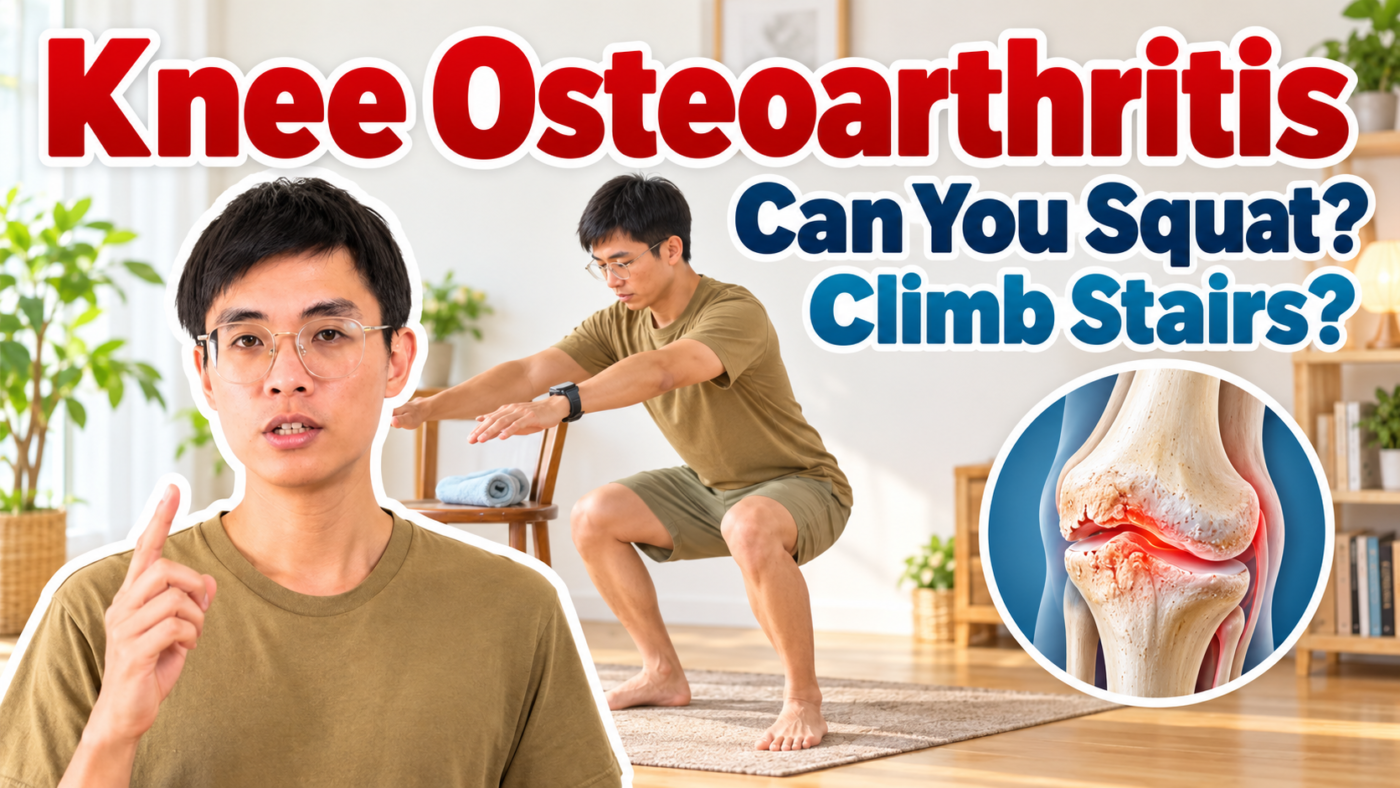
Squats for knee osteoarthritis can be confusing. Some people are told to avoid deep knee bending, while others are encouraged to strengthen their legs through progressive squat training.
The difference often comes down to your current symptoms, strength, activity level, and how well your knee tolerates and recovers from loading.
One healthcare professional may advise you to reduce squatting, kneeling, and stair climbing. Another may encourage you to strengthen your legs, practice squats, and gradually increase resistance.
So which approach is right?
The answer depends on the condition of your knee.
A knee that has suddenly become swollen and painful after an injury is very different from a knee with long-standing osteoarthritis, reduced strength, and limited activity.
Instead of asking, “Are squats bad for my knees?” a more useful question is:
“How much load can my knee tolerate right now, and how well does it recover afterward?”
For many people with stable knee osteoarthritis, appropriately modified exercise does not automatically damage the joint. Individualized exercise can help improve strength, physical function, mobility, and confidence.
The key is finding an appropriate starting point and progressing gradually.
Knee Loading Is Not Simply Good or Bad
Almost everything you do during the day places some load on your knees.
Walking, standing up from a chair, climbing stairs, carrying groceries, and squatting all require your knees to manage force.
That does not mean these activities are inherently harmful.
The same activity can be manageable for one person and excessive for another.
Walking up one flight of stairs is very different from climbing twenty floors.
Completing eight controlled chair squats is very different from suddenly doing one hundred deep squats.
Taking a short walk is very different from going on a long mountain hike after months of inactivity.
What matters is the total dose of activity.
Important factors include:
- Exercise intensity
- Number of repetitions
- Exercise frequency
- Range of motion
- Movement speed
- External resistance
- Current muscle strength
- Previous activity level
- Existing knee irritation
- Sleep and recovery
- Response the following day
This is why it is often too simplistic to label a movement as either completely safe or completely dangerous.
Understanding Your Current Knee Capacity
A useful rehabilitation concept is the idea that every joint has a current range of loading that it can tolerate and recover from.
You can think of this as your present exercise capacity.
Walking, squatting, stair climbing, and resistance training all use some of that capacity.
More repetitions, heavier resistance, deeper knee bending, and higher frequency generally increase the challenge.
Recovery allows your body to prepare for future activity.
However, your capacity is not permanently fixed.
The human body can adapt.
With appropriately progressed exercise, the quadriceps, glutes, calves, hips, and other supporting muscles can become stronger. Balance and movement control can improve. Activities that once felt difficult may gradually become easier.
The opposite can also happen.
If knee pain causes someone to avoid using their legs for months or years, strength and endurance may decline. Normal activities such as standing from a chair or climbing stairs may then become increasingly difficult.
For chronic knee problems, complete long-term avoidance is therefore not always the best strategy.
When You Should Seek an Assessment Before Exercising
Exercise should not be used to push through every type of knee pain.
Medical assessment may be appropriate if you experience:
- Severe pain following a fall, twist, or other injury
- Rapid or substantial swelling
- Significant redness or heat around the joint
- Inability to bear weight
- A knee that becomes locked
- Difficulty fully straightening the knee
- Major instability following an injury
- Rapidly worsening symptoms without an obvious explanation
An acutely injured knee should not be managed in the same way as stable, long-term osteoarthritis.
Chronic Knee Osteoarthritis Is Different
When knee symptoms have developed gradually and there are no warning signs of an acute injury, completely avoiding knee-loading activities simply because an X-ray shows osteoarthritis may unnecessarily reduce strength and physical capacity.
Therapeutic exercise is an important part of modern knee osteoarthritis management.
Programs commonly include strengthening, aerobic exercise, mobility work, and functional movement.
Some temporary discomfort can occur when someone begins exercising, particularly after a long period of inactivity.
This does not mean that all pain should be ignored.
It means the exercise should be adjusted to the individual.
Myth 1: Cartilage Is Like a Car Tire
A common belief is that cartilage behaves like a tire and becomes increasingly worn every time the knee is used.
The comparison is incomplete.
A tire is an inanimate object. The human body is biologically active and capable of adaptation.
Exercise does not mean forcing the knee through heavy or painful movements.
It also does not mean that exercise can restore severely damaged cartilage to a completely new condition.
The more realistic goal is to improve the strength and function of the entire system surrounding the knee.
Too little activity for too long can reduce physical capacity.
Too much activity too quickly can aggravate symptoms.
A progressive middle ground is often more useful.
Myth 2: An X-Ray Showing Osteoarthritis Means You Should Never Squat
Medical imaging can provide important information, but an X-ray does not tell the entire story.
Structural changes seen on imaging do not always correspond perfectly with pain and physical function.
Some people have substantial osteoarthritic changes yet remain active and functional.
Others may have relatively modest imaging changes but experience considerable discomfort.
Exercise decisions should therefore consider:
- Current swelling
- Pain pattern
- Range of motion
- Leg strength
- Hip strength
- Balance
- Movement control
- Daily function
- Recovery after exercise
An image is only one part of the overall assessment.
Myth 3: Your Knees Must Never Go Past Your Toes
Forward movement of the knees is a normal part of many everyday activities.
It occurs when you:
- Stand from a low chair
- Climb stairs
- Squat toward the floor
- Walk uphill
- Lower yourself onto a seat
Greater knee bending can increase forces around the joint, but greater load does not automatically mean injury.
The important question is whether the amount of loading is appropriate for your current capacity.
If a squat is uncomfortable, you can modify it instead of abandoning the movement completely.
Useful modifications include:
- Holding a stable support
- Using a higher chair
- Reducing squat depth
- Moving more slowly
- Performing fewer repetitions
- Using less resistance
- Resting longer between sets
Squatting can be adapted to many different ability levels.
A 5-Level Squat Progression for Sensitive Knees
The following progression begins with highly supported movements and gradually moves toward an unsupported bodyweight squat.
You do not need to complete every level.
Start with the easiest version that feels stable and manageable.
Use a sturdy, non-slip chair whenever appropriate.
Level 1: Assisted Shallow Squat
Stand behind a sturdy chair or beside a stable countertop.
Hold the support with both hands.
Place your feet in a comfortable position, approximately hip-width to shoulder-width apart.
Allow the toes to point slightly outward if that feels natural.
Move your hips slightly backward while gently bending your knees.
Only descend a short distance.
Pause briefly.
Press through your feet and return to standing.
Starting volume:
8 to 10 repetitions
1 to 2 sets
You should feel the muscles in your thighs and hips working.
There is no need to force yourself into a deep squat.
Level 2: High Chair Sit-to-Stand
Choose a firm chair with a relatively high seat.
Place your feet comfortably on the floor.
Slowly lower yourself until seated.
Lean your upper body slightly forward.
Press through your feet and stand back up.
If necessary, use your hands on your thighs or another stable support.
Starting volume:
8 to 10 repetitions
1 to 2 sets
As the exercise becomes easier, gradually reduce your reliance on your hands.
Level 3: Standard Chair Sit-to-Stand
Use a normal-height chair.
Slowly sit down under control.
Then stand back up.
Keep your feet firmly planted.
Allow your knees to move naturally in approximately the same direction as your toes.
Try to distribute your weight evenly between both legs.
Target:
8 to 12 controlled repetitions
If you can perform the exercise comfortably and recover well afterward, you may be ready to progress.
Level 4: Chair-Touch Squat
Stand immediately in front of a chair.
Slowly lower yourself toward the seat.
Take approximately three seconds during the lowering phase.
Lightly touch the chair with your hips.
Do not fully sit down.
Press through your feet and return to standing.
Target:
8 to 12 repetitions
2 to 3 sets
The chair provides a clear depth target and additional confidence without supporting your full body weight.
Level 5: Bodyweight Squat
Stand without a chair.
Squat only as deeply as you can comfortably control.
Keep your feet firmly on the floor.
Allow your knees to track naturally in the direction of your toes.
Return to standing.
Starting target:
8 to 12 repetitions
If this becomes easy and your knees recover well, progression may include:
- Slightly increasing squat depth
- Adding a light resistance
- Increasing repetitions
- Adding another set
Change only one variable at a time.
Gradual progression is usually more manageable than increasing weight, depth, and volume simultaneously.
How Often Should You Practice Squats?
For many beginners, a reasonable starting schedule may be approximately two strength sessions per week.
A session might include one to three sets of an appropriate squat variation.
However, the ideal amount varies according to:
- Age
- Health status
- Current symptoms
- Training experience
- Strength
- Recovery ability
- Other physical activity
Your response after the workout is just as important as the workout itself.
Why Going Up and Down Stairs Feel Different
People often describe knee pain simply as “pain on stairs,” but ascending and descending stairs place different demands on the muscles.
Going upstairs requires the legs to generate force and lift the body.
Going downstairs requires the quadriceps and other muscles to control the body while lowering it.
This is one reason the two movements can be practiced separately.
Exercise 1: Low Step-Up
Use a low, secure step.
Stand near a railing or another stable support.
Place one entire foot on the step.
Shift your weight toward that leg.
Press through the foot and raise your body onto the step.
Return to the starting position under control.
Start with:
6 to 8 repetitions per side
1 to 2 sets
As your control and strength improve, gradually progress toward:
8 to 12 repetitions
2 to 3 sets
Later progressions may include:
- A slightly higher step
- Less use of the railing
- A light external resistance
Progress gradually.
Exercise 2: Controlled Step-Down
Stand on a low step while holding a railing or stable support.
Place most of your weight on the supporting leg.
Slowly bend that knee while lowering the opposite foot toward the floor.
Take approximately three seconds during the lowering phase.
Lightly touch the floor with the free foot.
Return to the starting position.
The objective is control rather than maximum depth.
Avoid suddenly dropping downward or allowing the working leg to lose control.
Start with:
6 to 8 repetitions per side
1 to 2 sets
If this feels difficult, reduce the step height or shorten the range of motion.
Gradually increase the depth as your control improves.
How to Know When to Stop, Modify, or Progress
Rather than following a rigid rule, consider three different situations.
Stop and Seek Professional Assessment
Stop the exercise and seek appropriate medical advice if you experience:
- Sudden severe pain following trauma
- Rapidly increasing swelling
- Significant heat or redness
- Inability to put weight through the leg
- Mechanical locking
- Inability to straighten the knee
- Severe instability
- Rapidly worsening symptoms
These symptoms are not appropriate for trial-and-error online exercise progression.
Modify the Exercise
Mild discomfort does not always mean that all activity must stop.
If an exercise feels more difficult than expected, try modifying:
- Depth
- Resistance
- Repetitions
- Speed
- Range of motion
- External support
The movement should remain controlled.
There is no single pain score that is appropriate for every person.
Your overall symptom pattern and recovery are more important.
Progress When Recovery Is Good
Pay attention to how your knee feels later that day and the following day.
Consider whether:
- Swelling has increased
- You are limping
- Normal walking has become more difficult
- Your usual knee discomfort has substantially increased
- Sleep has been disrupted
- Everyday activities are noticeably harder
If symptoms remain manageable and return close to your usual baseline, the exercise dose may be appropriate.
This information can guide future progression.
Why the Next Day Matters
A workout does not need to feel completely effortless to be useful.
At the same time, exercise should not repeatedly leave your knee substantially worse.
Treat each training session as useful feedback.
Perform a manageable amount.
Observe your response.
Allow recovery.
Then decide whether the next session should involve the same amount, slightly less, or slightly more.
This approach is usually more sensible than suddenly performing a demanding routine because someone online promised that one exercise could fix knee pain.
How to Progress Gradually
Suppose you can comfortably complete two sets of ten chair-touch squats.
A simple progression could look like this:
Week 1
2 sets of 10 repetitions
Week 2
2 sets of 12 repetitions
Week 3
3 sets of 10 repetitions
Week 4
2 sets of 10 repetitions with a slightly greater range of motion
This is only an example.
Some people may progress more quickly.
Others may need several weeks at the same level.
The appropriate pace is individual.
Knee Health Is About More Than Cartilage
It is easy to focus exclusively on cartilage when discussing osteoarthritis.
But everyday function depends on a much larger system.
Appropriate exercise can improve:
- Quadriceps strength
- Glute strength
- Calf strength
- Hip control
- Balance
- Coordination
- Movement confidence
- General physical capacity
Improving these areas can make everyday tasks easier even when structural osteoarthritis remains present.
The goal is not necessarily to make an X-ray look normal.
The more meaningful goal is to improve your ability to walk, stand, squat, climb stairs, and participate in everyday life.
Why Avoiding Movement for Too Long Can Backfire
Pain naturally makes people cautious.
But long-term inactivity may gradually reduce:
- Muscle strength
- Endurance
- Balance
- Confidence
- Joint tolerance
- General fitness
As physical capacity declines, ordinary activities can begin to feel more demanding.
Gradually reintroducing appropriate movement can help rebuild that capacity.
The purpose is not to ignore pain.
The purpose is to exercise without repeatedly overwhelming the knee.
Can Exercise Reverse Knee Osteoarthritis?
Exercise should not be presented as a way to completely restore severely degenerated cartilage.
That would be unrealistic.
Its main benefits are different.
Appropriately individualized exercise can help improve:
- Muscle strength
- Physical function
- Walking ability
- Movement confidence
- Pain management
- General health
- Independence
Exercise is also not a replacement for medication, injections, surgery, or other medical treatments when those treatments are clinically necessary.
It is one important part of comprehensive knee care.
The Bigger Goal Is Everyday Independence
Squatting matters because it is part of ordinary life.
You use a squat-like movement when you:
- Sit down
- Stand from a toilet
- Get up from a chair
- Pick something up
- Work in the garden
- Reach toward the floor
- Play with children or grandchildren
The same is true of stair training.
You are not simply practicing gym exercises.
You are practicing the physical abilities that help maintain independence.
The goal is neither to avoid all loading nor to push through every painful sensation.
A more practical principle is simple:
Find a level your knee can tolerate today, recover well, and build gradually from there.
Frequently Asked Questions
Is Squatting Bad for Knee Osteoarthritis?
Not necessarily.
Squatting increases knee loading, but the movement can be modified by changing the depth, support, repetitions, speed, and resistance.
For many people with stable knee osteoarthritis, appropriately prescribed strengthening exercise can be part of effective management.
Can I Squat if My X-Ray Shows Cartilage Loss?
An X-ray alone does not determine which exercises you can perform.
Symptoms, swelling, strength, range of motion, balance, medical history, and response to exercise all matter.
Significant or unusual symptoms should be evaluated by a qualified healthcare professional.
Can My Knees Go Past My Toes During a Squat?
Yes, they can.
Forward knee movement occurs naturally during many normal activities, including standing from low chairs and climbing stairs.
Rather than following an absolute rule, use a range of motion that feels controlled and appropriate for your current ability.
What Is the Easiest Squat for Sensitive Knees?
An assisted shallow squat or high-chair sit-to-stand is often a practical starting point because both the range of motion and loading can be easily adjusted.
How Many Squats Should Beginners Do?
A conservative starting point may be approximately 8 to 10 controlled repetitions for 1 to 2 sets using an appropriate variation.
Individual requirements vary considerably.
Is Some Discomfort During Knee Exercise Normal?
Some people with osteoarthritis experience temporary discomfort when starting exercise.
Mild symptoms do not necessarily mean the joint is being damaged.
However, worsening pain, increasing swelling, altered walking, or poor recovery are reasons to reduce the workload and consider professional assessment.
Should I Exercise Every Day With Knee Osteoarthritis?
Regular physical activity can be helpful, but harder strengthening sessions do not necessarily need to be performed every day.
Recovery is part of training.
Many beginners can start strength training a few times per week and adjust according to their response.
Can Exercise Rebuild Damaged Knee Cartilage?
Exercise should not be expected to restore severely degenerated cartilage to a completely new state.
Its better-established benefits involve strength, pain management, physical function, mobility, and general health.
Final Takeaway
Knee osteoarthritis does not automatically mean that squatting, stair climbing, and strength training must disappear from your life.
Exercise also should not become a test of how much pain you can tolerate.
The better approach is gradual, individualized loading.
Start with a movement your knee can manage.
Observe your response.
Allow adequate recovery.
Progress slowly.
Over time, stronger legs and improved physical capacity may make many everyday activities easier.
The goal is not to protect your knees from every possible load.
The goal is to help your body become better prepared for the demands of everyday life.
Medical Disclaimer
This article is for educational purposes only and is not intended to provide medical advice, diagnosis, or treatment. Knee pain can have many causes, and exercise recommendations should be individualized. Seek professional medical evaluation for severe or rapidly worsening pain, significant swelling, redness or heat, inability to bear weight, joint locking, major instability, recent significant trauma, or other concerning symptoms.
This article is for general education and does not replace individualized care from a qualified health professional. Seek appropriate advice for persistent, severe, or concerning symptoms.
Read the full medical disclaimer