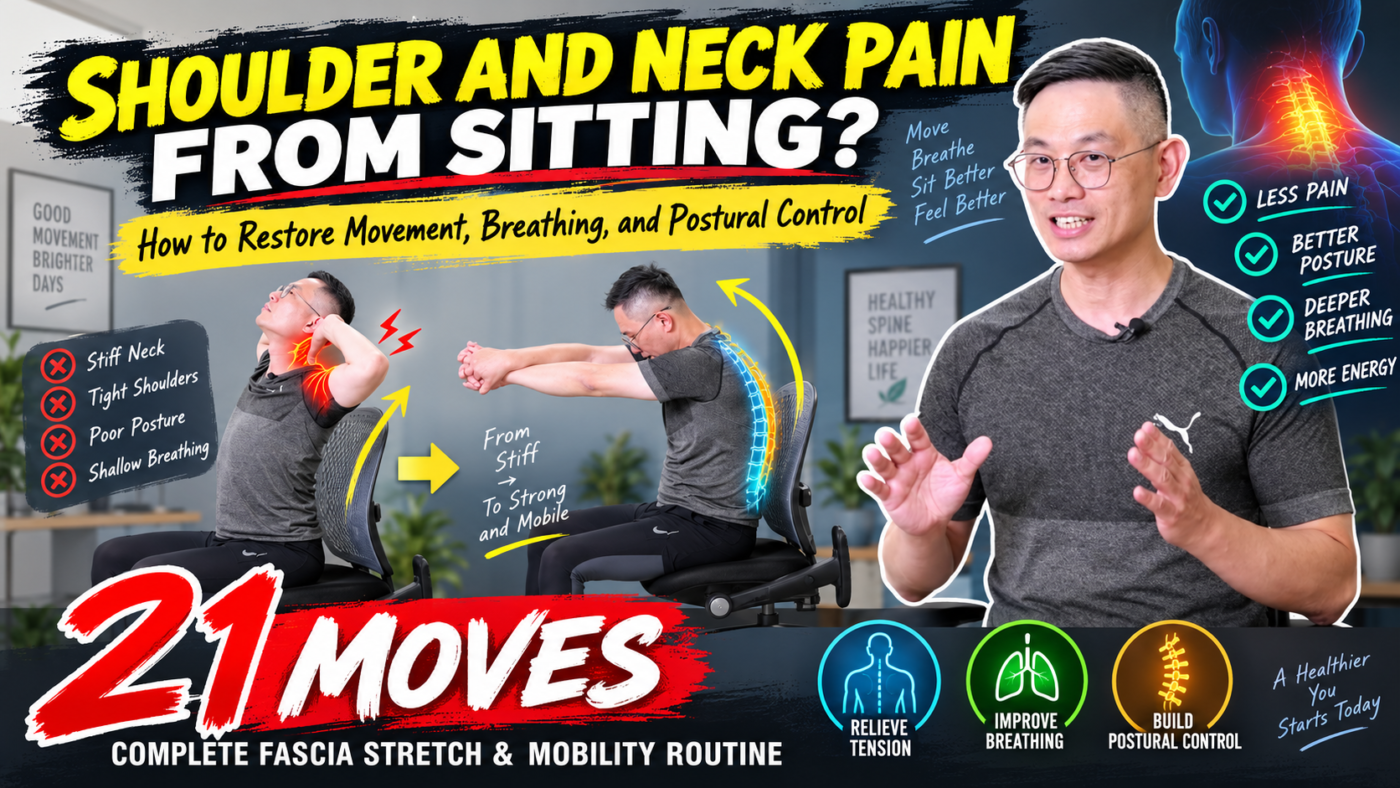
Shoulder and neck pain from sitting is extremely common among desk workers, especially after hours of computer work with limited movement.If your shoulders and neck feel tight after a long day at a desk, you may already suspect that posture has something to do with it.
Perhaps your shoulders gradually roll forward. Your upper back rounds. Your head drifts toward the screen. You straighten yourself for a few minutes, only to discover that your body soon returns to the same position.
It is easy to conclude that you are simply too weak.
So you strengthen your core, train your back, work harder in the gym, and repeatedly remind yourself to “sit up straight.”
Strengthening can certainly be useful, but the problem is often more complicated than a lack of strength.
Hours of relatively static sitting can change how your hips, rib cage, shoulders, neck, muscles, connective tissues, and nervous system are being used. Some areas remain shortened for long periods, others remain lengthened, and many joints simply stop moving through the variety of positions they normally experience during an active day.
The result may be stiffness, fatigue, reduced movement confidence, and uncomfortable muscle tension.
Instead of trying to force your body into one supposedly perfect posture, a more useful strategy is to restore movement variability, breathing, mobility, strength, and active control.
That is what this chair-based routine is designed to do.
The Real Problem Is Not Simply “Bad Posture”
Rounded shoulders, a forward head position, and increased upper-back rounding are commonly discussed as causes of neck and shoulder pain.
The relationship is not that simple.
Posture can influence how forces are distributed through the body, but there is no single perfect posture that everyone must maintain throughout the day.
People can have noticeable forward-head posture without pain, while someone who appears to have excellent posture may still experience significant neck or shoulder symptoms.
What often matters more is the combination of prolonged static positioning, insufficient movement, repetitive work, physical capacity, stress, sleep, previous injury, and individual sensitivity.
The important question is therefore not:
“How can I hold perfect posture all day?”
A better question is:
“How can I give my body enough movement, variation, strength, and recovery that sitting no longer dominates my entire day?”
What Prolonged Sitting Does to the Body
When you sit at a computer for a long time, several predictable things often happen.
The hips remain flexed.
The pelvis may gradually roll backward.
The upper back may become more rounded.
The shoulders may drift forward.
The head may move toward the screen.
The ribs may move less freely.
Instead of changing positions frequently, the body remains within a narrow range for hours.
This does not mean your muscles or fascia become permanently “stuck” after a few hours at a desk.
But biological tissues respond to repeated loading, and the nervous system becomes familiar with frequently used movement patterns.
A posture that you repeat for eight hours a day can therefore begin to feel normal simply because it is familiar.
That is why correcting posture through willpower alone rarely works for long.
Your body needs movement, not constant self-policing.
Understanding the Fascia and “Tension Network” Idea
Fascia is connective tissue that surrounds and interacts with muscles, nerves, blood vessels, organs, and other structures throughout the body.
Because connective tissues form continuous anatomical relationships, some movement systems describe the body as a tension network rather than a collection of completely independent muscles.
This can be a useful way to think about movement.
When your shoulder moves, the rest of the body does not become irrelevant. Your rib cage, spine, pelvis, breathing muscles, and nervous system all participate.
However, it is important not to turn the fascia concept into an explanation for every type of pain.
Shoulder or neck pain cannot usually be diagnosed simply as “fascial tension.”
Muscles, joints, nerves, tendons, workload, sleep, stress, physical activity, and many other factors can contribute.
The practical lesson is simpler:
Treat the body as an integrated movement system instead of repeatedly attacking one painful muscle.
What Is Upper Crossed Syndrome?
You may have heard the term “upper crossed syndrome.”
Traditionally, it describes a pattern that can include forward-head posture, rounded shoulders, increased thoracic kyphosis, relatively tight pectoral and upper-neck muscles, and reduced performance or endurance in muscles involved in deep-neck and scapular control.
The concept can be useful when planning exercise, but it should not be treated as a universal diagnosis.
Not everyone with rounded shoulders has the same muscular pattern.
And not everyone with that posture experiences pain.
Still, if you spend hours leaning toward a computer, restoring chest mobility, scapular movement, thoracic motion, neck control, and general strength can be worthwhile.
“Short and Tight” Versus “Long and Tense”
A particularly useful idea from the original upper-crossed model is that uncomfortable muscles are not always short.
Some muscles may feel tight because they have spent hours in a shortened position.
Others may feel equally tight while being held in a relatively lengthened position.
This explains why repeatedly stretching every muscle that feels tight does not always solve the problem.
A muscle can feel uncomfortable because it is overworked, under-recovered, sensitive, guarding, fatigued, or being asked to perform the same task for too long.
The answer is not always “stretch harder.”
Sometimes the answer is movement.
Sometimes it is strengthening.
Sometimes it is relaxation.
And often it is a combination of all three.
Why Massage Can Feel Great but the Tightness Returns
Massage, foam rolling, massage balls, and stretching can all make people feel better.
That benefit is real.
Massage can temporarily change pain sensitivity, muscle tone, local sensation, and range of motion. Gentle movement after massage may also feel easier.
But if you return immediately to another six hours in exactly the same working position, the symptoms may gradually return.
This does not mean massage “failed.”
It means a passive intervention cannot replace the active part of the solution.
If you want a more durable change, combine passive relief with movement, strength, adequate recovery, workplace variation, and regular breaks.
Passive Stretching Is Not the Enemy
Static stretching is often unfairly presented as outdated.
It is not.
Static stretching can improve flexibility and may feel very good.
The problem arises when stretching is treated as the only solution.
If you stretch your chest for 60 seconds and then spend the next four hours collapsed toward a laptop without moving, the exercise is being asked to overcome an enormous amount of repeated exposure.
A better approach is to combine static stretching with active mobility.
Instead of simply allowing another person or an object to pull your body into a position, you actively move into and out of the available range.
That makes the nervous system, muscles, joints, and coordination part of the exercise.
Active Versus Passive Mobility
Consider a simple neck movement.
If you throw your head backward as far as possible in an attempt to “stretch your neck,” you may simply compress sensitive structures at the back of the neck.
That is not the goal.
Instead, imagine becoming taller through the crown of your head.
Maintain that sense of length as you gently look upward only as far as comfortable.
The movement should feel spacious rather than jammed.
The same idea applies to your spine.
When rounding forward, do not simply collapse.
Imagine widening the upper back.
When opening the chest, do not aggressively arch the lower back.
Think about becoming taller and expanding through the rib cage.
We are not chasing the largest possible angle.
We are developing length with control.
The Role of the Nervous System
Muscle tension is influenced by the nervous system.
That is why movement quality can change when you slow down, breathe, feel safe, and deliberately control an exercise.
This does not mean you can literally “think fascia loose.”
It means that motor control, muscle activation, perceived threat, breathing, and attention can influence how movement feels.
This is one reason active mobility can be useful.
You are not merely being stretched.
You are practicing a movement.
What About Active Isolated Stretching?
Active Isolated Stretching, commonly abbreviated AIS, uses brief repeated stretches combined with active movement.
One concept associated with this style of training is reciprocal inhibition: activating muscles on one side of a joint may help reduce unnecessary activation in muscles performing the opposite action.
That principle has a physiological basis, although human movement is more complex than a simple on-off switch between opposing muscles.
You may encounter AIS instructions specifying extremely precise loads such as 0.5 kilograms or saying that every stretch must last less than two seconds.
Those numbers should not be treated as universal physiological laws.
For a home routine, a simpler rule works well:
Use light effort.
Move slowly.
Never force the end range.
Pause briefly.
Return.
Repeat several times.
Pain is not the goal.
Why Use a Chair?
A chair is more than something you sit on.
It can become an excellent low-load exercise platform.
A stable chair provides support.
It reduces balance demands.
It allows you to concentrate on breathing and movement.
It can make mobility work accessible to adults who are uncomfortable exercising on the floor.
This is particularly valuable for people over 40, older adults, office workers, and anyone rebuilding movement confidence.
The chair must be stable.
Avoid lightweight chairs that slide easily, unstable rolling chairs, or equipment that might tip when you lean against it.
Begin With Breathing
Before changing the shoulders or neck, begin with breathing.
Many people who sit for prolonged periods start using more movement through the upper chest and neck during breathing, particularly when stressed.
You do not have to force an enormous belly breath.
Instead, allow the lower ribs to expand gently.
Sit comfortably tall.
Let the shoulders relax.
Inhale slowly through the nose.
Imagine the lower rib cage expanding forward, sideways, and slightly backward.
Allow the abdomen to move naturally.
Then exhale without forcing.
Repeat three to five relaxed breaths.
You should not feel dizzy.
If you become light-headed, return to normal breathing.
Exercise 1: Seated Side-Rib Breathing
Sit toward one side of a stable chair.
Keep one side of the pelvis securely supported.
Reach the opposite arm toward the ceiling.
Imagine becoming taller rather than simply bending sideways.
Gently lengthen the side of the torso.
Do not collapse the opposite waist.
Maintain this position and breathe into the ribs on the lengthened side.
Take slow, relaxed breaths for approximately 20 to 30 seconds.
Return to the center.
Repeat on the opposite side.
The purpose is not extreme side bending.
The goal is to create space for rib-cage movement.
Exercise 2: Active Chest Opening
Sit tall with both feet supported.
Bring your arms forward as if you were hugging a large ball.
Allow the shoulder blades to move around the rib cage.
Inhale comfortably.
As you exhale, slowly open the arms outward.
Let the chest expand while keeping the lower back comfortable.
Do not squeeze the shoulder blades together as hard as possible.
Pause briefly.
Return to the hugging position.
Repeat approximately 6 to 10 times.
Use gentle effort.
Exercise 3: Active Upper-Back Expansion
Interlace your fingers in front of you.
Reach the hands forward.
Rather than collapsing the chest downward, imagine actively widening the area between the shoulder blades.
Allow the upper back to round slightly.
Keep the shoulders away from the ears.
Exhale as you reach.
Return slowly while inhaling.
Repeat approximately 6 to 10 times.
The sensation should be one of expansion across the upper back, not compression through the neck.
Exercise 4: Overhead Side Reach
Sit tall.
Reach both arms overhead if your shoulders allow it comfortably.
Hold one wrist lightly with the opposite hand.
Become taller through the spine.
Then gently lengthen toward one side.
Do not pull aggressively.
Return to the center and repeat.
Perform approximately 6 to 8 controlled repetitions.
Then switch sides.
If raising the arm produces shoulder pain, keep the arm lower.
Exercise 5: “Embrace the World”
This is one of the most useful movements in the routine because it combines upper-back flexion, chest opening, shoulder-blade movement, and breathing.
Sit toward the front half of the chair.
Bring your arms forward as though embracing a large ball.
Exhale.
Actively widen your upper back.
Allow the shoulder blades to move apart.
Then slowly open the arms.
Inhale.
Lift through the chest while keeping the neck long.
Do not throw your head backward.
Return to the embracing position.
Exhale and widen the back again.
Continue for approximately 6 to 10 repetitions.
Smooth movement is more important than range.
Exercise 6: Neck Lengthening With Upper-Back Movement
Sit tall.
Place your hands gently behind your head.
Do not pull on the neck.
Bring the elbows slightly forward as you widen the upper back.
Think of the crown of the head continuing to lengthen away from the pelvis.
Exhale.
Then open the elbows and chest gently.
Inhale.
Keep the neck long rather than sharply extending it.
Repeat approximately 6 to 8 times.
Exercise 7: Gentle Head Retraction
Forward-head posture is often addressed using a chin-tuck exercise.
The movement should be small.
Sit tall.
Keep your eyes looking straight ahead.
Move the head gently backward as though sliding it horizontally.
Do not look up.
Do not force the chin hard toward the chest.
Imagine the back of the skull moving upward at the same time.
Pause briefly.
Return.
Repeat approximately 8 to 10 times.
This should feel controlled and relatively easy.
Stop if it causes dizziness, headache, arm symptoms, or increasing neck pain.
Exercise 8: Controlled Neck Rotation
Sit tall.
Relax the shoulders.
Turn your head slowly toward the right within a comfortable range.
Return to the center.
Turn toward the left.
Do not force the chin toward the shoulder.
Perform approximately 6 to 8 repetitions in each direction.
For most people, active rotation alone is sufficient.
If you add self-massage, keep pressure gentle and limited to the muscular areas at the back of the neck.
Do not press deeply into the front or side of the neck.
A Note About Neck “Grinding,” Clicking, and Fascia
Some people hear clicks, pops, or rubbing sensations while moving the neck.
These sounds do not prove that hyaluronic acid has become unevenly distributed in the fascia.
Joint sounds can arise from several structures and are common even in healthy people.
Do not repeatedly rub or manipulate the neck simply to make noises disappear.
Seek professional evaluation if neck movement produces neurological symptoms, severe pain, progressive weakness, numbness, problems with coordination, unusual dizziness, or a new severe headache.
Exercise 9: Overhead Reach and Chest Opening
Sit upright.
Reach the arms upward as comfortably as possible.
Think about lengthening through the sides of the body.
Then open the arms outward while allowing the chest to expand.
Return slowly.
Repeat approximately 6 to 8 times.
Do not force the shoulders behind the body.
Exercise 10: Seated Forward Roll
Sit toward the front of the chair.
Reach upward gently.
Exhale.
Allow the head and upper back to round gradually.
Bring your torso toward your thighs only as far as comfortable.
You may lightly hold your knees.
Pause.
Then slowly rebuild your sitting position rather than snapping upright.
Inhale as you return.
Repeat approximately 3 to 6 times.
People with osteoporosis, recent spinal fractures, acute disc-related symptoms, or conditions for which spinal flexion has been restricted should obtain professional guidance before using deeper forward-bending exercises.
Exercise 11: Supported Thoracic Extension
Choose a chair with a stable backrest.
Sit securely.
Place your hands across your chest or behind the head without pulling on the neck.
Gently lean the upper back over the chair.
Think about opening the rib cage.
Do not aggressively hyperextend the lower back or neck.
Take several comfortable breaths.
Return slowly.
A small range may be enough.
You do not need to slide off the chair or allow the feet to lose secure contact with the floor.
Safety is more important than achieving the dramatic position shown in some mobility routines.
Exercise 12: Seated Side Stretch
Sit securely near one side of the chair.
Keep the pelvis supported.
Reach the opposite arm overhead.
Lengthen upward first.
Then lean gently to the side.
Breathe into the open side of the rib cage.
Hold approximately 20 to 30 seconds.
Return gradually.
Repeat on the other side.
If you want a more dynamic variation, move the arm through a slow arc while keeping the movement controlled.
Exercise 13: Chair-Supported Hip-Flexor Mobility
Long periods of sitting keep the hips flexed for much of the day.
Stand beside a stable chair or use it for support.
Place one leg behind you in a split stance.
Keep the torso tall.
Gently squeeze the glute on the back-leg side.
Allow the pelvis to move forward slightly until you feel a mild stretch through the front of the hip.
Return.
Repeat approximately 6 to 8 times.
Then hold a comfortable stretch for 20 to 30 seconds.
Do not force the lower back into a large arch.
Repeat on the other side.
Exercise 14: Seated Figure-Four Hip Mobility
Sit upright.
Place one ankle across the opposite thigh if your knee and hip allow it.
Keep the foot gently flexed.
Do not push forcefully on the knee.
Sit tall.
If you need more stretch, lean slightly forward from the hips while maintaining a comfortable spine.
Hold for approximately 20 to 30 seconds.
Return and change sides.
Stop if you feel knee pain.
Exercise 15: Seated Heel Raises
After mobility work, add a little muscular activity.
Sit tall with both feet on the floor.
Raise the heels while keeping the front of the feet in contact with the floor.
Lower slowly.
Repeat approximately 12 times.
Rest.
Perform two or three rounds if comfortable.
The calf muscles contribute to venous return from the legs, which is one reason frequent lower-leg movement is useful during long periods of sitting.
But a heel raise should not be advertised as a treatment for circulation disorders.
Exercise 16: Seated Marching
Adjust your position so the hips are comfortable and the feet are supported.
Sit tall.
Place your hands lightly on your hips.
Lift one foot several centimeters from the floor.
Keep the pelvis relatively level.
Lower gently.
Switch sides.
Perform approximately 10 to 12 alternating repetitions.
Move slowly enough that your trunk has to remain controlled.
This introduces a small amount of hip-flexor and trunk work without requiring you to get on the floor.
Exercise 17: Standing March With Heel Raise
Stand behind the chair and hold it lightly for balance.
Raise one heel and lift the opposite leg slightly if comfortable.
Lower slowly.
Alternate sides.
Perform approximately 10 to 12 repetitions.
The purpose is to restore movement after sitting while introducing a small balance challenge.
Do not perform the exercise without support if balance is uncertain.
Exercise 18: Chair-Supported Full-Body Lengthening
Stand behind a stable chair.
Place both hands on the backrest.
Walk backward until your arms are comfortably extended.
Soften the knees.
Send the hips backward.
Allow the torso to move toward a position roughly parallel with the floor only if comfortable.
Think of the spine becoming long rather than forcing the shoulders downward.
Hold for approximately 20 to 30 seconds.
You can then gently bend one knee and straighten the other, alternating sides.
This creates movement through the hips, calves, hamstrings, shoulders, and back.
To finish, walk toward the chair before standing upright.
Do not suddenly release the chair from a deeply bent position.
Dynamic Stretching and Static Stretching Can Work Together
There is no need to choose sides.
Dynamic mobility has advantages.
Static stretching has advantages.
Strength training has advantages.
Massage may also provide short-term relief.
The most useful program often combines them.
For example, you might first perform several controlled active repetitions, then finish with a comfortable static stretch.
What matters is how your body responds.
The goal is not to prove that one method is superior in every situation.
How Hard Should You Stretch?
Forget the idea that an effective stretch has to hurt.
Use a mild-to-moderate sensation.
You should be able to breathe normally.
Your face, jaw, shoulders, and hands should remain relaxed.
Never bounce aggressively into painful ranges.
When using dynamic repetitions, move to a comfortable endpoint, pause briefly, and return.
Six to ten repetitions is a reasonable starting range for many of these movements.
There is no magical number.
You Do Not Need to Hold Every Stretch for One Minute
Some stretches can be held for 20 to 30 seconds.
Others may feel comfortable for longer.
Dynamic mobility uses shorter repeated exposures.
Different approaches can improve range of motion.
The exact duration should depend on the goal, exercise, comfort, and individual response rather than one universal rule.
Breathing Should Remain Natural
Breathing is part of this routine, but you do not need a complicated formula.
A longer exhalation may feel relaxing.
For example, you might inhale for three to four seconds and exhale for four to six seconds.
There is no requirement that everybody must inhale for four seconds and exhale for eight.
If controlled breathing makes you dizzy or uncomfortable, return to normal breathing.
How Often Should Desk Workers Move?
The most important intervention may be the simplest one:
Do not remain completely still for hours.
You do not need to perform this entire routine every 40 minutes.
Instead, build movement into the working day.
Stand up.
Walk.
Reach overhead.
Move the shoulders.
Rotate gently.
Perform a few heel raises.
Change your sitting position.
Work standing for a while if that is comfortable.
Then sit again.
A two- or three-minute movement break repeated throughout the day may be more realistic than relying on one large corrective workout at night.
A Simple Five-Minute Desk Reset
If you do not have time for the entire routine, choose five movements.
Begin with several relaxed breaths.
Perform Embrace the World for 6 repetitions.
Perform gentle head retractions for 8 repetitions.
Perform overhead side reaches on both sides.
Perform 12 seated heel raises.
Stand and use the chair-supported full-body lengthening position for 20 to 30 seconds.
Then walk for one or two minutes.
That is enough to interrupt a long period of sitting.
A Longer 15-Minute Routine
When you have more time, combine the exercises into a fuller session.
Start with breathing and rib-cage mobility.
Move into chest opening and upper-back expansion.
Add neck retraction and rotation.
Perform side-body mobility.
Mobilize the hips.
Finish with heel raises, marching, and the chair-supported whole-body stretch.
You do not have to perform every exercise every day.
Choose the movements that make your body feel more capable afterward.
The Goal Is Not Perfect Posture
After finishing this routine, you may notice that standing taller feels easier.
Your shoulders may feel less guarded.
Your breathing may feel freer.
Your head may naturally rest in a different position.
That is useful.
But do not immediately turn the new position into another rigid posture you must maintain.
The best posture is often the next posture.
Sit upright for a while.
Relax.
Stand.
Walk.
Lean back.
Change position.
Move again.
Healthy bodies are designed to tolerate many positions.
Strength Training Still Matters
It would be misleading to say that chronic shoulder or neck discomfort from desk work is never a strength problem.
Strength and muscular endurance can matter.
Exercises for the upper back, shoulders, neck, trunk, and hips may improve physical capacity and make daily activities easier to tolerate.
The more complete approach is therefore not:
Mobility instead of strength.
It is:
Mobility plus strength plus movement variation plus recovery.
That combination is much more useful than chasing one explanation for every symptom.
When Shoulder or Neck Pain Needs Medical Evaluation
A mobility routine is appropriate for ordinary stiffness and mild musculoskeletal discomfort, but not every neck or shoulder symptom should be self-treated.
Seek professional medical evaluation if pain follows significant trauma, becomes severe or progressively worse, wakes you consistently at night, or is accompanied by unexplained fever or weight loss.
Prompt evaluation is also important if you develop progressive weakness, numbness, significant loss of coordination, difficulty walking, loss of hand dexterity, unusual dizziness, fainting, severe new headache, chest pain, shortness of breath, or symptoms spreading strongly into the arm.
Do not use exercise to delay appropriate diagnosis.
The Bigger Lesson
When your shoulders become uncomfortable after sitting, the answer is rarely to fight your body harder.
You do not necessarily need to force your shoulders backward.
You do not need to stretch until something gives.
You do not need to keep your core maximally tight.
And you do not need to fear every imperfect posture.
Give your body more movement.
Restore comfortable breathing.
Practice controlled mobility.
Build strength.
Change positions regularly.
Use the chair as a training tool instead of allowing it to become the position your body occupies for the entire day.
The body adapts to what it repeatedly does.
Fortunately, that principle works in both directions.
If prolonged sitting has become the dominant movement pattern of your day, small periods of intentional movement can begin restoring the variety your body has been missing.
Frequently Asked Questions
Can sitting all day cause shoulder and neck pain?
Long periods of relatively static sitting can contribute to neck and shoulder discomfort in some people, particularly when combined with repetitive computer work, limited movement, stress, poor recovery, or inadequate physical capacity. Sitting is not the only possible cause.
Does rounded-shoulder posture always cause pain?
No. Some people have rounded shoulders or forward-head posture without symptoms. Posture is only one factor among many that can influence musculoskeletal pain.
Is shoulder pain caused by fascia becoming tight?
Fascia may contribute to how tissues transmit force and how movement feels, but shoulder pain should not automatically be diagnosed as “tight fascia.” Muscles, tendons, joints, nerves, workload, stress, sleep, and other factors can also contribute.
Is stretching enough to fix rounded shoulders?
Stretching can improve flexibility, but a more complete program generally includes mobility, strengthening, movement variation, and changes in prolonged sitting habits.
Is dynamic stretching better than static stretching?
Neither method is universally superior. Dynamic mobility and static stretching can both be useful and can be combined in the same program.
What is Active Isolated Stretching?
Active Isolated Stretching is a style of repeated, relatively brief stretching that emphasizes active movement and controlled end-range exposure. Some of its proposed mechanisms are plausible, but highly specific claims about exact force, timing, or neurological responses should not be treated as universal rules.
How often should I take a break from sitting?
There is no single perfect interval for everyone. A practical approach is to change position and move regularly rather than remaining static for several hours at a time. Even brief movement breaks throughout the working day can be useful.
Can a chair really be used for exercise?
Yes. A stable chair can provide support for breathing exercises, spinal mobility, hip mobility, calf raises, marching, balance training, and gentle stretching.
Should I pull my shoulders back all day?
No. Holding the shoulder blades forcefully together all day simply creates another sustained posture. Aim for relaxed movement and frequent variation instead.
Are neck cracking and grinding sounds dangerous?
Many neck sounds occur without serious disease. However, sounds accompanied by significant pain, neurological symptoms, dizziness, weakness, or recent trauma deserve medical evaluation.
Medical Disclaimer
This article is intended for general educational and wellness purposes and does not provide medical diagnosis or individualized treatment. Neck, shoulder, back, and arm symptoms can have many causes. Consult a qualified healthcare professional if symptoms are persistent, severe, worsening, associated with trauma, or accompanied by weakness, numbness, loss of coordination, dizziness, severe headache, chest symptoms, or other concerning signs. Use a stable chair and stop any exercise that produces sharp pain, neurological symptoms, dizziness, or loss of balance.
This article is for general education and does not replace individualized care from a qualified health professional. Seek appropriate advice for persistent, severe, or concerning symptoms.
Read the full medical disclaimer