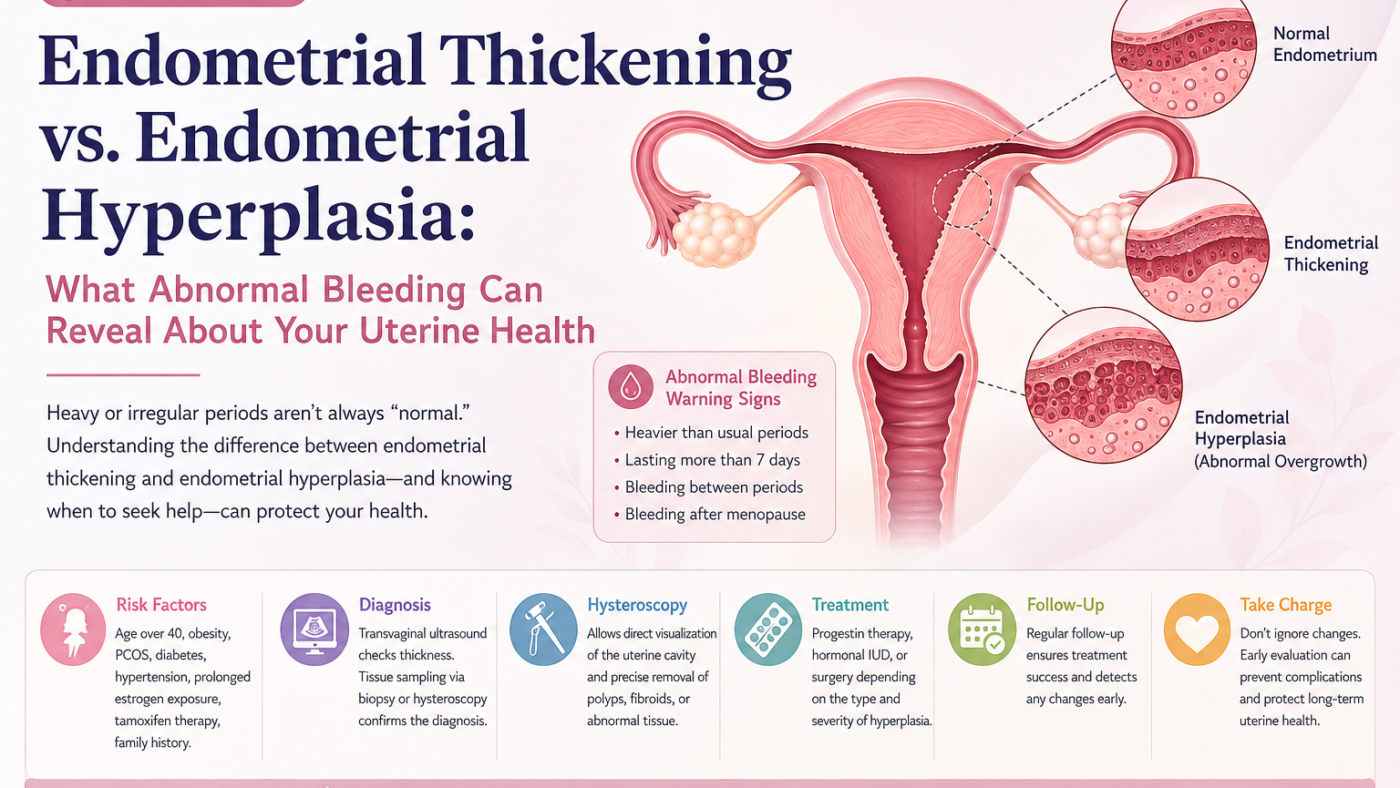
Heavy or unusual menstrual bleeding is easy to dismiss as “just a bad period.” But when bleeding suddenly becomes much heavier than usual, lasts longer than expected, causes exhaustion, or appears after menopause, it may be a sign that the uterine lining deserves closer evaluation.
One important distinction is often misunderstood: a thickened endometrium seen on ultrasound is not the same thing as endometrial hyperplasia.
The endometrium naturally becomes thicker and thinner throughout the menstrual cycle. Endometrial hyperplasia, by contrast, refers to abnormal overgrowth of the endometrial glands and is a pathological diagnosis that generally requires tissue examination.
Understanding that difference can prevent unnecessary anxiety while also helping women recognize when abnormal bleeding should not be ignored.
Endometrial Thickening and Endometrial Hyperplasia Are Not the Same Thing
The endometrium is the tissue lining the inside of the uterus.
Its thickness changes normally during the menstrual cycle. Shortly after menstruation, the lining is relatively thin. As estrogen rises, the endometrium gradually thickens in preparation for a possible pregnancy. After ovulation, progesterone changes the structure of the endometrium and prepares it for implantation.
Because of these normal hormonal changes, an ultrasound measurement showing a “thick” endometrium does not automatically mean disease.
The meaning of endometrial thickness depends on several factors, including:
- Age
- Menstrual-cycle timing
- Whether a woman is premenopausal or postmenopausal
- Bleeding symptoms
- Hormone exposure
- Other medical risk factors
If ultrasound shows an apparently thickened lining at a time when the endometrium would normally be expected to be thick, the finding may be physiological.
For some premenopausal women, repeating the ultrasound after menstruation can provide a clearer picture. If the endometrium becomes appropriately thin after the period, that can be reassuring.
Endometrial hyperplasia is different. It refers to abnormal proliferation of endometrial tissue and is usually confirmed by examining a tissue sample under a microscope.
Why Abnormal Bleeding Matters
One of the most important symptoms associated with endometrial abnormalities is abnormal uterine bleeding.
A woman may previously have had predictable menstrual cycles and then suddenly notice that her bleeding has become dramatically heavier.
Heavy bleeding does not always cause severe pain.
Conditions such as endometrial polyps, fibroids and endometrial hyperplasia may present primarily with increased bleeding rather than pain.
This is an important point because some women assume that a serious gynecological problem must hurt.
That is not always true.
When Is Menstrual Bleeding Considered Excessive?
There is considerable variation in what constitutes a normal period.
For many women, menstrual bleeding lasts roughly three to seven days. Some naturally have shorter periods, while others bleed somewhat longer.
Rather than focusing only on an exact number, it is often useful to compare the current pattern with a woman’s usual cycle.
Warning signs include:
- A sudden increase in menstrual flow
- Bleeding that repeatedly lasts longer than usual
- Needing to change pads or tampons very frequently
- Bleeding through nighttime protection
- Passing unusually large clots
- Needing multiple forms of protection at once
- Bleeding severe enough to interfere with sleep or normal activities
- Fatigue, weakness or dizziness
- Evidence of anemia
When blood loss becomes severe enough to produce anemia, it clearly deserves medical evaluation.
Heavy Bleeding Can Lead to Anemia
Chronic menstrual blood loss can gradually deplete the body’s iron stores.
Possible symptoms of iron-deficiency anemia include:
- Persistent fatigue
- Weakness
- Shortness of breath with exertion
- Dizziness
- Headaches
- Palpitations
- Pale skin
Some women adapt to chronic blood loss so gradually that they do not recognize how exhausted they have become.
A blood count and iron studies may therefore be appropriate when menstrual bleeding is persistently heavy.
Heavy Bleeding Does Not Automatically Mean Endometrial Hyperplasia
Endometrial hyperplasia is only one possible explanation.
Other causes of abnormal uterine bleeding may include:
Endometrial Polyps
Polyps are localized growths arising from the uterine lining. They can contribute to heavy periods, bleeding between periods or irregular bleeding.
Uterine Fibroids
Fibroids are benign muscular tumors of the uterus. Depending on their location and size, they may cause very heavy menstrual bleeding.
Adenomyosis
Adenomyosis occurs when endometrial-type tissue is found within the muscular wall of the uterus.
It is often associated with both heavy bleeding and painful periods.
Endometriosis
Endometriosis occurs when tissue resembling endometrium grows outside the uterine cavity.
It is different from endometrial hyperplasia and is much more strongly associated with pelvic pain.
The similar terminology can make these disorders confusing, but they are distinct conditions.
Why Hormones Matter
Endometrial growth is strongly influenced by estrogen and progesterone.
Estrogen stimulates growth of the uterine lining.
After ovulation, progesterone helps transform and stabilize that lining.
Problems can develop when the endometrium is repeatedly exposed to estrogen without enough opposing progesterone.
This is sometimes called unopposed estrogen exposure.
Over time, prolonged stimulation can increase the likelihood of endometrial hyperplasia.
Irregular or Absent Periods Should Not Always Be Ignored
Some younger women view infrequent menstruation as convenient.
But very irregular or absent periods can sometimes indicate that ovulation is not occurring regularly.
Without regular ovulation, progesterone exposure may also be inadequate, while estrogen continues stimulating the uterine lining.
Over long periods, this can increase the risk of endometrial overgrowth.
This does not mean that every missed period is dangerous. Pregnancy, stress, weight changes, intense exercise and many other conditions can alter menstrual cycles.
But persistent menstrual irregularity deserves investigation.
PCOS, Obesity and Endometrial Risk
Polycystic ovary syndrome, or PCOS, is one important cause of chronic irregular ovulation.
Women with PCOS may go long periods without menstruating.
Obesity can further increase endometrial stimulation because adipose tissue participates in estrogen metabolism.
For this reason, women with obesity, chronic anovulation or PCOS may have an increased risk of endometrial hyperplasia.
Maintaining a healthy weight and managing irregular cycles are therefore important parts of long-term uterine health.
Diabetes and High Blood Pressure
The discussion also identified diabetes and hypertension as conditions frequently seen alongside higher endometrial risk.
These conditions often cluster with obesity and metabolic dysfunction.
They do not mean that a woman will develop endometrial cancer, but they can form part of the overall risk profile clinicians consider when evaluating abnormal uterine bleeding.
Tamoxifen and the Endometrium
Tamoxifen is commonly used in the treatment of hormone-receptor-positive breast cancer.
Although it blocks estrogen activity in breast tissue, it can have estrogen-like effects on the endometrium.
Women taking tamoxifen may develop endometrial thickening, polyps or other uterine changes.
This does not mean that every woman using tamoxifen requires the same ultrasound schedule. The appropriate surveillance strategy depends on symptoms, menopausal status and the treating medical team.
However, unexpected uterine bleeding while taking tamoxifen should be discussed with a physician.
What About Menopause?
Menopause does not eliminate the need to think about the endometrium.
Before menopause, endometrial thickness varies greatly depending on the menstrual cycle.
After menopause, the situation changes because the endometrium is normally much less hormonally active.
This makes postmenopausal bleeding particularly important.
Any new vaginal bleeding after menopause should be medically evaluated rather than assumed to be harmless.
Ultrasound may be used to assess the uterine lining, but depending on the findings and clinical history, tissue sampling or hysteroscopy may also be required.
How Endometrial Hyperplasia Is Diagnosed
Ultrasound can identify thickening, but it cannot always determine exactly what the tissue represents.
A definitive diagnosis may require endometrial tissue.
Possible approaches include:
- Endometrial biopsy
- Dilation and curettage
- Hysteroscopy-directed biopsy
- Hysteroscopic removal of a focal lesion
Pathologists then examine the tissue under a microscope.
The goal is to determine whether the abnormality is benign, hyperplastic, atypical or malignant.
Why Hysteroscopy Changed Diagnosis and Treatment
Before hysteroscopy became widely available, dilation and curettage was commonly used to remove and sample endometrial tissue.
The limitation is that traditional curettage is performed without directly visualizing every part of the uterine cavity.
A focal lesion such as a polyp may therefore be missed or incompletely removed.
Hysteroscopy allows a physician to insert a small camera through the cervix and directly visualize the uterine cavity.
Suspicious areas can then be targeted more precisely.
This is particularly useful for polyps, submucosal fibroids and focal endometrial abnormalities.
“Hot” and “Cold” Hysteroscopic Techniques
The source discussion used the terms “hot knife” and “cold knife” to describe two broad hysteroscopic approaches.
A thermal technique uses electrical energy to cut or coagulate tissue.
A mechanical technique removes tissue without relying on thermal energy.
Mechanical hysteroscopic tissue-removal systems can cut and aspirate abnormal tissue while allowing continuous visualization of the uterine cavity.
One potential advantage of avoiding thermal energy is reduced heat-related injury to nearby endometrium.
However, no surgical technique is automatically best for every patient.
The choice depends on:
- The type of lesion
- Lesion size and location
- Fertility goals
- Equipment availability
- Surgeon experience
- Cost
- Individual medical considerations
What Is Endometrial Hyperplasia?
Endometrial hyperplasia refers to abnormal proliferation of the uterine lining.
Not every case has the same cancer risk.
Modern pathology places particular importance on whether atypical cells are present.
Hyperplasia without atypia generally carries a much lower risk of progression than atypical hyperplasia.
Atypical endometrial hyperplasia, also referred to in some classification systems as endometrial intraepithelial neoplasia, is considered a precancerous condition and requires much closer management.
Treatment of Endometrial Hyperplasia Without Atypia
Progestin therapy is commonly used for endometrial hyperplasia without atypia.
Treatment may involve:
- Oral progestins
- A levonorgestrel-releasing intrauterine system
- Other individualized hormonal approaches
Follow-up is important because treatment success needs to be documented.
Depending on the clinical situation, repeat endometrial sampling may be recommended.
The treatment schedule should be determined by a gynecologist rather than by a fixed rule applied to every patient.
When Atypical Hyperplasia Is Found
Atypical hyperplasia is more concerning because of its relationship with endometrial cancer.
Management depends heavily on:
- Age
- Fertility goals
- Menopausal status
- Other medical conditions
- Pathology findings
- Whether cancer is already suspected
For women who have completed childbearing, hysterectomy may be recommended.
For selected women who strongly wish to preserve fertility, conservative progestin-based treatment may sometimes be considered under close specialist supervision.
These patients require careful follow-up because persistent or progressive disease is possible.
Are the Ovaries Always Removed During Hysterectomy?
No.
Removal of the uterus and removal of the ovaries are separate decisions.
Whether the ovaries should be preserved depends on age, menopausal status, cancer risk, pathology and other clinical factors.
For a younger woman without invasive cancer, ovarian preservation may be considered.
When confirmed endometrial cancer is present, the surgical plan may be different.
This decision should be individualized with a gynecologic specialist.
A Benign Result Does Not Guarantee Every Future Problem Will Be Benign
Suppose a woman undergoes hysteroscopy and pathology confirms that a polyp or other lesion is benign.
That is reassuring for the lesion that was removed.
But it does not mean that every future episode of abnormal bleeding can automatically be ignored.
The endometrium is constantly responding to hormones and undergoing cellular turnover.
If years later bleeding becomes abnormal again or the endometrium appears significantly thickened, that should be treated as a new clinical event and reassessed.
Can Endometrial Polyps Come Back?
Yes.
Polyps can recur after removal.
If a previously removed lesion was benign and a later ultrasound shows only mild thickening without significant symptoms, observation may sometimes be appropriate.
But if abnormal bleeding returns, the lining becomes increasingly abnormal, or another focal lesion is suspected, repeat evaluation may be necessary.
Diet and Endometrial Hyperplasia
The original discussion raised the possibility that specific foods or environmental exposures might influence estrogen activity.
However, the material does not provide enough evidence to establish individual foods such as seafood or fish roe as causes of endometrial hyperplasia.
For practical prevention, the stronger lifestyle message is broader:
Maintain a healthy body weight.
Eat a balanced diet.
Exercise regularly.
Manage diabetes and metabolic risk.
Seek evaluation for persistent menstrual irregularity.
Avoid taking unregulated hormonal or hormone-like products without medical guidance.
These strategies address known or clinically relevant contributors more effectively than blaming a specific food.
Do Pregnancy and Childbirth Affect Risk?
Pregnancy dramatically changes the hormonal environment of the uterus and temporarily stops ovulation and menstruation.
Epidemiologically, having had pregnancies is associated with a lower lifetime risk of endometrial cancer compared with never having been pregnant.
However, this should not be interpreted as a recommendation to have more children as a medical treatment or prevention strategy.
Reproductive choices involve far more than disease-risk statistics.
Warning Signs That Deserve Medical Evaluation
Women should consider gynecological evaluation when they experience:
- Menstrual bleeding that suddenly becomes much heavier
- Bleeding lasting substantially longer than their usual period
- Recurrent bleeding between periods
- Bleeding after sex
- Postmenopausal bleeding
- Symptoms of anemia
- Persistent irregular or absent periods
- Recurrent abnormal ultrasound findings
- New bleeding while taking medications that affect the endometrium
Severe bleeding accompanied by fainting, marked weakness, shortness of breath, chest pain or hemodynamic instability requires urgent medical attention.
The Bottom Line
A thickened endometrium on ultrasound is not automatically endometrial hyperplasia, and endometrial hyperplasia is not automatically cancer.
The key is context.
In menstruating women, endometrial thickness changes normally during the cycle.
When abnormal bleeding, persistent thickening or risk factors are present, further evaluation may be needed.
Ultrasound can identify structural changes, but tissue sampling is what allows doctors to determine whether abnormal cells are present.
For women with benign hyperplasia, hormonal therapy and follow-up can often control the condition.
For atypical hyperplasia, more aggressive management may be necessary because of the greater risk of endometrial cancer.
The most important practical lesson is simple:
Do not ignore a major change in menstrual bleeding, and do not assume that a previous benign result explains every future episode.
Each new abnormal bleeding pattern deserves to be evaluated on its own merits.
Medical Disclaimer
This article is for educational purposes only and does not replace individualized medical evaluation. Abnormal uterine bleeding, postmenopausal bleeding, persistent menstrual irregularity or suspected endometrial disease should be evaluated by a qualified gynecologist.
This article is for general education and does not replace individualized care from a qualified health professional. Seek appropriate advice for persistent, severe, or concerning symptoms.
Read the full medical disclaimer

