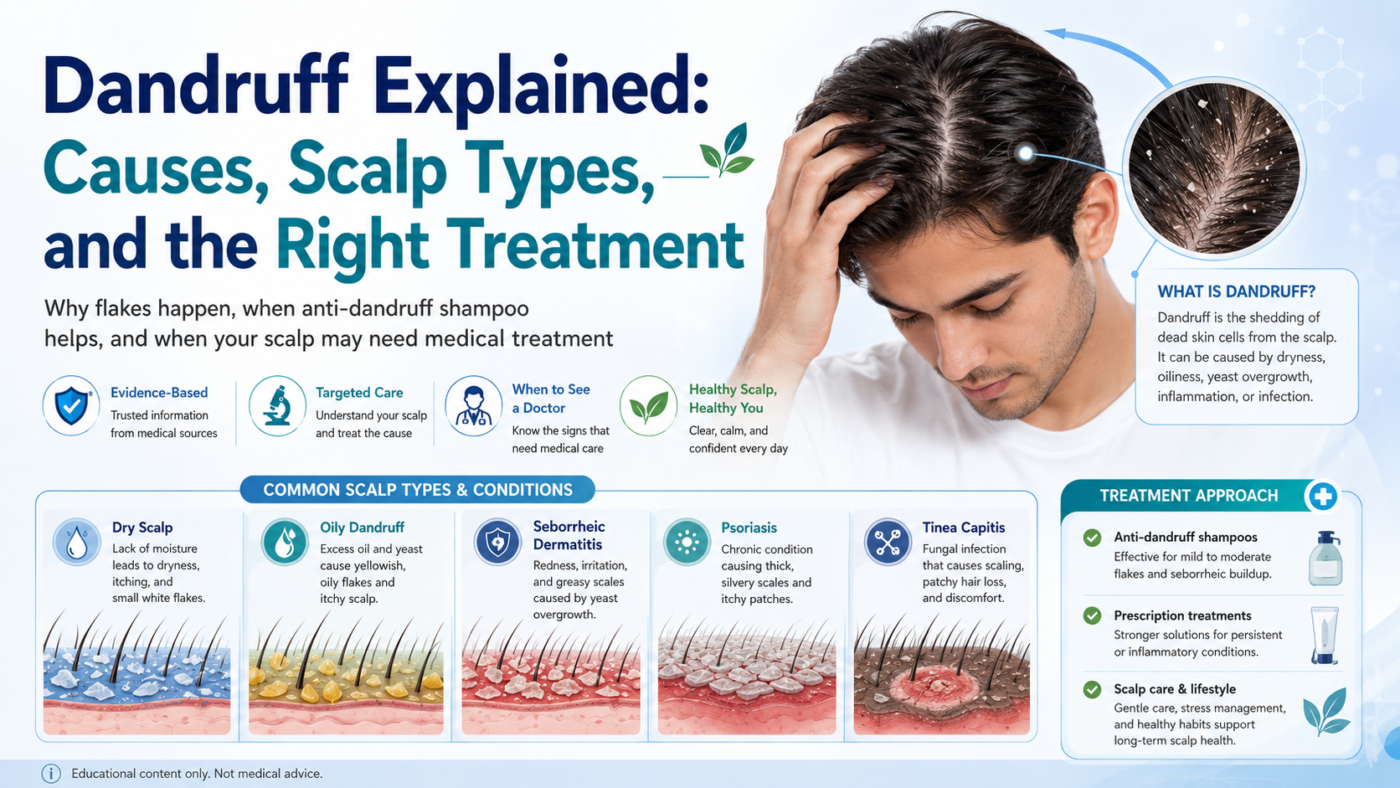
Dandruff is often treated as a simple hygiene problem: flakes appear on the shoulders, so people buy an anti-dandruff shampoo and expect the problem to disappear. In reality, scalp flaking is not a single disease. It is a visible sign that can arise from several very different scalp conditions.
For some people, the problem is simply a dry, irritated scalp. Others have an oilier scalp associated with dandruff or seborrheic dermatitis. Thick scaling may sometimes point to psoriasis, while patchy scaling accompanied by broken hairs or hair loss can indicate a fungal infection such as tinea capitis.
That distinction matters because a shampoo that improves one type of scalp problem can irritate another. Understanding what the flakes look like, when they appear, whether the scalp is inflamed, and whether there are other symptoms can help determine the most appropriate approach.
Dandruff Is a Symptom, Not One Single Condition
Normal skin continuously sheds dead cells. Usually, these cells are so small that we barely notice them. When turnover accelerates or the scalp becomes irritated, however, the shedding becomes visible as flakes.
Several conditions can create this appearance:
- Dry scalp
- Common dandruff
- Seborrheic dermatitis
- Psoriasis
- Atopic dermatitis affecting the scalp
- Tinea capitis, a fungal infection
- Irritant or allergic reactions to hair-care products
This is why persistent “dandruff” should not automatically be treated with increasingly aggressive cleansing.
Dry Scalp vs. Oily Dandruff
A useful first distinction is between a predominantly dry scalp and a scalp with excess oil and greasy scaling.
Dry Scalp
Dry scalp tends to produce small, light, powder-like flakes. The scalp may feel tight, sensitive or itchy.
It may become worse in:
Cold or dry climates
Strongly air-conditioned environments
Winter weather
After frequent shampooing
After using harsh cleansers
After washing with very hot water
After repeatedly applying products that strip away scalp oils
Someone who normally has a slightly oily scalp in a humid climate may develop dry flaking after traveling to a colder, drier environment. Scalp condition is therefore not always fixed.
If flakes appear very soon after shampooing and the scalp feels dry or itchy, over-cleansing may be part of the problem.
Oily Dandruff
An oilier scalp can produce larger flakes that stick together because of sebum. The scale may appear white or yellowish and can adhere to the scalp or hair.
People with naturally oily facial skin may also tend to have an oilier scalp, although this is not universal.
Heat, humidity, sweat and occlusion from hats or helmets may make the scalp feel oilier and can aggravate symptoms in susceptible people.
The Role of Malassezia
The scalp naturally contains microorganisms, including a group of yeasts known as Malassezia.
Malassezia is not simply a harmful germ that must be eliminated. It normally lives on human skin. In people who are susceptible, however, interactions between Malassezia, scalp oils and the skin’s immune response are believed to contribute to dandruff and seborrheic dermatitis.
This is one reason antifungal shampoos can help certain types of dandruff.
Importantly, Malassezia is a yeast, not a bacterium.
Seborrheic Dermatitis: When Dandruff Becomes Inflamed
Seborrheic dermatitis is more than simple flaking. The scalp becomes inflamed and may develop:
Redness
Itching
Greasy or yellowish scale
Larger flakes
Recurring flare-ups
It can also affect other oil-rich areas, including the eyebrows, sides of the nose, ears and upper chest.
Stress and sleep disruption are commonly reported triggers. Weather may also influence symptoms. Individual triggers vary considerably.
Dietary factors such as spicy, very sugary or high-fat foods are sometimes reported by patients as triggers, but the scientific evidence is not strong enough to say that these foods universally cause seborrheic dermatitis. Personal patterns are more useful than rigid food restrictions.
When “Dandruff” May Actually Be Psoriasis
Scalp psoriasis can initially resemble severe dandruff or seborrheic dermatitis.
Psoriasis is an immune-mediated inflammatory disease that accelerates skin-cell turnover. Scalp plaques can become thicker and more sharply defined than ordinary dandruff, sometimes developing silvery-white scale.
Other clues may include psoriasis on:
Elbows
Knees
Lower back
Behind the ears
Nails
Some people with psoriasis can also develop psoriatic arthritis, causing joint pain, stiffness or swelling.
Because scalp psoriasis and seborrheic dermatitis can overlap in appearance, persistent thick scaling is worth having evaluated professionally.
Tinea Capitis: A Fungal Infection That Needs Different Treatment
Another important condition is tinea capitis, commonly called scalp ringworm.
Unlike common dandruff, it is a contagious fungal infection.
Possible signs include:
Scaly patches
Broken hairs
Localized hair loss
Black-dot-like broken hairs
Redness
Tenderness
Pustules or inflammation in more severe cases
Severe inflammatory tinea capitis can occasionally scar the scalp and cause permanent hair loss.
Children are affected more commonly than adults, although anyone can develop it.
Transmission can occur through close contact, contaminated combs or hair tools, and sometimes infected animals.
Because the fungus grows within the hair shaft and follicle, shampoo alone is generally not sufficient. Confirmed tinea capitis usually requires prescription oral antifungal treatment.
This is one of the clearest examples of why assuming every flaky scalp is ordinary dandruff can be harmful.
Why Anti-Dandruff Shampoo Helps Some People but Makes Others Worse
Anti-dandruff shampoos are not all the same.
Depending on the product and country, active ingredients may include antifungal or scale-reducing agents such as:
Ketoconazole
Selenium sulfide
Salicylic acid
Other antifungal or keratolytic ingredients
These can be useful when dandruff involves Malassezia, excessive scalp oil or accumulated scale.
Salicylic acid, for example, helps loosen and remove scale. That can be useful for a thick, flaky scalp.
But a person with an already dry, sensitive scalp may find aggressive scale-removing or strongly cleansing products irritating.
The lesson is simple: stronger cleansing is not automatically better.
How Soon After Washing Do the Flakes Appear?
Timing can offer clues.
If the scalp looks clean immediately after washing but becomes oily and flaky toward the following day, insufficient cleansing or oily dandruff may be contributing.
If the scalp begins flaking within a few hours of shampooing, especially with tightness or itching, excessive cleansing or irritation becomes more plausible.
This timing alone cannot diagnose a condition, but it can help identify whether the scalp is being stripped too aggressively.
Caring for a Dry Scalp
For a predominantly dry scalp, the priority is protecting the skin barrier.
A practical approach includes:
Use a mild shampoo rather than the strongest oil-removing formula available.
Avoid excessively hot water.
Do not assume that everyone needs daily shampooing. Washing frequency can be adjusted according to scalp oil production, activity level and symptoms.
Rinse shampoo thoroughly.
Use warm or cool airflow when drying the scalp rather than prolonged high heat.
People with eczema or very sensitive skin may need specifically formulated scalp moisturizers or medical treatment.
Caring for an Oily, Flaky Scalp
An oily scalp generally needs adequate cleansing so that sweat, oil and scale do not accumulate excessively.
People with conventional dandruff or mild seborrheic dermatitis may benefit from an appropriate anti-dandruff shampoo.
After exercise, allowing sweat and oil to remain trapped beneath hair or headwear for prolonged periods may aggravate symptoms in susceptible people. Washing or rinsing after heavy sweating can therefore be reasonable.
Long hair itself does not cause dandruff, but dense hair can make the scalp hotter, more humid and more difficult to rinse thoroughly.
When Inflammation Needs Medical Treatment
Once the scalp becomes significantly red, painful or intensely itchy, shampoo alone may not be enough.
Dermatologists may use treatments including antifungal therapy, anti-inflammatory scalp solutions or other prescription medications depending on the diagnosis.
Psoriasis may require a completely different treatment strategy from seborrheic dermatitis.
Tinea capitis requires antifungal treatment and often oral medication.
Trying to suppress every scalp condition with the same over-the-counter product can delay the correct diagnosis.
Should You Blow-Dry Your Scalp?
Drying the scalp after washing is reasonable, particularly for people with dense hair.
The goal, however, is to remove moisture without overheating the skin.
Use stronger airflow with moderate temperature rather than concentrating very hot air on one spot.
A scalp that becomes hot, tight or itchy after blow-drying may be experiencing irritation.
Shampoo Residue Can Irritate the Scalp
Shampoos contain surfactants that remove oil and allow dirt to rinse away. They may also contain fragrances, preservatives, conditioning ingredients and botanical extracts.
These ingredients are generally intended to be rinsed off.
Leaving shampoo residue on the scalp can irritate sensitive skin, so thorough rinsing matters.
People with recurrent irritation may also benefit from simpler, fragrance-free formulations rather than assuming that a longer ingredient list means better scalp care.
Is Washing Hair With Soap Better?
Not necessarily.
Traditional soap is usually alkaline, while the skin and scalp are naturally mildly acidic. Alkaline soap can leave some people with dry, rough hair and an irritated scalp.
A person with resilient, oily skin may tolerate soap without obvious symptoms, while another person with dry or sensitive skin may experience significant itching and flaking.
One person’s successful routine should therefore not automatically be copied by everyone else.
Hair Dye and Perming Can Irritate the Scalp
Hair dyes and chemical perming agents can irritate the scalp, particularly when the skin is already inflamed or damaged.
People with sensitive scalps should minimize direct contact between chemicals and the scalp whenever possible.
Hair coloring should ideally be postponed during an active flare involving:
Redness
Open sores
Severe itching
Scratching injuries
Active dermatitis
Anyone who develops recurrent burning, swelling or rash after hair coloring should seek professional advice because allergic contact dermatitis is possible.
Hats and Helmets: Helpful or Harmful?
Headwear can be useful because it protects the scalp from ultraviolet radiation, especially in people with thinning hair.
The problem arises when sweat, oil and heat remain trapped for long periods.
If a helmet or hat feels excessively hot or damp, allowing ventilation when practical can improve comfort.
Helmet liners should also be cleaned regularly because they accumulate sweat, oil and skin debris.
Lifestyle Factors and Scalp Flares
Stress and inadequate sleep are frequently associated with worsening inflammatory skin disorders, including seborrheic dermatitis and psoriasis.
Maintaining regular sleep, managing stress and avoiding known personal triggers may therefore help reduce flare frequency.
People often report that alcohol, smoking or certain foods worsen itching or redness. The degree of evidence differs by condition, so these should be viewed as individual triggers rather than universal causes of dandruff.
When You Should See a Dermatologist
Ordinary mild dandruff can often be managed at home. Professional evaluation becomes more important when there is:
Persistent redness
Severe itching
Pain
Pus or crusting
Thick plaques
Rapidly worsening scale
Broken hairs
Patchy hair loss
Scarring
Symptoms elsewhere on the body
Nail abnormalities
Joint pain
Failure to improve despite appropriate dandruff care
These features raise the possibility that the problem is something other than ordinary dandruff.
The Bottom Line
Dandruff is not simply a sign that someone has failed to wash their hair properly.
Fine powdery flakes may come from dryness and over-cleansing. Greasy scale may be associated with conventional dandruff or seborrheic dermatitis. Thick plaques can suggest psoriasis. Patchy scaling with broken hairs or hair loss may indicate tinea capitis.
That is why the best treatment begins with identifying the underlying scalp condition rather than repeatedly switching between stronger shampoos.
A healthy scalp does not necessarily require aggressive cleaning. It requires the right balance of cleansing, barrier protection, inflammation control and, when necessary, medical diagnosis.
Medical Disclaimer
This article is for educational purposes only and is not a substitute for professional medical diagnosis or treatment. Persistent scalp inflammation, hair loss, infection, severe itching or thick scaling should be evaluated by a qualified healthcare professional.
This article is for general education and does not replace individualized care from a qualified health professional. Seek appropriate advice for persistent, severe, or concerning symptoms.
Read the full medical disclaimer

