Knee pain becomes increasingly common with age, but it does not always come from the same structure. Bone, cartilage, ligaments, tendons, bursae and the menisci can all contribute to discomfort. That is why treating every painful knee as “arthritis” or simply taking supplements without knowing the cause can miss the real problem.
One condition that deserves particular attention is a meniscus tear. Meniscal injuries may occur suddenly after a twist or impact, but they can also develop gradually through aging, repetitive loading and degeneration. Some people recover with conservative treatment and rehabilitation, while others need arthroscopic surgery.
Understanding what the meniscus does, why it becomes vulnerable, and how rehabilitation should progress can help protect long-term knee function.
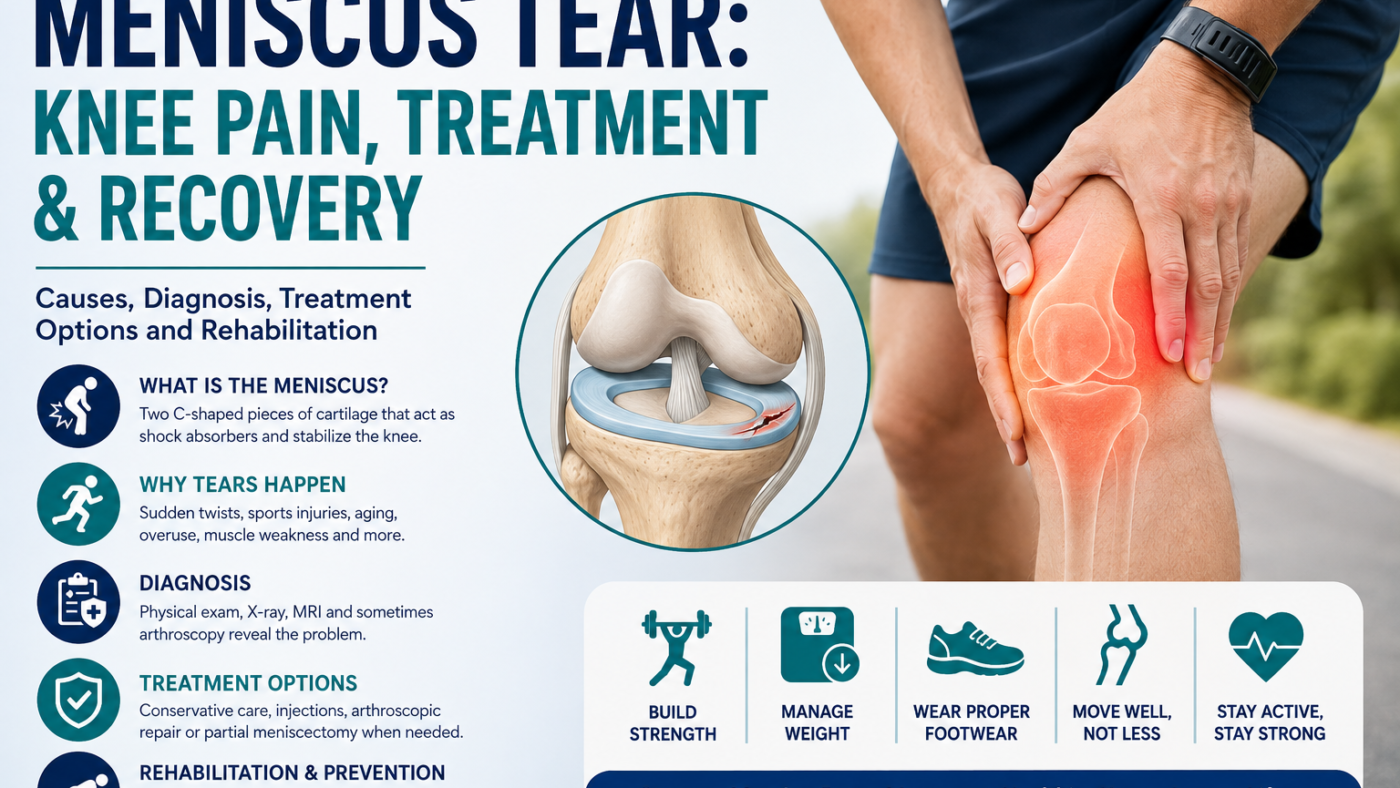
What Is the Meniscus?
Each knee contains two menisci:
- the medial meniscus on the inner side of the knee
- the lateral meniscus on the outer side
These crescent-shaped fibrocartilage structures sit between the femur and tibia.
A useful way to think about them is as part of the knee’s shock-absorbing and load-distributing system.
When you walk, run, jump or climb stairs, the knee must repeatedly absorb forces generated by body weight and movement. The menisci help distribute those forces across the joint surface, contribute to stability and assist normal movement between the bones.
Without adequate meniscal function, stresses on the articular cartilage can increase.
The Meniscus and the Cruciate Ligaments Are Different Structures
People often confuse the meniscus with the anterior cruciate ligament.
The knee has two major cruciate ligaments:
Anterior cruciate ligament (ACL)
Helps control forward movement and rotational stability of the tibia.
Posterior cruciate ligament (PCL)
Helps prevent excessive backward movement of the tibia.
The two ligaments cross within the knee, which is why they are called “cruciate” ligaments.
The menisci, by contrast, are fibrocartilage structures located between the femur and tibia.
A traumatic knee injury can damage more than one structure at the same time. An ACL injury and a meniscus tear, for example, may occur together.
A Sudden Twist Can Injure Both the ACL and Meniscus
One example described in the original discussion involved an active adult who stepped unexpectedly into a hole while crossing a road.
The knee became immediately painful, and walking became extremely difficult. Swelling developed by the next morning.
After clinical examination and subsequent MRI, both the cruciate ligament and meniscus were found to be injured.
This illustrates an important principle:
A relatively brief twisting event can produce significant internal knee injury.
The mechanism does not necessarily require a dramatic collision.
When the foot is planted and the body turns suddenly, considerable rotational and shear forces can pass through the knee.
Why Twisting Movements Can Tear the Meniscus
The meniscus has some elasticity, but it is not designed to tolerate unlimited rotational stress.
Meniscal injuries are particularly associated with combinations of:
- weight bearing
- knee flexion
- rotation
- sudden direction changes
- loss of muscular control
Basketball provides a classic example.
A player may plant one foot while turning toward the basket. If another player makes contact at the same moment, rotational force through the knee can increase dramatically.
The same mechanism can occur during ordinary activities when someone slips, steps into a hole or turns unexpectedly.
Strong Muscles Help Protect the Knee
The knee does not function in isolation.
Muscles of the:
- hips
- thighs
- calves
- trunk
all contribute to lower-limb control.
If these muscles cannot adequately stabilize the body during movement, greater loads may be transferred to passive structures such as ligaments, menisci and cartilage.
This is one reason rehabilitation after knee injury focuses not only on the knee itself but also on the entire lower-extremity kinetic chain.
Muscle Imbalance Can Also Matter
Weakness is not the only issue.
A person may be very strong overall yet still have poor balance between muscle groups.
Heavy resistance training can build substantial strength, but if certain muscles become disproportionately dominant while other stabilizing muscles lag behind, movement mechanics may become less efficient.
This does not mean strength training causes meniscus tears. Properly designed resistance training is generally valuable for joint health.
The practical lesson is that strength should be accompanied by mobility, neuromuscular control and balanced development.
Previous Injuries Can Affect the Entire Kinetic Chain
The original discussion also described a patient with an earlier Achilles tendon injury on the same side as the later knee injury.
Because rehabilitation had been incomplete, the calf became noticeably smaller.
Clinicians suspected that this weakness may have altered lower-limb mechanics and increased stress elsewhere.
The human body functions as a kinetic chain.
Changes in one area may affect another:
Foot and ankle → knee → hip → pelvis → trunk
For example, persistent ankle weakness may alter gait and force distribution. Likewise, hip weakness can change knee alignment during walking, squatting or stair climbing.
This does not mean every Achilles injury will cause a knee injury. Rather, incomplete recovery can sometimes contribute to compensatory movement patterns.
Why the Meniscus Becomes More Vulnerable With Age
Meniscus injuries are not limited to athletes.
In middle-aged and older adults, many tears are degenerative rather than purely traumatic.
Several age-related changes may contribute.
Reduced vascularity
The meniscus has a limited blood supply, particularly in its inner regions.
Because blood flow is important for bringing nutrients and repair cells to damaged tissue, some meniscal tears have relatively poor healing potential.
Structural degeneration
With age, meniscal tissue may gradually become less resilient.
The tissue can become:
- more fibrotic
- less elastic
- less hydrated
- more vulnerable to repetitive stress
This means that a movement tolerated easily at age 30 may sometimes provoke symptoms later in life.
Loss of muscle mass
Unless deliberately maintained, skeletal muscle tends to decline with age.
Reduced strength around the hip, thigh and calf means less muscular support for the knee.
Consequently, more mechanical load may be transferred directly through the joint structures.
Meniscus Damage and Osteoarthritis Often Overlap
In middle-aged and older adults, the most common cause of chronic knee pain is generally osteoarthritis.
But osteoarthritis and degenerative meniscus abnormalities frequently coexist.
The two cannot always be separated neatly.
A person with knee osteoarthritis may simultaneously have:
- cartilage degeneration
- meniscal degeneration
- bone changes
- inflammation
- altered joint mechanics
This is one reason an MRI finding of a meniscal tear does not automatically prove that the tear is the sole source of pain.
Clinical symptoms and physical examination remain important.
Other Causes of Knee Pain
The original discussion ranked several possibilities commonly encountered in clinical practice.
Among middle-aged and older adults, important causes include:
Osteoarthritis
The most common broad category, often accompanied by cartilage and meniscal degeneration.
Meniscal injury
May be traumatic or degenerative.
Ligament injury
ACL, PCL and collateral ligament injuries may produce pain or instability.
Bursitis
Inflammation of fluid-filled bursae around the knee may occur in people who kneel frequently.
This is particularly relevant for occupations or activities involving prolonged kneeling.
What Does a Meniscus Tear Feel Like?
Symptoms vary depending on the tear pattern and severity.
A sudden traumatic tear may produce:
- sharp pain
- swelling
- a popping sensation
- difficulty bearing weight
- catching
- locking
- a feeling that the knee is stuck
Degenerative injuries can be much less dramatic.
A person may simply notice:
- deep joint-line discomfort
- intermittent catching
- pain after prolonged walking
- stiffness
- discomfort during squatting or stairs
Symptoms may gradually appear over months or years.
Can You Press on the Meniscus and Find the Pain?
Sometimes.
The medial and lateral joint lines may become tender when a meniscus is injured.
However, because much of the meniscus lies deep within the knee, patients may describe the sensation simply as:
“It hurts somewhere inside the knee.”
The absence of a clearly tender spot therefore does not rule out meniscal pathology.
Does Rest Help?
Rest often reduces symptoms temporarily.
But a meaningful meniscal injury may still cause discomfort whenever the knee is loaded.
Complete inactivity is rarely practical anyway. People still have to walk, stand and perform daily activities.
Long periods of unnecessary immobilization can also weaken surrounding muscles.
That is why modern rehabilitation generally aims for appropriate, progressive movement rather than indefinite rest, provided that the injury and surgical instructions allow it.
Which Activities Increase Meniscal Stress?
Meniscal injuries can occur through several different patterns.
Sudden rotational sports
Activities involving cutting, pivoting or twisting can increase risk.
Examples include:
- basketball
- soccer
- racket sports
- skiing
High-volume endurance activity
Long-distance running or prolonged cycling does not automatically damage the meniscus.
However, as muscles fatigue, movement control can deteriorate.
When stabilizing muscles can no longer effectively manage forces, stress may shift toward passive joint structures.
This is particularly relevant when training intensity exceeds conditioning.
Repetitive kneeling
Prolonged kneeling can increase pressure around the knee and is also associated with certain types of bursitis.
Repeated stair climbing while fatigued
Stairs are not inherently harmful.
The issue is movement quality.
When the hips, thighs and trunk become fatigued, a person may descend heavily rather than controlling the movement through muscle.
This can increase impact forces through the lower limb.
Are Deep Squats Bad for the Meniscus?
Not necessarily.
A properly performed squat can be an excellent strengthening and mobility exercise for many people.
The original discussion distinguished between appropriate squatting and remaining in a deep squat for prolonged periods.
Duration, depth, individual joint health, previous injury, mobility and load all matter.
Someone with an active knee injury should not automatically copy unrestricted deep-squat routines without clinical guidance.
How Doctors Evaluate a Suspected Meniscus Tear
Diagnosis usually begins with the history and physical examination.
Clinicians may ask:
- How did the injury occur?
- Was there twisting?
- Was there immediate swelling?
- Does the knee lock?
- Does it give way?
- Is pain located along the joint line?
Special physical examination maneuvers may assess ligaments and meniscal structures.
Imaging may then be selected according to the clinical situation.
What Can an X-Ray Show?
Standard X-rays do not directly visualize the meniscus.
They are still useful.
X-rays can reveal:
- joint-space narrowing
- bone spurs
- alignment abnormalities
- fractures
- advanced osteoarthritis
Because cartilage occupies part of the space between bones, a reduced joint space can indirectly suggest cartilage loss.
What Can Ultrasound Show?
Musculoskeletal ultrasound is useful for evaluating many superficial structures around the knee.
It may provide information about:
- tendons
- bursae
- fluid
- some peripheral meniscal regions
- certain ligament structures
However, deeper intra-articular structures can be difficult to visualize completely.
Why MRI Is Important
MRI provides much more detailed images of soft tissues inside the knee.
It can help evaluate:
- menisci
- ACL and PCL
- cartilage
- bone marrow
- other soft tissues
For suspected internal derangements such as significant meniscal or cruciate ligament injury, MRI is often an important noninvasive imaging tool.
Whether MRI is necessary depends on symptoms, examination and whether the result is expected to change management.
What About Arthroscopy?
Arthroscopy involves inserting a small camera into the joint.
It provides direct visualization of structures inside the knee and can also allow treatment during the same procedure.
But arthroscopy is invasive.
It is not ordinarily used simply because someone has knee pain.
Modern practice generally reserves surgical evaluation for situations in which symptoms, structural findings and clinical circumstances justify it.
Does Every Meniscus Tear Need Surgery?
No.
This is one of the most important points.
Many meniscal injuries—particularly certain degenerative tears—are initially managed without surgery.
Conservative treatment may involve:
- temporary activity modification
- appropriate pain control
- physical therapy
- progressive strengthening
- movement retraining
- gradual return to activity
The goal is not always to make an MRI look completely normal.
The goal is often to restore comfortable, useful function.
A person may regain excellent knee function even if some structural abnormality remains visible on imaging.
When Might Surgery Be Considered?
Surgery may be considered when factors such as the following are present:
- a significant traumatic tear
- mechanical locking
- an unstable tear
- associated ligament injury
- persistent symptoms despite appropriate conservative treatment
- tear characteristics suitable for repair
- substantial functional limitation
Decisions should be individualized with an orthopedic specialist.
Age alone does not determine treatment.
Meniscus Repair Versus Meniscectomy
When surgery is needed, surgeons may attempt to preserve meniscal tissue whenever feasible.
Meniscus repair
The torn tissue is sutured or otherwise repaired.
Whether a tear can be repaired depends on:
- location
- tear type
- blood supply
- tissue quality
- size
- patient factors
Partial meniscectomy
Damaged tissue that cannot be repaired may be trimmed.
Modern orthopedic practice generally emphasizes preservation of as much functional meniscal tissue as reasonably possible because the meniscus plays an important role in joint load distribution.
Complete meniscal removal is far less desirable when avoidable because loss of meniscal tissue can increase long-term joint stress.
What About Knee Replacement?
A meniscus tear by itself does not usually mean someone needs a knee replacement.
Joint replacement is generally considered in much more advanced situations, such as severe osteoarthritis with substantial pain and functional impairment after other appropriate treatments have failed.
It should not be viewed simply as the next step after meniscus surgery.
Rehabilitation After ACL and Meniscus Surgery
The original patient described undergoing ligament reconstruction and meniscus repair, followed by rehabilitation beginning relatively early after surgery.
Modern postoperative rehabilitation usually emphasizes a carefully staged return of:
- range of motion
- muscle activation
- strength
- balance
- walking
- functional movement
However, the exact timetable differs considerably depending on the surgery performed.
A patient who has undergone meniscus repair may have different loading restrictions from someone who has had an isolated ligament procedure or partial meniscectomy.
Therefore, postoperative exercises should follow the surgeon and rehabilitation team’s protocol.
What Is Closed-Chain Exercise?
The program described in the original discussion used the terms closed kinetic chain and open kinetic chain.
In a closed-chain lower-limb exercise, the foot is generally fixed against a surface.
Examples may include:
- supported mini-squats
- sit-to-stand exercises
- selected step exercises
In an open-chain exercise, the distal limb moves relatively freely.
An example is seated knee extension.
Closed-chain exercises are frequently used in rehabilitation because they can involve coordinated activation of multiple muscle groups and resemble many functional movements.
But neither category is universally “safe” or “unsafe.”
Exercise selection depends on:
- surgery type
- tissue healing
- load
- range of motion
- rehabilitation stage
Why Modern Rehabilitation Does Not Usually Mean Complete Bed Rest
Older beliefs often encouraged prolonged inactivity after surgery.
Current rehabilitation generally recognizes that appropriately prescribed movement can help preserve:
- circulation
- range of motion
- muscle mass
- neuromuscular control
- confidence in the joint
The important word is appropriate.
A statement such as “everyone should start exercise one week after surgery” would be too broad. The timing and intensity must depend on the operation and individual healing.
Can Injections Heal a Torn Meniscus?
The original discussion mentioned dextrose-based injections and platelet-derived treatments such as platelet-rich plasma.
These treatments are being used and studied in musculoskeletal medicine.
However, the evidence is not strong enough to say that injections reliably regenerate a torn meniscus or replace appropriate surgery when surgery is clearly indicated.
PRP may improve symptoms in some knee conditions, but outcomes vary according to diagnosis, preparation technique and patient characteristics.
Patients should therefore be cautious about claims that an injection will simply “grow the meniscus back.”
The Most Important Part of Long-Term Recovery: Restore the Whole Kinetic Chain
Whether treatment is conservative or surgical, rehabilitation should not focus only on the painful spot.
Strong muscles around the entire lower limb can improve control and reduce unnecessary stress.
Important regions include:
Gluteal muscles
Help stabilize the pelvis and control femoral movement.
Quadriceps
Essential for knee extension, shock absorption and stair control.
Hamstrings
Contribute to knee stability and coordinated movement.
Calf muscles
Important for gait, propulsion and lower-limb force control.
Core
Supports overall balance and movement efficiency.
Good rehabilitation aims to rebuild coordination between all of them.
Five Practical Principles for Protecting the Knee
The discussion can be distilled into five useful principles.
1. Build and maintain muscle
Do not wait until pain appears.
Regular resistance exercise for the hips, thighs and calves can help preserve joint function as you age.
2. Maintain a reasonable body weight
Higher body mass increases the load that the knee must repeatedly manage.
Weight management can therefore be important for people with knee pain.
But weight loss should not mean undereating to the point of losing muscle.
Adequate nutrition, including sufficient protein, remains important for maintaining lean mass.
3. Wear appropriate footwear
Shoes do not need to be extremely soft.
They should generally provide adequate fit, stability and cushioning for the activity being performed.
Very thin or inappropriate footwear may be uncomfortable for some people, especially during repeated impact activity.
4. Avoid prolonged extreme loading positions
Long periods of kneeling or deep squatting may aggravate symptoms in susceptible knees.
This is different from saying that kneeling or squatting is universally harmful.
Dose matters.
5. Do not become afraid of movement
This may be the most important principle for older adults.
After a painful injury, people sometimes conclude:
“My knee is damaged, so I should stop using it.”
Complete avoidance can accelerate weakness.
Weak muscles then provide even less support to the knee, potentially making future movement more difficult.
The better goal is usually:
Move within an appropriate range, rebuild strength progressively and increase activity as tolerated and medically appropriate.
Healthy Movement Protects the Meniscus Better Than Avoiding Movement
The meniscus is an important structure, but protecting it does not mean protecting the knee from all activity.
Human joints are designed to move.
The more useful strategy is to move with sufficient:
- strength
- control
- mobility
- recovery
- appropriate loading
That becomes particularly important after middle age, when muscle mass and tissue resilience may decline unless deliberately maintained.
Frequently Asked Questions
What is the main function of the meniscus?
The menisci help distribute loads across the knee, absorb shock, improve joint congruence and contribute to stability.
Can a meniscus tear heal on its own?
Some tears have better healing potential than others. Tears near the outer vascular region may heal more readily than tears in poorly vascularized inner regions. Tear pattern, age, tissue quality and other injuries also matter.
Does a meniscus tear always cause severe pain?
No. Acute traumatic tears may cause sudden pain and swelling, while degenerative tears may produce gradual aching, catching or intermittent discomfort.
Is MRI always necessary?
No. MRI is most useful when the diagnosis remains uncertain, internal soft-tissue injury is suspected, or imaging would influence treatment.
Does every meniscus tear require arthroscopy?
No. Many patients can improve with conservative management and structured rehabilitation.
Can I exercise with a meniscus injury?
Often yes, but the appropriate exercises depend on the severity and type of injury. Locking, significant swelling, instability or a recent operation requires individualized medical and rehabilitation guidance.
Are stairs bad for the knees?
Not automatically. Stair climbing is a normal functional activity. Problems are more likely when excessive loading, poor control, fatigue or active joint disease is present.
Should older adults avoid squatting?
Not necessarily. Squatting ability can be valuable for mobility and strength. Depth, duration and load should be adapted to the individual, especially when knee disease is present.
Medical Disclaimer
This article is for general educational purposes only and does not replace individualized diagnosis or treatment by a physician, orthopedic surgeon or physical therapist. Sudden inability to bear weight, major swelling, a locked knee, marked instability, severe pain after trauma or other concerning symptoms should be evaluated by a qualified healthcare professional.
This article is for general education and does not replace individualized care from a qualified health professional. Seek appropriate advice for persistent, severe, or concerning symptoms.
Read the full medical disclaimer