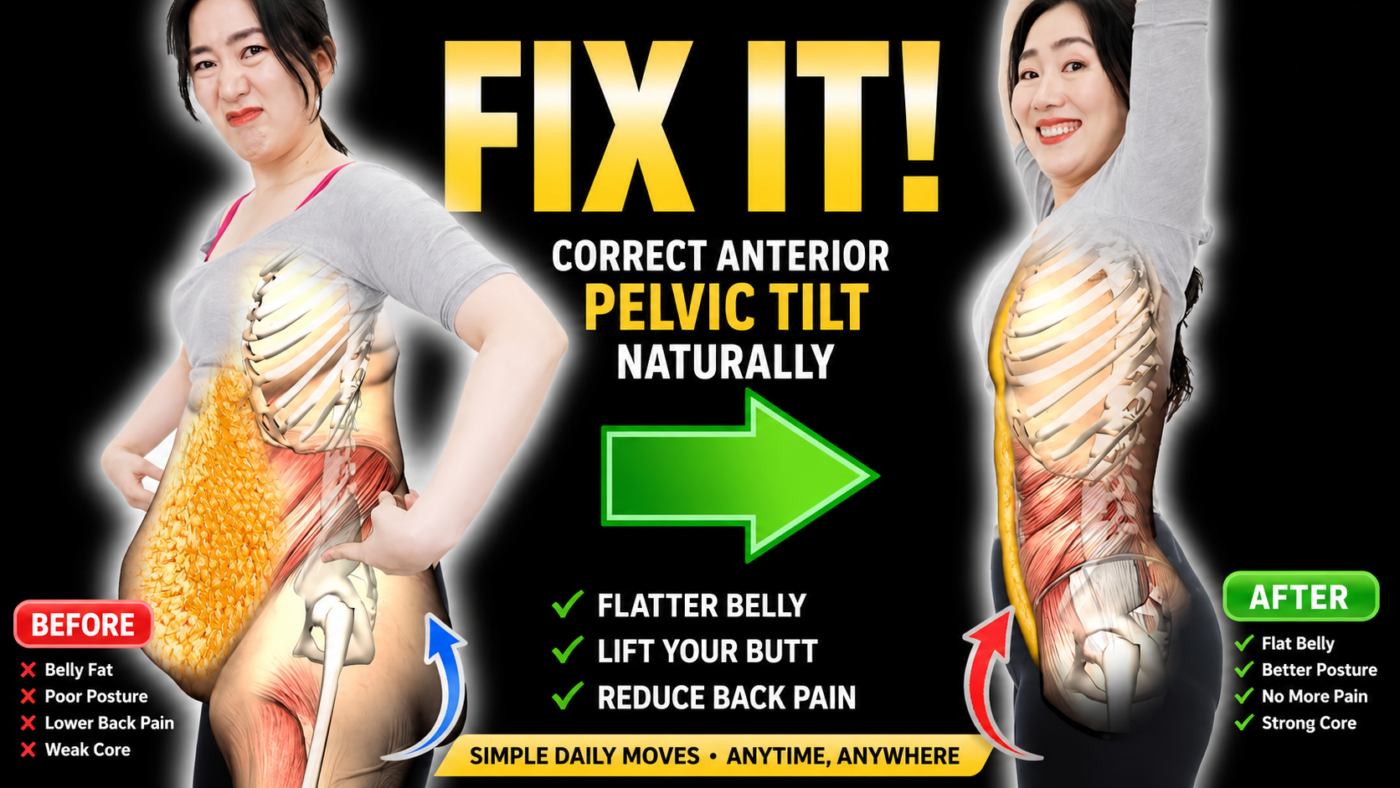
Modern life asks us to spend enormous amounts of time sitting. We sit at desks, in cars, on sofas, and in front of screens. Over time, some people begin to notice a familiar pattern: the lower back feels overly arched, the abdomen appears to project forward, the hips feel stiff, and the gluteal muscles seem less active.
This posture is often described as anterior pelvic tilt, but it is important to understand what that term actually means. A small amount of forward pelvic tilt is common and can exist in completely healthy people. In fact, a frequently cited study of 120 healthy young adults found an anteriorly rotated pelvis in 85% of the men and 75% of the women examined. The original material incorrectly states 70% for women; the published figure was 75%. More importantly, these participants were asymptomatic, so the presence of anterior pelvic tilt alone should not automatically be treated as a disorder.
The more useful question is not simply, “Is my pelvis tilted forward?” but rather:
Can I comfortably control my pelvis, rib cage, breathing, hips, and trunk while I stand and move?
The gentle routine below explores exactly that.
What Is Anterior Pelvic Tilt?
Anterior pelvic tilt describes a position in which the front of the pelvis rotates downward while the back rotates upward. This can accompany increased extension in the lumbar spine, creating the appearance of a more pronounced lower-back arch.
Some people also notice:
- a forward-projecting abdomen
- stiffness around the hips or lower back
- difficulty engaging the abdominal or gluteal muscles
- a tendency to stand with the ribs pushed forward
- discomfort after prolonged standing or sitting
However, posture varies naturally between individuals. An anteriorly tilted pelvis does not automatically mean that something is structurally wrong.
Research on posture and low-back pain supports a nuanced interpretation. A recent systematic review found that pelvic-tilt measurements may differ somewhat between people with and without low-back pain, but the evidence was heterogeneous and did not establish a simple cause-and-effect relationship.
That distinction matters because the goal of exercise should usually be better movement capacity and comfort, not forcing every body into one supposedly perfect alignment.
Does Anterior Pelvic Tilt Cause Lower-Back or Knee Pain?
It can be associated with movement patterns that contribute to discomfort in some people, but anterior pelvic tilt by itself cannot reliably explain lower-back pain, knee pain, gait problems, or other musculoskeletal symptoms.
The body is far more complicated than a single postural angle.
Pain can be influenced by:
- muscular strength
- activity level
- sleep
- previous injury
- joint mobility
- workload
- stress
- movement habits
- neurological sensitivity
- individual anatomy
For that reason, it is better to think of pelvic position as one component of a larger movement system.
There is also limited evidence that simply trying to “correct” pelvic tilt through exercise reliably changes symptoms or permanent alignment. A systematic review examining nonsurgical treatment for excessive anterior pelvic tilt concluded that the available evidence was limited and generally low quality.
Exercise can still be valuable. The benefit is that it may improve strength, body awareness, breathing, mobility, and control even when it does not permanently change a particular pelvic angle.
A Necessary Correction About the Internal-Organ Claims
The original routine suggests that anterior pelvic tilt can push internal organs downward, cause pelvic-organ prolapse, and make the body deliberately accumulate abdominal fat to protect those organs.
Those statements should not be presented as established medical facts.
Pelvic-organ prolapse is a medical condition influenced by factors such as pregnancy and childbirth, aging, connective-tissue support, menopause, chronic increases in abdominal pressure, obesity, and previous pelvic surgery. Ordinary anterior pelvic tilt has not been established as a direct cause.
Likewise, there is no good evidence that the body intentionally deposits lower-abdominal fat as a protective response to anterior pelvic tilt.
Body-fat accumulation is primarily influenced by factors such as overall energy balance, genetics, hormones, age, activity, sleep, and diet.
So this routine should be understood as a posture, movement, and muscle-control practice, not as a treatment for organ prolapse or localized abdominal fat.
Why the Rib Cage Matters
One useful idea in the original method is that posture is not only about the pelvis.
The pelvis, spine, rib cage, diaphragm, abdominal wall, and hips interact continuously.
When someone stands with both the pelvis tipped forward and the lower ribs pushed prominently forward, the lumbar spine may remain in relatively greater extension. Some people find this position tiring or uncomfortable.
Rather than forcefully “tucking” the pelvis throughout the day, it can be more helpful to experiment with a gentler relationship between the rib cage and pelvis.
Think of the trunk as a cylinder.
The rib cage forms the upper portion.
The pelvis forms the base.
The abdominal wall, back muscles, diaphragm, and pelvic floor help coordinate pressure and movement between them.
When these structures work together well, breathing and movement can feel more controlled.
Why Breathing Is Included
The diaphragm is the primary muscle of breathing, but breathing also interacts with the abdominal wall, spinal muscles, rib cage, and pelvic floor.
That makes breathing useful during postural exercise.
The objective is not to force the chest upward or hold the stomach rigidly.
Instead, try to maintain enough abdominal control to support your trunk while still allowing comfortable breaths.
If raising your arms makes your breathing harder rather than easier, lower them slightly. The exercise should adapt to your body rather than the other way around.
The Gentle Anterior Pelvic Tilt Exercise Routine
This routine progresses from pelvic awareness to breathing, overhead reaching, and marching.
Move slowly.
Nothing should produce sharp pain, numbness, tingling, dizziness, or worsening symptoms.
Exercise 1: Gentle Hip Circles
Stand with your feet approximately hip-width apart.
Place both hands on your waist.
Begin making slow circles with your pelvis.
Let the movement travel smoothly through the hips rather than forcing the lower back.
Breathe naturally throughout the movement.
Complete several circles in one direction, then reverse.
The purpose is simple: become aware of how the pelvis can move rather than holding it rigidly in one position.
Hip circles may also provide a gentle warm-up for the muscles around the pelvis, hips, and lower trunk.
Do not chase the largest possible circle.
A comfortable circle is enough.
Exercise 2: Explore Pelvic Tilting
Remain standing.
Place one hand over the back of your pelvis near the sacrum and the other over your lower abdomen if that helps you feel the movement.
Slowly allow the pelvis to tip slightly forward.
Notice how the lower-back arch changes.
Then gently reverse the movement.
Imagine the front of the pelvis rotating upward slightly while the tailbone moves downward.
Avoid aggressively squeezing the buttocks or flattening the spine.
The objective is not to find one “correct” position.
Instead, learn that you can actively move between positions.
Perform several slow repetitions.
Exercise 3: Find a Comfortable Midrange Position
After exploring both directions, settle somewhere between the extremes.
Think:
Ribs comfortably over pelvis.
Maintain a light abdominal contraction, but do not suck your stomach inward as hard as possible.
Keep your knees soft.
Keep breathing.
This is the position you will use for the following exercises.
Exercise 4: Pelvic Control With Breathing
Keep your hands on your lower abdomen or around your ribs.
Take a slow breath in.
Notice your rib cage expanding.
Then breathe out without collapsing your posture.
Try another breath.
The abdomen should not be completely rigid.
Allow natural movement.
The original routine asks participants to compare breathing in different pelvic positions. That is a useful body-awareness exercise.
You may discover that certain positions feel easier or more comfortable than others.
There is no requirement that everyone experience the same response.
Exercise 5: Raise the Arms
Maintain your comfortable pelvic and rib-cage position.
Slowly raise both arms overhead.
Your elbows can remain bent.
Only lift as far as your shoulders comfortably allow.
Avoid forcing the arms behind your head or dramatically arching the lower back.
Continue breathing.
Ask yourself:
Does my lower back automatically arch as my arms rise?
Do my ribs flare forward?
Can I maintain a comfortable trunk position without holding my breath?
If necessary, lower your arms until you can.
This turns a simple arm raise into a useful coordination exercise involving the shoulders, rib cage, abdomen, pelvis, and spine.
Exercise 6: Overhead Reach
With your arms comfortably overhead, imagine reaching gently toward the ceiling.
At the same time, keep your feet grounded.
This creates a sensation of length through the trunk.
Breathe in as you reach.
Do not aggressively pull the stomach inward.
Do not clench the glutes as hard as possible.
Then breathe out and relax your shoulders while maintaining comfortable lower-body stability.
Repeat several times.
The movement should feel like lengthening rather than straining.
Exercise 7: Raised-Arm Marching
Now progress to the main movement.
Stand tall with your ribs comfortably positioned over your pelvis.
Lightly engage your abdominal muscles.
Raise your arms as high as comfortably possible.
Then begin marching slowly in place.
Lift one knee.
Lower it.
Lift the other.
Continue alternating.
The hip-flexor muscles, including the iliopsoas complex, participate when you lift the thigh. Your abdominal, spinal, gluteal, and leg muscles also help stabilize the body.
This makes marching a useful functional coordination exercise.
However, it is inaccurate to claim that activating the psoas mechanically “lifts belly fat.” Muscles can become stronger and movement can improve, but exercise cannot physically pull localized fat upward or selectively burn fat from one body area.
What marching can do is challenge the trunk and hips while helping you practice controlling pelvic and rib-cage position during movement.
Exercise 8: Light, Quiet Steps
Once marching feels comfortable, make the steps softer.
Imagine moving lightly rather than stomping.
Maintain an easy breathing rhythm.
This brings the exercise closer to ordinary walking.
The practical goal is not to hold a perfect posture throughout every second of the day.
It is to develop enough awareness and control that you can move comfortably through different positions.
Exercise 9: Repeat the Overhead Lengthening Drill
Stop marching.
Keep your lower body stable.
Bring your hands together if comfortable and reach upward.
Inhale.
Imagine lengthening the spine rather than arching it.
Reach gently upward while maintaining a relaxed neck.
Then exhale and soften the shoulders.
Repeat two or three times.
You may notice that your posture feels different after marching.
That does not necessarily mean your skeletal alignment has been permanently changed. More likely, your muscles, breathing pattern, and perception of position have temporarily changed.
That is still useful.
A Simple 5-Minute Version
When you do not have time for the complete routine, use this abbreviated sequence:
Minute 1: Slow hip circles in both directions.
Minute 2: Gentle forward and backward pelvic tilts.
Minute 3: Find a comfortable middle position and practice slow breathing.
Minute 4: Raise the arms and perform gentle overhead reaches.
Minute 5: March slowly in place while maintaining comfortable trunk control.
You can perform this as a movement break after prolonged sitting.
Will These Exercises Flatten the Lower Belly?
They may change how your abdomen looks temporarily by altering posture, muscle activation, and the relationship between the ribs and pelvis.
Strengthening and coordinating the abdominal wall can also improve trunk control.
But these exercises cannot selectively remove lower-abdominal fat.
Localized fat loss, often called “spot reduction,” is not something a particular posture drill can reliably produce.
Reducing body fat generally requires a sustained combination of:
- appropriate energy intake
- regular physical activity
- resistance training
- adequate protein
- sufficient sleep
- long-term consistency
The standing routine can complement those habits, but it should not replace them.
Can the Routine Lift the Buttocks?
Again, there is an important distinction.
Changing pelvic position can alter the visual angle of the buttocks, and activating the gluteal muscles can temporarily make them feel firmer.
Long-term increases in glute size or strength, however, come primarily from progressive resistance exercise.
Exercises such as squats, hip thrusts, step-ups, lunges, and Romanian deadlifts provide a much stronger hypertrophy stimulus than simply squeezing the buttocks while standing.
So consider this routine a coordination and posture practice, not a complete glute-building program.
Can It Help Lower-Back Pain?
Possibly, for some people.
Gentle movement, exercise, strengthening, and gradually increasing activity are commonly useful components of managing nonspecific low-back pain.
But no single posture correction works for everyone.
If a particular pelvic position feels better, it may be useful to practice it. If another position feels comfortable, that can also be normal.
The current evidence does not support labeling one universal pelvic position as the cause of most back pain.
The better objective is to increase your ability to move comfortably through many positions.
Common Mistakes
Avoid forcefully tucking the pelvis for long periods. Excessive correction simply replaces one rigid posture with another.
Do not hold your breath while tightening the abdomen.
Do not force the arms completely overhead if shoulder mobility does not allow it.
Do not aggressively squeeze the glutes throughout every repetition.
Do not assume that an anterior pelvic tilt seen in a mirror means you have a medical problem.
And do not continue through sharp or progressively worsening pain.
Who Should Be More Cautious?
Consider professional assessment before attempting corrective exercises if you have significant or persistent back pain, recent surgery, major hip or spinal injury, progressive weakness, numbness, unexplained bowel or bladder changes, or symptoms of pelvic-organ prolapse.
Pregnant and postpartum individuals may also benefit from individualized advice when dealing with pelvic-floor or pelvic-organ symptoms.
Exercise videos and general routines cannot diagnose these conditions.
What the Herrington Study Actually Tells Us
The study frequently quoted in discussions of anterior pelvic tilt deserves special attention.
Lee Herrington examined 120 healthy, asymptomatic young adults, including 65 men and 55 women, with an average age of approximately 24 years.
Anterior pelvic tilt was observed in:
85% of the men
and
75% of the women
Only a minority were classified as neutral or posteriorly tilted.
That finding leads to almost the opposite conclusion from the one sometimes presented online.
It does not show that most healthy people secretly have a dangerous postural abnormality.
Instead, it demonstrates that some degree of anterior pelvic orientation is extremely common even among people without symptoms.
This is why posture should be interpreted in context.
The Bigger Goal: Movement Options, Not Perfect Posture
The most valuable part of this routine is not the promise of instantly correcting the pelvis.
It is the opportunity to practice:
pelvic awareness,
trunk control,
rib-cage positioning,
comfortable breathing,
hip movement,
overhead reaching,
and coordinated walking.
Bodies are designed to move between positions.
Sometimes we flex.
Sometimes we extend.
Sometimes the pelvis rotates forward.
Sometimes it rotates backward.
A resilient body is not one that stays perfectly aligned all day.
It is one that can comfortably adapt.
So rather than repeatedly asking:
“Is my pelvis perfectly neutral?”
a more useful set of questions may be:
Can I move comfortably?
Can I breathe normally?
Can I stand and walk without unnecessary tension?
Can I generate strength when I need it?
Those are far more meaningful goals for long-term movement and health.
Final Takeaway
Raised-arm marching, pelvic tilting, breathing drills, hip circles, and gentle overhead reaches can form a practical standing routine for improving body awareness, trunk coordination, and hip mobility.
They may also help some people feel more comfortable after prolonged sitting.
But anterior pelvic tilt itself is common, including among symptom-free adults, and it should not automatically be treated as a disease. These exercises cannot selectively burn belly fat, physically reposition internal organs, cure pelvic-organ prolapse, or guarantee relief from back or knee pain.
Use them instead for what they can realistically provide: movement practice, muscular control, breathing awareness, and another way to keep your body active.
Medical Disclaimer
This article is for educational purposes only and is not medical advice. Persistent or severe pain, neurological symptoms, pelvic-floor symptoms, or other concerning conditions should be assessed by an appropriate healthcare professional.
References for the published article
Herrington L. Assessment of the degree of pelvic tilt within a normal asymptomatic population. Manual Therapy. 2011;16(6):646–648.
A 2024 systematic review on postural asymmetry and low-back pain found possible differences in pelvic tilt between groups but emphasized substantial heterogeneity and the inability to draw firm causal conclusions.
A systematic review of nonsurgical interventions for excessive anterior pelvic tilt found insufficient high-quality evidence to establish that such interventions reliably reduce anterior pelvic tilt or related symptoms.
This article is for general education and does not replace individualized care from a qualified health professional. Seek appropriate advice for persistent, severe, or concerning symptoms.
Read the full medical disclaimer