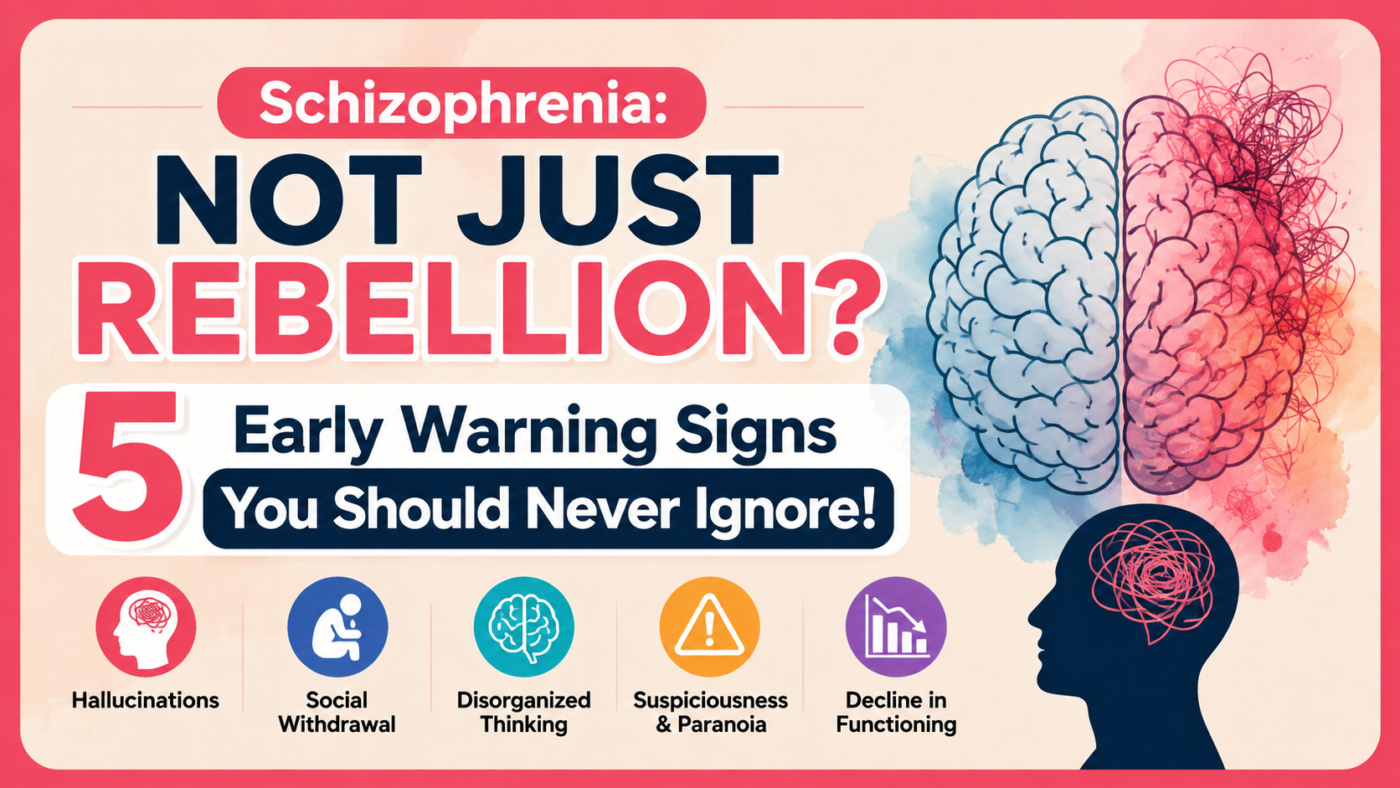
Schizophrenia is a serious but treatable mental health condition that can change the way a person perceives reality, organizes thoughts, experiences emotions, and functions in everyday life.
Despite decades of public discussion, schizophrenia is still widely misunderstood. One of the most persistent misconceptions is that schizophrenia means having a “split personality.” It does not. Schizophrenia is not dissociative identity disorder, and a person’s personality does not literally divide into separate personalities.
Instead, schizophrenia can affect perception, thinking, motivation, communication, judgment, and the ability to distinguish some internal experiences from events occurring in the external world.
For some people, the most noticeable symptoms are hallucinations or delusions. For others, the earliest changes may be much quieter: withdrawing from friends, struggling at school or work, neglecting personal care, losing motivation, becoming unusually suspicious, or having increasing difficulty concentrating and organizing daily activities.
Understanding these changes matters because early assessment and treatment can make an important difference.
What Is Schizophrenia?
Schizophrenia is a psychiatric disorder characterized by disturbances in several areas of mental functioning.
Symptoms vary considerably from person to person and can change over time. They are often grouped into three broad categories: psychotic symptoms, negative symptoms, and cognitive symptoms.
Psychotic symptoms involve changes in how reality is perceived or interpreted. These may include hallucinations, delusions, and disorganized thinking.
Negative symptoms refer to reductions in abilities or behaviors that are normally present, such as motivation, emotional expression, social interaction, or interest in everyday activities.
Cognitive symptoms can involve difficulties with attention, working memory, planning, decision-making, and organizing information.
Not every person experiences every symptom, and having one unusual experience does not by itself mean that someone has schizophrenia.
A diagnosis requires a careful clinical assessment.
Hallucinations: Hearing or Seeing What Others Do Not
Hallucinations are sensory experiences that occur without an external stimulus that other people can detect.
In schizophrenia, auditory hallucinations are especially common.
A person may hear one voice, several voices, familiar voices, unfamiliar voices, whispering, commentary, criticism, conversation, or commands.
To the individual experiencing them, these voices can feel completely real.
That is an important point for families to understand.
Simply telling someone, “That is not real,” may not immediately change the experience. From the person’s perspective, the voice may feel as convincing as an ordinary sound heard by anyone else.
Hallucinations are not always threatening. Some people report neutral or even comforting voices. However, distressing, critical, suspicious, or threatening hallucinations are common and may produce fear, anger, confusion, depression, or social withdrawal.
Visual hallucinations can also occur, but prominent visual hallucinations may prompt clinicians to consider other explanations as well, including neurological conditions, medical illnesses, medication effects, sleep-related phenomena, or substance use.
Hallucinations therefore need to be evaluated in context rather than automatically attributed to schizophrenia.
What Are Delusions?
Delusions are strongly held beliefs that remain convincing to the individual despite evidence that would normally lead someone to reconsider them.
Examples may include believing that strangers are secretly monitoring them, that television broadcasts contain personal messages, that someone is controlling their thoughts, or that other people are conspiring against them.
The content of psychotic experiences can be influenced by a person’s environment, culture, personal history, fears, relationships, and current events.
This may explain why contemporary political figures, celebrities, technology, social media, surveillance systems, or major news events sometimes become incorporated into delusional beliefs.
The specific content can change from one generation to another, while the underlying disturbance in reality testing remains similar.
Is Schizophrenia Caused by Severe Stress?
Not necessarily.
Major stress can influence mental health and may contribute to the timing or severity of symptoms in vulnerable individuals, but schizophrenia cannot usually be explained by one stressful event.
Current understanding suggests that schizophrenia develops through a complex interaction of biological vulnerability, genetics, brain development, and environmental factors.
Family conflict should therefore not automatically be blamed for causing schizophrenia.
Similarly, parents should not assume that they somehow created the disorder through ordinary parenting mistakes.
Stress may affect symptoms, but it is only one part of a much larger picture.
Is Schizophrenia Genetic?
Genetics contribute to schizophrenia risk, but schizophrenia is not determined by a single “schizophrenia gene.”
A family history of the disorder can increase risk, yet many people with affected relatives never develop schizophrenia.
Conversely, some people diagnosed with schizophrenia have no known family history.
This tells us that genetic vulnerability is important but not sufficient by itself to explain who develops the condition.
Researchers continue to study how genes interact with brain development and environmental influences.
Why Does Schizophrenia Often Appear in Young People?
Schizophrenia commonly first becomes apparent from late adolescence through early adulthood.
The timing differs between individuals, and onset patterns also differ somewhat between men and women.
This period of life coincides with continuing maturation and reorganization of brain networks, while young adults are also experiencing major social, educational, occupational, and emotional transitions.
Scientists have investigated processes such as synaptic pruning, neurotransmitter signaling, brain connectivity, immune mechanisms, genetics, and environmental exposures.
However, it would be misleading to say that schizophrenia occurs simply because “brain pruning goes wrong.”
The biology is considerably more complicated and remains an active area of research.
Early Warning Signs: When Normal Teenage Change May Be Something More
Adolescence naturally brings changes in personality, independence, mood, relationships, interests, and behavior.
Occasional withdrawal, irritability, unusual clothing, changes in sleep, or disagreement with parents do not automatically indicate mental illness.
What deserves greater attention is a significant and persistent decline from someone’s previous level of functioning, particularly when several changes occur together.
Possible warning signs can include:
Increasing social withdrawal
A major decline in school or work performance
Unusual suspiciousness or fear
Increasing difficulty concentrating
Marked deterioration in personal hygiene
Disorganized speech or behavior
Difficulty completing routine activities
Sleeping at unusual times or severe disruption of sleep
Appearing distracted by things other people cannot hear
Talking or responding to unseen stimuli
Believing that ordinary events contain special personal messages
Reporting voices that other people cannot hear
Increasing difficulty distinguishing imagination from external reality
One isolated behavior is rarely enough to establish a diagnosis.
The pattern, severity, persistence, and impact on daily functioning matter.
Why Some People Do Not Realize They Are Ill
During the early stages of psychosis, some people recognize that something unusual is happening.
They may wonder:
“Why am I hearing this?”
“Why does everything suddenly feel different?”
“Why do I feel as though people are watching me?”
During this stage, they may be more willing to ask for help.
As psychosis becomes more severe, however, insight can decrease.
A person may become completely convinced that the hallucination or delusional belief reflects external reality.
When family members suggest medical care, the person may interpret that suggestion as another threat.
This is not necessarily stubbornness.
Reduced awareness of illness can itself be part of psychosis.
That is one reason family members and close friends can play an important role in helping someone receive professional assessment.
Why Early Treatment Matters
Psychosis should not simply be left untreated in the hope that it will disappear.
Earlier access to effective treatment after the onset of psychosis is associated with better opportunities to stabilize symptoms, protect educational and occupational functioning, maintain relationships, and work toward recovery.
Modern early-psychosis programs often use coordinated specialty care.
Rather than relying exclusively on medication, these programs may combine psychiatric treatment, psychotherapy, family education, supported employment or education, case management, and individualized recovery planning.
The objective is not simply to “make symptoms disappear.”
It is to help the person build or rebuild a meaningful life.
The Dopamine Question: Is Schizophrenia Simply Too Much Dopamine?
Dopamine plays an important role in schizophrenia, particularly in psychotic symptoms, but the common explanation that schizophrenia is simply caused by “too much dopamine” is incomplete.
The brain contains several dopamine pathways, and dopamine signaling interacts with many other neurotransmitter and neural systems.
Research suggests that abnormal dopamine function in certain circuits is involved in psychosis, while other brain systems contribute to cognitive, motivational, emotional, and negative symptoms.
Modern schizophrenia research also examines glutamate signaling, brain connectivity, neurodevelopment, genetics, inflammation, cognition, and environmental factors.
Therefore, dopamine should be understood as an important piece of the puzzle rather than the entire explanation for schizophrenia.
How Antipsychotic Medication Helps
Antipsychotic medications are a central part of schizophrenia treatment.
They can reduce the frequency and intensity of hallucinations, delusions, severe suspiciousness, and other psychotic symptoms.
Different medications affect dopamine and other neurotransmitter systems in different ways.
Treatment does not simply “restore dopamine to normal.”
Instead, medications modify neurotransmitter signaling in ways that can reduce psychosis and help stabilize functioning.
The response varies considerably between individuals.
A medication that works well for one person may cause unacceptable side effects or provide insufficient benefit for another.
This is why medication selection should involve ongoing discussion between the individual and the treating clinician.
Treatment Is About Function, Not Just Eliminating Every Voice
An important goal of modern schizophrenia care is recovery of everyday functioning.
Ideally, treatment reduces psychotic symptoms as much as possible while allowing the person to participate in education, employment, relationships, self-care, and community life.
Some people experience complete remission of psychotic symptoms.
Others may continue to experience occasional residual hallucinations despite otherwise substantial recovery.
In these situations, increasing medication indefinitely in an attempt to eliminate every remaining symptom may not always be the best approach because higher doses can increase the risk of adverse effects.
Treatment therefore requires balancing symptom control, functioning, quality of life, personal preferences, and side effects.
The best outcome is not defined simply by whether a person ever hears another voice.
Recovery is broader than that.
What Are Long-Acting Injectable Antipsychotics?
Some antipsychotic medications are available as long-acting injections.
Instead of remembering a tablet every day, a person receives medication at scheduled intervals determined by the specific drug.
Depending on the medication and treatment stage, injections may be given every few weeks, monthly, or at longer intervals.
Long-acting injectable antipsychotics can be useful for people who prefer this form of treatment or who have difficulty consistently taking daily medication.
They can provide more predictable medication delivery and make missed treatment easier to identify.
For some families, this also reduces daily conflict surrounding reminders to take medication.
However, long-acting injections are not automatically superior for every individual.
They still have potential side effects, require appropriate medical monitoring, and should be selected through shared decision-making.
Some people using an injectable medication may also temporarily or continuously need oral medication.
Treatment must be individualized.
Why Stopping Medication Suddenly Can Be Risky
One common challenge occurs when someone feels better and concludes that treatment is no longer necessary.
Unfortunately, improvement may be evidence that treatment is working rather than evidence that the underlying condition has permanently disappeared.
Stopping antipsychotic medication abruptly without clinical guidance can substantially increase the risk of symptom recurrence for many patients.
Relapse can disrupt education, employment, relationships, housing, and recovery.
Medication changes—including dose reductions or discontinuation—should therefore be planned with a qualified clinician rather than made suddenly on one’s own.
Medication Is Only One Part of Treatment
Medication is extremely important for many people with schizophrenia, particularly for controlling psychotic symptoms.
But medication alone does not address every difficulty associated with the disorder.
A comprehensive recovery plan may include:
Psychotherapy
Family education and intervention
Cognitive behavioral approaches
Social-skills development
Supported employment
Educational support
Occupational rehabilitation
Life-skills training
Substance-use treatment when necessary
Physical health monitoring
Sleep and lifestyle support
Community mental health services
Recovery-oriented planning
People may need help rebuilding confidence, routines, relationships, learning skills, and work capacity after an acute episode.
Recovery therefore involves much more than suppressing hallucinations.
Understanding Negative Symptoms
Some of the most disabling features of schizophrenia are less dramatic than hallucinations.
Negative symptoms can include reduced motivation, diminished emotional expression, decreased social interest, difficulty initiating activities, and reduced ability to experience pleasure.
Families may mistakenly interpret these changes as laziness or lack of effort.
At the opposite extreme, families may become so protective that they stop encouraging the person to participate in ordinary activities.
Neither extreme is ideal.
During an acute episode, rest and reduced demands may be appropriate.
As symptoms stabilize, however, gradual re-engagement with relationships, education, hobbies, daily responsibilities, rehabilitation, or work can become an important part of recovery.
The pace should be individualized and realistic.
How Families Can Help
Schizophrenia affects families as well as the individual experiencing it.
Caregivers may feel frightened, exhausted, confused, guilty, frustrated, or uncertain about the future.
They may wonder whether they should challenge a delusional belief, agree with it, ignore it, or persuade the person that it is false.
A useful principle is to acknowledge the person’s emotional experience without reinforcing the delusion.
For example, instead of arguing aggressively about whether someone is being followed, a family member can recognize that the person feels frightened and help them seek professional support.
Statements such as “That sounds frightening” may preserve communication better than confrontation.
At the same time, caregivers do not need to pretend that they share the belief.
Families can also help by noticing early warning signs of relapse, supporting treatment appointments, encouraging healthy routines, reducing unnecessary conflict, and helping the individual gradually return to meaningful activities.
Family members themselves may also benefit from education, counseling, caregiver support, and respite.
Schizophrenia Does Not Mean the End of School, Work, or Relationships
A diagnosis of schizophrenia does not automatically mean that someone will permanently lose the ability to study, work, live independently, or maintain relationships.
Outcomes vary widely.
Some people experience substantial or complete recovery. Others require ongoing treatment and support but still build meaningful lives.
Recovery may involve returning to university, working, forming relationships, living independently, volunteering, developing new skills, or simply gaining greater control over one’s daily life.
The goal should not be to force someone to appear indistinguishable from everyone else.
The goal is to help that person achieve the highest realistic level of health, autonomy, participation, and quality of life.
Can Smartphones, Social Media, and AI Help—or Make Things Worse?
Digital technology presents both opportunities and risks.
For someone recovering from schizophrenia, technology can help with appointment reminders, calendars, education, job preparation, communication, transportation, and structured problem solving.
AI tools may also help with ordinary tasks such as preparing for an interview, organizing a schedule, improving writing, or practicing social communication.
However, AI should not be used as an authority for deciding whether a hallucination, conspiracy, surveillance belief, or delusion is objectively true.
Generative AI systems can make mistakes and may sometimes respond in ways that unintentionally reinforce an inaccurate belief.
A person experiencing psychosis should therefore avoid relying on an AI chatbot as a substitute for psychiatric assessment or treatment.
Family members may help by encouraging technology use for practical, reality-based purposes while directing questions about hallucinations, paranoia, medication, and diagnosis toward qualified healthcare professionals.
AI can be a useful tool.
It should not become a replacement for treatment or trusted human relationships.
When Urgent Help Is Needed
Most people with schizophrenia are not violent, and having schizophrenia should never automatically cause someone to be viewed as dangerous.
However, any psychiatric crisis can require urgent assistance.
Seek immediate professional or emergency help if someone is at imminent risk of harming themselves or another person, is unable to maintain basic safety, is severely disorganized, has become extremely agitated or confused, or is experiencing hallucinations commanding dangerous actions.
Acute psychosis deserves the same seriousness as other medical emergencies.
Hope and Recovery
Schizophrenia can be frightening when symptoms first appear.
For families, watching someone they love suddenly behave differently can produce enormous uncertainty.
But schizophrenia should not automatically be understood as a lifelong downward trajectory.
Effective treatments exist.
Medication can substantially reduce psychotic symptoms for many people. Psychological and family interventions can improve coping and communication. Rehabilitation can help people regain daily skills. Supported education and employment can reconnect people with meaningful roles.
Early treatment can improve the opportunity for recovery.
Perhaps the most important change in modern schizophrenia care is the shift from asking only:
“How do we suppress the illness?”
to asking:
“How can this person build the life they want while receiving the support they need?”
That is a much more hopeful—and much more accurate—way to understand recovery.
Frequently Asked Questions
Is schizophrenia the same as having multiple personalities?
No. Schizophrenia and dissociative identity disorder are different conditions. Schizophrenia primarily involves disturbances in perception, thinking, reality testing, cognition, motivation, and functioning.
What is usually the first sign of schizophrenia?
There is no single first sign. Some people develop social withdrawal, concentration problems, suspiciousness, disrupted sleep, unusual beliefs, declining performance, or changes in self-care before clear psychosis appears.
Are hallucinations always frightening?
No. Hallucinations can be neutral, comforting, critical, threatening, or confusing. Auditory hallucinations are particularly common in schizophrenia.
Can stress cause schizophrenia?
Stress may influence when symptoms appear or worsen, but schizophrenia is not generally caused by one stressful event. Genetics, neurodevelopment, biological factors, and environmental influences all appear to contribute.
Can people with schizophrenia recover?
Yes. Recovery varies between individuals, but substantial improvement and meaningful recovery are possible. Treatment can help people participate in education, employment, relationships, independent living, and community life.
Does everyone with schizophrenia need medication forever?
Treatment duration is individualized. Many people benefit from long-term antipsychotic treatment, particularly when relapse risk is high. Medication should not be stopped or substantially changed without discussion with the treating clinician.
Are long-acting injections better than tablets?
Not automatically. Long-acting injectable medications can be valuable for some people, particularly when daily medication is difficult or the person prefers injections, but treatment choice should consider effectiveness, side effects, preferences, medical history, and individual circumstances.
Can AI diagnose schizophrenia?
No. AI tools should not be relied upon to diagnose schizophrenia or determine whether hallucinations or delusional beliefs are real. Assessment should be performed by qualified healthcare professionals.
A Note on Health Information
Schizophrenia and psychosis require individualized medical assessment. Hallucinations, paranoia, confusion, changes in behavior, or unusual beliefs can also occur with other psychiatric conditions, substance use, medications, neurological disorders, medical illnesses, severe sleep deprivation, and other causes.
This article is intended to provide general health education and should not be used to diagnose yourself or another person.
Medical Disclaimer
The information provided by Health, Beauty & Longevity is for general educational purposes only and is not a substitute for professional psychiatric or medical advice, diagnosis, or treatment. Never start, stop, or change a prescribed psychiatric medication without discussing the decision with an appropriately qualified healthcare professional. If you or another person may be in immediate danger, seek local emergency assistance immediately.
This article is for general education and does not replace individualized care from a qualified health professional. Seek appropriate advice for persistent, severe, or concerning symptoms.
Read the full medical disclaimer