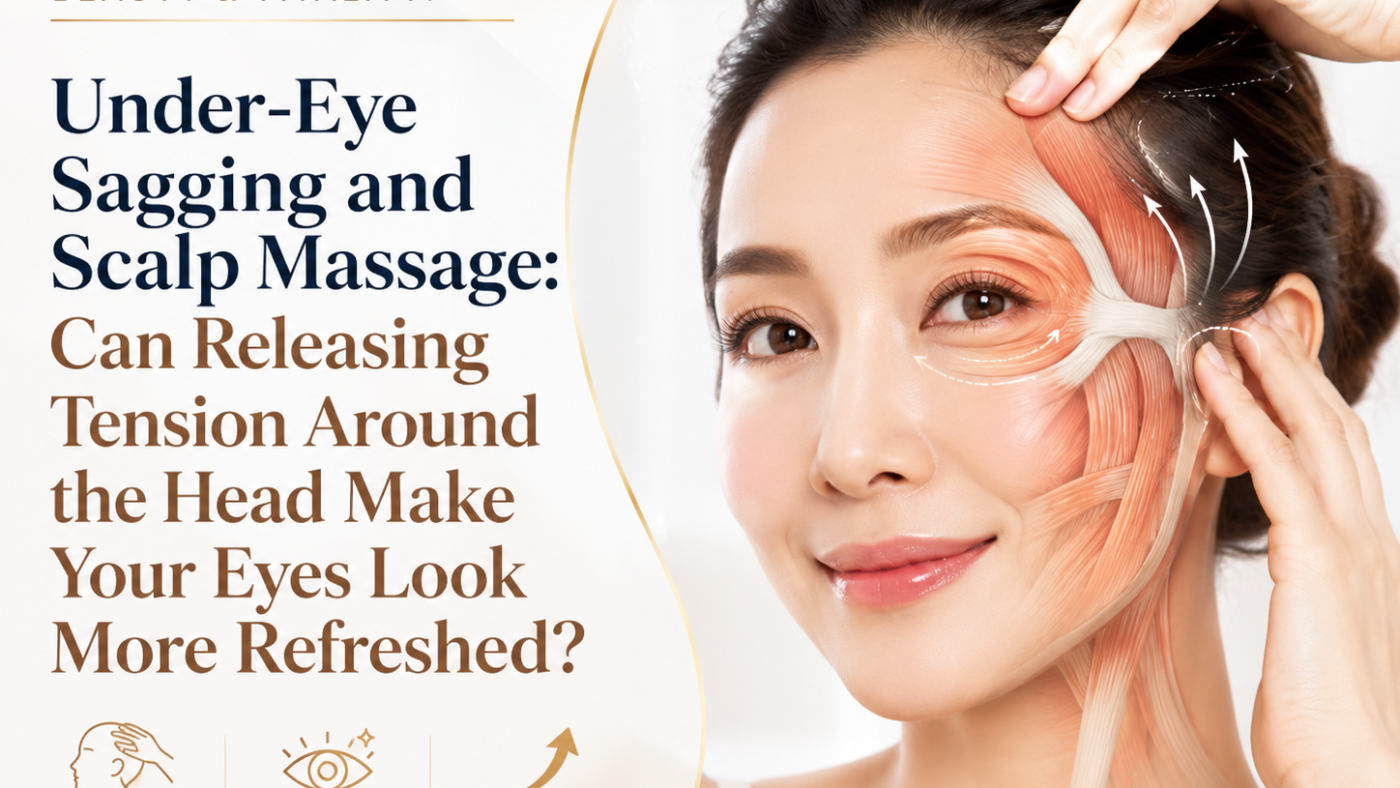
The area beneath the eyes is one of the first places many people notice changes associated with fatigue, fluid retention, facial expression, skin aging, and loss of structural support. When the under-eye area looks puffy, tired, or less firm, it is tempting to search for a massage technique that can instantly “lift” the eyes.
One increasingly popular approach involves massaging the scalp, ears, temples, hairline, and tissues around the eyes. The theory is that tension in the connective tissues of the scalp and face contributes to a tired appearance and that releasing this tension can improve circulation and make the eye area look more open and refreshed.
There is a reasonable wellness idea underneath this trend.
Gentle massage can temporarily increase local blood flow, relax tense muscles, improve body awareness, and help some people feel less tight around the scalp, forehead, temples, and jaw. Light facial massage may also temporarily influence superficial fluid movement and facial puffiness.
But this does not mean that scalp fascia can literally be pulled from the back of the head to permanently lift sagging skin beneath the eyes.
Understanding what massage can—and cannot—do makes it possible to use these techniques more safely and realistically.
Why Does the Under-Eye Area Change With Age?
The tissues around the eyes are delicate and structurally complex.
Changes in appearance can involve several factors at the same time, including:
- Thinning and reduced elasticity of the skin
- Changes in collagen and elastin
- Redistribution or protrusion of orbital fat
- Changes in facial bone structure
- Weakening of supporting tissues
- Fluid retention
- Allergies
- Sleep quality
- Sun exposure
- Genetics
- Repeated facial movement
This is why there is rarely one single cause of “under-eye sagging.”
A massage can influence tension and superficial fluid movement, but it cannot reverse every structural component of aging.
What Is the Epicranial Aponeurosis?
The original massage technique places considerable emphasis on a structure called the epicranial aponeurosis, also known as the galea aponeurotica.
This is a broad sheet of connective tissue across the top of the skull.
It connects muscles at the front and back of the scalp and forms part of the layered soft-tissue structure covering the skull.
The scalp and face are connected through an intricate network of skin, connective tissue, muscles, nerves, blood vessels, and fascial structures.
However, this should not be interpreted to mean that tightening in the back of the scalp literally pulls the under-eye tissues downward through a simple mechanical cable system.
Human facial anatomy is considerably more complex.
Can Scalp Tension Affect How Your Face Feels?
Yes—in terms of sensation and muscular tension.
People commonly experience tightness around the:
- Scalp
- Forehead
- Temples
- Jaw
- Neck
- Base of the skull
Stress, prolonged screen use, jaw clenching, posture, headaches, and habitual facial tension can all contribute to a sensation of tightness.
Gentle scalp massage may help some people relax these areas.
After massage, the forehead or eye region may feel more comfortable and less tense.
That change can also affect how someone perceives their facial appearance.
Feeling relaxed often makes the entire face look softer.
Can Massage Actually Lift Under-Eye Sagging?
This is where expectations need to remain realistic.
Massage may temporarily make the eye area appear more refreshed by:
- Relaxing facial tension
- Increasing local warmth and circulation
- Encouraging gentle superficial fluid movement
- Reducing the appearance of mild temporary puffiness
- Helping the person relax facial expressions
These effects can sometimes make the eyes appear slightly more open.
But massage has not been shown to permanently reposition substantially sagging skin, orbital fat, or other structural tissues.
A temporary visual improvement should not be confused with permanent anatomical lifting.
The Difference Between Puffiness and Sagging
This distinction is particularly important.
Puffiness
Under-eye puffiness can fluctuate.
It may appear worse:
- In the morning
- After a salty meal
- After alcohol
- During allergy episodes
- Following poor sleep
- After crying
Because fluid contributes to some forms of puffiness, gentle movement, time, cooling, and massage may temporarily change the appearance.
Structural Sagging or Bags
Persistent under-eye bags can involve changes in skin elasticity, supporting tissues, and orbital fat.
Massage cannot remove these structural changes.
That does not make massage useless—it simply means it should be viewed as a relaxation and cosmetic-care technique rather than a substitute for medical or dermatologic treatment.
What Is Fascia?
Fascia is connective tissue that surrounds, supports, separates, and connects structures throughout the body.
The term has become extremely popular in beauty and wellness content.
Unfortunately, it is sometimes described as if it were a piece of fabric that can simply become “stuck” and then be manually pulled back into its original position.
The reality is more nuanced.
Gentle manual pressure can affect the sensation and mobility of superficial tissues, but claims that a few minutes of massage permanently reshape facial fascia should be treated cautiously.
Why Ear Massage Can Feel So Relaxing
The massage begins by gently holding and rotating the ears.
The ears and surrounding tissues contain many sensory nerve endings, so gentle manipulation can produce a strong sensation despite using relatively little pressure.
Massaging around the ears may also indirectly relax tension in nearby areas such as the:
- Temples
- Jaw
- Side of the scalp
- Upper neck
This can make the entire head feel lighter.
It does not mean the ears are physically holding facial skin upward.
The benefit is better understood as relaxation and sensory stimulation.
Step 1: Gentle Ear Circles
Sit comfortably in front of a mirror.
Using your fingertips, gently hold the outer portion of each ear.
Slowly move the ears in small circles.
Continue for approximately:
20–30 seconds
The movement should feel comfortable.
Do not aggressively pull or twist the ear.
Breathe slowly while allowing your jaw and shoulders to relax.
Step 2: Massage Around the Base of the Ears
Place your fingertips in the soft tissues immediately around the ears.
Use small circular movements.
Work gradually around the:
- Front of the ear
- Area above the ear
- Tissue behind the ear
Avoid forceful pressure.
The goal is relaxation—not creating pain.
If you feel tenderness, reduce the pressure rather than trying to “break through” the discomfort.
Pain is not evidence that fascia is being successfully released.
Step 3: Relax the Side of the Scalp
Place several fingertips slightly above the ears.
Allow the fingertips to contact the scalp firmly enough that the skin moves slightly with your fingers.
Make slow circular movements.
Avoid rubbing aggressively across the hair.
Instead, gently move the scalp itself.
Continue for:
20–30 seconds on each side.
This technique can feel particularly relaxing for people who carry tension around the temples.
Step 4: Massage the Hairline
Move your fingertips toward the hairline around the temples.
Instead of strongly pulling the skin upward, use gentle pressure.
Make slow circles or very small upward movements.
Keep the forehead relaxed.
You may notice the eye area temporarily appears slightly more open when the skin near the temple is moved upward.
This is a direct mechanical effect while the tissue is being moved—not evidence of permanent lifting.
Step 5: Relax Around the Eyebrows
Place clean fingertips along the eyebrow region.
Use extremely gentle pressure.
Move slowly from the inner eyebrow toward the outer eyebrow.
Avoid pressing directly on the eyeball.
The tissues around the eyes are delicate, so more pressure is not better.
For cosmetic massage, comfort should always be the priority.
Step 6: Gentle Under-Eye Massage
The under-eye area requires the greatest caution.
Use your ring finger or another fingertip that allows very light pressure.
Place the fingertip on the orbital bone beneath the eye—not directly on the eyeball.
Make very small, gentle movements.
Do not aggressively stretch the skin.
A practical rule is:
If the skin is being dramatically dragged or distorted, you are probably using more force than necessary.
Can Massage Improve Blood Flow?
Massage can temporarily increase local skin temperature and blood flow.
This may contribute to the warm or tingling sensation people notice after rubbing the scalp or face.
That sensation is real.
However, feeling increased warmth does not automatically mean that sagging tissues have been anatomically lifted.
Blood-flow changes and structural rejuvenation are two different things.
Why Your Eyes May Look More Open After Massage
Several effects may contribute.
First, relaxing the forehead and temples may reduce unconscious tension around the eyes.
Second, gently manipulating the tissues may temporarily alter superficial fluid distribution.
Third, focusing on posture and breathing may reduce facial strain.
Finally, simply becoming more aware of the muscles around the eyes can change facial expression.
Together, these factors can create a temporary “awake” appearance.
What About Stimulating Facial Bones?
The idea that pressing around the orbital bones can regenerate or enlarge facial bones enough to prevent sagging eyelids is not supported as a practical cosmetic treatment.
Facial bone structure does change with age.
However, ordinary manual massage does not rebuild age-related skeletal changes in the way sometimes suggested by online beauty videos.
Bone health is influenced much more substantially by factors such as:
- Age
- Hormones
- Nutrition
- Vitamin D status
- Protein intake
- Physical activity
- Resistance exercise
- Genetics
- Certain medical conditions and medications
Gentle pressure around the orbital rim may feel stimulating, but it should not be described as facial bone regeneration.
What About the Meibomian Glands?
The meibomian glands are specialized oil-producing glands located within the eyelids.
They produce lipids that help stabilize the tear film and reduce excessive evaporation from the surface of the eye.
This makes them extremely important for eye comfort.
However, they are not cosmetic “lifting glands.”
People with meibomian gland dysfunction may be advised by an eye-care professional to use specific treatments such as warm compresses and carefully performed eyelid hygiene.
Randomly pressing or massaging directly around the eye should not be treated as a substitute.
Never press directly on the eyeball.
Do Not Massage Through Sharp Pain
One problematic idea in some massage routines is that sharp pain means a tight area is being successfully released.
That is not a safe assumption.
Massage does not need to hurt to work.
Stop or reduce pressure if you experience:
- Sharp pain
- Burning
- Numbness
- Tingling that persists
- Dizziness
- Visual changes
- Eye pain
- Headache that worsens
A comfortable stretching or pressure sensation is very different from significant pain.
A Safer 5-Minute Head and Eye Relaxation Routine
You can simplify the original routine into a gentle five-minute practice.
Minute 1: Ear and Jaw Relaxation
Gently rotate the ears and massage the tissues surrounding them.
Keep your jaw relaxed.
Minute 2: Side-of-Scalp Massage
Massage above and behind the ears using slow circular movements.
Minute 3: Temple and Hairline Massage
Move toward the temples and hairline.
Use light upward and circular pressure.
Minute 4: Eyebrow Relaxation
Massage gently along the eyebrows and orbital bones.
Avoid the eyeballs.
Minute 5: Breathing and Facial Relaxation
Close your eyes.
Inhale slowly.
Exhale slowly.
Relax the forehead.
Release the jaw.
Allow your shoulders to drop.
Finish with a natural smile rather than aggressively contracting the facial muscles.
Why Relaxation Matters More Than Force
One of the best ideas in the original routine is the emphasis on slow breathing.
Relaxation can reduce unconscious muscle tension throughout the face and head.
People often tighten their:
- Forehead
- Jaw
- Temples
- Eyes
- Shoulders
without realizing it.
A massage routine becomes more useful when it is treated as a short relaxation practice rather than an aggressive attempt to force tissues into a younger position.
Can Facial Massage Make You Look 20 Years Younger?
No massage can reliably promise to make a person biologically or structurally 20 years younger.
Such statements are motivational language rather than realistic medical claims.
Skin aging involves multiple biological processes that cannot be reversed with a few minutes of manual massage.
However, regular self-care may make someone look more rested and feel more confident.
That is a worthwhile outcome without needing an exaggerated anti-aging promise.
What Actually Helps Protect the Eye Area From Premature Aging?
For long-term skin appearance, evidence-supported habits matter considerably more.
Daily Sun Protection
Ultraviolet exposure contributes substantially to visible skin aging.
Regular broad-spectrum sunscreen use is one of the most valuable preventive habits.
Avoid Smoking
Smoking accelerates visible skin aging and damages collagen and elastin.
Adequate Sleep
Insufficient sleep can make the eye region appear darker, puffier, and more fatigued.
Treat Allergies
Repeated rubbing caused by itchy eyes can irritate the delicate eye area.
Maintain Good Nutrition
Adequate protein, fruits, vegetables, essential fatty acids, and micronutrients support overall skin health.
Use Appropriate Skin Care
Depending on the individual, moisturizers, retinoids, antioxidants, and other evidence-based skincare ingredients may support skin appearance.
Products used near the eyes should be formulated appropriately for this delicate region.
Massage Should Complement—Not Replace—Skin Care
Think of facial massage as one layer of a broader beauty routine.
A sensible routine may include:
Sun protection + appropriate skincare + sleep + exercise + nutrition + stress management + optional gentle massage.
That combination is considerably more realistic than expecting any single massage maneuver to stop facial aging.
When Under-Eye Changes Need Professional Evaluation
Sometimes an apparent cosmetic issue deserves medical attention.
Seek professional advice if you notice:
- Sudden swelling around one eye
- Significant redness
- Eye pain
- Vision changes
- Persistent inflammation
- A new lump
- Severe eyelid drooping
- Swelling accompanied by breathing problems
- Persistent symptoms that are getting worse
A dermatologist, ophthalmologist, optometrist, or other appropriate healthcare professional can determine whether the problem is cosmetic, dermatologic, allergic, or eye-related.
Who Should Avoid Aggressive Facial Massage?
Use additional caution if you have:
- Recent facial surgery
- Recent cosmetic injections or procedures
- Active skin infection
- Severe acne inflammation
- Eye infection
- Recent eye surgery
- Significant rosacea flare
- Open wounds
- Unexplained facial numbness or pain
If you recently underwent a cosmetic procedure, follow the aftercare instructions from the clinician who performed it.
A Better Goal Than “Never Sag Again”
Aging is not a failure of skincare.
Every face changes with time.
The most useful goal is not to create a face that “never ages.”
A healthier goal is to support comfortable skin, preserve function, protect against avoidable damage, and use cosmetic techniques that help you feel refreshed without unrealistic promises.
Gentle massage can fit very well within that philosophy.
The Bottom Line
Scalp, ear, temple, and facial massage can be a pleasant way to relax tension around the head and face.
It may temporarily improve the sensation of tightness, increase local warmth, encourage superficial fluid movement, and make the eye area appear more rested in some people.
But it cannot be expected to permanently lift under-eye tissues, rebuild facial bones, reverse decades of aging, or eliminate structural eye bags.
The safest approach is gentle.
Avoid aggressive pulling.
Avoid sharp pain.
Never press directly on the eyeballs.
Treat massage as a relaxing beauty and wellness ritual—not a medical facelift performed with your fingertips.
That more realistic expectation does not make the practice less valuable.
In fact, it makes it easier to enjoy the genuine benefits without relying on exaggerated promises.
FAQ
Can scalp massage reduce under-eye sagging?
Scalp massage may help relax tension and temporarily improve how the face feels, but there is no strong evidence that it permanently lifts structural under-eye sagging.
Can facial massage reduce under-eye puffiness?
Gentle massage may temporarily affect superficial fluid movement and can sometimes make mild puffiness look less noticeable. Persistent or unexplained swelling should be evaluated appropriately.
Does fascia cause eye bags?
Fascia is one part of the complex connective-tissue anatomy of the face, but persistent under-eye bags usually involve multiple factors including skin elasticity, fat, supporting tissues, bone structure, genetics, and fluid retention.
Can massaging behind the ears lift the face?
Massage around the ears can feel relaxing and may reduce perceived tension. It does not permanently pull facial tissues upward.
Should facial massage hurt?
No. Significant or sharp pain is not required for effective massage. Reduce pressure or stop if a technique is painful.
Can massage stimulate facial bones and reverse aging?
Ordinary facial massage has not been shown to rebuild age-related facial bone loss or reverse structural aging.
Can I massage directly beneath my eyes?
Only very gentle pressure should be used around the orbital bone. Avoid aggressive stretching and never press directly on the eyeball.
Can facial massage help me look younger?
It may temporarily make the face appear more relaxed or refreshed, but it should not be expected to reverse biological aging or create permanent lifting.
Medical Disclaimer
This article is for educational and informational purposes only and is not intended to diagnose, treat, cure, or prevent any medical condition. It is not a substitute for professional medical, dermatologic, or eye-care advice. Stop facial or scalp massage if it causes significant pain, visual changes, dizziness, persistent numbness, or worsening symptoms. Anyone with recent facial or eye surgery, active infection, significant eye disease, or recent cosmetic procedures should consult an appropriate healthcare professional before attempting massage around the eyes.
References
American Academy of Ophthalmology. Educational resources on eyelid health, dry eye disease, meibomian gland dysfunction, and age-related changes around the eyes.
American Academy of Dermatology. Guidance on skin aging, sun protection, and evidence-based strategies for maintaining healthy skin.
National Eye Institute. Educational information on tear-film health, dry eye disease, and eyelid-related conditions.
Peer-reviewed anatomical literature describing the scalp, galea aponeurotica, superficial musculoaponeurotic system, facial connective tissues, and age-related changes in facial soft tissue and bone.
Peer-reviewed dermatology and cosmetic-science literature examining facial massage, skin blood flow, skin elasticity, and temporary changes in facial morphology following mechanical stimulation.
This article is for general education and does not replace individualized care from a qualified health professional. Seek appropriate advice for persistent, severe, or concerning symptoms.
Read the full medical disclaimer