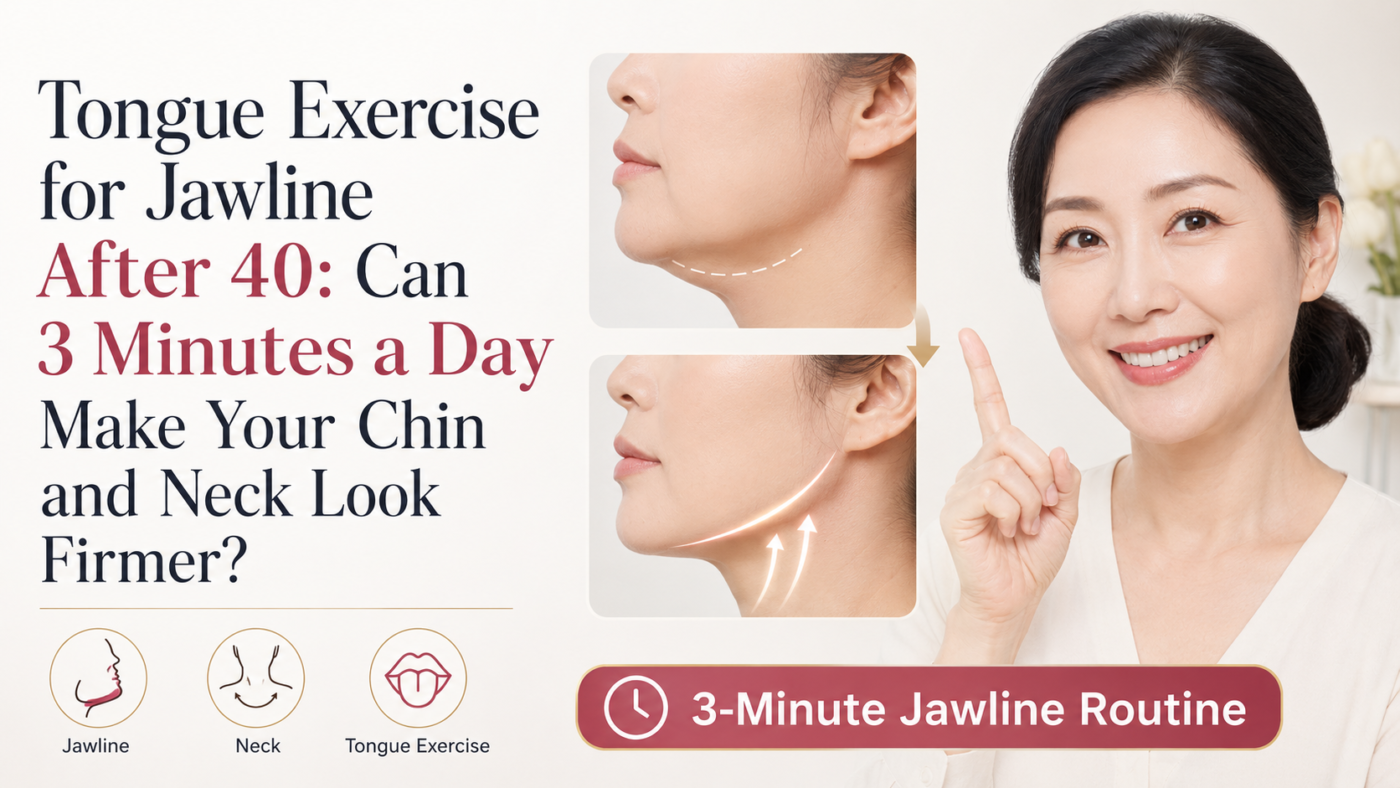
Can a Tongue Exercise Really Change Your Jawline?
A tongue exercise can feel surprisingly demanding.
Press your tongue firmly against the roof of your mouth.
Create gentle suction.
Hold for a moment.
Then release it with a small popping sound.
Repeat the movement several times and you may quickly notice fatigue beneath the tongue, around the floor of the mouth and sometimes under the chin.
That sensation has helped fuel a growing online claim:
Strengthen your tongue and you can tighten a sagging jawline.
Some routines promise visible improvement in only three minutes.
The idea is intriguing because the tongue does not exist in isolation. It interacts with muscles attached to the mandible, hyoid bone and floor of the mouth.
But feeling those muscles working does not automatically mean loose skin, submental fat or age-related jawline changes are disappearing.
The real anatomy is considerably more complicated.
What Actually Determines Your Jawline?
A defined jawline depends on much more than one muscle.
Its appearance is influenced by:
- The shape of the mandible
- Chin projection
- Skin thickness and elasticity
- Subcutaneous fat
- Submental fat beneath the chin
- Platysma muscle
- Muscles above the hyoid bone
- Deep neck tissues
- Facial fat distribution
- Age-related collagen changes
- Genetics
- Overall body composition
As we age, skin becomes less elastic, connective tissue changes and fat distribution can shift.
The underlying facial skeleton also changes gradually.
Together, these factors can make the border between the jaw and neck appear less sharp.
That means a single tongue movement cannot realistically address every cause of a softer jawline.
What Happens During a Tongue Pop?
Place your tongue against your palate and create suction.
Several structures have to coordinate.
Your tongue changes shape.
The tongue forms a seal against the palate.
Muscles connected to the tongue and floor of the mouth contribute to positioning.
The jaw remains relatively stable.
Pressure changes inside the oral cavity.
When you suddenly release the seal, you hear the characteristic “pop.”
This is a legitimate muscular movement.
It is therefore reasonable to call tongue popping an orofacial exercise.
What has not been established is that repeatedly making this sound causes visible jawline lifting.
Which Muscles Are Involved?
The tongue contains both intrinsic and extrinsic muscles.
Intrinsic muscles alter the shape of the tongue.
Extrinsic muscles help move the tongue forward, backward, upward and downward.
Several muscles in the region beneath the jaw also interact with the tongue, mandible and hyoid bone.
These include structures such as the:
- Mylohyoid
- Geniohyoid
- Digastric
- Genioglossus
Together, these structures are important for swallowing, speech, oral control and movement of the floor of the mouth.
When you press your tongue firmly against the palate, you may therefore feel activity underneath the chin.
That sensation is anatomically plausible.
It does not prove that the exercise is lifting loose skin.
Can Weak Tongue Muscles Cause a Sagging Jawline?
Not in the simple way often described online.
Tongue weakness can occur in certain neurological, muscular and age-related conditions and may affect swallowing or oral function.
But cosmetic jawline sagging generally has multiple causes.
Age-related skin laxity, submental fat, facial anatomy and connective-tissue changes are usually much more important to visible jawline contour than ordinary tongue strength.
So this statement:
Weak tongue muscles cause your jawline to sag.
is too simplistic.
A more accurate statement would be:
Tongue and floor-of-mouth muscles contribute to oral and under-chin function, but they are only one small part of the anatomy influencing jawline appearance.
Can Tongue Training Strengthen Muscles?
Yes.
This is where the idea has a legitimate foundation.
The tongue is muscular tissue, and targeted tongue exercises are used in several clinical fields.
Orofacial myofunctional therapy can include tongue, lip and oral exercises for functional purposes.
Research has investigated these approaches for swallowing, oral function and other problems.
There is also growing interest in whether myofunctional exercises might change aspects of facial appearance.
However, the evidence for cosmetic facial rejuvenation remains much less established than the evidence for functional rehabilitation.
A 2024 systematic review of myofunctional speech therapy for facial rejuvenation found studies reporting some improvements, but protocols varied considerably and stronger evidence is still needed.
A broader recent systematic review of mechanical facial rejuvenation techniques—including facial exercise, myofunctional therapy and massage—similarly concluded that evidence for aesthetic benefits remains uncertain.
So:
The muscles can be exercised.
But:
The cosmetic outcome cannot yet be guaranteed.
The 3-Minute Tongue Exercise for Jawline Routine
If you enjoy facial exercise, here is a gentler and more realistic version of the routine.
Do not try to create the loudest possible pop.
The goal is controlled muscle activation.
Minute 1: Tongue-to-Palate Suction
Sit or stand comfortably.
Relax your shoulders.
Keep your head approximately upright.
Place as much of your tongue as comfortably possible against the roof of your mouth.
Create gentle suction.
Hold for:
2–3 seconds.
Release.
Repeat slowly.
You may hear a light popping sound.
Continue for approximately:
30 seconds.
Rest briefly.
Then repeat for another 30 seconds.
Do not clench your teeth.
Do not hold your breath.
Minute 2: Add Gentle Neck Positioning
Return your tongue to the roof of your mouth.
Create gentle suction again.
This time, slowly turn your head slightly toward the left.
Return to center.
Turn gently toward the right.
The neck movement should remain comfortable.
Do not throw your head backward or aggressively stretch the front of your neck.
Continue alternating sides while performing slow tongue suction-and-release movements.
Minute 3: Under-Chin Awareness
Place clean fingertips very lightly under the chin.
Perform another tongue-to-palate contraction.
You may feel tissue beneath your fingers become firmer as muscles contract.
This can help you understand which area is working.
Release.
Repeat slowly.
The fingers are there for feedback, not to force tissue upward.
Avoid digging your thumbs deeply into the soft tissues beneath the jaw.
Finish with several relaxed breaths.
A More Challenging Version
Once the basic tongue exercise becomes comfortable, you can increase the muscular challenge slightly.
Press your entire tongue against the palate.
Hold the suction for:
5 seconds.
Relax for:
5 seconds.
Repeat:
5–10 times.
This creates a controlled isometric contraction rather than hundreds of frantic tongue pops.
For muscle training, controlled effort is generally more sensible than simply performing the movement as fast as possible.
Should You Pop the Tongue Fast?
You can increase speed somewhat, but there is no evidence that faster popping produces faster jawline changes.
Very rapid repetitive movements may simply fatigue the tongue.
They may also cause:
- Jaw tension
- Mouth fatigue
- Tongue soreness
- Headache in susceptible people
More intensity is not automatically more effective.
If you feel pain, stop.
Why Do You Feel It Under Your Chin?
This is one of the most interesting parts of the exercise.
When the tongue moves and presses against the palate, structures associated with the tongue, hyoid and floor of the mouth also become active.
That can create a feeling of contraction under the chin.
If you look in a mirror during a strong tongue-to-palate contraction, the submental area may even appear temporarily tighter.
But remember:
muscular contraction is temporary.
When the muscle relaxes, the appearance changes again.
Long-term structural change requires much more evidence.
Can Tongue Exercise Reduce a Double Chin?
There is currently no good evidence that tongue popping selectively burns submental fat.
A double chin can result from:
- Submental fat
- Genetics
- Jaw anatomy
- Skin laxity
- Aging
- Body weight
- Neck anatomy
Muscle exercise does not allow you to choose exactly where your body burns fat.
If excess submental fat is the main cause, a tongue exercise is unlikely to produce the same effect as meaningful overall fat loss or an evidence-based cosmetic treatment.
That does not make the exercise useless.
It simply changes the expectation.
Can It Firm Loose Skin?
This claim is also unproven.
Skin firmness depends heavily on collagen, elastin and the extracellular matrix.
These structures change gradually with age and ultraviolet exposure.
Exercising an underlying muscle does not automatically regenerate significant amounts of skin collagen above it.
A stronger underlying muscle could theoretically influence contour in certain anatomical areas.
But that is very different from directly tightening loose skin.
Does Tongue Popping “Drain Waste Products”?
No good evidence supports this wording.
Your body already has established systems for removing metabolic waste.
Blood circulation carries many metabolic products.
The lymphatic system transports interstitial fluid, immune cells and other substances.
Your kidneys, liver, lungs and gastrointestinal system all participate in processing and eliminating substances from the body.
There is no reservoir of facial “toxins” that becomes trapped beneath the jaw because you have not performed enough tongue pops.
That claim should therefore be removed from health content.
What About Lymphatic Drainage?
The lymphatic system is real.
Manual lymphatic drainage is also a real clinical technique.
But it is a specialized form of massage, most commonly associated with management of certain forms of lymphedema.
Even within medical lymphatic treatment, evidence varies depending on the condition and protocol.
Research has found benefits of professionally performed manual lymphatic drainage for some types of postoperative facial swelling, such as after orthognathic surgery.
That does not establish that ordinary under-chin pinching removes cosmetic puffiness from healthy adults.
Those are different situations.
Should You Pinch Under the Jaw?
The original routine includes deep, prolonged pinching beneath the jaw.
I would not recommend aggressive pinching.
The area beneath the jaw contains many important structures.
You do not need to compress them strongly to obtain a cosmetic benefit.
Instead, if massage feels pleasant:
Use clean fingertips.
Apply light pressure.
Move gently along the skin.
Stop if the area becomes sore.
Avoid leaving bruises.
A massage should not hurt simply because someone calls it “lymphatic.”
Does Pressing the Lymph Nodes Make Them Work Faster?
There is no established principle that squeezing lymph nodes harder causes better drainage.
Lymph nodes are biological filtering and immune structures.
They are not buttons that need to be manually activated.
Professional manual lymphatic drainage techniques generally use relatively light, controlled movements—not aggressive deep pinching of lymph nodes.
So:
deep pressure is not better lymphatic drainage.
Does Pinching Speed Up Collagen Repair?
This is another claim that should not be presented as established fact.
Controlled medical procedures can stimulate wound-healing pathways and collagen remodeling.
Examples include certain lasers, microneedling and other dermatological treatments.
But that does not mean pinching the skin beneath your chin with your fingers predictably accelerates collagen repair.
There is no good clinical evidence supporting that claim.
In fact, vigorous facial massage can sometimes cause irritation, redness, swelling or dermatitis in susceptible people.
A Safer Jawline Massage
If you want to combine massage with the tongue routine, keep it simple.
Step 1
Place two fingers gently beneath the center of the chin.
Do not push deeply into the throat.
Step 2
Slide outward toward the jawline using light pressure.
Step 3
Repeat several times toward each side.
Step 4
Move your hands toward the sides of the neck with very gentle strokes.
Step 5
Relax completely.
This is best viewed as a soothing massage—not a lymph-node treatment.
Can Massage Make the Jawline Look Better Temporarily?
Possibly.
Facial appearance changes throughout the day.
Temporary fluid shifts, muscular tension, posture and facial expression can all affect how defined the jawline appears.
Gentle massage may make the area:
- Feel relaxed
- Feel warmer
- Look temporarily less tense
- Feel less puffy in some circumstances
These short-term changes are possible.
They are not evidence of permanent lifting.
What About Posture?
Posture can have a surprisingly large effect on how the jaw and neck look in photographs and mirrors.
Try this:
Push your head forward.
Allow the shoulders to round.
Look at your jawline.
Now return your head gently over your shoulders and lengthen the back of your neck.
The contour changes immediately.
No fat disappeared.
No collagen suddenly appeared.
The geometry simply changed.
For that reason, healthy neck positioning can complement jawline exercises.
It should not be sold as permanent structural rejuvenation.
A Better 6-Minute Jawline Routine After 40
Instead of doing only tongue pops, combine several gentle components.
Minute 1 — Tongue Suction
Press the tongue against the palate.
Hold.
Release.
Repeat.
Minute 2 — Slow Tongue Pops
Perform comfortable tongue pops at a controlled pace.
Avoid jaw clenching.
Minute 3 — Neck Rotation
Turn gently left and right while maintaining good posture.
Minute 4 — Chin Retraction
Keep your head level.
Gently draw your chin backward as though creating a small “double chin.”
Do not look down.
Release.
Repeat slowly.
This trains cervical positioning rather than forcing the neck into extension.
Minute 5 — Light Jaw Massage
Use gentle outward strokes beneath the jaw.
No deep pinching.
Minute 6 — Relaxation
Relax your tongue.
Drop your shoulders.
Breathe slowly.
Allow your jaw to remain unclenched.
This produces a more balanced routine than aggressively performing one movement for several minutes.
Can You Get Results in Three Minutes?
You can certainly feel something in three minutes.
Your tongue may feel fatigued.
The floor of your mouth may feel active.
You may become more aware of your posture.
Your face may temporarily look slightly different because of muscular contraction.
But three minutes is not enough to conclude that you have remodeled the skin or permanently lifted your jawline.
If facial exercise has any meaningful long-term cosmetic effect, research suggests it would more likely require repeated practice over weeks rather than one short session.
The available studies on facial exercises generally use sustained programs, and systematic reviews still regard the overall aesthetic evidence as insufficient or uncertain. PubMed
How Often Should You Practice?
There is no scientifically established optimum schedule for cosmetic tongue popping.
A conservative starting point is:
3–5 minutes once a day
or:
3–5 days per week.
Stop if you develop persistent soreness.
There is no advantage to exercising an irritated tongue or jaw.
Who Should Be Careful?
Avoid or modify this routine if you have:
- Significant temporomandibular joint pain
- Recent dental procedures
- Recent oral surgery
- Tongue injury
- Painful oral ulcers
- Significant swallowing problems
- Neurological disease affecting tongue control
- Unexplained lumps beneath the jaw
- Active head or neck infection
If tongue weakness has developed suddenly or you notice new speech or swallowing problems, do not treat it as a beauty issue.
Seek medical assessment.
When Jawline Changes Need Medical Attention
Most changes in jawline appearance are cosmetic and gradual.
But see a healthcare professional if you develop:
- A new lump
- Persistent one-sided swelling
- Enlarged lymph nodes that do not resolve
- Difficulty swallowing
- Unexplained pain
- Sudden facial weakness
- Tongue weakness
- Unintentional weight loss
- Persistent hoarseness
A massage or face-yoga routine should never delay assessment of a new neck mass.
What Actually Has Stronger Evidence for Jawline Improvement?
The answer depends on the cause.
If Submental Fat Is the Main Issue
Overall weight management may help when excess body fat contributes.
Medical cosmetic options can also target submental fat in appropriately selected patients.
If Skin Laxity Is the Main Issue
Professional aesthetic approaches may include:
- Energy-based treatments
- Collagen-stimulating procedures
- Selected injectables
- Surgical lifting procedures
The evidence for professionally administered nonsurgical facial treatments is substantially stronger for some established procedures than for home facial exercises. PubMed
If Jaw Anatomy Is the Main Issue
Exercise cannot change adult mandibular bone projection.
That is an important limitation.
Sometimes what appears to be a “weak jawline” is largely skeletal anatomy rather than muscle weakness.
Tongue Exercise vs. Mewing
Tongue-to-palate exercise is sometimes confused with “mewing.”
They are not necessarily the same thing.
Tongue-to-palate resistance is simply a muscular exercise.
“Mewing” commonly refers to maintaining a particular tongue posture for extended periods with claims that it can reshape the adult jaw.
There is insufficient evidence that tongue posture alone dramatically remodels an adult facial skeleton.
So you do not need to force your tongue upward all day in pursuit of a new jawbone shape.
Comfortable oral function matters more.
What You May Realistically Notice
After several weeks of regular tongue exercise, you may become better at:
- Creating tongue-palate suction
- Controlling tongue movements
- Recognizing tension beneath the chin
- Maintaining relaxed jaw posture
- Becoming aware of head and neck position
Some people may also feel that the area looks somewhat firmer during muscular contraction.
Those are reasonable outcomes.
What cannot currently be guaranteed is:
- Permanent jawline lifting
- Elimination of a double chin
- Removal of facial waste products
- Accelerated collagen repair
- Permanent lymphatic drainage
- Visible rejuvenation after one three-minute session
The Bottom Line
A tongue exercise is much more interesting anatomically than it first appears.
Your tongue interacts with a complex system of muscles involved in swallowing, speech, oral control and the floor of the mouth.
Pressing the tongue to the palate and releasing it creates genuine muscle activity.
So tongue popping is not meaningless.
But there is a large difference between:
“This exercise activates tongue and oral muscles.”
and:
“Three minutes will permanently lift your jawline.”
Current research does not support the second claim.
The same applies to aggressive under-chin massage.
There is no convincing evidence that pinching lymph nodes removes facial waste or rapidly repairs collagen.
A better approach is gentle:
Train the tongue if you enjoy it.
Maintain comfortable neck posture.
Use light massage rather than painful pinching.
Protect your skin from UV exposure.
Maintain a healthy body composition.
And keep your expectations realistic.
A three-minute routine can be a useful daily beauty ritual.
It just does not need to be described as a three-minute facelift to be worthwhile.
FAQ
Can tongue exercise tighten the jawline?
A tongue exercise activates muscles involved in tongue and oral-floor function, but there is insufficient evidence that it permanently tightens a sagging jawline.
Does tongue popping reduce a double chin?
There is no reliable evidence that tongue popping selectively burns submental fat.
Why can I feel tongue exercises under my chin?
Muscles and structures involved in tongue movement interact with the floor of the mouth, hyoid region and tissues beneath the jaw, so activity can be felt under the chin.
How long should I do tongue exercise?
Start with approximately three minutes at a comfortable intensity. There is no established evidence that longer sessions produce better cosmetic outcomes.
Does tongue exercise stimulate lymphatic drainage?
There is insufficient evidence that tongue popping produces clinically meaningful facial lymphatic drainage.
Should I massage my lymph nodes?
Do not aggressively squeeze or pinch lymph nodes. Professional manual lymphatic drainage uses specialized techniques and is different from deep home massage.
Does pinching the skin increase collagen?
There is no good evidence that ordinary skin pinching reliably accelerates collagen repair.
Can facial exercise improve appearance after 40?
Some small studies report localized aesthetic improvements, but systematic reviews conclude that evidence remains limited and inconsistent.
When will I see results?
You may notice muscular control or awareness within days or weeks. Permanent visible jawline changes cannot be predicted from current evidence.
Is tongue popping safe?
It is generally low-risk when performed gently, but stop if it causes tongue pain, jaw pain, headache or other symptoms.
Medical Disclaimer
This article is for educational and informational purposes only and is not intended to diagnose, treat or prevent any medical condition. People with swallowing disorders, neurological conditions, significant TMJ problems, recent oral or dental surgery, unexplained neck swelling or other relevant conditions should consult an appropriate healthcare professional before attempting intensive tongue, jaw or neck exercises.
This article is for general education and does not replace individualized care from a qualified health professional. Seek appropriate advice for persistent, severe, or concerning symptoms.
Read the full medical disclaimer