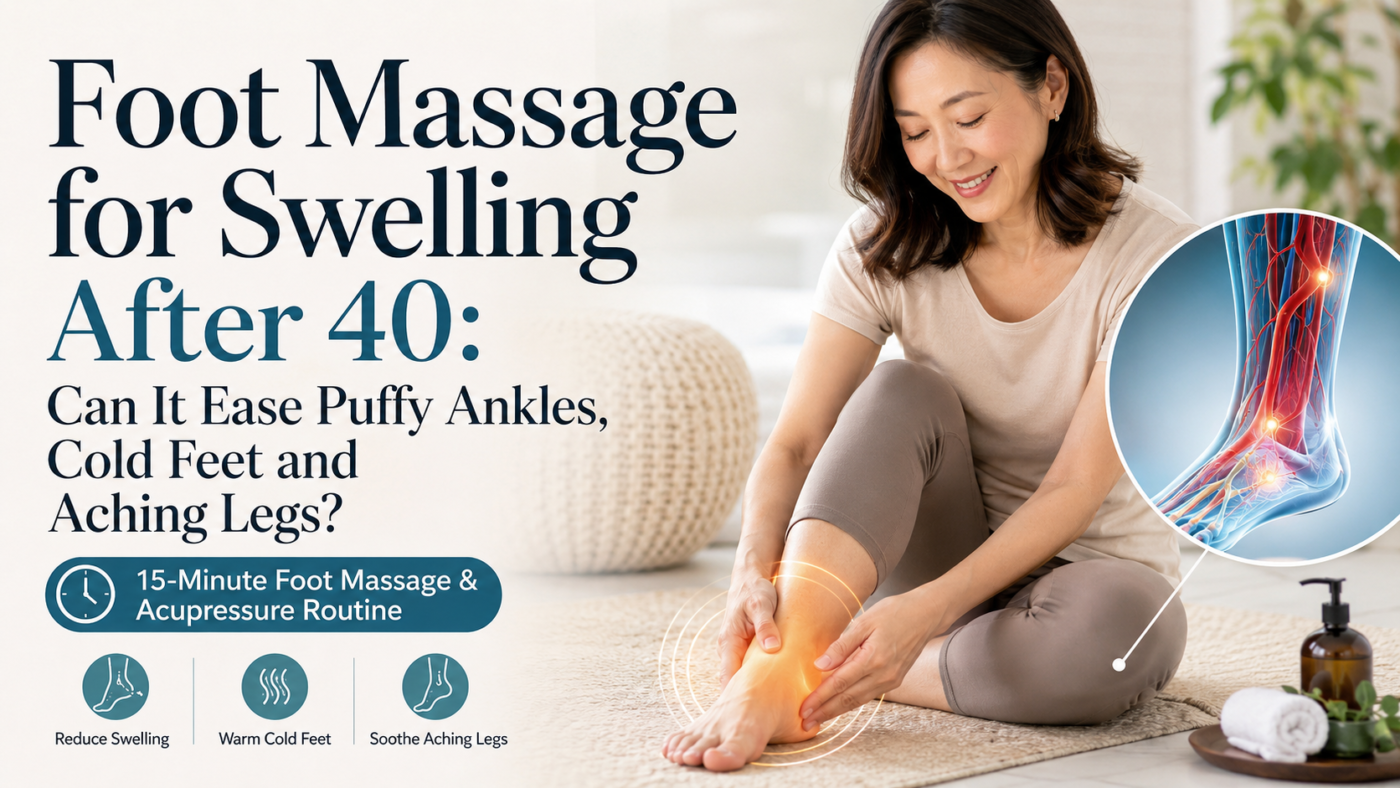
Can Foot Massage Really Help Puffy, Tired Legs?
A foot massage for swelling can feel remarkably soothing after a long day.
Warm the toes with your hands, rotate the ankles, massage around the foot and gradually stroke upward from the ankle toward the calf. Within minutes, the feet may feel warmer and the legs may feel less heavy.
Those sensations are real.
Massage can influence local tissues, temporarily alter skin blood flow and provide pleasant sensory stimulation. Moving the ankles also activates muscles around the lower leg and may help the normal movement of blood and fluid during everyday activity.
But this is where realistic expectations matter.
A massage that makes your legs feel lighter is not necessarily treating the medical cause of edema.
And a temporary increase in local warmth does not mean that a particular pressure point has dramatically improved circulation throughout your entire body.
The routine can still be worthwhile without those promises.
Why Do Feet and Ankles Become Puffy?
There are many reasons.
After sitting or standing for a long time, gravity can encourage fluid to collect in the lower legs. This is why some people notice sock marks or slightly puffy ankles toward the end of the day.
Temporary swelling can also be influenced by:
- Hot weather
- Prolonged sitting
- Long flights
- High salt intake
- Certain medications
- Pregnancy
- Menstrual and hormonal changes
- Reduced physical activity
But persistent or pronounced swelling may have a completely different cause.
Leg edema can also occur with chronic venous problems, lymphatic disorders, heart disease, kidney disease and other medical conditions.
Most importantly, sudden swelling of one leg, particularly when accompanied by calf pain, tenderness, warmth or redness, can be associated with deep vein thrombosis.
That is not something to massage away.
It requires medical evaluation.
What Can Massage Actually Do?
Some experimental research has found that massage of the lower limbs can produce short-term changes in local tissue perfusion.
For example, a controlled study of lower-limb massage found measurable changes in local perfusion during and after massage.
Another study involving people with diabetic peripheral neuropathy found that both therapist-delivered Thai foot massage and self-foot massage increased measured foot skin blood flow immediately after treatment and improved ankle range of motion.
Those findings make the simple statement:
“Massage may temporarily increase local blood flow.”
reasonable.
They do not prove:
“Foot massage improves circulation throughout your entire body.”
That is a much larger claim.
The distinction is especially important on a health website.
Can Foot Massage Warm Cold Feet?
It can temporarily.
Rubbing and manipulating the skin generates heat through friction, while local vascular responses may also change skin temperature and blood flow.
This can make cold feet feel warmer after massage.
A small pilot study of reflexology also reported short-term changes in skin temperature and blood flow in people who experienced cold intolerance, although the study was very small and cannot establish a reliable treatment effect.
So if your feet simply feel cold after sitting still in winter, gentle massage may feel pleasant.
But persistently cold feet deserve more attention.
They can sometimes be associated with:
- Raynaud phenomenon
- Peripheral artery disease
- Diabetes
- Thyroid problems
- Nerve problems
- Anemia
- Medication effects
If one foot is consistently much colder than the other, its color changes significantly, wounds heal slowly, or you develop pain when walking, seek medical assessment rather than relying on massage.
A 15-Minute Foot Massage for Swelling and Tired Legs
This routine is intended for otherwise healthy adults experiencing ordinary tiredness or mild temporary puffiness.
The pressure should feel comfortable.
Pain is not evidence that the massage is working.
Step 1: Prepare Your Feet
Sit somewhere stable.
Keep a towel nearby.
If you prefer, use a small quantity of moisturizer or massage oil so your hands glide comfortably.
Do not use so much oil that your feet or floor become dangerously slippery.
Before beginning, look at your feet.
Do not massage over:
- Open wounds
- Skin infections
- New unexplained bruising
- Inflamed veins
- Severe redness
- Acute injury
Then begin.
Step 2: Warm the Toes
Cup your toes between your hands.
Gently rub them for approximately 30–60 seconds.
Work around each toe without aggressively pulling or twisting it.
The goal is simply to warm the tissues and become aware of the feet.
If you have decreased sensation due to neuropathy, be particularly careful because excessive friction or pressure may damage skin without causing normal warning pain.
Step 3: Move Between the Toes
Gently place your fingers between the toes if comfortable.
Do not force them apart.
Spread the toes slightly and relax.
Repeat several times.
Toe mobility varies considerably between people, so there is no need to reproduce an extreme stretch.
Step 4: Rotate the Ankle
Support the lower leg.
Slowly circle the ankle in one direction.
Perform approximately:
5–10 comfortable circles.
Reverse direction.
Ankle movement is useful because walking depends on adequate mobility through the foot and ankle.
Keep the movement slow rather than forcing the joint to its maximum range.
Step 5: Massage the Top of the Foot
Using your fingers or soft knuckles, make gentle strokes along the top of the foot.
Avoid digging aggressively between the bones.
Move from the toes toward the ankle.
Repeat several times.
You may experience a pleasant warming sensation.
That is enough.
Step 6: Massage Around the Ankle
Use your fingertips to make small circles around the soft tissues near the ankle.
Avoid pressing directly and forcefully onto prominent bones.
Work slowly around the area.
People with ordinary end-of-day puffiness may find this soothing.
Remember, however, that general self-massage is not the same thing as professional manual lymphatic drainage, which is a specialized technique used for certain lymphatic conditions.
Step 7: Stroke From the Ankle Toward the Calf
Place both hands around the lower leg.
Use broad, comfortable strokes upward from the ankle toward the calf.
Release your pressure as you bring your hands back down.
Repeat slowly.
Do not squeeze the calf aggressively.
A foot massage for swelling should feel relaxing rather than painful.
If one calf is suddenly swollen, warm, red or painful, do not continue this step.
Step 8: Warm the Entire Ankle
Rub around the ankle with both hands for approximately 20–30 seconds.
Friction can temporarily warm the skin.
This can make the next part of the routine more comfortable.
What Is the SP6 / Sanyinjiao Point?
The video introduces an acupressure point known in Japanese as a “tsubo” and in Traditional Chinese Medicine as Sanyinjiao, usually abbreviated SP6.
The Chinese name is:
三阴交 — Sānyīnjiāo
Traditionally, the name refers to the meeting of three yin meridian systems of the leg.
In traditional East Asian medicine, SP6 has been used for a wide variety of concerns involving menstruation, digestion, sleep and other symptoms.
That traditional theory should be distinguished from modern anatomy and physiology.
There is no anatomical structure known as a “three-yin-meridian intersection” in contemporary medicine.
Where Is SP6?
SP6 is generally described as being on the inside of the lower leg, approximately several finger-widths above the highest point of the inner ankle bone, close to the posterior border of the tibia.
Do not become obsessed with locating the point to the millimeter.
For a gentle home routine, the important rule is:
Do not press so strongly that you cause sharp pain, numbness or bruising.
Does SP6 Improve Whole-Body Circulation?
This is where the original video overreaches.
SP6 has been studied scientifically, but most research does not concern generalized circulation or ankle swelling.
For example, systematic reviews have investigated SP6 acupressure for primary menstrual pain, with some studies reporting reductions in pain. Research quality and protocols vary considerably.
That provides evidence that the point is a legitimate subject of clinical research.
It does not prove that pressing SP6:
- Increases blood flow throughout the body
- Removes ankle edema
- Raises metabolism
- Balances body temperature
- Improves cardiovascular health
Those claims require separate evidence.
Current evidence is insufficient to make them confidently.
How to Add Gentle SP6 Acupressure
If you enjoy traditional acupressure, you can include it as an optional component.
Locate the general SP6 area.
Use the pad of your thumb.
Apply comfortable, steady pressure.
Hold for approximately:
10–20 seconds.
Release.
Repeat two or three times.
The sensation may feel mildly tender.
It should not feel intensely painful.
You do not need to press harder simply because a point feels sensitive.
Tenderness is not a reliable diagnostic test for “poor circulation.”
Continue From the Heel Toward the Ankle
Return your attention to the heel.
Use your fingers to make gentle upward strokes toward the ankle.
Work around the sides of the heel rather than digging directly into painful areas.
Then continue the strokes toward the lower calf.
Keep your pace rhythmic and comfortable.
Massage the Calf Gently
Wrap your hands loosely around the calf.
Use broad strokes rather than deep squeezing.
Move upward.
Relax.
Repeat.
Avoid vigorous “wringing” motions if you:
- Bruise easily
- Take blood-thinning medication
- Have prominent painful veins
- Have recently injured your leg
Massage should never leave significant bruising.
Finish With Light Upward Strokes
For the final minute, use lighter strokes from the ankle toward the knee.
Then allow the leg to relax.
Notice how it feels compared with the other side.
You may notice:
Warmth.
Relaxation.
Less stiffness.
A temporary reduction in the sensation of heaviness.
These are perfectly worthwhile effects even if the actual circumference of the leg has barely changed.
Then repeat the routine on the opposite side.
Does Massage Really “Drain” Fluid?
The word drain is frequently used in beauty massage videos.
It needs context.
Your lymphatic system does move excess fluid from tissues, and specialized manual lymphatic drainage techniques can be part of professionally supervised treatment for lymphedema.
But ordinary cosmetic self-massage has not been proven to act like a pump that rapidly removes every type of leg swelling.
If swelling is caused by kidney disease, heart disease, venous insufficiency or a blood clot, rubbing the leg does not correct the underlying cause.
Therefore, a better description for this home routine is:
gentle leg massage for comfort and temporary puffiness
rather than:
draining edema from the body.
Will Massage Make Your Legs Look Slimmer?
Possibly temporarily—but not because it burns leg fat.
If mild fluid accumulation decreases or the tissues become less compressed, the ankle or lower leg may temporarily look slightly less puffy.
That can produce a more defined appearance.
But massage cannot selectively melt fat from the legs.
Long-term leg shape is influenced by:
- Body fat
- Muscle mass
- Genetics
- Bone structure
- Fluid retention
- Venous health
- Physical activity
If your goal is more toned legs, combine massage with movement rather than replacing movement with massage.
Walking.
Calf raises.
Resistance training.
Cycling.
Swimming.
And other appropriate exercises have much greater effects on muscle and body composition.
Can Foot Massage Lower Blood Pressure?
Do not depend on it for this purpose.
Some individual massage studies have reported changes in blood pressure, while other research has not found convincing benefits.
A systematic review specifically examining foot reflexology in people with hypertension concluded that pooled results did not show a convincing blood-pressure-lowering effect.
Therefore:
Massage can be relaxing.
But:
Massage is not a treatment for hypertension.
Never reduce or stop prescribed blood-pressure medication because a massage makes you feel better.
Does Massage “Boost Metabolism”?
There is no good evidence that pressing the ankle or SP6 meaningfully increases whole-body metabolism.
Massage does not burn calories at anything close to the level produced by walking, cycling or resistance exercise.
If you feel warmer during a massage, this does not mean your metabolic rate has suddenly accelerated enough to cause weight loss.
Warmth and fat burning are not interchangeable concepts.
Why Do Legs Sometimes Feel So Much Better Afterward?
Because comfort is a legitimate physiological outcome.
Massage provides sensory input to the nervous system.
It moves the skin and soft tissues.
It may alter local perfusion.
It can improve your awareness of tight areas.
Ankle rotations provide movement after prolonged sitting.
And the entire experience can simply be relaxing.
You do not need to describe those effects as a “miracle” for them to matter.
For someone who has spent eight hours sitting at a desk, ten minutes spent moving the feet, rotating the ankles and gently massaging the lower legs can feel excellent.
That is a perfectly valid reason to do it.
A Better Routine for Puffy Legs After 40
If ordinary end-of-day leg heaviness is your concern, combine massage with movement.
Try:
1. Walk Regularly
Avoid sitting motionless for several hours.
Even brief walking breaks activate the calf muscles.
2. Perform Calf Raises
Rise slowly onto your toes.
Lower again.
Try:
10–20 repetitions
if comfortable.
3. Move Your Ankles
While seated, alternate between pointing and flexing the feet.
4. Change Position
Avoid remaining in one position all day.
5. Elevate the Legs When Appropriate
For some forms of ordinary dependent swelling, resting with the legs elevated may feel helpful.
6. Use Massage for Comfort
Finish with several minutes of gentle massage.
This gives you a much more complete routine than relying on one pressure point.
When You Should NOT Massage a Swollen Leg
This section is extremely important.
Do not assume every swollen ankle simply needs “better circulation.”
Seek prompt medical evaluation for new or unexplained swelling, particularly when:
- Only one leg suddenly swells
- The calf becomes painful or tender
- The leg becomes unusually warm or red
- Swelling occurs after recent surgery or prolonged immobilization
- You have a history of blood clots
Sudden unilateral swelling with calf pain can be associated with deep vein thrombosis.
If leg swelling occurs together with shortness of breath, chest pain, faintness or coughing blood, seek emergency medical care.
Do not massage first.
Other Reasons to Be Careful
Get individualized medical advice before deep foot or leg massage if you have:
- Significant peripheral artery disease
- Diabetic neuropathy
- Open diabetic foot wounds
- Severe varicose-vein symptoms
- Lymphedema
- Active infection
- Recent fracture or surgery
- Significant osteoporosis
- Bleeding disorders
- Blood-thinning medication
Gentle touch may still be possible for some people, but the correct technique depends on the condition.
What About Pregnancy and SP6?
SP6 has traditionally been used in obstetric acupuncture and acupressure research.
Because pregnancy changes circulation and because unilateral swelling can sometimes signal a medical problem, pregnant people should not use aggressive pressure-point routines as a substitute for prenatal medical care.
If you are pregnant and want to use sustained SP6 acupressure, discuss it with an appropriately qualified healthcare professional first.
What Can You Realistically Expect After Two Weeks?
After two weeks of regular practice, you might become:
More comfortable performing ankle movements.
More aware of how your feet feel.
More consistent about caring for your legs.
Better at noticing stiffness or asymmetry.
You may also experience temporary warmth and relaxation after each session.
What cannot be guaranteed is:
- Permanently improved circulation
- Lower blood pressure
- Faster metabolism
- Elimination of edema
- Dramatically slimmer legs
- A body “20 years younger”
Those promises are unnecessary.
The routine already has value as a relaxing self-care practice.
The Bottom Line
A foot massage for swelling can be a pleasant addition to a healthy movement routine, particularly when your feet and ankles simply feel tired, stiff or mildly puffy after a long day.
Gentle massage may temporarily increase local blood flow.
Rubbing can make cold feet feel warmer.
Ankle rotations can maintain mobility.
Light calf strokes may feel relaxing.
And SP6 acupressure can be incorporated as a traditional Eastern wellness practice when it is described accurately.
What the evidence does not support is the claim that pressing SP6 or massaging the feet automatically improves whole-body circulation, permanently eliminates edema, dramatically boosts metabolism or produces healthier blood pressure.
The safest approach is to combine the best of both worlds:
Respect traditional practices.
Understand modern physiology.
Enjoy massage for what it can realistically provide.
And recognize when swollen legs require medical attention rather than stronger massage.
Your feet do not need a miracle.
Sometimes they simply need movement, appropriate care—and a few minutes of attention.
FAQ
Does foot massage for swelling actually work?
Gentle massage may temporarily change local blood flow and make tired or mildly puffy feet feel more comfortable. It should not be considered a treatment for unexplained or medically caused edema.
Can massage reduce swollen ankles?
Minor temporary puffiness may sometimes look or feel better after movement and gentle massage. Persistent, severe or unexplained swelling needs medical evaluation.
Can foot massage improve circulation?
Studies suggest certain massage techniques can temporarily affect local blood flow. This does not establish that home foot massage improves circulation throughout the entire body.
Can foot massage warm cold feet?
Rubbing generates warmth and may temporarily change local blood flow, so feet can feel warmer immediately after massage. Persistent or asymmetric cold feet should be medically evaluated.
What is the SP6 Sanyinjiao point?
SP6, or Sanyinjiao, is a traditional acupuncture and acupressure point on the inner lower leg above the medial ankle. It has been studied for several conditions, particularly menstrual symptoms, but evidence does not establish it as a treatment for generalized poor circulation or leg edema.
Does SP6 boost metabolism?
There is insufficient evidence that pressing SP6 meaningfully increases whole-body metabolic rate or causes weight loss.
Can massage make my legs slimmer?
It does not remove leg fat. A temporary reduction in ordinary puffiness may make the legs look slightly more defined, but long-term body composition requires nutrition and physical activity.
How long should I massage my feet?
For general relaxation, approximately 5–15 minutes can be sufficient. There is no proven requirement to perform a specific massage for exactly two weeks.
Should massage hurt?
No. Strong pain is not evidence of better circulation or a more effective pressure point. Reduce the pressure or stop.
Can I massage sudden swelling in one leg?
No. Sudden swelling in one leg—particularly with calf pain, warmth or redness—requires medical assessment because deep vein thrombosis is one possible cause.
Medical Disclaimer
This article is intended for general educational purposes only and does not diagnose or treat edema, vascular disease, lymphedema, hypertension or other medical conditions. New, persistent, severe or one-sided leg swelling should be medically evaluated. Seek urgent medical care for sudden unilateral swelling with pain or for swelling accompanied by chest pain, shortness of breath or other concerning symptoms. People with vascular disease, diabetes-related neuropathy, wounds, recent surgery, pregnancy or other relevant conditions should seek individualized advice before performing intensive foot or leg massage.
This article is for general education and does not replace individualized care from a qualified health professional. Seek appropriate advice for persistent, severe, or concerning symptoms.
Read the full medical disclaimer