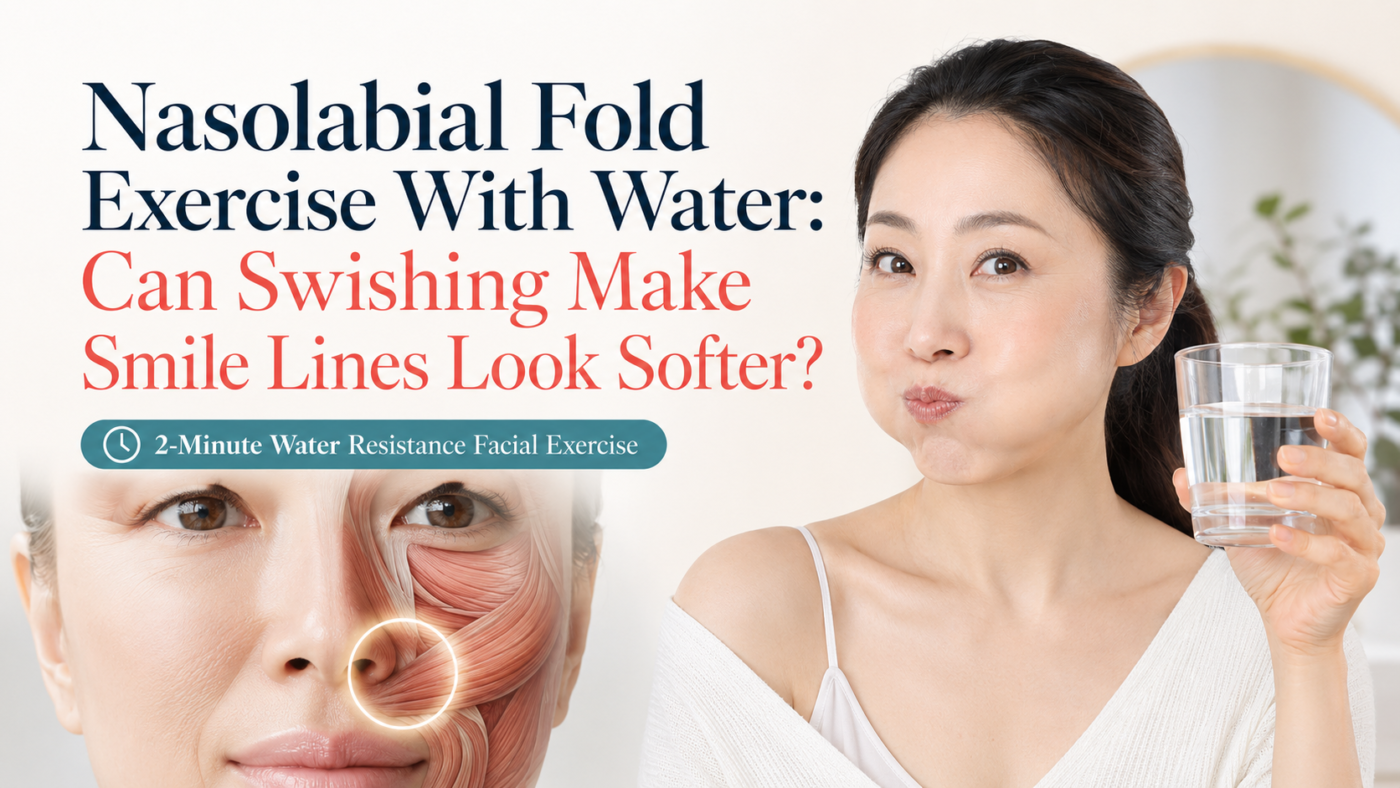
Can Moving Water Inside Your Mouth Really Change Your Face?
A nasolabial fold exercise using nothing more than a small amount of water sounds almost too easy.
Take a sip.
Hold the water inside your mouth.
Move it forward and backward while alternately puffing and drawing in your cheeks.
Continue for a minute or two.
The muscles around the lips and cheeks begin to work surprisingly hard.
Some facial-exercise videos claim that this routine can make nasolabial folds disappear “from the inside out,” eliminate puffiness inside the mouth, lift sagging cheeks and even regulate the autonomic nervous system.
The reality is more interesting—and considerably less dramatic.
Moving water around the mouth does create resistance. Your lips must remain sealed. The cheek muscles must control pressure. The tongue, lips and surrounding facial muscles coordinate continuously to prevent the water from escaping.
That means the activity can reasonably be described as an orofacial muscle exercise.
But exercising facial muscles is not the same thing as erasing a structural facial fold.
Understanding that distinction can help you use this exercise realistically without expecting a one-minute anti-aging miracle.
What Are Nasolabial Folds?
Nasolabial folds are the lines or creases that run from the sides of the nose toward the corners of the mouth.
Almost everyone has them to some degree.
They are part of normal facial anatomy and become particularly visible when smiling.
With age, however, the folds may become deeper or remain visible even when the face is relaxed.
This happens because facial aging is not confined to the skin.
The face contains multiple interconnected layers, including:
- Skin
- Subcutaneous fat
- Deep facial fat compartments
- Connective tissue
- Retaining ligaments
- Facial muscles
- Bone
All of these structures change with age.
Facial fat compartments can change in volume and position. Connective tissues can become more lax. Skin loses some elasticity and collagen. Changes in the underlying facial skeleton can alter support for the overlying soft tissues.
Anatomical research also shows that the nasolabial fold itself contains a complex arrangement of muscle fibers, connective tissue and fat compartments.
For that reason, no single facial muscle is solely responsible for the appearance of the fold.
And no simple exercise can reliably reverse every anatomical factor involved.
What Happens During a Water-Swishing Facial Exercise?
Put a small quantity of water in your mouth and try moving it forcefully from front to back.
You quickly notice that this requires muscular control.
The lips must close firmly enough to prevent leakage.
The cheeks alternately expand and contract.
The tongue helps reposition the water.
Muscles around the mouth coordinate with deeper oral structures.
One particularly important muscle is the orbicularis oris.
What Is the Orbicularis Oris?
The orbicularis oris surrounds the mouth and contributes to movements such as closing, pursing and shaping the lips.
It is active during many everyday actions, including:
Speaking.
Eating.
Drinking.
Kissing.
Whistling.
Pronouncing certain sounds.
Keeping liquid inside the mouth.
When you hold water behind closed lips while creating changing pressure inside your mouth, the orbicularis oris contributes to maintaining the lip seal.
So the original video is reasonable in suggesting that the exercise challenges muscles around the mouth.
What it cannot establish is that stronger activation of the orbicularis oris automatically smooths nasolabial folds.
Those folds extend beyond the lips and are influenced by multiple structures in the midface.
Can Facial Muscles Actually Become Stronger?
Muscles generally adapt when they are repeatedly challenged.
Orofacial muscles are no exception.
Speech therapy and orofacial myofunctional therapy use specific exercises for functional purposes in selected patients.
Facial exercises designed for appearance are a different question.
A small 20-week study of middle-aged women found improvements in upper- and lower-cheek fullness following a structured facial-exercise program.
That finding attracted considerable attention because it suggested that repeated facial muscle training might potentially alter visible facial appearance.
But the study was small, had no untreated control group and involved an extensive exercise program—not a single water-swishing exercise.
More recent systematic reviews have reached a cautious conclusion: some studies report localized aesthetic improvements, but the overall evidence remains too limited and inconsistent to confidently recommend facial exercises as a proven rejuvenation treatment. PubMed
So there is a legitimate scientific question here.
There just is not yet a definitive anti-aging answer.
Can Water Swishing Make Nasolabial Folds Disappear?
There is currently no strong clinical evidence showing that water swishing can eliminate nasolabial folds.
That does not mean the exercise does absolutely nothing.
Regular movement may improve awareness and coordination of the muscles around the lips and cheeks.
Some people may temporarily feel that the area is:
- More active
- Warmer
- Firmer
- Less stiff
- More “awake”
A temporary change in muscle tone or blood flow may also make the face feel different immediately afterward.
But a subjective feeling of tightening should not be confused with structural reversal of a nasolabial fold.
A fold shaped by skin aging, fat distribution, connective tissue, ligament support and facial anatomy cannot realistically be expected to disappear after several minutes of oral resistance exercise.
What About Facial Puffiness?
The original video claims that puffiness “inside the mouth” contributes significantly to sagging around the cheeks and lips.
That description is not medically precise.
Facial puffiness usually refers to visible swelling or fluid accumulation in facial tissues.
Temporary facial puffiness can be influenced by many things, including:
- Sleep
- Salt intake
- Alcohol
- Allergies
- Crying
- Hormonal changes
- Certain medications
- Illness
- Fluid balance
Persistent swelling can also have medical causes.
There is no established condition in which normal “puffiness inside the mouth” is considered a major cause of age-related nasolabial folds.
Moving water around the oral cavity therefore should not be marketed as a way to “drain” swelling responsible for facial sagging.
Could the Exercise Temporarily Change How the Face Looks?
Possibly.
This is one area where expectations can remain reasonable.
Exercise changes muscle contraction.
Changing muscle contraction changes facial expression.
Facial tissues can also look slightly different immediately after repeated movements.
For example, if you practice strong lip closure, cheek inflation and cheek suction, you may become more aware of how you hold the lower half of your face.
Some people may find that improved muscular control creates a subtly firmer expression.
But temporary appearance changes are not equivalent to permanent wrinkle reduction.
Take photographs under the same:
Lighting.
Camera distance.
Facial expression.
Head position.
Time of day.
Otherwise, even tiny changes in lighting or smiling can make nasolabial folds appear dramatically different.
Can Facial Exercise Make Wrinkles Worse?
This is another question worth discussing.
Wrinkles can be divided broadly into dynamic and static components.
Dynamic lines appear when muscles move.
Static lines remain visible at rest.
Because facial expression contributes to repetitive skin folding, it is reasonable to avoid excessively forceful or repetitive movements that dramatically crease the skin.
However, there is not enough evidence to conclude that normal facial exercise necessarily worsens aging.
The more practical approach is moderation.
You do not need to contort your face as hard as possible.
A gentle resistance challenge is enough.
Pain, jaw strain or excessive skin pulling is not a sign that an exercise is working better.
How to Try the Water Nasolabial Fold Exercise
If you want to experiment with the exercise, use a safer and gentler version.
Step 1: Practice Without Water
Before adding water, practice using air.
Close your lips gently.
Fill your cheeks with a comfortable amount of air.
Move the air from one cheek to the other.
Then gently draw the cheeks inward.
Do not strain your jaw.
Practice for about:
20–30 seconds.
Rest.
Repeat if comfortable.
This allows you to learn the movement without worrying about choking or spilling water.
Step 2: Use a Small Amount of Water
Once comfortable, take a small sip of plain drinking water.
You do not need a large mouthful.
About 10–20 mL may be sufficient for many adults.
The original routine suggests approximately 20–30 mL, but there is no known therapeutic dose.
Use only enough to create gentle resistance.
You should be able to keep the water comfortably controlled.
Step 3: Keep Your Lips Closed
Maintain a relaxed but secure lip seal.
Do not squeeze your mouth as hard as possible.
Move the water toward one cheek.
Then the other.
Then toward the front of the mouth.
Slowly guide it backward again.
Your goal is controlled movement—not speed.
Step 4: Add Gentle Suction
Once you have good control, experiment with gently drawing your cheeks inward while keeping the water contained.
This creates a different resistance pattern.
Stop if you experience:
Jaw pain.
Facial cramping.
Dizziness.
Difficulty swallowing.
Coughing.
Shortness of breath.
Step 5: Keep It Short
You do not need several minutes of maximum effort.
Start with:
20–30 seconds
followed by a rest.
Gradually work toward:
1 minute
if comfortable.
Two or three short rounds are more sensible than forcing yourself through a painful endurance challenge.
Step 6: Spit or Swallow Normally
When finished, stop moving the water.
Return your face to a relaxed position.
Swallow normally if it is safe for you to do so, or spit the water into a sink.
There is no beauty benefit from holding it longer.
A Simple 3-Minute Facial Routine
If you enjoy this style of exercise, try this short sequence instead of performing only aggressive water swishing.
Minute 1: Air Resistance
Inflate one cheek gently.
Move the air to the opposite side.
Alternate slowly.
Then relax.
Minute 2: Water Resistance
Use a small sip of water.
Move it slowly from side to side.
Maintain gentle lip closure.
Avoid rapid or forceful swishing.
Minute 3: Relaxation
Remove the water.
Relax your jaw.
Allow your lips to rest naturally.
Massage the muscles around the jaw and cheeks very lightly if that feels comfortable.
Finish without tension.
The objective should be muscular awareness—not exhaustion.
What About Massaging the Back of the Head?
The video ends with massage around the back of the head.
There is nothing inherently wrong with gently massaging tense muscles in this area if it feels pleasant.
People often hold tension around the neck, scalp and jaw.
But fatigue during a mouth exercise does not mean that tension has accumulated at the back of the skull and must be “released.”
Similarly, there is no established evidence that massaging the back of the head amplifies the anti-aging effects of the exercise.
Think of it simply as relaxation.
Does This Exercise Regulate the Autonomic Nervous System?
This claim goes too far.
The autonomic nervous system controls numerous involuntary functions including:
Heart rate.
Blood pressure.
Digestion.
Sweating.
Pupil responses.
Breathing-related regulation.
Facial and oral activities interact with sensory and motor neural pathways, but that is very different from demonstrating that a particular water-swishing facial exercise meaningfully “regulates” autonomic nervous system function.
That claim has not been established in clinical research.
If the exercise feels relaxing, it is perfectly reasonable to describe the subjective effect as:
relaxing
or:
calming
without turning that sensation into an unproven neurological treatment.
Can It Replace Skincare?
No.
Facial exercise and skincare act through completely different mechanisms.
If your main goal is healthier-looking skin and slower visible photoaging, several strategies have far stronger evidence than facial exercises:
Consistent sun protection.
Avoiding smoking.
A suitable moisturizer.
Retinoids or retinol when appropriate.
Adequate sleep.
A nutritionally balanced diet.
Managing chronic skin conditions.
Sun exposure is particularly important because ultraviolet radiation contributes substantially to premature skin aging.
A facial exercise cannot compensate for years of unprotected UV exposure.
What Can Actually Improve Nasolabial Folds?
This depends on how deep the folds are and what causes them.
For mild folds, optimizing skin quality and overall facial health may make the face look fresher even if the folds remain.
For more pronounced folds, dermatologists and plastic surgeons may consider treatments such as:
- Hyaluronic acid fillers
- Energy-based skin treatments
- Collagen-stimulating procedures
- Selected lifting procedures
- Surgical approaches in appropriate patients
Hyaluronic acid fillers, in particular, have considerably more clinical evidence for improving moderate-to-severe nasolabial folds than facial exercises do.
That does not mean everyone needs cosmetic treatment.
Nasolabial folds are a normal facial feature.
Treatment is a personal aesthetic choice, not a medical necessity.
Who Should Avoid Water-Swishing Exercises?
Most healthy adults can move a small amount of water around the mouth without difficulty.
But this routine is not suitable for everyone.
Avoid it or seek professional guidance if you have:
Difficulty swallowing.
A history of aspiration.
Neurological disease affecting swallowing.
Significant facial weakness.
Recent oral surgery.
Recent dental surgery.
Severe temporomandibular joint pain.
Active oral infection.
Significant choking risk.
Anyone who coughs frequently when drinking water should not use water as resistance for a facial exercise without appropriate medical or swallowing assessment.
In that situation, practicing with air is safer than deliberately holding and manipulating liquid in the mouth.
How Often Should You Do It?
There is no scientifically established schedule.
If you enjoy it and have no discomfort, a conservative starting point is:
1–3 minutes once a day
including rests.
More is not automatically better.
Facial muscles are active all day during talking, chewing, swallowing and expression.
There is no reason to exhaust them.
Consistency and comfort are more sensible goals than intensity.
When Should You Expect Results?
This is another area where online videos often create unrealistic expectations.
Do not expect your nasolabial folds to disappear after one session.
Do not expect a dramatic transformation after seven days.
Studies of broader facial-exercise programs that reported visible changes generally involved repeated exercises over many weeks, not a few minutes.
Even then, evidence remains limited.
A reasonable experiment would be to practice consistently for 8–12 weeks, take standardized photographs and decide whether you personally notice a meaningful change.
If there is no difference, that does not mean you failed.
It may simply mean the exercise does not substantially affect the structures responsible for your folds.
The Bottom Line
A water-based nasolabial fold exercise is a creative way to provide resistance to muscles around the lips and cheeks.
The movement can challenge lip closure, cheek control and coordination.
That makes it a legitimate facial-muscle activity.
What it is not is a proven method for making nasolabial folds disappear from the inside out.
Current research on facial exercises is intriguing but limited.
Some studies report localized improvements in cheek appearance or muscle-related facial characteristics, while systematic reviews continue to conclude that the evidence is not strong enough to establish facial exercises as reliable facial rejuvenation treatments.
There is also no convincing evidence that swishing water:
Eliminates internal facial puffiness.
Reverses facial sagging.
Regulates the autonomic nervous system.
Or erases smile lines.
So try the exercise if you enjoy it.
Keep the resistance gentle.
Stop if your jaw or face hurts.
And treat it as one small component of a broader beauty and healthy-aging routine.
Sometimes the most useful approach to facial aging is not promising that every line can disappear.
It is understanding what your face is actually made of—and choosing habits that support it realistically.
FAQ
Can a nasolabial fold exercise remove smile lines?
There is not enough evidence to show that facial exercise can reliably remove nasolabial folds. Some facial-exercise studies suggest localized aesthetic changes, but results are inconsistent and existing studies are generally small.
Does swishing water exercise facial muscles?
Yes. Keeping water inside the mouth and moving it around requires coordinated activity of the lips, cheeks, tongue and other orofacial structures.
Does it strengthen the orbicularis oris?
The orbicularis oris contributes to lip closure during the exercise, so it is being activated. However, there is no established clinical protocol showing how much water swishing would be necessary to meaningfully strengthen it.
Can stronger mouth muscles reduce nasolabial folds?
Not necessarily. Nasolabial folds are influenced by skin, connective tissue, facial fat, ligaments, muscles and underlying bone. Muscle strength is only one potential component of facial appearance.
Can water swishing reduce facial puffiness?
There is no strong evidence that moving water around inside the mouth reduces facial edema or fluid retention.
How long should I do the exercise?
Start with approximately 20–30 seconds and rest. If comfortable, gradually work toward one minute. There is no evidence that longer or more intense sessions produce better cosmetic results.
Should I use 20–30 mL of water?
There is no scientifically established amount. Use only a small, comfortable quantity that you can control safely.
Can I practice without water?
Yes. Using air to inflate and gently draw in the cheeks provides a safer alternative, particularly for beginners.
Can this exercise regulate the autonomic nervous system?
There is insufficient evidence to support that claim. It may feel relaxing, but that should not be interpreted as proof of autonomic nervous system regulation.
Is facial exercise worth trying after 40?
It may be worth trying if you enjoy noninvasive facial-care practices and maintain realistic expectations. It should complement—not replace—sun protection, skincare and evidence-based medical or cosmetic care when desired.
Medical Disclaimer
This article is for educational and informational purposes only and is not intended as medical diagnosis, treatment or individualized healthcare advice. People with swallowing problems, aspiration risk, significant facial weakness, neurological conditions, temporomandibular joint disorders, recent oral or dental surgery, or other relevant medical conditions should consult an appropriate healthcare professional before attempting liquid-based oral exercises.
This article is for general education and does not replace individualized care from a qualified health professional. Seek appropriate advice for persistent, severe, or concerning symptoms.
Read the full medical disclaimer