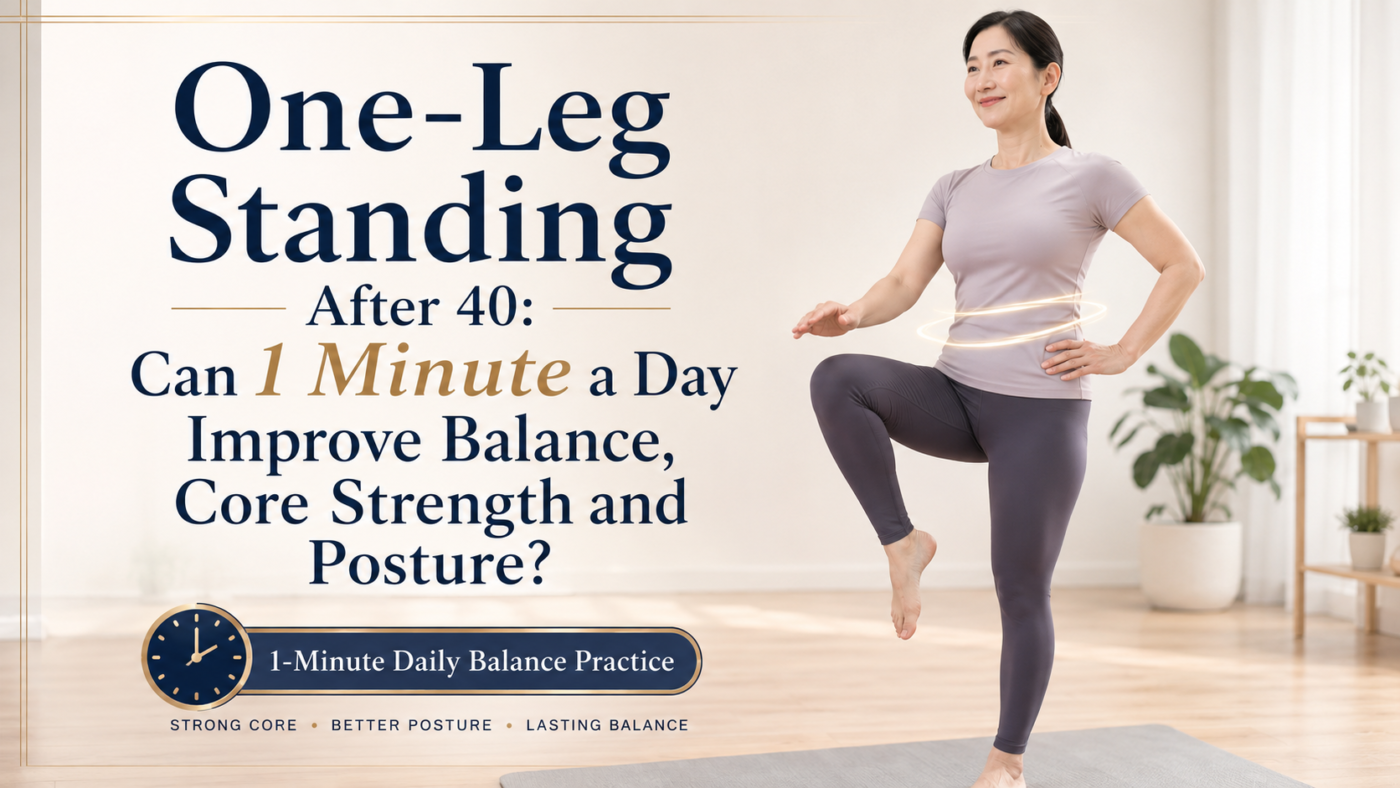
Can You Stand on One Leg?
A one leg stand looks almost too simple to count as exercise. Lift one foot from the floor, stay upright, maintain your balance, and hold the position.
Try it on the other side and you may immediately notice something interesting: one leg often feels steadier than the other.
That difference can reveal a lot about balance, coordination, hip control and body awareness.
For adults over 40, these abilities become increasingly important. Balance is not just about preventing an embarrassing wobble. It contributes to walking confidence, exercise performance, joint control and the ability to remain physically independent later in life.
This is why single-leg standing is widely used in balance assessment and training.
But social-media videos sometimes attach much bigger promises to this simple exercise: that standing on one leg for one minute will flatten your belly, automatically burn abdominal fat, replace an hour of walking or correct hip and knee pain within seven days.
The exercise is useful.
Those promises require a closer look.
What Happens When You Stand on One Leg?
Standing normally distributes your body weight across two feet. Lift one foot, and suddenly your nervous system has a much more demanding job.
Your body must continuously make tiny adjustments to keep your center of mass over a much smaller base of support.
Your ankles respond.
Your hip muscles stabilize the pelvis.
Your trunk makes subtle corrections.
Your eyes, inner ear and proprioceptive system provide information about where your body is in space.
Your brain integrates those signals and adjusts muscle activity almost continuously.
That is why a one leg stand can feel surprisingly difficult even though you are barely moving.
The National Institute on Aging includes standing on one foot among exercises that can be used to train balance, alongside heel-to-toe walking, sideways walking and Tai Chi. 美国国家老龄化研究院
Research on sensorimotor and proprioceptive exercise also suggests that appropriately designed training programs can improve balance measures in older adults. PubMed
So the basic concept is sound:
Practicing balance can make balance better.
Does a One Leg Stand Work Your Core?
Yes—but not in the way many fitness videos describe it.
Your “core” is not a single abdominal muscle. It is a coordinated system involving muscles around the abdomen, spine, pelvis, hips and diaphragm.
When you stand on one leg, those muscles must help control your trunk and pelvis so that you do not collapse or rotate excessively.
That means the exercise can challenge trunk stability.
Research evaluating core-training programs in older adults has found improvements in both static and dynamic balance, including performance on one-leg stance tests. PubMed
However, simply pulling your stomach inward as hard as possible is unnecessary.
A better cue is:
Stand tall, breathe normally and gently brace your midsection as though preparing for a light push.
You should still be able to breathe comfortably.
What Does the Iliopsoas Have to Do With It?
The video highlights the iliopsoas, and there is some useful anatomy behind that idea.
The iliopsoas is formed primarily by the psoas major and iliacus muscles. It is one of the body’s major hip flexors, meaning that it helps lift the thigh toward the torso.
When you raise one knee during a single-leg exercise, the iliopsoas contributes to that movement.
Research also indicates that the iliopsoas can contribute to dynamic hip stability and has secondary roles related to trunk movement and stabilization. PubMed
But this does not mean that activating the iliopsoas directly tightens abdominal fat.
Muscle activation and fat loss are two different physiological processes.
That distinction matters.
Can One-Leg Standing Flatten Your Belly?
It depends on what you mean by “flatten.”
A balance exercise may improve your awareness of posture and teach you to control your pelvis and trunk more effectively.
If someone normally stands with poor trunk control, improving posture may make the abdomen look somewhat more supported while standing.
Core training can also strengthen muscles beneath the abdominal wall over time.
But that is not the same as losing abdominal fat.
A one-minute balance exercise does not selectively melt fat around the waist.
Meaningful changes in abdominal fat generally require sustained changes in overall energy balance and substantially more physical activity than a one-minute static exercise alone provides.
Large reviews show that regular aerobic exercise, resistance exercise and combined exercise programs can reduce abdominal fat over time. PubMed
That is very different from claiming:
Stand on one leg for one minute and belly fat automatically disappears.
Current evidence does not support that promise.
What About “Spot Reduction”?
The topic is more complicated than the old statement that spot reduction is absolutely impossible.
A small randomized trial found evidence that prolonged abdominal endurance training combined with aerobic exercise produced somewhat greater local trunk-fat reduction than aerobic exercise alone in a specific group of men. PubMed
But look carefully at the exercise dose.
Participants were not standing on one leg for sixty seconds.
They trained repeatedly for weeks using substantial aerobic and abdominal exercise.
So this finding does not support the claim that brief core activation automatically burns belly fat.
For practical purposes, if your goal is a smaller waist, think globally:
move more, build muscle, manage total energy intake and exercise consistently.
Is One Minute a Day Enough?
One minute is enough to start.
That is different from saying one minute is enough to transform your body.
A short daily practice can be valuable because it is easy to remember and easy to repeat.
If you currently struggle to balance for even 10 seconds, practicing safely every day may help your nervous system become more familiar with the task.
You may notice that you wobble less.
You may become more confident.
You may learn how to position your hips and trunk more effectively.
But there is no scientific basis for guaranteeing a flat stomach after seven days.
More substantial changes in balance, strength and body composition generally require progressive training over weeks and months.
The one-minute challenge is best viewed as a habit starter, not a seven-day body transformation.
The 7-Day One-Leg Stand Challenge
Here is a safer and more realistic version.
Do the exercise near a sturdy chair, kitchen counter or wall.
Do not practice in an area where falling could cause injury.
Day 1: Find Your Baseline
Stand tall with both feet comfortably apart.
Place one hand near a stable support.
Slowly lift one foot only a few centimeters from the floor.
Try to hold for:
10–20 seconds per side.
Notice whether one side feels easier.
Do not worry about matching the other side immediately.
Day 2: Build Control
Repeat the exercise.
This time focus on keeping your pelvis approximately level.
Avoid leaning dramatically to one side.
Try:
20–30 seconds per side.
Touch the chair whenever necessary.
Using support is not cheating.
It is smart training.
Day 3: Add Gentle Core Control
Before lifting the foot, stand tall and gently engage your abdominal muscles.
Do not hold your breath.
Raise one knee slightly.
Hold for:
20–30 seconds.
Repeat on the opposite side.
Day 4: Raise the Knee
If the basic exercise feels secure, raise the knee a little higher.
You do not need to pull it to your chest.
The higher position increases the challenge to the standing leg, hip and trunk.
Continue breathing normally.
Day 5: Add Arm Position
Once you can balance comfortably, experiment with your arms.
Begin with your arms near your sides.
Then try placing your hands on your hips.
For a greater challenge, raise your arms.
Changing arm position changes your body’s center of mass and makes the balance task more demanding.
Day 6: Add Slow Movement
Instead of holding completely still, slowly lift and lower the knee.
Try:
5–10 controlled repetitions on each side.
This transforms the exercise from purely static balance into a simple dynamic balance drill.
Day 7: The One-Minute Challenge
If you can perform the earlier versions safely, attempt to accumulate:
60 seconds per side.
You do not have to complete the entire minute continuously.
For example:
20 seconds
rest
20 seconds
rest
20 seconds
still equals one minute of practice.
Quality is more important than forcing yourself to stay upright while losing control.
Beginner Version
If balancing is difficult, keep one or two fingertips on a sturdy counter.
Lift your foot only slightly from the floor.
Another option is to keep the toes of the raised foot touching the ground lightly, like a kickstand.
Gradually reduce the amount of assistance as your control improves.
The objective is to challenge balance without creating unnecessary fall risk.
More Advanced Version
Only after the standard version becomes easy, try progressing gradually.
Possible variations include:
- Raising the knee higher
- Moving the arms
- Slowly turning the head
- Performing controlled knee raises
- Standing on a slightly less stable surface under professional guidance
Closing your eyes dramatically increases difficulty and removes an important source of balance information.
For most people practicing alone—particularly anyone with a history of falls—there is little reason to rush into eyes-closed single-leg exercises.
Should You Pull Your Belly In?
The instruction “pull your belly in” appears repeatedly in fitness videos.
A mild abdominal contraction can help you become aware of trunk positioning.
But aggressively sucking your stomach inward throughout the exercise is not necessary.
Instead:
Keep the ribs comfortably above the pelvis.
Allow your spine to maintain its natural curves.
Gently engage your trunk.
Continue breathing.
Your goal is control, not maximum tension.
Should You Push the Sacrum Forward?
Be cautious with this instruction as well.
There is no single pelvic position that everyone should force themselves into.
Excessively tucking the pelvis can create unnecessary tension and may make movement less natural.
A better goal is a comfortable neutral posture:
Head tall.
Shoulders relaxed.
Rib cage controlled.
Pelvis comfortable.
Standing knee soft rather than aggressively locked.
Can One-Leg Standing Replace Walking?
No.
This is one of the most important corrections to the original claim.
Balance training and walking serve different purposes.
A one leg stand challenges balance, coordination and postural control.
Walking provides sustained locomotion and can contribute much more meaningfully to aerobic activity and daily energy expenditure.
The two should complement each other rather than compete.
You do not need to choose:
one minute of balance OR sixty minutes of walking.
A far better healthy-aging program includes both balance training and regular aerobic activity, together with muscle-strengthening exercise.
The National Institute on Aging similarly recommends a combination of aerobic, strength and balance activities rather than relying on only one form of exercise. 美国国家老龄化研究院
Can It Reduce Knee or Hip Pain?
Possibly for some people—but it is not guaranteed.
Improving strength, balance and movement control can be useful components of rehabilitation for certain musculoskeletal conditions.
But knee and hip pain can come from many different causes.
Arthritis, tendinopathy, bursitis, referred pain, previous injuries and other conditions require different approaches.
A seven-day one-leg challenge should therefore not be presented as a treatment for joint pain.
If standing on one leg increases hip, groin, knee or back pain, stop and modify the exercise.
Why Balance Becomes More Important With Age
Balance depends on several systems working together.
These include:
- Vision
- The vestibular system of the inner ear
- Proprioception
- Muscle strength
- Joint mobility
- Reaction speed
- Coordination
- Brain processing
Changes in any of these systems can affect stability.
That makes balance training particularly useful as part of a long-term healthy-aging program.
It is also one reason a simple one-leg test can feel very different from one person to another.
If you have persistent dizziness, repeated falls or a sudden unexplained loss of balance, do not simply try to “train through it.” Balance problems can have medical causes and deserve appropriate evaluation. 美国国家老龄化研究院
A Better After-40 Exercise Formula
If your real goal is a stronger body and a healthier waistline after 40, use the one leg stand as one piece of your routine.
A stronger weekly program combines:
Walking or other aerobic exercise for cardiovascular fitness and energy expenditure.
Resistance training for muscle and strength.
Balance training for stability and coordination.
Mobility work for comfortable movement.
Adequate nutrition and protein to support body composition and recovery.
Sleep and recovery to help maintain consistent training.
That approach is far more powerful than searching for one exercise that supposedly melts belly fat.
What You May Notice After Seven Days
A week is enough to notice improvements in familiarity.
You may feel:
- Less wobbling
- Better awareness of your posture
- Greater confidence on one side
- Better coordination when raising your knee
- More awareness of your abdominal and hip muscles
Those are meaningful accomplishments.
What you should not expect is automatic abdominal fat loss simply because seven days have passed.
Body composition changes occur on a much longer timeline.
The Bottom Line
A one leg stand is one of those exercises that proves simple does not necessarily mean useless.
Standing on one foot challenges balance, proprioception, hip stability and trunk control simultaneously. It requires no gym equipment and can be practiced almost anywhere with appropriate support.
For people over 40, that makes it a useful addition to a broader healthy-aging routine.
But keep expectations realistic.
One minute of single-leg standing will not replace walking.
It will not automatically activate belly-fat burning.
It cannot guarantee a flat stomach in seven days.
And it is not a universal treatment for knee or hip pain.
What it can do is help you practice an ability that becomes increasingly valuable as the years pass:
controlling your own body confidently in space.
Start with 10 seconds if that is where you are today.
Hold onto a chair if you need it.
Progress gradually.
And combine balance training with walking and strength exercise.
The most powerful transformation does not come from one magical minute.
It comes from turning that minute into the beginning of a sustainable movement habit.
A one leg stand can challenge balance without requiring gym equipment.
Practicing the one leg stand regularly may help improve confidence and body control.
The one leg stand should be viewed as a balance exercise rather than a belly-fat treatment.
Beginners can modify the one leg stand by keeping one hand on a sturdy chair or counter.
For adults over 40, the one leg stand can be one useful part of a broader healthy-aging exercise program.
FAQ
Is standing on one leg good exercise after 40?
Yes. Single-leg standing is a legitimate balance exercise and can challenge postural control, hip stability and coordination. It works best as part of a program that also includes aerobic and strength exercise.
Can standing on one leg reduce belly fat?
One-leg standing alone is unlikely to produce meaningful belly-fat loss. Regular aerobic activity, resistance training, nutrition and overall energy balance have much greater effects on body composition.
Does a one leg stand strengthen the core?
It can challenge trunk muscles because they must help stabilize the pelvis and torso while the base of support is reduced. More comprehensive core and resistance training is still needed for substantial strength development.
How long should I stand on one leg?
Beginners can start with 10–20 seconds while staying close to a sturdy support. Gradually work toward 30–60 seconds as balance improves.
Should both sides be equally easy?
Not necessarily. Mild differences between sides are common. A large or newly developed difference, particularly when accompanied by weakness, dizziness, numbness or pain, may warrant professional evaluation.
Can one-leg standing replace walking?
No. Walking and balance training provide different benefits. Ideally, use both.
Will standing on one leg flatten my stomach in seven days?
There is no reliable evidence that one minute of single-leg standing daily will produce significant abdominal-fat loss in seven days. It may improve posture and body awareness, which can change how you hold your torso.
Is it safe for older adults?
Many people can practice it safely when a sturdy chair, counter or wall is available for support. People with significant balance problems, recurrent falls, dizziness or certain neurological or orthopedic conditions should seek individualized guidance.
Medical Disclaimer
This article is for educational and informational purposes only and is not a substitute for professional medical advice, diagnosis or treatment. Exercise ability and fall risk differ between individuals. If you have recurrent falls, dizziness, osteoporosis, significant joint pain, neurological disease, recent surgery or another condition affecting balance, consult a qualified healthcare professional before beginning a new exercise program.
This article is for general education and does not replace individualized care from a qualified health professional. Seek appropriate advice for persistent, severe, or concerning symptoms.
Read the full medical disclaimer