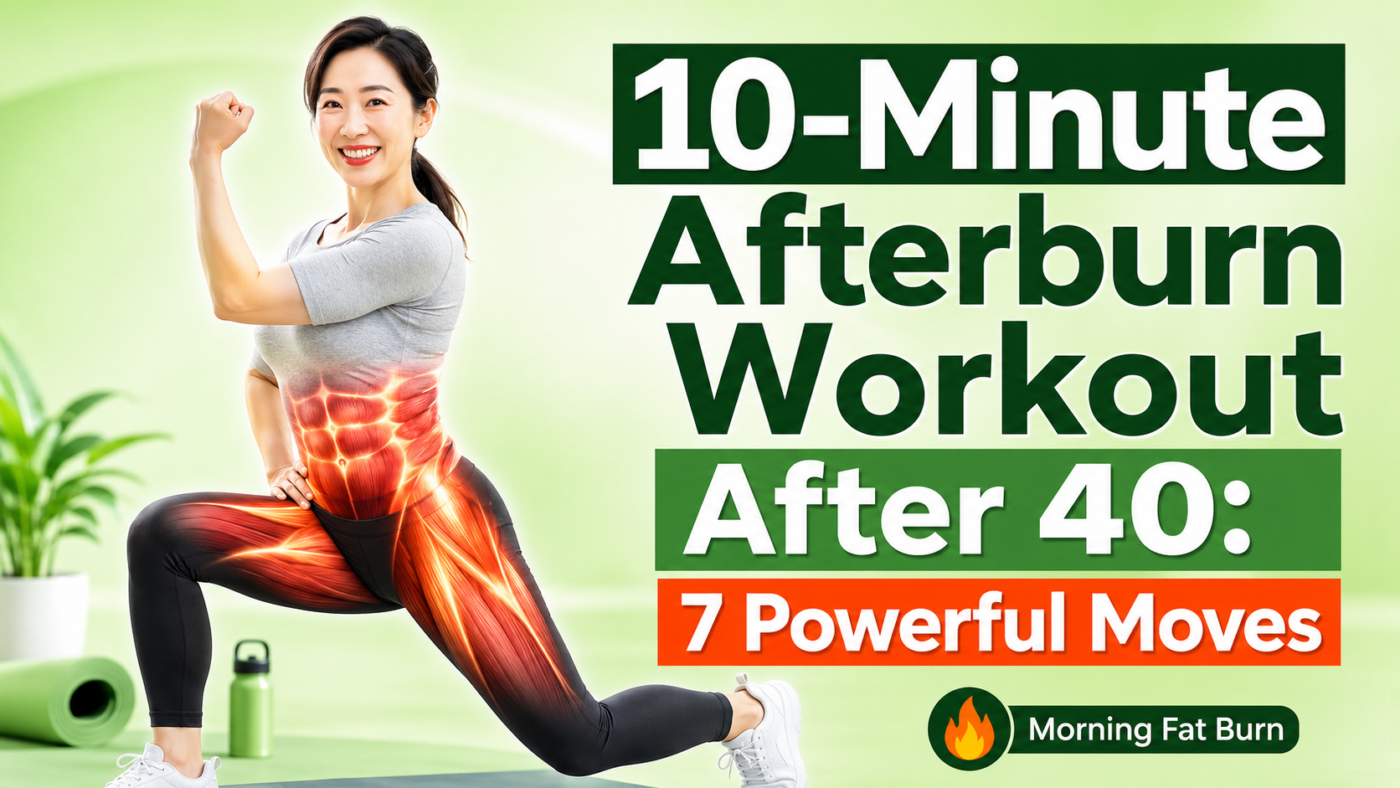
A 10-minute workout sounds almost too short to matter.
Yet there is a real physiological phenomenon that explains why your body can continue using slightly more energy after exercise ends.
It is called the afterburn effect, scientifically known as excess post-exercise oxygen consumption, or EPOC.
After a sufficiently challenging workout, oxygen consumption and energy expenditure can remain elevated while your body returns toward its resting state.
That means you really can continue burning some additional calories after the workout is finished.
But there is an important distinction.
The afterburn effect does not mean body fat keeps “melting away” effortlessly for the rest of the day.
And a single 10-minute routine cannot replace regular physical activity, strength training, or appropriate nutrition.
The good news is that short workouts can still be extremely useful—especially when they help busy adults move consistently.
For people over 40, a well-designed 10-minute routine that uses large muscle groups can support cardiovascular fitness, muscular strength, mobility, and overall energy expenditure.
What Is the Afterburn Effect?
Afterburn is the informal name for excess post-exercise oxygen consumption.
During exercise, the body increases oxygen use to meet the demands of working muscles.
After exercise ends, metabolism does not instantly return to its exact resting level.
Your body continues using energy as it restores physiological balance.
This recovery process can involve:
- Restoring oxygen stores
- Regulating body temperature
- Replenishing energy substrates
- Normalizing heart rate and breathing
- Supporting tissue recovery
That elevated post-exercise oxygen consumption is EPOC.
Is the Afterburn Effect Real?
Yes.
EPOC has been documented extensively in exercise physiology research.
A systematic review comparing high-intensity interval exercise, sprint interval exercise, and moderate continuous exercise found that higher-intensity sessions generally produced greater post-exercise energy expenditure.
The effect was particularly noticeable after more demanding exercise protocols.
However, the absolute number of extra calories burned afterward was relatively modest.
That distinction matters.
EPOC is real.
It is not a metabolic loophole that allows you to stop exercising while fat continues disappearing at a dramatic rate.
Does High-Intensity Exercise Create More Afterburn?
Generally, yes.
Exercise intensity is one of the strongest determinants of EPOC.
Research suggests that:
higher intensity → greater recovery demand → larger EPOC
That is one reason interval training is often associated with a stronger afterburn effect than easy steady-state activity.
But high intensity is not automatically better for everyone.
Beginners, adults returning to exercise, and people with joint or cardiovascular concerns may benefit more from moderate training that they can perform consistently.
A workout does not need to leave you exhausted to be useful.
Can a 10-Minute Workout Cause Afterburn?
Yes, potentially.
A short exercise session can produce EPOC if the intensity is high enough to meaningfully challenge the cardiovascular and muscular systems.
However, duration also matters.
Ten minutes of gentle stretching will not produce the same effect as ten minutes of moderately challenging full-body exercise.
That means the better question is not:
“Is 10 minutes enough?”
It is:
“What am I doing during those 10 minutes?”
Why Short Workouts Still Matter
Even when the afterburn effect is modest, a 10-minute workout can be valuable.
Short exercise sessions are:
- Easier to fit into a busy schedule
- Less intimidating for beginners
- Useful for breaking up sedentary time
- Easier to repeat consistently
- Capable of contributing to weekly activity totals
The biggest advantage may not be EPOC at all.
It may simply be that you actually do the workout.
Do You Need Long Workouts to Lose Weight?
No.
Long workouts are not mandatory.
But total activity still matters.
CDC guidance emphasizes that weight loss occurs when physical activity and dietary intake create a sustained calorie deficit.
Most weight loss comes from reducing calorie intake, while regular physical activity is especially important for health and maintaining weight loss.
Short workouts can contribute to that total.
They simply should not be treated as a substitute for all other movement.
Does Exercise Keep Your Metabolism Elevated All Day?
Sometimes metabolism remains slightly elevated after exercise.
But the magnitude and duration depend heavily on:
- Exercise intensity
- Exercise duration
- Fitness level
- Workout type
- Individual physiology
A moderate 10-minute workout is unlikely to keep metabolism dramatically elevated for the entire day.
That does not make it ineffective.
It simply means the “24-hour fat-burning furnace” language commonly used online exaggerates the science.
Is Morning Exercise Better for Afterburn?
There is no universal rule that morning exercise creates more EPOC than the same workout performed later.
Morning workouts can still have practical advantages.
For example:
- They may be easier to complete before the day becomes busy.
- They can help some people establish a routine.
- Exercise may improve alertness and mood.
- Completing activity early may encourage more movement throughout the day.
But if you exercise more consistently in the afternoon or evening, that is perfectly reasonable.
The best exercise time is often the time you will actually maintain.
Why Use Large Muscle Groups?
Full-body movements often involve more muscle mass than small isolation exercises.
Exercises involving the legs, hips, back, shoulders, and core can create a larger overall physiological demand.
Examples include:
- Squats
- Step movements
- Lunges
- Rows
- Arm swings
- Hip hinges
- Whole-body intervals
This can increase total energy expenditure during the workout.
But moving the shoulder blades themselves does not “switch on metabolism.”
It is the overall muscular work that matters.
A Beginner-Friendly 10-Minute Afterburn Workout
The original routine combines lower-body movements, arm swings, hamstring activation, rotation, and wide-stance squatting.
Below is a safer version designed for adults over 40.
The goal is moderate challenge—not exhaustion.
Minute 1: March and Arm Swing
Stand tall.
March gently in place.
Swing your arms naturally.
Gradually increase the pace.
Keep breathing comfortably.
This raises body temperature and prepares the joints.
Minute 2: Supported Reverse Knee Bend
Hold a chair if needed.
Step one foot slightly backward.
Bend both knees only as far as comfortable.
Return to standing.
Alternate sides.
Keep movements controlled.
If your knees are sensitive, use a very shallow range.
Minute 3: Standing Knee Drives
Stand tall.
Lift one knee toward the chest.
Lower.
Alternate sides.
Add gentle arm movement if comfortable.
Continue at a pace that raises your breathing slightly.
Minute 4: Standing Hamstring Curl
Stand behind a chair.
Bend one knee and bring the heel toward the buttock.
Lower slowly.
Alternate sides.
Keep the torso upright.
This activates the hamstrings without requiring floor exercise.
Minute 5: Hip Hinge and Reach
Stand with feet hip-width apart.
Push your hips backward.
Keep a slight bend in the knees.
Reach your hands forward.
Return to standing.
This trains the posterior chain.
Keep the spine neutral and avoid forcing the lower back.
Minute 6: Step-Back With Arm Swing
Step one leg backward.
Swing both arms forward or upward.
Return.
Alternate sides.
Move rhythmically.
This combines upper- and lower-body activity.
Minute 7: Standing Torso Rotation
Stand with feet comfortably apart.
Keep the hips mostly forward.
Rotate the upper body gently from side to side.
Let the arms move naturally.
Do not force the spine.
Minute 8: Wide-Stance Squat
Stand with feet wider than hip width.
Turn the toes slightly outward.
Bend the knees and hips.
Lower only as far as comfortable.
Press through the feet to stand.
Keep knees generally tracking in the same direction as the toes.
Minute 9: Squat With Arm Swing
Continue the wide stance.
Perform a shallow squat while swinging the arms forward.
Stand and lower the arms.
Move at a steady pace.
If this is difficult, reduce the depth.
Minute 10: Faster Full-Body Finish
Choose one:
- Faster marching
- Side steps
- Shallow squats
- Step-backs
- Knee drives
Work at a challenging but controlled pace for approximately 30 seconds.
Then slow down for 30 seconds.
Finish by walking in place and breathing normally.
How Hard Should the Workout Feel?
For beginners, aim for roughly:
5–7 out of 10 effort
You should be breathing harder than at rest.
But you should still feel in control.
You do not need:
- Maximum effort
- Breathlessness
- Pain
- Dizziness
- Exhaustion
EPOC is not worth chasing at the expense of safe training.
Can Beginners Get an Afterburn Effect?
Yes.
But beginners do not need true high-intensity interval training immediately.
Moderately challenging exercise may be enough to create some post-exercise oxygen consumption while allowing the body to adapt safely.
As fitness improves, intensity can gradually increase.
Should You Lower the Squat as Deep as Possible?
No.
A deeper squat increases range of motion and may increase muscular demand.
But deeper is not automatically better.
Your ideal depth depends on:
- Hip mobility
- Knee comfort
- Ankle mobility
- Strength
- Balance
A shallow squat performed comfortably is much better than a painful deep squat.
Do Squats Boost Metabolism?
Squats use large lower-body muscles and therefore contribute to energy expenditure.
Repeated resistance training can also help build or maintain muscle.
Muscle tissue contributes to resting energy expenditure.
However, a few squats do not dramatically accelerate metabolism for hours.
Again, cumulative training matters more than any single exercise.
Can Muscle Still Grow After 40?
Absolutely.
Adults can build muscle in midlife and later adulthood.
Progressive resistance training remains effective with age.
This is one of the strongest reasons to include strength work after 40.
Maintaining muscle supports:
- Strength
- Physical function
- Bone health
- Balance
- Metabolic health
- Independence
The message should be:
You can still become stronger after 40.
Not:
One 10-minute workout will transform your metabolism.
Is Afterburn Important for Fat Loss?
It contributes, but it is not the main factor.
Suppose a workout causes additional calorie expenditure afterward.
That is helpful.
But your total daily and weekly energy balance still matters much more.
A small EPOC bonus cannot compensate for consistently eating far more energy than you use.
CDC guidance emphasizes that physical activity and dietary changes work together for weight management.
What Is More Important Than Afterburn?
Several things.
Total Weekly Activity
Adults should aim for at least 150 minutes of moderate-intensity aerobic activity each week, or 75 minutes of vigorous-intensity activity, plus muscle-strengthening activity on at least two days.
Strength Training
Muscle preservation becomes increasingly important with age.
Daily Movement
Walking, stairs, household tasks, and general movement add up.
Nutrition
Fat loss requires a sustained calorie deficit.
Consistency
One spectacular workout matters less than months of regular activity.
Can You Do Several 10-Minute Sessions?
Yes.
For many people, this is an excellent strategy.
For example:
Morning: 10-minute full-body workout
Lunch: 10-minute brisk walk
Evening: 10-minute strength or mobility session
Short bouts can accumulate into meaningful weekly activity.
CDC explicitly notes that activity can be spread throughout the week and divided into smaller chunks.
Do You Need to Exercise Every Morning?
No.
Morning exercise is optional.
Choose a time that works consistently.
Some people thrive with early workouts.
Others perform better later.
Adherence matters more than clock time.
Who Should Modify This Routine?
Use extra caution if you have:
- Significant knee pain
- Hip arthritis
- Balance problems
- Cardiovascular disease
- Uncontrolled blood pressure
- Recent surgery
- Severe back pain
- A long period of inactivity
CDC advises people with chronic conditions, or inactive individuals considering vigorous exercise, to discuss appropriate activity with a healthcare professional.
What If You Cannot Do Squats?
Replace them with:
- Chair sit-to-stands
- Supported mini-squats
- Marching
- Side steps
- Wall-supported movements
There is nothing magical about squats.
The goal is safely challenging large muscle groups.
How Often Can You Do This Workout?
A moderate version may be performed several times per week.
If the workout becomes genuinely vigorous, allow adequate recovery.
A simple schedule could be:
Monday: 10-minute full-body workout
Tuesday: Walking
Wednesday: 10-minute workout
Thursday: Mobility or walking
Friday: 10-minute workout
Weekend: Longer walk or strength session
Adjust according to fitness level.
Can 10 Minutes Change Your Body?
Ten minutes can contribute.
But visible body-composition changes require accumulated effort.
Think in weeks and months.
Not minutes.
Short workouts work best when they become part of a larger lifestyle.
The Bottom Line
The afterburn effect is real.
After sufficiently challenging exercise, your body can continue using slightly more energy during recovery.
Higher-intensity exercise generally produces more EPOC than easier continuous exercise.
But the additional calorie burn is modest.
A 10-minute workout does not create effortless fat loss for the rest of the day.
Its real value is that it can:
- Increase physical activity
- Challenge major muscle groups
- Improve fitness
- Support muscle maintenance
- Fit into a busy schedule
- Help build consistency
That is more than enough reason to use it.
Do not chase the afterburn.
Build the habit.
Frequently Asked Questions
Is the afterburn effect real?
Yes. It is scientifically known as excess post-exercise oxygen consumption, or EPOC.
Does afterburn keep burning fat all day?
Energy expenditure may remain temporarily elevated, but the effect is usually modest and should not be interpreted as dramatic all-day fat burning.
Can a 10-minute workout create afterburn?
Yes, especially when it involves sufficiently challenging full-body exercise, although the size of the effect varies.
Is HIIT best for afterburn?
Higher-intensity interval exercise generally produces greater EPOC than moderate continuous exercise, but HIIT is not necessary for everyone.
Is morning exercise better for fat loss?
Not necessarily. Consistency and total activity matter more than the time of day.
Can short workouts help weight loss?
Yes, as part of an overall activity and nutrition strategy.
Do squats increase afterburn?
Challenging compound exercises can contribute to greater exercise demand, but no single movement guarantees a large afterburn effect.
Can people over 40 build muscle?
Yes. Progressive resistance training remains effective in midlife and later adulthood.
How much exercise should adults get?
CDC recommends at least 150 minutes of moderate-intensity aerobic activity weekly, or 75 minutes vigorous activity, plus at least two days of muscle strengthening.
Is EPOC the most important part of fat loss?
No. Overall energy balance, total activity, strength training, nutrition, sleep, and consistency matter more.
Medical Disclaimer:
This article is for educational and informational purposes only and is not medical advice. Stop exercising if you experience chest pain, severe shortness of breath, faintness, sharp joint pain, or other concerning symptoms. People with cardiovascular disease, uncontrolled blood pressure, significant joint conditions, recent surgery, or a prolonged period of inactivity should consult a qualified healthcare professional before beginning vigorous exercise.
References
- Panissa VLG, Fukuda DH, Staibano V, Marques M, Franchini E. Magnitude and Duration of Excess of Post-Exercise Oxygen Consumption Between High-Intensity Interval and Moderate-Intensity Continuous Exercise: A Systematic Review. Obesity Reviews. 2021;22:e13099.
- Centers for Disease Control and Prevention. Physical Activity and Your Weight and Health.
- Centers for Disease Control and Prevention. Adult Activity: An Overview.
- Centers for Disease Control and Prevention. Benefits of Physical Activity.
This article is for general education and does not replace individualized care from a qualified health professional. Seek appropriate advice for persistent, severe, or concerning symptoms.
Read the full medical disclaimer