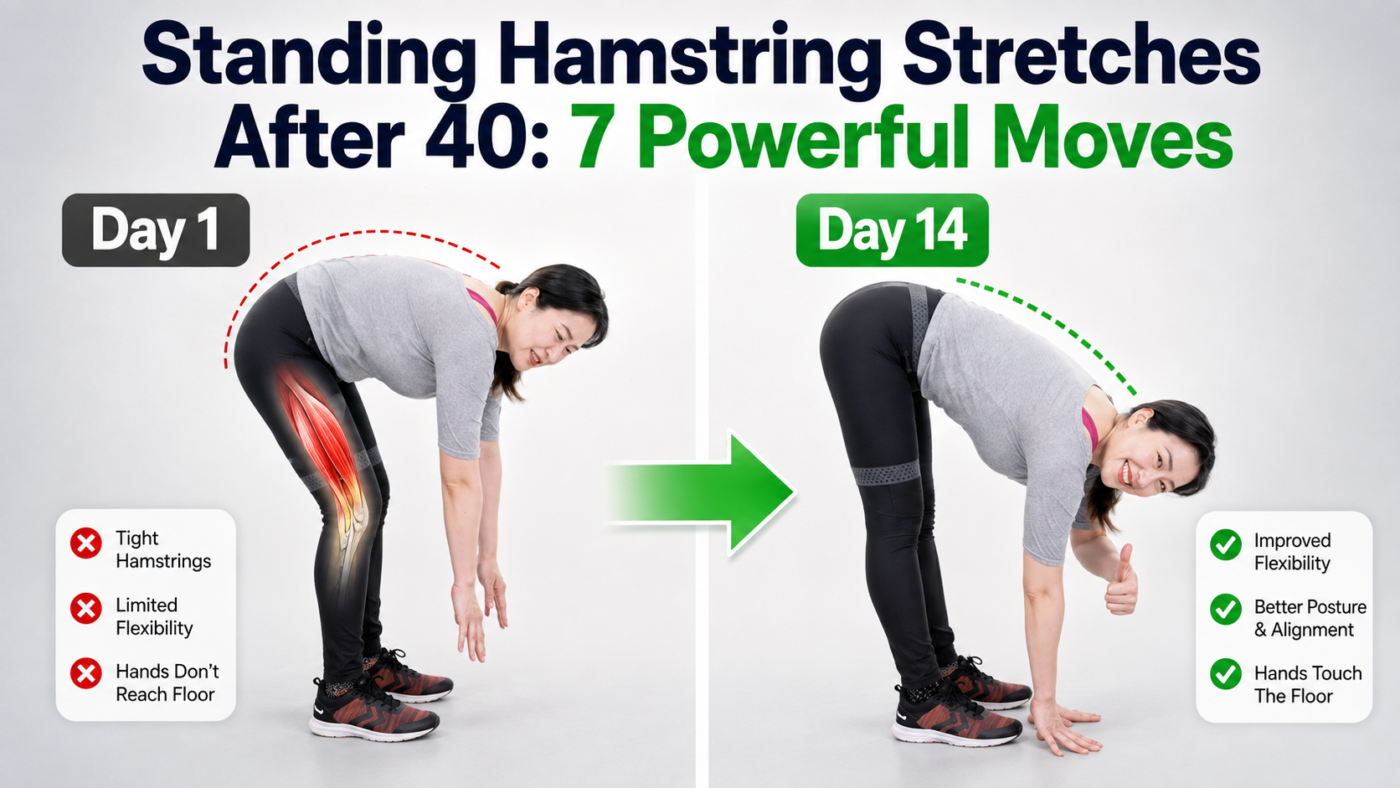
Standing hamstring stretches after 40 can be a simple way to improve flexibility, make forward bending feel easier, and reduce the sensation of stiffness through the backs of the legs.
Many adults notice that touching the floor becomes harder with age.
The hamstrings feel tight.
The calves pull.
The lower back rounds.
And bending forward may feel more like a struggle than a stretch.
This has led to a popular claim online:
“Tight hamstrings are stopping you from losing weight.”
That is not quite how the body works.
Hamstring stiffness does not directly block fat loss.
And stretching the hamstrings does not suddenly switch the body into a high-fat-burning state.
But improving flexibility can make walking, exercise, strength training and everyday movement more comfortable.
That may help you stay more active.
And greater physical activity can support healthy weight management over time.
So the real benefit is not magical fat burning.
It is better movement.
Why Hamstrings Often Feel Tighter After 40
The hamstrings are a group of three major muscles running along the back of the thigh:
- Biceps femoris
- Semitendinosus
- Semimembranosus
They help bend the knee and extend the hip.
They are active during walking, running, climbing stairs, lifting and many other movements.
Hamstrings may feel tighter with age for several reasons.
These include:
- Long periods of sitting
- Reduced physical activity
- Limited movement variety
- Previous injury
- Muscle weakness
- Reduced stretch tolerance
- Hip stiffness
- Calf stiffness
- Individual anatomy
Importantly, the feeling of “tightness” does not always mean the muscle has physically shortened.
The nervous system also plays a major role in how much stretch you tolerate.
Can Tight Hamstrings Stop Weight Loss?
No.
Fat loss depends primarily on long-term energy balance.
That means overall calorie intake and total energy expenditure matter much more than hamstring flexibility.
Stretching burns relatively few calories.
A flexible person can gain weight.
A stiff person can lose weight.
There is no metabolic barrier caused by tight hamstrings.
However, hamstring stiffness may indirectly matter if it makes movement uncomfortable.
If bending, walking, exercising or strength training feels difficult, you may naturally avoid activity.
In that case, improving flexibility could help you move more.
The realistic relationship is:
Better flexibility → easier movement → more activity → better support for weight management
Not:
Looser hamstrings → automatic fat loss
Do Hamstrings Burn a Lot of Energy?
The hamstrings are large, important muscles.
When they contract during exercises such as deadlifts, running, cycling or hamstring curls, they contribute to energy expenditure.
But simply stretching them does not require the same amount of energy as actively training them.
This is an important distinction.
If your goal is to support metabolism and body composition, combine flexibility work with:
- Walking
- Resistance training
- Aerobic exercise
- Adequate protein
- Appropriate calorie intake
Stretching should support exercise—not replace it.
Can Tight Hamstrings Cause Hip, Knee or Back Pain?
They may contribute in some people.
The hips, knees, ankles and spine work together during movement.
If hamstring flexibility is limited, some people may compensate by changing how they bend or move.
But pain is complex.
Lower-back pain can involve many factors.
Knee pain can arise from many different structures.
Hip pain has many possible causes too.
It is therefore inaccurate to say hamstring stiffness is always the cause.
Think of hamstring flexibility as one piece of overall movement capacity.
Why Forward Bending Is a Useful Flexibility Check
A standing forward bend involves more than the hamstrings.
It also depends on:
- Hip mobility
- Calf flexibility
- Spinal movement
- Pelvic control
- Neural tension
- Individual body proportions
So touching the floor is not a perfect health test.
But it can be useful for comparing your own mobility over time.
Instead of asking:
“Can I touch the floor?”
Ask:
“Does this movement feel more comfortable than it did a month ago?”
That is much more meaningful.
You Do Not Need to Touch Your Toes
Many people think a proper hamstring stretch requires straight knees and palms on the floor.
It does not.
A slight knee bend is completely acceptable.
Forcing the knees straight can increase discomfort behind the knees or along the sciatic nerve.
Progress should be gradual.
Why Standing Hamstring Stretches Can Be Convenient
Floor stretching is useful, but not everyone wants to lie down or sit on the floor.
Standing exercises have several advantages.
They can be:
- Performed almost anywhere
- Combined with a chair for support
- Easier for people with difficulty getting onto the floor
- Added to walking or exercise sessions
- Used as short movement breaks during the day
That makes them especially practical for adults over 40.
7 Standing Hamstring Stretches After 40
The following routine adapts the original video into a safer, more evidence-based sequence.
Use a sturdy chair or wall for support when needed.
1. Supported Calf and Hamstring Stretch
Stand behind a sturdy chair.
Place your hands lightly on the chair.
Step one foot backward.
Keep the heel comfortably toward the floor.
Gently shift your hips backward until you feel a mild stretch through the calf and back of the thigh.
Hold for 20–30 seconds.
Switch sides.
Do not bounce.
2. Gentle Leg Swings
Hold the back of a chair.
Stand tall.
Swing one leg gently forward and backward.
Keep the motion controlled.
You do not need to lift the leg very high.
Perform 8–12 swings.
Switch sides.
This is a dynamic warm-up, not a maximal stretch.
3. Standing Knee Lifts
Hold a chair if needed.
Lift one knee toward the chest.
Lower slowly.
Alternate sides.
Perform 8–12 repetitions per side.
This activates the hip flexors and core while adding light movement.
It may increase energy expenditure slightly, but it should not be described as a blood-sugar treatment.
4. Standing Quadriceps Stretch
Hold a chair.
Bend one knee.
Bring the heel gently toward the buttock.
Hold the ankle if comfortable.
Keep the knees relatively close together.
Hold for 20–30 seconds.
Repeat on the other side.
This stretches the front of the thigh and can help balance a routine focused on the posterior chain.
5. Wide-Stance Side Stretch
Stand with your feet wider than shoulder width.
Bend one knee slightly.
Keep the other leg more extended.
Shift your hips toward the bent side.
You may feel a stretch in the inner thigh of the straighter leg.
Hold for 20–30 seconds.
Switch sides.
Do not push heavily on the knee.
6. Wide-Leg Forward Hinge
Stand with your feet comfortably apart.
Keep a slight bend in the knees.
Place your hands on a chair, thighs or another stable surface.
Push the hips backward.
Hinge forward from the hips.
Stop when you feel a comfortable stretch through the backs of the legs.
Hold for 20–30 seconds.
You do not need to touch the floor.
7. Chair-Supported Hamstring Pulse
Place both hands on the back of a chair.
Step backward slightly.
Push your hips behind you.
Keep the knees soft.
Slowly alternate between slightly bending and straightening the knees.
Move only through a comfortable range.
Repeat 8–12 times.
This rhythmic movement can help you become more comfortable near the end of your hamstring range without forcing a long static stretch.
Recheck Your Forward Bend
After finishing the routine, stand comfortably.
Slowly hinge forward again.
Do not force the movement.
You may notice:
- Hands reaching slightly lower
- Less tension
- Easier hip movement
- Straighter legs
- Less rounding
- No obvious change
All of these are acceptable.
Temporary range-of-motion improvements after stretching are common.
Long-term flexibility requires repeated practice.
Why Flexibility Often Improves Immediately
You may become more flexible after one session because of:
- Increased stretch tolerance
- Increased tissue temperature
- Reduced guarding
- Familiarity with the position
- Temporary changes in muscle stiffness
That does not mean the muscles permanently lengthened in ten minutes.
Long-term adaptation takes time.
Does the Psoas Control Hamstring Flexibility?
Not directly.
The iliopsoas is an important hip-flexor muscle.
It helps flex the hip and influences pelvic and trunk movement.
But saying:
“If the psoas is tight, the hamstrings cannot function properly”
is too absolute.
The relationship between hip flexors and hamstrings depends on posture, pelvic position, strength and movement strategy.
Both muscle groups can benefit from mobility and strengthening work.
Does Knee Lifting Lower Blood Sugar?
Active muscle contractions use glucose.
Walking and exercise can therefore improve glucose regulation as part of regular physical activity.
But a few standing knee lifts should not be presented as guaranteed to lower blood sugar.
People with diabetes should follow medical guidance regarding exercise, medication and glucose management.
Does Stretching Boost Metabolism?
Not significantly.
Stretching uses energy, but much less than brisk walking, resistance training or aerobic exercise.
A better way to support metabolism is to preserve or build muscle and remain physically active.
Good options include:
- Strength training
- Walking
- Cycling
- Swimming
- Hiking
- Dancing
Flexibility training helps you participate in those activities more comfortably.
Why Strength Matters Too
Flexible hamstrings are useful.
Strong hamstrings are equally important.
Consider adding exercises such as:
Glute Bridges
10–15 repetitions
Romanian Deadlift With Light Weight
8–12 repetitions
Standing Hamstring Curl
10–15 repetitions per side
Sit-to-Stand
8–12 repetitions
Step-Ups
8–12 repetitions per side
Strength and flexibility complement each other.
Can Hamstring Training Help Healthy Aging?
Yes.
Maintaining lower-body strength and mobility supports:
- Walking
- Balance
- Stair climbing
- Rising from chairs
- Carrying objects
- Independence
This is a much more meaningful benefit than promising that flexible hamstrings make someone “20 years younger.”
How Often Should You Stretch?
For many adults, three to five short sessions per week is a practical starting point.
Gentle mobility can often be done daily if comfortable.
You do not need long sessions.
Ten minutes can be enough for a useful mobility break.
How Intense Should the Stretch Feel?
Aim for mild-to-moderate tension.
A stretch should not cause:
- Sharp pain
- Numbness
- Tingling
- Electrical sensations
- Joint pain
- Severe pulling behind the knee
If these occur, reduce the range or stop.
Why You Should Avoid Aggressive Stretching
More intensity does not necessarily mean better results.
Forceful stretching can irritate:
- Muscles
- Tendons
- Nerves
The hamstrings attach near the pelvis and knee, so repeatedly pushing into pain is unnecessary.
Consistency beats aggression.
Can Hamstring Stretching Make Your Body Feel Lighter?
Possibly.
After a gentle mobility session, people often report feeling:
- Looser
- Warmer
- Less stiff
- More comfortable
- More confident moving
That feeling is real.
It simply should not be interpreted as immediate fat loss.
Can Stretching Make You Look Slimmer?
Sometimes posture and movement change temporarily after stretching.
Standing more upright or moving more freely can alter appearance.
But stretching does not remove body fat.
Any true change in body composition requires time.
What Really Helps Fat Loss After 40?
A realistic strategy includes:
Regular Walking
Walking is an accessible way to increase daily activity.
Resistance Training
Preserving muscle becomes increasingly important with age.
Appropriate Nutrition
Fat loss requires a sustained energy deficit.
Adequate Protein
Protein supports muscle maintenance.
Consistent Sleep
Sleep affects appetite, recovery and activity.
Patience
Body composition changes over months, not minutes.
A Better Goal Than Touching the Floor
Instead of chasing:
“Palms flat on the floor.”
Aim for:
“Comfortable movement without pain.”
Useful improvements include:
- Easier bending
- Better walking
- Comfortable stairs
- Less stiffness after sitting
- Better exercise technique
Those outcomes matter more than an extreme flexibility test.
The Bottom Line
Standing hamstring stretches after 40 can improve flexibility and make forward bending feel easier.
They may also make walking, exercise and everyday movement more comfortable.
But tight hamstrings do not stop weight loss.
Stretching does not dramatically boost metabolism.
And increased flexibility does not automatically create a body that burns fat more easily.
The most effective approach combines:
mobility + strength + regular physical activity + nutrition
Stretch so you can move better.
Strengthen so you can stay capable.
And use that improved movement to support a healthier, more active life.
Frequently Asked Questions
Can tight hamstrings prevent weight loss?
No. Hamstring stiffness does not directly block fat loss.
Do standing hamstring stretches burn fat?
They use some energy, but not enough to function as a meaningful fat-loss exercise by themselves.
Can stretching boost metabolism?
Not significantly. Strength training and overall physical activity have much greater effects on energy expenditure.
Can tight hamstrings cause lower-back pain?
They may contribute to movement limitations in some people, but back pain has many possible causes.
Can I improve my forward bend in one session?
Yes, temporary improvements are common.
Do I need straight knees during a hamstring stretch?
No. A slight knee bend is often safer and more comfortable.
Does knee lifting lower blood sugar?
Exercise can support glucose regulation, but a few knee lifts are not a medical treatment for high blood sugar.
How often should I stretch my hamstrings?
Three to five short sessions per week is a practical starting point.
Should stretching hurt?
No. Mild tension is normal; sharp pain, tingling or numbness is not.
What is better for healthy aging: flexibility or strength?
Both matter. Strength, mobility, balance and aerobic fitness work together.
Medical Disclaimer:
This article is for educational and informational purposes only and is not medical advice. Stop stretching if you experience sharp pain, numbness, tingling, weakness or significant joint discomfort. People with recent hamstring injuries, severe back pain, neurological symptoms or major mobility limitations should consult a qualified healthcare professional before starting a new flexibility routine.
This article is for general education and does not replace individualized care from a qualified health professional. Seek appropriate advice for persistent, severe, or concerning symptoms.
Read the full medical disclaimer