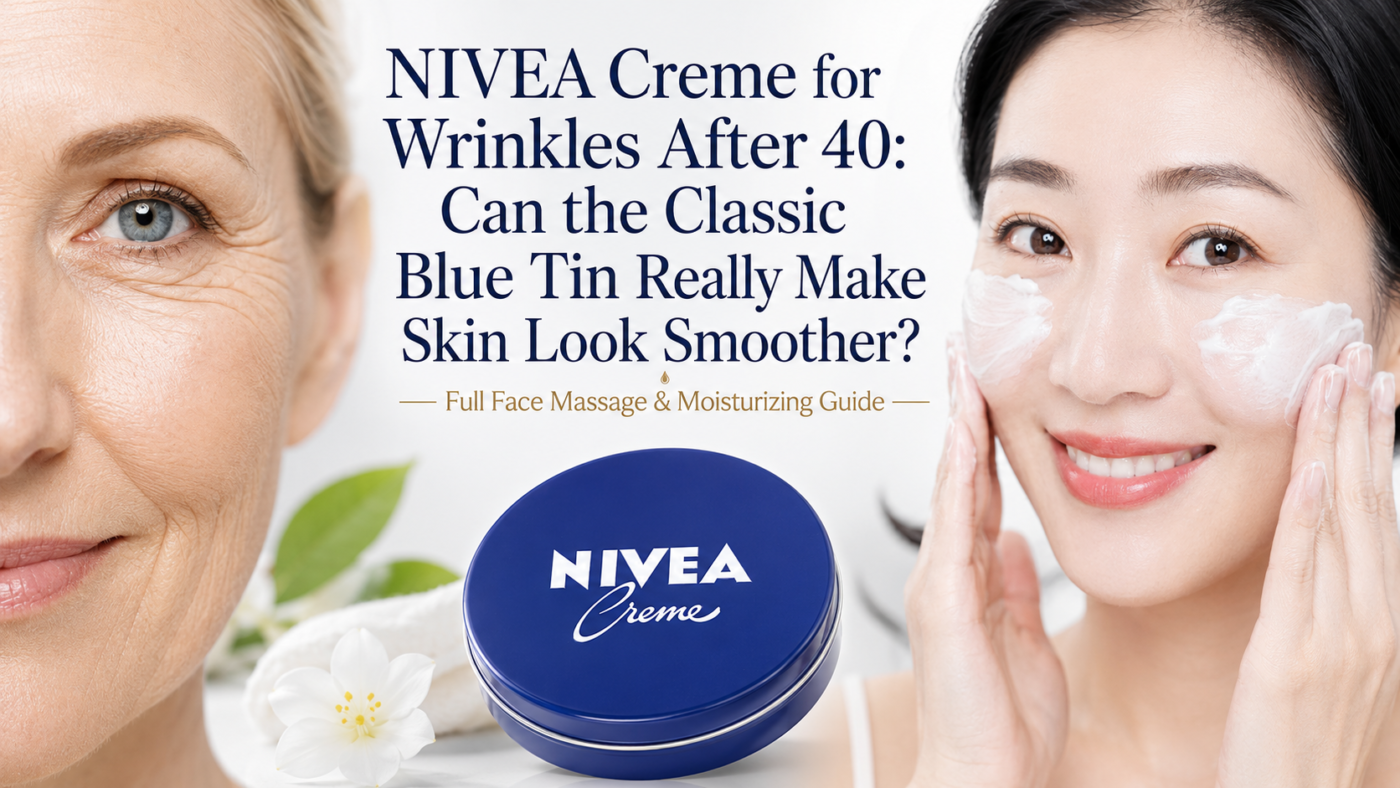
NIVEA Creme for wrinkles after 40 has become a popular beauty topic because this classic blue tin can make dry, dehydrated skin look noticeably smoother and more supple.A small blue tin of NIVEA Creme has been sitting in bathrooms, bedside drawers and family cabinets for generations.
For people considering NIVEA Creme for wrinkles after 40, hydration is the most realistic benefit to expect.For decades, many people thought of it as a simple, old-fashioned moisturizer.
Then social media rediscovered it.
Suddenly, beauty videos began claiming that this inexpensive cream could smooth wrinkles, tighten sagging skin, reduce under-eye bags and even rival luxury creams costing hundreds of dollars.
The popularity of NIVEA Creme for wrinkles after 40 largely comes from its rich moisturizing texture.Some users swear that their skin looks noticeably plumper and younger after applying a thick layer of the classic blue tin.
So what is really happening?
The answer is surprisingly simple.
NIVEA Creme can be very effective at reducing dryness and making dry skin look smoother and more supple. When dehydrated skin becomes better moisturized, fine lines can temporarily appear softer.Using NIVEA Creme for wrinkles after 40 cannot replace sunscreen or evidence-based anti-aging treatments.
But that is not the same as reversing structural wrinkles or lifting sagging facial tissue.
For adults over 40—especially those experiencing increasing dryness—the classic cream may be a useful, affordable moisturizer.
The key is understanding what it can realistically do.
Why Skin Often Feels Drier After 40
Skin changes gradually with age.
Sebum production may decline, the skin barrier can become less efficient, and water loss through the outer layer of the skin can become more noticeable.When using NIVEA Creme for wrinkles after 40, apply only as much as your skin needs.
Hormonal changes around menopause can further contribute to dryness in many women.
As a result, skin may begin to feel:
- Drier
- Rougher
- Less supple
- More easily irritated
- More visibly lined
Fine lines caused or exaggerated by dehydration can become particularly obvious.
This is one reason a rich occlusive moisturizer can sometimes produce a surprisingly dramatic visual improvement.
It is not erasing the underlying wrinkle.
It is improving the condition of the outer skin.Ultimately, NIVEA Creme for wrinkles after 40 works best as a moisturizer rather than a wrinkle-removal treatment.
What Is NIVEA Creme?
NIVEA Creme is one of the world’s longest-running mass-market moisturizers.
Beiersdorf introduced the original NIVEA Creme in 1911. The now-iconic blue-and-white tin design appeared in 1925 and celebrated its 100th anniversary in 2025. According to Beiersdorf, the classic product remains part of the brand’s current portfolio.
The cream is designed primarily to provide rich skin conditioning and moisture protection.
It is not marketed as a prescription wrinkle treatment.
That distinction is important.
Why Can a Thick Cream Make Wrinkles Look Better?
Many visible fine lines become more noticeable when skin is dry.
A rich moisturizer can improve appearance through several mechanisms.
Occlusion
Occlusive ingredients form a protective layer over the skin.
This reduces transepidermal water loss—the evaporation of water through the skin surface.
When the outermost skin layers retain more water, the skin can look plumper and smoother.
Emollience
Emollient ingredients fill microscopic spaces between surface skin cells.
This can reduce roughness and make the skin feel softer.
Humectancy
Some moisturizers also contain ingredients that help attract or retain water within the outer skin layers.
Together, these effects can create the appearance of smoother skin.
That appearance can be very noticeable if the skin was dry beforehand.
Does NIVEA Creme Actually Remove Wrinkles?
Not in the structural sense.
There are different types of visible lines.
Dehydration Lines
These can improve significantly when skin is properly moisturized.
Expression Lines
These occur from repeated facial movement and changes in skin elasticity.
Moisturizer may soften their appearance but cannot eliminate the underlying movement.
Deep Age-Related Wrinkles
These involve changes in collagen, elastin, subcutaneous tissue, sun damage and facial anatomy.
A basic moisturizer cannot reverse all of these changes.
So when someone says:
“NIVEA erased my wrinkles overnight.”
A more scientifically accurate interpretation is often:
“The moisturizer hydrated my dry skin enough that my fine lines became less visible.”
That is still a useful cosmetic effect.
It simply should not be confused with permanent wrinkle removal.
Is NIVEA Creme the Same as La Mer?
This is one of the most persistent beauty myths online.
People sometimes compare the classic blue NIVEA Creme with luxury creams because both may use rich emollient and occlusive bases.
But similarity in a few base ingredients does not make two complete cosmetic formulas identical.
Cosmetic performance depends on:
- Ingredient concentrations
- Ingredient combinations
- Emulsifier systems
- Texture
- Humectants
- Botanical or fermented extracts
- Fragrance
- Preservatives
- Manufacturing methods
- Product stability
- Skin compatibility
Therefore, it is not scientifically justified to say that a low-cost cream is automatically equivalent to a luxury product simply because part of the ingredient list looks similar.
Price also does not guarantee superior anti-aging results.
The more useful question is:
Does the product moisturize your skin effectively without irritating it?
For many people, the answer with NIVEA Creme may be yes.
Why Does NIVEA Creme Feel So Rich?
The classic blue tin is much thicker than many modern gel moisturizers.
That rich texture is useful for dry skin because it creates a stronger occlusive layer.
This can be particularly beneficial on:
- Dry cheeks
- Dry forehead
- Around the mouth
- Hands
- Elbows
- Knees
- Other rough areas
People with very oily or acne-prone skin may find it too heavy.
Skin type matters more than age alone.
Can NIVEA Creme Tighten Sagging Skin?
Not permanently.
Sagging involves changes in:
- Collagen
- Elastin
- Facial fat
- Ligaments
- Bone structure
- Muscle
- Skin thickness
A moisturizer cannot physically restore all of those structures.
However, well-hydrated skin reflects light more evenly and can look smoother and slightly firmer.
That visual effect can be mistaken for lifting.
Think of it as surface improvement, not structural tightening.
Can It Improve Smile Lines?
It can make dry smile lines look softer.
Nasolabial folds are partly structural features influenced by facial anatomy, fat distribution and aging.
Cream cannot eliminate them.
Applying moisturizer around the nose and mouth may soften the appearance of superficial dryness.
Massage may also temporarily relax facial tension.
But neither method permanently removes the fold.
What About Under-Eye Wrinkles?
The skin around the eyes is thin and sensitive.
Moisturization can help dry fine lines look smoother.
But the eye area requires more caution.
A thick fragranced cream may irritate some people or migrate into the eyes.
If you want to use NIVEA Creme near the eyes:
- Use a very small amount
- Keep it away from the lash line
- Do not rub aggressively
- Stop if it stings
- Avoid getting it directly into the eyes
There is no need to massage the eyelids forcefully.
Can NIVEA Reduce Under-Eye Bags?
Not reliably.
Under-eye puffiness can be influenced by:
- Fluid retention
- Sleep
- Allergies
- Genetics
- Salt intake
- Fat-pad changes
- Aging
- Skin laxity
A cool product or very gentle massage may temporarily make mild puffiness look better.
But moisturizer itself does not permanently remove under-eye bags.
Does Facial Massage Improve Circulation?
Gentle massage can temporarily increase local blood flow.
This may create:
- Warmth
- Temporary redness
- A fresh appearance
- Increased surface glow
These changes are temporary.
They do not mean that skin cells have been permanently “activated.”
Nor does increased circulation automatically increase collagen production enough to erase wrinkles.
Does Facial Massage Improve Lymphatic Drainage?
The lymphatic system does help move fluid through tissues.
Gentle facial massage may temporarily influence superficial fluid movement, which is one reason some people notice short-term reduction in puffiness.
But this should not be described as removing “toxins” or “waste buildup.”
If an area below the ear or along the jaw hurts when pressed, pain does not prove that waste products are trapped there.
Pain simply means the tissue is sensitive.
Do not massage painful areas aggressively.
Should Facial Massage Hurt?
No.
The idea that pain proves a massage is working is incorrect.
Strong pressure can irritate the skin, cause inflammation and potentially worsen redness or sensitivity.
For facial massage, the goal should be:
slip + gentle pressure + controlled movement
Not:
pain + scraping + aggressive knuckle pressure
Can Massage Lift the Jawline?
A massage can temporarily alter the way the face looks.
Reduced puffiness, different muscle tension and increased blood flow can create a sharper-looking contour immediately afterward.
That does not mean the jawline has been structurally lifted.
Once fluid distribution and muscle tension return to normal, much of the effect may fade.
Is NIVEA Creme Good for Skin Over 40?
It can be.
Age alone does not determine which moisturizer you need.
But many people over 40 experience increasing dryness, so a richer product can become more useful.
NIVEA Creme may work particularly well if your skin is:
- Dry
- Very dry
- Rough
- Flaky
- Tight after cleansing
- More dehydrated in winter
If your skin is oily, acne-prone or easily clogged, a lighter moisturizer may be more comfortable.
Is It Safe to Use Every Day?
For most people who tolerate the formula, a basic moisturizer can be used daily.
However, individual reactions vary.
The classic NIVEA Creme contains fragrance, so people with very sensitive skin, fragrance sensitivity, rosacea or eczema-prone skin may prefer a fragrance-free alternative.
Patch testing is sensible if you are unsure.
When Should You Apply It?
A moisturizer generally works best when applied after cleansing while the skin still has a little moisture.
This helps reduce water loss.
A simple evening routine might be:
Step 1: Cleanse
Use a gentle facial cleanser.
Avoid very hot water.
Step 2: Apply Any Treatment Product
If you use a dermatologist-recommended serum or treatment, apply it according to the product instructions.
Step 3: Moisturize
Apply a thin layer of cream.
You do not need a thick mask unless your skin is extremely dry and tolerates it well.
A Safer NIVEA Facial Massage
If you enjoy facial massage, the cream can provide useful slip.
The goal should be relaxation and comfortable application rather than trying to physically erase wrinkles.
Step 1: Warm a Small Amount Between Your Hands
Take a modest amount of cream.
Rub it gently between your fingers and palms.
This helps spread the thick texture more easily.
Step 2: Apply to the Cheeks
Press the cream gently over the cheeks.
Use upward and outward gliding motions.
Do not pull hard on the skin.
Step 3: Around the Mouth
Apply a small amount around the mouth.
Use light circular motions.
Avoid aggressively stretching the skin.
Step 4: Nasolabial Area
Use your fingertips to glide gently beside the nose and across the cheeks.
Do not attempt to mechanically “iron out” smile lines.
Step 5: Under the Eyes
Use your ring finger or another light-touch finger.
Tap or glide extremely gently across the orbital bone.
Stay away from the eye itself.
Step 6: Temples
Use small circles at the temples.
This is mainly for relaxation.
Step 7: Forehead
Glide your fingertips outward across the forehead.
Avoid strong knuckle pressure.
Step 8: Between the Eyebrows
Gentle circular massage may feel relaxing if you tend to frown.
Do not press hard enough to cause pain.
Step 9: Jawline
Glide lightly from the center of the chin toward the ears.
Again, this should not hurt.
Step 10: Finish With Gentle Pressing
Place clean palms lightly against the cheeks and forehead.
There is no need to push ingredients “deeper.”
Topical moisturizers primarily work within the outer skin layers.
How Often Should You Massage?
If your skin tolerates massage well, one to three gentle sessions per week is more than enough.
You do not need long daily sessions.
People with sensitive skin may do better with simple moisturizer application and no massage at all.
Who Should Avoid Facial Massage?
Avoid aggressive facial massage if you have:
- Active acne cysts
- Open wounds
- Active eczema
- Severe rosacea flare
- Sunburn
- Skin infection
- Recent facial surgery
- Recent injectable procedures unless your clinician approves it
If pressure consistently hurts, stop.
Can NIVEA Replace Retinol?
No.
Moisturizers and retinoids serve different purposes.
A moisturizer mainly supports hydration and the skin barrier.
Retinoids have significantly stronger evidence for improving photoaging, fine lines and skin texture over time.
Many people use both:
retinoid + moisturizer
rather than choosing one or the other.
Can NIVEA Replace Sunscreen?
Absolutely not.
This is one of the most important points for anyone worried about wrinkles.
UV exposure is a major contributor to premature skin aging.
Broad-spectrum sunscreen is considerably more important for wrinkle prevention than facial massage.
A practical anti-aging routine should prioritize:
- Sunscreen
- Gentle cleansing
- Moisturization
- Evidence-based treatments when appropriate
- Healthy lifestyle habits
Massage is optional.
What Actually Helps Prevent Wrinkles?
The strongest long-term foundations include:
- Daily broad-spectrum sunscreen
- Avoiding tanning
- Not smoking
- Adequate sleep
- Balanced nutrition
- Regular exercise
- Appropriate moisturizer
- Retinoids when suitable
- Dermatologic treatment when needed
An inexpensive moisturizer can fit beautifully into that routine.
It simply should not be expected to do everything.
Why Does Skin Sometimes Look Dramatically Better Immediately?
Imagine dry paper becoming slightly damp.
The surface changes.
Something similar happens when dry skin becomes hydrated.
The outer skin cells swell slightly with water.
Surface roughness decreases.
Light reflects more evenly.
Fine dehydration lines become less obvious.
That is why someone can apply a rich cream and genuinely say:
“My wrinkles look much better.”
Their observation may be real.
The interpretation simply needs to be accurate.
What About the $4 Price Claim?
The exact retail price varies substantially by country, tin size, retailer and time.
NIVEA Creme is positioned as an affordable mass-market moisturizer, but an article should avoid presenting “$4” as a universal fixed price.
A better statement is:
“an inexpensive drugstore moisturizer.”
This keeps the article accurate internationally.
The Bottom Line
The classic NIVEA blue tin does not need miraculous anti-aging claims to be useful.
It is a rich moisturizer with more than a century of history.
For dry skin—particularly skin that becomes drier with age—it can help reduce moisture loss, soften roughness and make superficial fine lines temporarily look smoother.
That can create a visible improvement.
But it does not permanently erase deep wrinkles.
It does not lift sagging facial tissue.
It does not remove facial fat.
And massage cannot push skincare ingredients deep into the face or remove hidden toxins.
If NIVEA Creme feels comfortable on your skin, use it for what it does well:
moisturizing, softening and protecting dry skin.
Combine it with sun protection and evidence-based skincare, and that inexpensive blue tin can still earn a place in a modern routine.
Sometimes good skincare does not need to be expensive.
It just needs to do the basics well.
Frequently Asked Questions
Does NIVEA Creme remove wrinkles?
It may temporarily soften the appearance of fine dehydration lines by moisturizing the skin, but it cannot permanently remove deep structural wrinkles.
Is NIVEA Creme good for people over 40?
It can be useful for people experiencing increasing dryness, although suitability depends more on skin type than age alone.
Can NIVEA Creme tighten sagging skin?
No moisturizer can permanently lift sagging skin. Better hydration may make the surface look smoother and slightly plumper.
Is NIVEA Creme the same as La Mer?
No. Some products may share certain types of base ingredients, but their complete formulas are different. Similarity in a few ingredients does not prove equivalent performance.
Can I use NIVEA Creme under my eyes?
Some people can tolerate a tiny amount around the orbital area, but keep it away from the eyes and lash line and discontinue use if irritation occurs.
Can facial massage remove under-eye bags?
Gentle massage may temporarily reduce mild puffiness in some people, but it cannot permanently remove anatomical under-eye bags.
Does facial massage remove toxins?
No. Painful spots during massage do not prove that toxins or waste products are trapped beneath the skin.
Can I use NIVEA Creme every night?
If your skin tolerates the product and benefits from a rich moisturizer, nightly use may be reasonable.
Is NIVEA good for acne-prone skin?
Some acne-prone users may find the texture too rich or occlusive. A lighter facial moisturizer may be more comfortable.
Should facial massage hurt?
No. Facial massage should be gentle. Pain, bruising or persistent irritation means the pressure is excessive.
Medical Disclaimer:
This article is for educational and informational purposes only and is not medical advice. Stop using any skincare product that causes persistent burning, redness, swelling or irritation. People with chronic skin conditions or persistent facial swelling should consult a qualified dermatologist or healthcare professional.
References
- Beiersdorf. Brand History: NIVEA. NIVEA Creme was introduced in 1911 and the blue tin design followed in 1925.
- Beiersdorf. From Hamburg to the World: 100 Years of the Blue NIVEA Tin. 2025.
- Beiersdorf. Iconic Blue Tin Now Available in Two Versions. 2026. The company confirms the classic NIVEA Creme remains available alongside the newer Natural Touch version.
This article is for general education and does not replace individualized care from a qualified health professional. Seek appropriate advice for persistent, severe, or concerning symptoms.
Read the full medical disclaimer