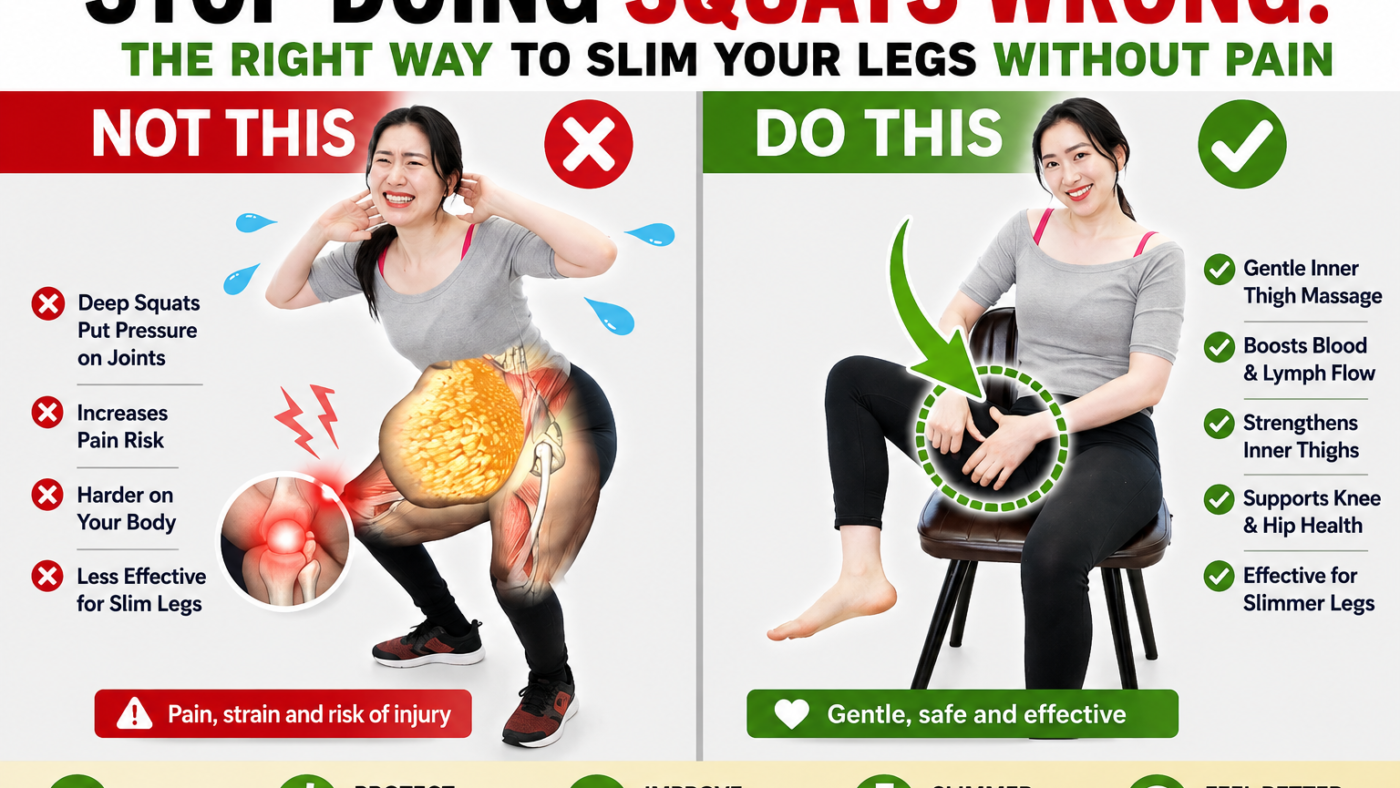
Slimmer legs after 40 can be a realistic goal when you focus on strength, mobility, regular physical activity and sustainable weight management rather than painful or excessive exercise. Many women want more defined legs but assume the answer must be endless squats, lunges and exhausting lower-body workouts.
That can become frustrating—especially if your knees hurt, your hips feel stiff, or your legs already feel heavy and tired.
The good news is that improving the way your legs look and function does not require punishing exercise.
But there is also an important truth that social-media fitness videos often leave out:
Massaging your inner thighs cannot selectively melt thigh fat.
You cannot “peel away fascia” to make a leg permanently thinner.
And improving circulation does not automatically cause fat stored in the thighs to disappear.
What gentle massage, mobility work and inner-thigh strengthening can do is help your legs feel less tense, improve movement, increase muscular control and make it easier to stay active consistently.
For women in their 40s and beyond, that can be far more valuable than forcing painful squats.
Why Your Legs May Feel Different After 40
Many women notice changes in their body during their 40s and 50s.
Muscle mass can gradually decline with age, especially without resistance training. Hormonal changes around perimenopause and menopause may also affect muscle, bone and joint comfort.
Research has found that musculoskeletal discomfort becomes more common during the menopausal transition.
However, this does not mean estrogen loss is the sole explanation for every aching knee, stiff hip or tired leg.
Age, previous injuries, body weight, activity level, sleep, muscle strength, arthritis and other health conditions can all influence how your legs feel.
That is why the best strategy is not to blame a single hormone or muscle.
Instead, focus on maintaining strength, mobility and regular physical activity.
Does Extra Body Weight Put More Stress on the Knees?
Body weight influences the mechanical load placed on the lower extremities during walking, climbing stairs and other activities.
For someone who already has sensitive knees, movements such as deep squats may feel uncomfortable.
That does not mean squats are inherently harmful.
A properly scaled squat can be an excellent strengthening exercise.
The key is matching the exercise to your current strength, mobility and symptoms.
If deep squatting hurts, there are many other ways to train the legs.
You do not have to exercise through pain to make progress.
Can You Specifically Slim the Inner Thighs?
This is one of the most important myths to correct.
Performing exercises for one body part does not allow you to choose where fat disappears first.
Your genetics, hormones, overall body composition and energy balance strongly influence where your body stores and loses fat.
Inner-thigh exercises can strengthen the muscles underneath the fat.
They may improve muscle tone and leg control.
But they cannot selectively burn the layer of fat directly above those muscles.
If reducing overall body fat is your goal, the larger strategy should include:
- Regular physical activity
- Appropriate nutrition
- Strength training
- Adequate protein
- Consistent sleep
- Sustainable calorie control when weight loss is appropriate
Leg exercises then help preserve and develop the muscles beneath the changing body composition.
Meet Your Inner-Thigh Muscles
The muscles commonly called the inner thighs are largely the hip adductors.
Major adductor muscles include:
- Adductor longus
- Adductor brevis
- Adductor magnus
- Gracilis
- Pectineus
Their primary role is bringing the thigh toward the midline of the body.
They also contribute to pelvic stability, hip control and movement during walking and exercise.
These muscles do not simply “switch off” because you get older.
However, like other muscles, they may become weaker if they are not challenged regularly.
Do Weak Inner Thighs Cause Knee Pain?
Not necessarily.
Knee pain is rarely explained by one muscle.
The hips, quadriceps, hamstrings, calves and feet all contribute to lower-limb movement.
Strength deficits around the hip can be relevant in certain types of knee pain, but simply strengthening the adductors is not a universal treatment.
If you have persistent knee pain, swelling, locking, instability or difficulty bearing weight, get the problem evaluated rather than trying to massage it away.
What About “Lymphatic Flow”?
The lymphatic system is a genuine and important part of human physiology.
It helps transport fluid, proteins and immune cells through the body.
But online beauty content often uses “lymphatic drainage” to explain almost any temporary change in body shape.
That is misleading.
Your thighs contain lymphatic vessels and lymph nodes, but massage does not permanently remove fat from your legs.
People with true lymphedema may sometimes receive specialized manual lymphatic drainage as part of medical treatment.
That is very different from ordinary cosmetic thigh massage.
For otherwise healthy people, normal muscle contractions generated during walking and exercise already help support fluid movement.
Why Massage Can Still Make Your Legs Feel Better
Removing exaggerated claims does not make massage useless.
Gentle self-massage may:
- Feel relaxing
- Temporarily reduce the sensation of muscular tightness
- Increase local warmth
- Improve body awareness
- Make subsequent stretching feel more comfortable
- Provide a pleasant recovery ritual
Those are perfectly reasonable reasons to use massage.
You simply do not need to claim that you are breaking fat deposits or peeling fascia away from the muscles.
You Cannot “Peel Off” Fascia
Fascia is connective tissue that surrounds and connects muscles and other structures throughout the body.
It is not a layer that can be physically peeled away by grabbing your thigh.
Pressing, rolling or massaging tissue may temporarily change how stiff or sensitive an area feels.
But the idea that painful grabbing breaks apart fascia and permanently reshapes the thigh is not supported by anatomy.
More pressure is therefore not necessarily better.
If massage produces bruising or significant pain, it is too aggressive.
A Gentle Inner-Thigh Routine
Here is a safer way to adapt the original routine.
The sequence combines light massage, mobility, stretching and strengthening.
The goal is comfortable movement—not pain.
Step 1: Gentle Inner-Thigh Massage
Sit comfortably on a sturdy chair.
Keep your feet supported.
Place your hands on the inner portion of one thigh, staying away from the groin itself and avoiding direct pressure on sensitive structures.
Use your palms and fingers to gently compress and release the soft tissue.
Work gradually from above the knee toward the upper thigh.
Use comfortable pressure.
Continue for approximately 30–60 seconds.
Repeat on the other side.
The purpose is simply to warm the area and reduce the sensation of tension.
Step 2: Gentle Thigh Shaking
Remain seated.
Relax one leg as much as possible.
Use your hands to gently shake the thigh muscles.
Keep the movement light.
Repeat for approximately 20–30 seconds before switching sides.
There is no need to make the tissue hurt.
Step 3: Outer-Thigh Massage
Place your hands on the outer part of your thigh.
Massage gently using slow circular or kneading motions.
If an area is sensitive, reduce the pressure.
Pain during massage does not prove that blood flow is blocked.
Nor does it prove that toxins or fat deposits are trapped there.
Step 4: Seated Knee Lift
Sit toward the front of a stable chair.
Keep your torso comfortably upright.
Lift one knee toward your chest as far as comfortable.
Lower the foot.
Repeat approximately 8–12 times.
Then change sides.
This gently works the muscles around the hip without requiring deep knee bending.
Step 5: Figure-Four Hip Stretch
Sit upright.
Place one ankle across the opposite thigh.
If this feels comfortable, gently hinge forward from the hips.
You should feel a stretch around the buttock or outer hip.
Do not force the knee downward.
Hold for approximately 20–30 seconds.
Repeat on the opposite side.
Step 6: Inner-Thigh Activation
Sit upright with your feet flat.
Place a pillow, folded towel or soft ball between your knees.
Gently squeeze your knees inward.
Hold for approximately three to five seconds.
Relax.
Repeat 8–12 times.
This is a straightforward way to activate the hip adductors without aggressive movement.
Step 7: Seated Hip Abduction
Now train the opposite direction.
Loop a light resistance band around the thighs if available.
Gently move your knees apart while keeping your feet stable.
Return slowly.
Repeat approximately 8–15 times.
Training both inward and outward hip movement can help create more balanced hip strength.
Step 8: Controlled Leg Crosses
Sit back securely in the chair.
If your balance and hip mobility allow, extend your legs slightly forward.
Slowly cross one leg over the other and return.
Alternate sides.
Keep the movement controlled rather than swinging rapidly.
If you feel hip or back discomfort, skip this exercise.
Step 9: Seated Inner-Thigh Stretch
Sit toward the front edge of the chair.
Open your feet and knees to a comfortable width.
Keep your spine relaxed but upright.
Gently lean toward one side.
You should feel a mild stretch along the opposite inner thigh.
Hold for approximately 20–30 seconds.
Repeat on the other side.
Avoid forcing your knee downward with strong pressure.
Step 10: Hamstring Stretch
Extend one leg in front of you.
Keep the heel on the floor and point the toes upward.
Maintain a small knee bend if necessary.
Hinge slightly forward from your hips.
Stop when you feel gentle tension behind the thigh.
Hold for approximately 20–30 seconds.
Repeat on the other side.
Step 11: Leg Circles
Sit securely toward the back of the chair.
Lift one foot slightly from the floor.
Make a comfortable circle using the hip.
Keep the movement relatively small at first.
Perform several circles in one direction.
Then reverse.
Repeat with the opposite leg.
Large movements are unnecessary.
Control matters more than range.
Step 12: Finish With Gentle Massage
Finish the routine by lightly sweeping your hands along the thighs.
There is no need for deep pressing.
Think of this as a relaxing cool-down rather than an attempt to “drain” fat or break adhesions.
Should Massage Hurt?
No.
Mild pressure can be comfortable.
Strong pain is not evidence that the massage is more effective.
Stop if you experience:
- Sharp pain
- Numbness
- Tingling
- Burning
- Significant bruising
- Sudden swelling
- Skin discoloration
Avoid deep massage over varicose veins, active inflammation, recent injuries or unexplained swelling unless a healthcare professional has advised otherwise.
What If Your Legs Are Swollen?
Occasional mild leg puffiness can have simple causes such as prolonged sitting.
But persistent or unexplained swelling deserves more caution.
Seek prompt medical evaluation for sudden swelling—particularly when one leg becomes noticeably more swollen than the other.
Swelling accompanied by pain, warmth, redness, chest pain or shortness of breath requires urgent medical attention.
Do not aggressively massage an unexplained swollen leg.
Do Squats Make Your Legs Bulky?
For most recreational exercisers, ordinary squats do not suddenly create enormous thighs.
Building substantial muscle usually requires progressive resistance training, sufficient nutrition and time.
Squats can strengthen the quadriceps, glutes and other lower-body muscles.
They can be extremely useful.
The problem is not that squats are “bad.”
The problem is doing an exercise that hurts and believing pain is necessary for results.
If conventional squats bother your knees, alternatives include:
- Sit-to-stand exercises
- Wall-supported squats
- Partial squats
- Glute bridges
- Step-ups
- Hip abduction exercises
- Hamstring curls
- Walking
- Cycling
- Water exercise
Choose the version your body tolerates.
The Best Exercise for Slimmer-Looking Legs
There is no single best movement.
For body-composition goals, combining several approaches is usually more useful.
1. Walk Regularly
Walking is accessible, inexpensive and easy to scale.
It also adds meaningful daily activity without requiring complicated equipment.
2. Strength Train
Train the entire lower body rather than obsessing over one part of the thigh.
Good programs typically include movements for:
- Quadriceps
- Hamstrings
- Glutes
- Hip adductors
- Hip abductors
- Calves
3. Include Aerobic Activity
Cycling, brisk walking, swimming, dancing and other aerobic activities can increase total energy expenditure.
4. Manage Nutrition
Physical activity helps with weight management, but food intake remains a major component of fat loss.
A sustainable eating pattern is more effective than trying to “massage calories away.”
Why Strength Matters More After 40
Resistance training becomes particularly valuable as we age.
Without sufficient muscular loading, muscle mass and strength tend to decline over time.
That does not mean women over 40 need punishing workouts.
Two or three intelligently designed strength sessions each week can be a powerful foundation.
Beginners can start with:
- Chair stands
- Bridges
- Step-ups
- Light resistance-band exercises
- Supported squats
- Calf raises
- Hip exercises
Gradually progress as strength improves.
Can This Routine Reduce Cellulite?
Massage may temporarily alter the appearance of skin because of changes in pressure and fluid distribution.
But it does not permanently remove cellulite.
Cellulite is influenced by connective tissue structure, fat distribution, skin characteristics, hormones and genetics.
It is extremely common in women and is not evidence of poor health.
Can You Get Results in One Session?
You might immediately feel:
- Warmer
- More relaxed
- Less stiff
- More mobile
That is entirely plausible.
But permanent fat loss, substantial muscle development or major changes in thigh circumference do not occur during a single massage session.
Be skeptical of dramatic before-and-after photographs taken only minutes apart.
Temporary posture, lighting, muscle contraction and fluid movement can dramatically change how legs look in photographs.
A More Realistic 4-Week Goal
Instead of asking:
“Can I make my thighs thinner today?”
Try asking:
“Can I make my legs stronger and easier to move this month?”
For four weeks, combine:
3–5 days: walking or another aerobic activity
2–3 days: lower-body resistance training
3–5 days: short mobility sessions
Optional: gentle thigh massage for relaxation
That strategy has substantially more long-term value than relying on massage alone.
Women Over 40 Don’t Need to Stop Training Hard
Another misconception deserves correction.
Women do not need to abandon squats and strength exercises simply because they have turned 40.
If your joints tolerate resistance exercise, progressively challenging your muscles is one of the most valuable things you can continue doing as you age.
The right message is not:
“Stop squatting after 40.”
It is:
“Choose exercises your joints tolerate and build strength progressively.”
The Bottom Line
You do not need painful squats to take care of your legs.
Gentle inner-thigh massage, mobility exercises and stretching can help your legs feel more relaxed and comfortable.
Inner-thigh strengthening can improve muscular control around the hips and contribute to a balanced lower-body program.
But massage cannot selectively remove thigh fat.
It cannot physically peel away fascia.
And increasing local circulation does not automatically produce slimmer thighs.
If your goal is slimmer-looking, stronger and healthier legs, combine comfortable movement with resistance training, aerobic activity and appropriate nutrition.
Massage can be part of the routine.
It just should not be mistaken for the mechanism of fat loss.
After 40, the goal is not to punish your legs.
The goal is to keep them strong enough to carry you confidently through the decades ahead.
or women seeking slimmer legs after 40, strength training should be part of the overall strategy.
The key to slimmer legs after 40 is not aggressive massage or hundreds of squats.
Walking can also support the broader goal of slimmer legs after 40 by increasing daily physical activity.
Building stronger hips and thighs is especially useful when working toward slimmer legs after 40.
Frequently Asked Questions
Can inner-thigh massage make my legs thinner?
Not by removing body fat. Massage may temporarily reduce feelings of tension or puffiness, but permanent fat loss requires changes in overall energy balance.
Can massage break down thigh fat?
Ordinary self-massage does not destroy fat cells or selectively burn fat from the area being massaged.
Can massage “peel fascia”?
No. Fascia is connective tissue and cannot literally be peeled away from muscle through ordinary massage.
Does improving circulation burn thigh fat?
No. Healthy circulation is important, but increased local blood flow does not automatically cause stored fat in that specific area to disappear.
Are squats bad for women over 40?
No. Squats can be excellent exercises when appropriately performed and scaled. Women with pain can use modified squats or alternative exercises.
Can strengthening inner thighs help my knees?
Hip strength can contribute to lower-limb control, but knee pain has many possible causes. Inner-thigh strengthening is not a universal cure.
Why do my joints hurt more during menopause?
Musculoskeletal discomfort becomes more common during the menopausal transition, and hormonal changes may be one contributing factor. Aging, activity level, strength, previous injuries and medical conditions can also contribute.
How often can I perform this routine?
Gentle mobility can usually be performed several times per week if comfortable. Strengthening exercises generally benefit from recovery time between harder sessions.
Should thigh massage hurt?
No. Mild pressure may feel pleasant, but sharp pain, significant bruising, numbness or persistent soreness is a reason to reduce pressure or stop.
What is the best way to slim my legs?
You cannot selectively control where fat is lost. Overall fat reduction, combined with lower-body strength training, aerobic activity and adequate nutrition, offers a more evidence-based strategy.
Medical Disclaimer: This article is for educational and informational purposes only and is not medical advice. Stop any exercise or massage that causes sharp pain, numbness, unusual swelling or significant discomfort. Seek professional medical evaluation for persistent knee or hip pain, sudden one-sided leg swelling, unexplained swelling, or other concerning symptoms.
References
- Centers for Disease Control and Prevention. Physical Activity and Your Weight and Health. Updated 2026.
- World Health Organization. Guidelines on Physical Activity and Sedentary Behaviour.
- Wright VJ, et al. Research and reviews concerning musculoskeletal symptoms during the menopausal transition.
- Musculoskeletal Manifestations of Perimenopause: A Systematic Review and Meta-Analysis of 93,021 Women. Journal of Bone and Joint Surgery Open Access. 2026.
- The Influence of Sex Hormones on Musculoskeletal Pain and Osteoarthritis. The Lancet Rheumatology.
- American College of Sports Medicine. Guidance on resistance training, physical activity and body composition.
- National Institutes of Health / National Library of Medicine. Research concerning hip strengthening and lower-extremity function.
This article is for general education and does not replace individualized care from a qualified health professional. Seek appropriate advice for persistent, severe, or concerning symptoms.
Read the full medical disclaimer