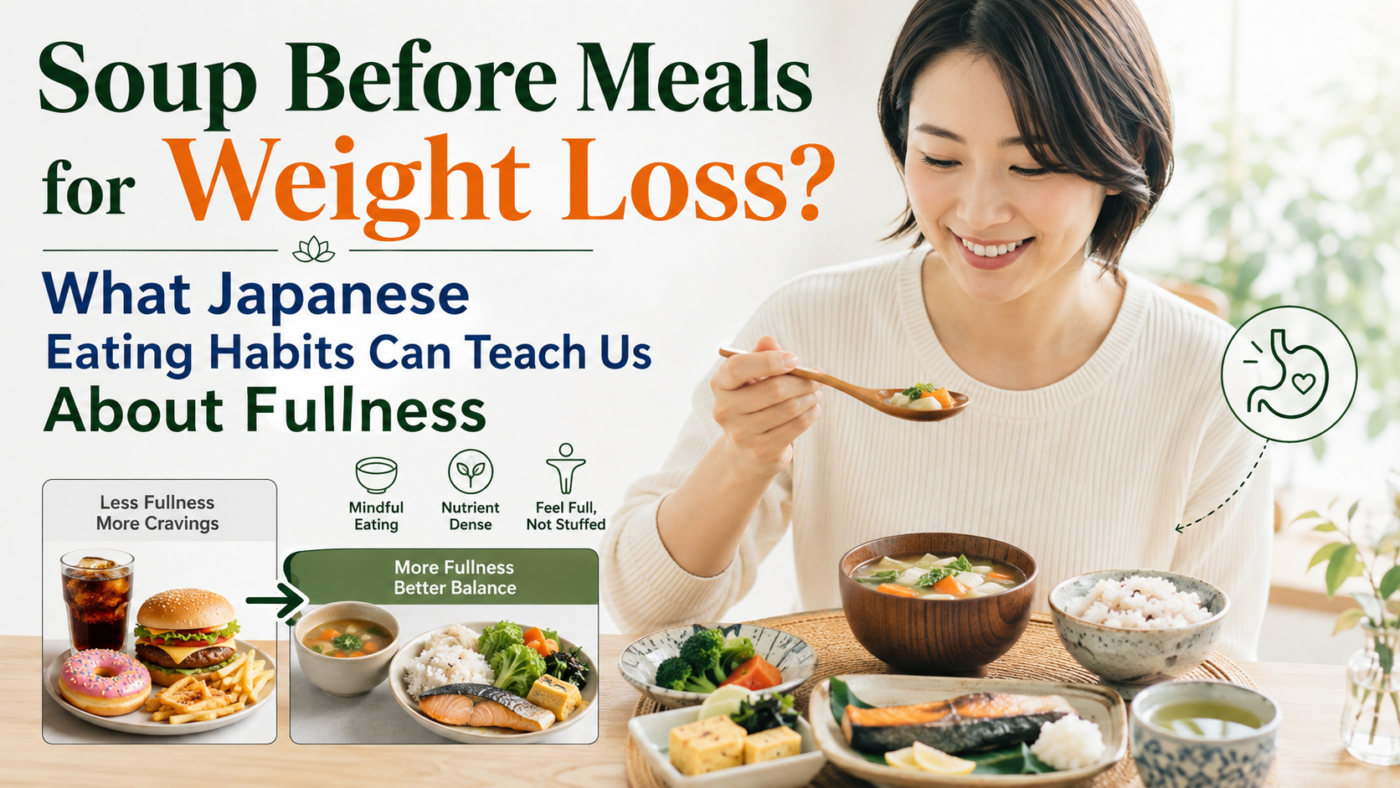
Soup before meals for weight loss sounds almost too simple to be useful. There is no magical Japanese soup that melts body fat, and adding a bowl of broth to an otherwise high-calorie diet will not automatically make the scale move.
Yet there is an interesting piece of nutrition science behind the idea.
Research suggests that certain low-energy-density soups—especially vegetable-based soups containing plenty of water and relatively few calories—may increase fullness and help some people consume fewer calories during the rest of a meal.
This makes soup less of a “fat-burning secret” and more of a practical tool for portion control.
Traditional Japanese eating patterns also offer a useful lesson. Meals are often structured around modest portions of rice, soup, vegetables, and protein rather than relying on one oversized entrée. The Japanese Ministry of Agriculture, Forestry and Fisheries describes the traditional ichiju-sansai pattern as rice accompanied by one soup and several dishes, creating variety without requiring enormous portions.
The useful takeaway is not that everyone should copy a Japanese diet exactly.
It is that meal structure, portion size, energy density, vegetables, and beverage choices can make eating a satisfying amount of food easier without consuming excessive calories.
Why Weight Management Is About More Than Willpower
People often hear a simple explanation for weight change: calories consumed versus calories expended.
At the physiological level, long-term body-weight change does depend heavily on energy balance. But knowing that fact does not automatically make eating less easy.
Hunger, food environment, portion size, sleep, stress, medications, physical activity, genetics, food palatability, and habitual eating patterns can all influence how much a person eats.
That is why constantly fighting hunger through extreme calorie restriction often becomes difficult to sustain.
A more realistic strategy is to change the composition of meals so that a satisfying volume of food provides fewer calories.
This concept is known as dietary energy density.
Foods with high water and fiber content—such as many vegetables, fruits, and broth-based soups—usually contain fewer calories per gram than foods rich in fat, refined carbohydrates, or added sugars.
Research on energy density suggests that lower-energy-density eating patterns can allow people to consume satisfying portions while moderating calorie intake.
The goal is not necessarily to eat tiny portions.
It is to make more of the portion come from foods that provide volume, nutrients, and satisfaction for relatively fewer calories.
Can Soup Before a Meal Actually Help You Eat Less?
There is evidence that it can, at least in certain circumstances.
In a controlled study published in Appetite, adults were given different forms of low-energy-density vegetable soup before lunch. Compared with eating lunch without soup, consuming soup first reduced total energy intake at the meal by about 20 percent.
Importantly, this included the calories from the soup itself.
The researchers tested chunky soup, pureed soup, and other variations and found that several forms produced similar results.
That does not mean everyone will automatically eat exactly 20 percent fewer calories.
It does show that a relatively low-calorie, water-rich first course can sometimes increase satiation enough to reduce how much is eaten afterward.
Reviews of dietary energy density research have reached a similar general conclusion: incorporating foods such as vegetable soup, salad, fruit, and vegetables can make it easier to eat satisfying portions while keeping overall energy intake more moderate.
Why Soup May Be Filling
The explanation is more interesting than simply saying “warm soup fills your stomach.”
Water Adds Volume Without Many Calories
A broth-based vegetable soup can occupy considerable volume while providing relatively little energy.
Compare a bowl containing broth, cabbage, mushrooms, carrots, tomatoes, and leafy greens with the same physical volume of fries, cookies, cheese, or fried snacks.
Both take up space on the plate or in the stomach, but their calorie content can be dramatically different.
Food volume contributes to satiation, and incorporating water directly into food can be particularly useful for reducing its energy density.
This is one reason soup may behave differently from simply adding a caloric beverage to a meal.
Vegetables Can Add Fiber and Texture
A soup containing vegetables, beans, lentils, or whole grains may also provide dietary fiber.
Fiber can contribute to fullness and supports digestive and cardiovascular health.
However, simply putting a few pieces of mushroom into broth does not transform soup into a weight-loss treatment.
The overall composition still matters.
A soup rich in vegetables and legumes is nutritionally very different from a cream-based soup loaded with butter, cheese, cream, processed meat, or large amounts of refined starch.
Eating Soup May Slow the Pace of a Meal
Soup is usually consumed with a spoon and takes time to eat.
A slower meal gives the sensory and gastrointestinal processes involved in satiation more opportunity to develop before a large amount of food has been consumed.
This does not mean that slow eating alone guarantees weight loss, but meal pace may be another practical reason soup works well for some people.
Is Warm Soup More Filling Than Cold Food?
This is where many online explanations go too far.
There is not strong evidence that warming the stomach itself produces a special fat-loss or appetite-suppressing effect.
Studies demonstrating greater satiety from soup generally involve differences in food structure, water content, energy density, volume, and eating experience—not simply temperature.
Therefore, you do not need to believe that “hot food switches on fullness hormones” to benefit from soup.
Temperature can make a meal comforting and enjoyable, but the strongest nutritional argument for soup is its potential low energy density and nutrient-rich composition.
What Japanese Meal Structure Can Teach Us
Traditional Japanese meals are often discussed as though there were a single secret responsible for Japan’s comparatively low prevalence of obesity.
Reality is more complicated.
Genetics, food environment, transportation, physical activity, cultural norms, portion sizes, socioeconomic factors, healthcare, and dietary patterns all contribute.
There is no scientifically defensible claim that Japanese people remain lean simply because they drink soup.
However, traditional Japanese meal structure does illustrate several habits that fit well with modern nutrition science.
The Japanese ichiju-sansai pattern typically centers on rice accompanied by one soup and several dishes. Official Japanese government material describes this format as a nutritionally balanced traditional meal structure.
Rather than one enormous plate dominated by a single food, several smaller components can provide different flavors, textures, vegetables, and protein sources.
There is also a simpler ichiju-issai or “one soup, one dish” approach in Japanese food culture.
Neither pattern needs to be treated as a strict formula.
The bigger lesson is structure.
A meal might contain:
- a moderate portion of rice or another whole-grain carbohydrate
- vegetables
- a source of protein such as fish, tofu, chicken, eggs, beans, or lean meat
- a vegetable-rich soup
- water or unsweetened tea
This can be satisfying without requiring the enormous portion sizes found in some restaurant and takeaway meals.
Portion Size Really Does Matter
Serving size can strongly influence how much people eat.
Controlled feeding studies have repeatedly found that larger portions tend to increase energy intake.
People do not always compensate later by eating substantially less.
That makes portion environment important.
One advantage of a Japanese-style multi-component meal is that it can create the visual and sensory experience of abundance through several modest dishes rather than one oversized high-calorie entrée.
You still see plenty of food.
You still experience different flavors.
But the total amount of energy may be easier to manage.
Soup Is Not a Free Food
This distinction is important.
Not every soup supports weight management.
A vegetable broth containing vegetables, mushrooms, tofu, or beans can be relatively low in energy density.
A large restaurant bowl containing heavy cream, butter, cheese, coconut cream, fatty meat, noodles, and large amounts of oil may contain hundreds of calories.
Some soups can rival a full entrée.
So if your goal is weight management, look at the entire recipe rather than assuming that the word “soup” means healthy.
A Better Soup Formula
A practical everyday soup does not need to be complicated.
Start with water or a lower-sodium broth.
Add several vegetables such as:
carrots, cabbage, mushrooms, tomatoes, spinach, bok choy, celery, onions, zucchini, broccoli, cauliflower, or leafy greens.
For greater staying power, consider adding a modest portion of protein or legumes, such as:
tofu, lentils, beans, chicken, fish, eggs, or edamame.
Flavor it with herbs, spices, ginger, garlic, citrus, vinegar, pepper, or a modest amount of miso or soy sauce.
The objective is not to make the soup nearly calorie-free.
The objective is to create a nourishing, satisfying food with a relatively low energy density.
What About Miso Soup?
Miso soup is a familiar component of Japanese meals and can be an easy way to include tofu, seaweed, mushrooms, vegetables, and warm fluid.
It can fit perfectly well into a balanced diet.
However, miso is salty.
That matters because high sodium intake can contribute to elevated blood pressure in susceptible people.
If you eat miso soup frequently, portion size and the amount of miso used are worth considering.
Soup should support the overall quality of your diet rather than become a major source of sodium.
Canned Soup Can Work Too—But Read the Label
You do not have to prepare homemade stock every day.
Canned and packaged soups can be convenient.
The major issue is that sodium content varies enormously between products.
The American Heart Association recommends comparing Nutrition Facts labels and selecting lower-sodium versions of soups, broths, and other packaged foods when possible.
A practical choice is a soup that contains plenty of vegetables or legumes, relatively little added sugar, and less sodium than competing products.
If the soup is only a broth filled with salt, it offers fewer nutritional advantages.
Soup Versus Soda or Juice
Replacing sugar-sweetened beverages with soup is not a direct nutritional comparison because one is a food and the other is a beverage.
But there is an important lesson here.
Sugary drinks can add significant calories without producing the degree of fullness expected from an equivalent amount of solid or semi-solid food.
If you routinely drink soda, sweetened tea, energy drinks, or large quantities of juice with meals, replacing some of those drinks with water or unsweetened tea can reduce added sugar and calorie intake.
Adding a vegetable-based soup to the meal may provide additional volume and nutrients.
The American Heart Association recommends minimizing added sugars from foods and beverages as part of a heart-healthy dietary pattern.
Does Soup Prevent Blood Sugar Spikes?
Not automatically.
A bowl of soup does not create a barrier that prevents carbohydrates from entering the bloodstream.
The metabolic effect depends on what is in the soup and what accompanies it.
Meals containing fiber-rich vegetables, legumes, whole grains, protein, and less refined carbohydrate may produce a different glucose response than meals dominated by sugary beverages and highly refined carbohydrates.
But it would be misleading to claim that drinking any savory soup before eating prevents a blood sugar spike.
People with diabetes should continue following an individualized nutrition and medication plan rather than relying on soup as a glucose-control technique.
Does Soup Burn Belly Fat?
No food selectively burns abdominal fat.
You cannot target visceral or subcutaneous abdominal fat by drinking soup, tea, lemon water, vinegar, or any other single food.
Body fat decreases when a sustainable energy deficit develops over time.
Where fat is lost first is influenced by genetics, hormones, sex, age, and individual physiology.
Where soup may help is much less dramatic but far more believable:
If a low-energy-density soup makes a meal satisfying with fewer total calories, repeating that pattern may support an overall calorie deficit.
That can contribute to gradual weight loss.
But the soup itself is not melting fat.
Does Japan Really Have Less Obesity Than the United States?
Yes, obesity prevalence differs substantially between the two countries, although comparing national statistics requires attention to definitions, dates, and measurement methods.
Recent CDC data show that 40.3 percent of U.S. adults had obesity during August 2021 through August 2023.
Japan has historically reported a much lower prevalence of obesity when the international BMI threshold of 30 kg/m² is used.
But this difference cannot be reduced to one bowl of soup.
Public transportation and walking patterns, food culture, serving sizes, availability of certain foods, social norms, genetics, and numerous other factors can contribute.
It is much more useful to study individual habits than to conclude that one country has discovered a universal weight-loss secret.
A Simple Way to Try the Soup Strategy
You do not need to overhaul your diet tomorrow.
Try this experiment with one meal each day.
Choose a modest bowl of vegetable-rich, broth-based soup.
Eat it slowly before or at the beginning of your main meal.
Then eat your usual balanced meal and pay attention to your appetite.
Do you naturally want a slightly smaller entrée?
Do you feel satisfied sooner?
Does the meal still feel enjoyable?
If the answer is yes, soup may be a useful tool for you.
If it makes no difference, there is no reason to force it.
Nutrition strategies work best when they fit comfortably into everyday life.
Build the Rest of the Meal Well
Soup should complement a balanced meal rather than replace adequate nutrition.
A useful plate can include vegetables, a quality protein source, and a sensible portion of whole grains or another minimally processed carbohydrate.
For example:
vegetable soup + grilled fish + rice + vegetables
or
lentil soup + whole-grain bread + salad
or
miso soup + tofu + rice + steamed greens
or
tomato vegetable soup + chicken + roasted vegetables
There is nothing uniquely fat-burning about these combinations.
Their advantage is that they can provide protein, fiber, water, micronutrients, and satisfying food volume without requiring an enormous calorie load.
Five Mistakes That Can Turn a Healthy Soup Into a High-Calorie Meal
A soup strategy becomes less useful when the soup itself becomes extremely energy dense.
Be especially mindful of large amounts of cream, cheese, butter, oil, processed meat, refined noodles, and oversized portions.
Another common mistake is assuming “healthy-looking” restaurant soup must be low calorie.
Restaurant soups can contain substantial sodium, fat, and calories.
Nutrition labels or restaurant nutrition information can sometimes reveal a very different picture from what the bowl looks like.
Weight Loss Should Not Feel Like Starvation
One of the most useful ideas in the original Japanese-inspired approach is psychological rather than cultural:
A successful eating pattern should not depend entirely on being hungry and resisting food all day.
Trying to maintain severe restriction through willpower alone is difficult for many people.
Strategies that increase meal satisfaction—vegetables, protein, fiber, lower-energy-density foods, reasonable portions, slower eating, and structured meals—can make calorie management more sustainable.
Soup can be one of those strategies.
It is not the only one.
What Matters More Than Soup
If your goal is long-term weight management, focus on the larger pattern.
Regular physical activity helps maintain cardiovascular fitness, mobility, muscle mass, insulin sensitivity, and energy expenditure.
Adequate protein becomes particularly important with age because preserving muscle supports strength and metabolic health.
Vegetables, fruits, whole grains, legumes, nuts, seeds, fish, and other nutrient-dense foods help build an overall healthy dietary pattern.
Sleep and stress management matter too.
One bowl of soup cannot compensate for an otherwise poor diet, chronic sleep deprivation, heavy alcohol consumption, or consistently low physical activity.
Think of soup as one helpful tool inside a much larger toolbox.
The Bottom Line
There is no Japanese soup that magically melts ten kilograms of body fat.
But underneath the exaggerated online claims is a useful nutrition principle.
Low-energy-density foods can make it easier to eat satisfying portions while consuming fewer calories.
Vegetable-rich soup is one practical example.
Traditional Japanese meal patterns also demonstrate how modest portions of several foods—rice, vegetables, protein, and soup—can create a satisfying meal without relying on a single oversized entrée.
If you want to experiment, start simply:
Add a small bowl of vegetable-rich, lower-sodium soup to a meal.
Reduce sugary drinks.
Keep your main meal balanced.
Notice your hunger and fullness.
And judge the habit by what happens over weeks and months—not by promises that body fat will “melt away” overnight.
Sustainable health rarely comes from one magical food.
It comes from small habits that are realistic enough to repeat.
Frequently Asked Questions
Can eating soup before a meal help with weight loss?
Some controlled studies have found that consuming low-energy-density soup before a meal can reduce total energy intake during that meal. Whether this leads to meaningful long-term weight loss depends on the rest of your diet, activity, and overall calorie intake.
What type of soup is best for weight management?
Vegetable-rich, broth-based soups are usually a practical choice because they can provide substantial food volume for relatively few calories. Beans, lentils, tofu, lean meat, or fish can add protein and make the soup more satisfying.
Is miso soup good for weight loss?
Miso soup can be part of a balanced diet, but it is not a weight-loss treatment. Pay attention to sodium intake, especially if you eat it frequently or have high blood pressure.
Does hot soup suppress appetite better than cold food?
There is not enough evidence to claim that heat itself produces a special appetite-suppressing effect. Soup’s water content, volume, energy density, texture, and meal context are more plausible explanations for its satiating effects.
Can soup flatten belly fat?
No. Food cannot selectively reduce abdominal fat. A dietary pattern that creates a sustainable calorie deficit can gradually reduce overall body fat, including abdominal fat for many people.
Can I use canned soup?
Yes. Compare nutrition labels and favor varieties containing vegetables, beans, or other nutrient-dense ingredients while limiting products particularly high in sodium, saturated fat, or added sugar.
Is Japanese food automatically healthier than Western food?
No. Both Japanese and Western diets include nutritious foods and highly processed, energy-dense foods. Portion size, ingredients, food quality, overall dietary pattern, and lifestyle matter more than the nationality of the cuisine.
Medical and Nutrition Disclaimer
This article is for educational purposes only and is not individualized medical or nutritional advice. Weight changes can be influenced by medical conditions, medications, pregnancy, menopause, sleep disorders, mental health, and other factors. Anyone with diabetes, kidney disease, cardiovascular disease, an eating disorder, medically unexplained weight change, or another health condition should discuss major dietary changes with an appropriate healthcare professional.
References
Flood JE, Rolls BJ. Soup preloads in a variety of forms reduce meal energy intake. Appetite. 2007.
Rolls BJ and colleagues. Research on dietary energy density, portion size, satiation, and weight management.
U.S. Centers for Disease Control and Prevention, National Center for Health Statistics. Obesity and Severe Obesity Prevalence in Adults: United States, August 2021–August 2023.
Ministry of Agriculture, Forestry and Fisheries of Japan. Guidance on traditional Japanese cuisine and the ichiju-sansai meal pattern.
American Heart Association. Dietary guidance on sodium, added sugars, packaged foods, vegetables, and heart-healthy eating.
This article is for general education and does not replace individualized care from a qualified health professional. Seek appropriate advice for persistent, severe, or concerning symptoms.
Read the full medical disclaimer