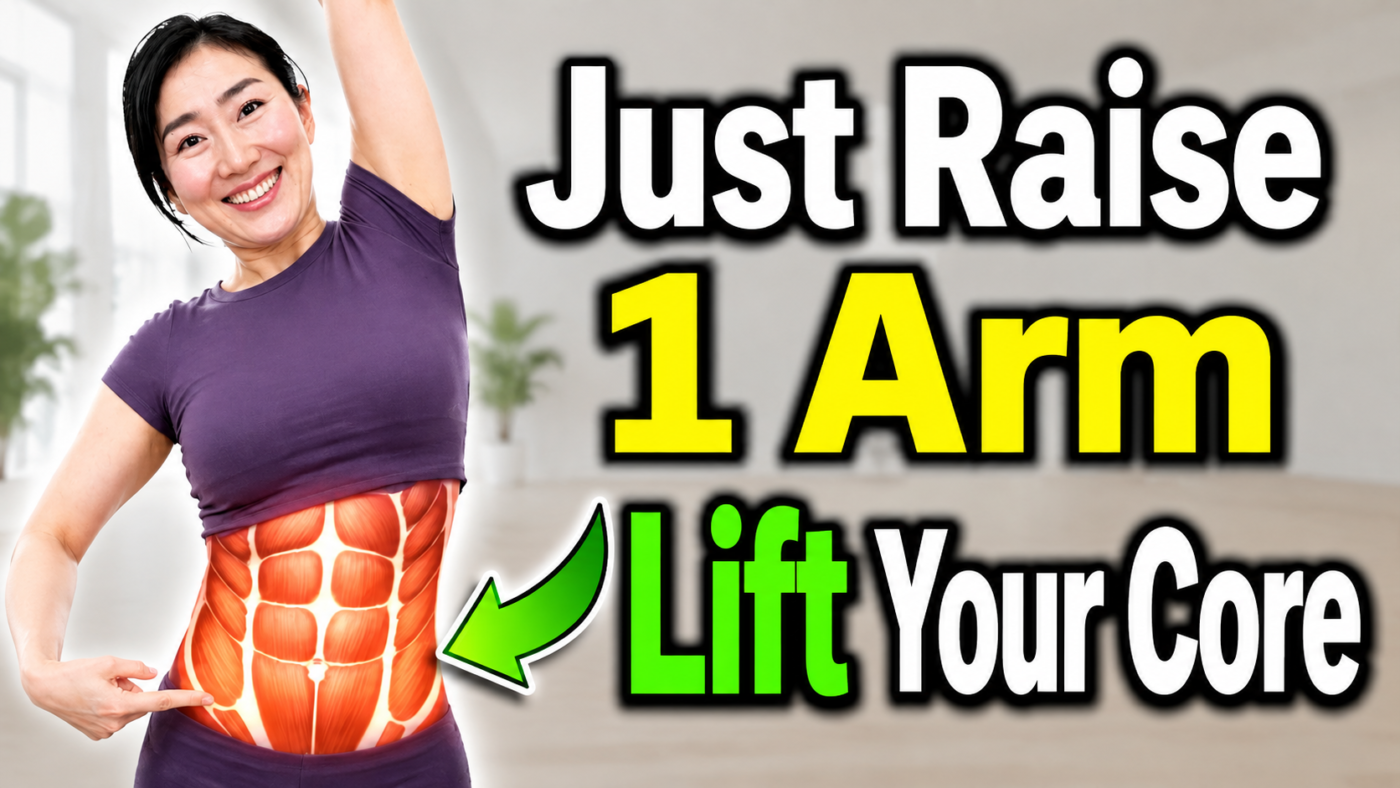
Sometimes a simple change in posture can make your abdomen look noticeably different within seconds. Raise one arm overhead, lengthen through your side body, press your foot into the floor and your midsection may suddenly appear taller, firmer or less compressed.
That visual change can feel dramatic, but it is important to understand what is actually happening.
A one-arm side stretch does not instantly burn belly fat or permanently flatten the abdomen. What it can do is change rib-cage position, pelvic alignment, trunk muscle activity and the way you hold your body. Those changes may temporarily make the abdomen look more lifted while also providing a useful mobility and core-control exercise.
For adults over 40, this kind of movement can be especially helpful as part of a broader routine focused on posture, balance, trunk strength and comfortable everyday movement.
Why Your Belly Can Look Different When You Raise One Arm
The abdomen does not exist in isolation.
Its appearance is influenced by the relationship between the pelvis, rib cage, spine and abdominal wall.
When you stand in a relaxed posture, your rib cage may drop forward, your pelvis may tilt and your abdominal tissues may project outward more visibly.
Raise one arm overhead and several things may change at once.
Your rib cage elevates.
Your trunk lengthens.
Your side waist stretches.
Your pelvis may subtly reposition.
Your abdominal wall may become more active to stabilize the movement.
The result can make the torso appear longer and more organized.
That does not mean abdominal fat has disappeared.
It means posture has changed.
The Core Is More Than Your Abs
Many people think of the core as the six-pack muscles at the front of the abdomen.
In reality, trunk stability depends on a broader system that includes the abdominal muscles, back muscles, diaphragm, pelvic floor and muscles around the hips.
When you reach one arm overhead while keeping the rest of the body controlled, these muscles work together to prevent excessive leaning, twisting or collapsing.
That coordinated effort is often more useful for everyday movement than simply doing repeated crunches.
Why Pressing the Foot Into the Floor Matters
The original movement emphasizes pressing the heel or foot into the ground while reaching the opposite arm upward.
That cue can be useful.
Your foot provides the base from which the rest of the body organizes movement.
Actively pressing into the floor may increase awareness of the leg and hip while encouraging the trunk to stabilize against the upward reach.
This does not mean a literal “energy line” travels from the heel into the abdominal muscles.
A better explanation is that the nervous system coordinates multiple muscle groups at once.
The foot, leg, hip and trunk cooperate to maintain balance and posture.
Can This Exercise Wake Up a “Muscle Chain”?
The idea of interconnected muscle chains is often used in fitness and movement education.
While the body does coordinate muscles across regions, it is misleading to describe a chain as being completely “asleep” and then permanently switched on by one stretch.
Instead, think of the exercise as practicing whole-body coordination.
The more often you practice standing tall, pushing into the floor, lengthening through the trunk and controlling side bending, the easier that movement strategy may become.
That can carry over into walking, reaching and other everyday activities.
Will It Reduce Belly Fat?
No single stretch can selectively burn belly fat.
This is one of the most important claims to correct.
Body fat decreases through a sustained energy deficit influenced by nutrition, physical activity, sleep, metabolism and individual biology.
You cannot choose one area of the body and remove fat from that location simply by stretching or activating nearby muscles.
This is known as the problem of spot reduction.
A side stretch may strengthen or activate abdominal muscles, but it does not specifically melt fat from the waist.
If your abdomen looks flatter immediately after the exercise, posture is the more likely explanation.
Posture Can Change How the Midsection Looks
Imagine compressing an accordion.
It becomes shorter and wider.
Lengthen it, and its shape changes.
The human torso is obviously much more complex, but the basic visual principle helps explain why posture can influence abdominal appearance.
When the rib cage and pelvis are stacked more comfortably and the trunk is elongated, the abdominal area may look less compressed.
That can produce an immediate cosmetic difference without any change in fat mass.
This is not a trick.
It is simply biomechanics.
Step 1: Start With a Comfortable Standing Position
Stand with your feet approximately hip-width to shoulder-width apart.
Keep your knees soft rather than locked.
Allow your shoulders to relax.
Take a normal breath.
Notice your posture before making any adjustments.
Do not suck your stomach in aggressively.
The goal is natural control.
Step 2: Gentle Chest and Trunk Rotation
Place your hands on your hips.
Slowly rotate your upper body from side to side.
Keep the movement comfortable.
Your pelvis can move slightly, but avoid forcing a large twist.
Perform approximately 8 to 10 repetitions.
Breathe normally.
This serves as a warm-up for the spine, ribs and hips.
Step 3: Controlled Hip Circles
Place your hands on your head or hips.
Slowly move your pelvis in a circle.
Keep the movement small and smooth.
Perform five circles in one direction.
Then reverse.
You may notice stiffness in one direction.
Do not force through it.
The purpose is simply to prepare the hips and trunk for larger movements.
Step 4: Standing Twist With Knee Lift
Stand tall.
Bring one knee upward while gently rotating your torso toward that side.
Lower the foot.
Repeat on the opposite side.
Move slowly enough to maintain balance.
Perform 6 to 10 repetitions per side.
This combines trunk rotation, hip flexion and balance.
If balance is difficult, keep one hand on a chair or countertop.
Step 5: The One-Arm Reach
Now come to the main movement.
Stand with your feet comfortably apart.
Raise your right arm toward the ceiling.
Reach upward without shrugging aggressively.
At the same time, press your right or opposite foot firmly but comfortably into the floor, depending on which variation feels more natural.
Think about creating length between your foot and fingertips.
Do not hold your breath.
Stay here for approximately 10 to 20 seconds.
Then lower your arm.
Step 6: Add a Gentle Side Bend
Raise one arm overhead again.
Lengthen upward first.
Then gently lean your torso toward the opposite side.
Avoid collapsing forward.
Imagine creating a long curve from your hip through your ribs to your fingertips.
You should feel a stretch along the side of your trunk.
Hold for approximately 10 to 20 seconds.
Return to center.
Repeat on the opposite side.
What Muscles Are Working?
You may feel activity through several areas, including:
- Obliques
- Deep abdominal muscles
- Latissimus dorsi
- Intercostal muscles
- Gluteal muscles
- Hip stabilizers
- Muscles around the spine
Which muscles you feel most depends on your posture, anatomy and technique.
The exercise is valuable precisely because it involves several regions rather than isolating one small muscle.
Keep the Pelvis Controlled
One common mistake is allowing the pelvis to shift dramatically sideways while the upper body bends.
A small shift is normal.
But if the hips move excessively, you may lose much of the controlled trunk work.
Think about keeping both sides of the pelvis relatively long.
You do not need to lock your body rigidly.
Just avoid collapsing.
What Should Your Toes Do?
The original routine emphasizes keeping the toes active.
That cue can help some people feel more stable.
Spread your toes naturally.
Keep the whole foot in comfortable contact with the floor.
Avoid clawing or gripping excessively.
Your feet should feel active but not tense.
Does This “Sculpt” the Abs?
The movement can train abdominal muscles, particularly when performed with control.
But “sculpting” is a combination of muscle development and body-fat level.
A stretch alone will not dramatically reveal abdominal definition.
If improving visible abdominal muscle definition is your goal, a more complete program should include resistance training, overall physical activity and appropriate nutrition.
This one-arm stretch can be part of that program, but not the entire strategy.
A Simple Six-Minute Routine
Try this sequence:
1. Standing chest rotation — 60 seconds
Move gently from side to side.
2. Hip circles — 60 seconds
Complete both directions.
3. Standing twist with knee lift — 60 seconds
Alternate sides.
4. Right-arm overhead reach — 30 seconds
Press into the floor and lengthen upward.
5. Left-arm overhead reach — 30 seconds
Repeat on the other side.
6. Right side bend — 30 seconds
Keep your trunk long.
7. Left side bend — 30 seconds
Move slowly.
8. Relaxed arm swings — 60 seconds
Shake out your shoulders and breathe.
This is enough for a short mobility break.
Why You May Feel Taller Afterwards
After repeatedly reaching upward and side bending, the trunk may feel less compressed.
Your shoulders may sit differently.
Your rib cage may feel more mobile.
Your abdominal muscles may feel more engaged.
That combination can create a sensation of standing taller.
It does not mean your spine has permanently lengthened.
The effect is more likely related to temporary changes in posture, muscle tone and movement awareness.
Can This Help Hip Discomfort?
Possibly, depending on the cause.
Standing side bends and trunk movements involve the hip muscles and pelvis, so some people may feel looser afterward.
However, hip pain has many possible causes.
A simple stretch cannot be expected to treat arthritis, tendon injuries, labral problems or other medical conditions.
If pain is persistent or worsening, professional evaluation is more appropriate than repeatedly stretching through it.
What About Shoulder Blade Pain?
The overhead reach involves the shoulder blade and upper back.
Some people with mild muscular stiffness may feel more comfortable after gentle movement.
But shoulder blade pain can also be referred from the neck, shoulder joint or other structures.
If reaching overhead increases pain, numbness or tingling, stop.
Does This Increase Metabolism?
Not in the dramatic way some videos suggest.
A few minutes of gentle stretching uses some energy, but it does not suddenly cause metabolism to accelerate at extraordinary speed.
Regular movement is beneficial.
Resistance training, aerobic activity and maintaining muscle mass are much more important for long-term metabolic health.
Avoid interpreting a warm or energized feeling after exercise as evidence that your metabolism has been permanently “switched on.”
Can One Movement Make You Look 10 Years Younger?
No exercise can reliably subtract a decade from biological age.
However, posture influences appearance.
Someone standing taller, moving confidently and appearing less stiff may look more energetic.
That can create a more youthful impression without literally reversing aging.
This is a healthier goal.
Instead of trying to become younger, focus on becoming more capable.
Why This Type of Exercise May Matter After 40
After 40, maintaining muscle strength, mobility and balance becomes increasingly valuable.
Daily life often includes less overhead reaching, side bending and floor-to-standing movement than the body is capable of performing.
A short movement routine can reintroduce some of that variety.
The goal is not extreme flexibility.
It is preserving comfortable movement options.
Who Should Modify the Exercise?
Use extra caution if you have:
- Significant shoulder injuries
- Severe lower-back pain
- Recent abdominal surgery
- Balance problems
- Dizziness
- Hernia symptoms
- Acute hip pain
- Uncontrolled cardiovascular conditions
Use a wall or chair for support if necessary.
Avoid holding your breath during the stretch.
Stop if you feel sharp pain, dizziness or unusual symptoms.
The Bigger Lesson: Appearance and Function Are Connected
A protruding abdomen is not always simply a matter of body fat.
Posture, breathing, rib-cage position and pelvic alignment can influence how the midsection appears.
That does not mean posture is the cause of every abdominal concern.
But it does mean that improving movement quality can sometimes create an immediate visual change.
More importantly, better trunk control may make everyday movement feel easier.
Reach upward.
Press into the floor.
Lengthen through your side.
Breathe.
Repeat regularly.
Not because one stretch will melt belly fat, but because teaching your body to move as an integrated system is valuable at every age.
FAQ
Can raising one arm make your belly look flatter?
It can temporarily change the appearance of your midsection by lengthening the torso, changing rib-cage and pelvic position and activating trunk muscles. It does not instantly remove belly fat.
Does a side stretch burn belly fat?
No. You cannot selectively burn fat from the abdomen by stretching one area. Overall fat loss depends on energy balance, physical activity and other lifestyle factors.
Does this exercise strengthen the core?
Yes, particularly when you maintain control while reaching and side bending. The abdominal and spinal stabilizing muscles help control the trunk.
How long should I hold the stretch?
Beginners can start with approximately 10 to 20 seconds per side and repeat as comfortable.
Should I press my heel into the floor?
Gently pressing the foot into the floor can improve stability and help you coordinate the leg, hip and trunk during the movement.
Can this exercise improve posture?
It may help you practice a taller, more organized trunk position and increase awareness of rib-cage and pelvic alignment, but lasting posture changes require regular practice and strength.
Can this help lower-back or hip pain?
Some people may feel better after gentle movement, but pain has many possible causes. Stop if symptoms worsen and seek professional care for persistent or severe pain.
Is this exercise safe after 40?
For many healthy adults, yes. People with significant balance problems, recent surgery or musculoskeletal conditions should modify the movement or seek professional guidance.
Medical Disclaimer
This article is for educational and informational purposes only and is not medical advice. Exercise responses vary between individuals. Stop if you experience sharp pain, dizziness, numbness or unusual symptoms. People with injuries, medical conditions, recent surgery or significant balance limitations should consult an appropriate healthcare professional before beginning a new exercise program.
This article is for general education and does not replace individualized care from a qualified health professional. Seek appropriate advice for persistent, severe, or concerning symptoms.
Read the full medical disclaimer