Can you really determine a man’s kidney function or sexual performance simply by looking at his hands?
Claims like these appear frequently in traditional wellness videos and social media posts.
You may hear that full fingertips indicate strong kidney function.
A short little finger may supposedly reveal weak vitality.
Lines on the middle finger are sometimes claimed to predict erectile dysfunction or premature ejaculation.
The fleshy area between the thumb and index finger may even be described as a visual test of sexual performance.
These ideas can sound surprisingly convincing when presented alongside photographs or personal stories.
But modern medicine does not use finger shape, palm lines or hand fullness to diagnose kidney function, erectile dysfunction or premature ejaculation.
There is, however, one part of this topic that deserves serious attention.
The pelvic floor.
Pelvic floor muscles support important functions in both men and women.
For men, these muscles contribute to bladder and bowel control and also participate in sexual function.
Learning how to contract and relax them properly can therefore be a useful part of a healthy aging and rehabilitation routine.
What Are the Male Pelvic Floor Muscles?
The pelvic floor is a group of muscles and connective tissues forming a supportive layer at the bottom of the pelvis.
You can think of it as a muscular hammock.
In men, the pelvic floor helps support structures including the bladder, prostate and rectum.
These muscles also surround areas involved in urination and bowel control.
They participate in several important functions.
Urinary control
Bowel control
Pelvic organ support
Sexual function
Coordination with abdominal and breathing muscles
Like other skeletal muscles, pelvic floor muscles can become weaker or less coordinated.
Aging is one possible contributor.
Other factors can include prostate surgery, being overweight, chronic coughing, repeated straining from constipation and certain medical conditions.
Why Men May Benefit From Pelvic Floor Training
Pelvic floor muscle training is commonly called Kegel exercise.
Kegels involve intentionally contracting and then fully relaxing the pelvic floor muscles.
For men, properly performed exercises may be useful for several purposes.
Improving urinary control
Reducing urine leakage
Reducing post urination dribbling
Supporting rehabilitation after some prostate procedures
Improving awareness and control of the pelvic floor
Supporting bowel control
Potentially improving aspects of sexual function
The evidence for urinary control is well established enough that pelvic floor exercises are commonly incorporated into clinical care.
Sexual function is more complicated.
Research suggests pelvic floor training may improve erectile dysfunction or premature ejaculation in some men, but study protocols vary considerably and an ideal universal training program has not been established.
That means Kegels can be useful without promising miraculous results.
Can You Diagnose Kidney Function From the Hands?
No.
Kidney function is evaluated with medical information such as blood tests, urine tests, blood pressure, medical history and sometimes imaging.
The appearance of the fingertips is not a validated kidney function test.
Finger pads can appear fuller or thinner because of normal anatomy, age, hydration, skin characteristics, temperature and many other factors.
A person’s hands cannot tell you whether the kidneys are filtering blood normally.
Can Hand Shape Predict Erectile Dysfunction?
There is no reliable clinical test in which a doctor examines finger fullness, finger length, wrinkles or the space between the thumb and index finger to determine erectile function.
Erectile dysfunction can have many causes.
These include cardiovascular disease.
Diabetes.
High blood pressure.
Certain medications.
Hormonal problems.
Neurological conditions.
Psychological stress.
Smoking.
Alcohol.
Pelvic surgery.
Sleep disorders.
Relationship factors.
Because erection problems can sometimes be an early clue to cardiovascular or metabolic disease, persistent erectile dysfunction deserves proper medical evaluation rather than hand reading.
Traditional Chinese Medicine and Kidney Qi
Traditional Chinese Medicine uses the word Kidney within a broader traditional framework that is not identical to the anatomical kidneys of modern medicine.
TCM may associate Kidney Qi or Kidney Yang with concepts such as vitality, reproduction, aging and sexual function.
Those concepts can be discussed as part of traditional health culture.
However, they should not be confused with laboratory measurements of kidney filtration or a modern medical diagnosis of erectile dysfunction.
A physical sign on the hand cannot reliably prove Kidney Qi deficiency or anatomical kidney disease.
How to Find Your Pelvic Floor Muscles
Identifying the correct muscles is the first challenge.
One simple method is to imagine that you are trying to prevent yourself from passing gas.
Gently squeeze the muscles around the anus.
You should feel a subtle lifting sensation inside the pelvis.
For men, another clue is that an effective contraction may produce a slight lifting sensation around the base of the penis and scrotum.
Some clinical instructions also describe briefly trying to stop urine flow once to identify the muscles.
But this distinction is extremely important.
Stopping Urine Is a Test, Not a Daily Exercise
Repeatedly interrupting urine flow is not a recommended way to perform pelvic floor training.
Doing it once occasionally can help you identify which muscles are involved.
Once you know what they feel like, perform your exercises when you are not urinating.
Repeatedly stopping urine flow can interfere with complete bladder emptying and is not necessary for strengthening the pelvic floor.
Do not make it part of your regular bathroom routine.
How to Perform a Basic Male Kegel
Start in a comfortable position.
Lying down is often easiest for beginners.
Relax your shoulders.
Relax your thighs.
Breathe normally.
Gently contract the pelvic floor muscles.
Imagine lifting them upward and inward.
Hold for approximately three seconds.
Then completely relax.
Rest for approximately three seconds.
Repeat.
A reasonable beginner target is around 10 controlled repetitions.
The exact number is less important than using the correct muscles and relaxing fully between contractions.
Do Not Squeeze Everything at Once
One of the biggest problems in the original routine is the instruction to aggressively tighten the buttocks, abdomen and pelvic floor together.
That is not usually the goal of a basic Kegel.
Try not to strongly clench your buttocks.
Do not squeeze your thighs together.
Do not pull your stomach inward as hard as possible.
Do not hold your breath.
The pelvic floor should perform the primary contraction.
Your abdomen and surrounding muscles may naturally participate slightly, but excessive whole body tension can make it harder to learn pelvic floor control.
Think about precision rather than maximum force.
Relaxation Is Half of the Exercise
A healthy pelvic floor does not only need to contract.
It also needs to relax.
This is especially important because some people do not have a weak pelvic floor.
They have muscles that are overly tense or poorly coordinated.
Constantly performing more and stronger Kegels may make certain pelvic floor symptoms worse.
After each contraction, allow the muscles to relax completely.
Do not remain clenched throughout the day.
Strong muscles should be able to both contract and release.
A Simple Beginner Routine
Begin with 10 repetitions.
For each repetition:
Gently tighten the pelvic floor.
Hold for about three seconds.
Relax completely for about three seconds.
Continue breathing normally.
Once this becomes easy and comfortable, you may gradually increase the duration of the contraction.
Some people progress toward five or ten second holds.
You can practice while lying down, sitting or standing.
Changing positions makes the muscles work under different conditions.
There is no need to immediately perform 100, 150 or 300 repetitions.
More is not automatically better.
How Often Should Men Do Kegels?
Training recommendations vary according to the reason you are doing them.
A common clinical approach involves several short sets throughout the day rather than hundreds of nonstop contractions.
For example, you might perform one controlled set in the morning, another later in the day and another in the evening.
People recovering from surgery or receiving treatment for urinary problems may be given a different program by a pelvic floor therapist or urologist.
The important principle is gradual progression.
Do not chase an arbitrary daily repetition number.
Can You Overtrain the Pelvic Floor?
Yes.
Pelvic floor muscles are still muscles.
They can become fatigued.
Excessive tightening may also contribute to difficulty relaxing the pelvic floor.
Overdoing Kegel exercises can sometimes contribute to problems with urination or bowel movements.
If you develop pelvic pain, difficulty urinating, worsening urinary symptoms or unusual tension after increasing your training, stop increasing the repetitions and seek professional advice.
Pelvic floor exercise should improve function rather than create a permanent state of muscle tension.
How Long Before You Notice Results?
Muscle training takes time.
Do not expect a dramatic transformation after one session.
Some people begin noticing changes within several weeks of consistent training.
For bladder control, improvement may take several weeks or longer.
Sexual function is even more variable.
The outcome depends on the underlying cause of the problem, whether the correct muscles are being trained, consistency and many other health factors.
There is no reliable promise that one month of Kegels will restore someone to the sexual function of adolescence.
Can Kegels Improve Erectile Function?
Possibly, for some men.
The pelvic floor includes muscles that participate in erection and ejaculation.
Research examining men with erectile dysfunction has reported improvements following pelvic floor muscle training in some studies.
However, evidence remains limited by differences in training methods, participant populations and study quality.
Kegels should therefore be viewed as one possible component of treatment.
They do not replace evaluation for cardiovascular disease, diabetes, hormone abnormalities or other causes of erectile dysfunction.
Can Pelvic Floor Training Help Premature Ejaculation?
Some evidence suggests it may help certain men improve ejaculatory control.
Learning how the pelvic floor contracts and relaxes may improve awareness and muscular control.
But premature ejaculation can have psychological, neurological, relationship and other contributing factors.
Pelvic floor training is not guaranteed to solve the problem.
Treatment may involve behavioral approaches, counseling, topical medications or prescription treatment depending on the individual.
Can Kegels Guarantee Morning Erections?
No.
Morning erections are influenced by sleep cycles, nerve function, vascular health, hormones, age and other factors.
Performing a certain number of pelvic floor contractions cannot guarantee that someone will wake with an erection every day.
Changes in morning erections can also occur normally.
Persistent erectile problems should be evaluated based on overall health rather than the result of one exercise routine.
Can Kegels Improve Prostate Health?
Pelvic floor exercises do not directly strengthen the prostate gland.
They strengthen muscles around the pelvis.
These exercises are frequently used around prostate surgery because stronger and better coordinated pelvic floor muscles may help improve urinary control.
That is different from claiming that Kegels prevent or cure prostate disease.
Men with urinary difficulty, pelvic pain, blood in the urine or other concerning symptoms should seek medical evaluation.
The Standing Version
Once you understand the basic contraction, you can practice while standing.
Stand comfortably.
Keep your knees relaxed.
Maintain normal breathing.
Gently lift the pelvic floor.
Hold briefly.
Relax completely.
Repeat.
Standing makes the muscles work against gravity and can be a useful progression.
There is no need to perform visible body movements.
A correctly performed pelvic floor contraction is usually subtle.
Adding a Gentle Squat
A squat can be combined with pelvic floor awareness as part of general strength training.
Stand with your feet comfortably apart.
Slowly bend your hips and knees into a shallow squat.
Maintain natural breathing.
Return to standing.
If you choose to coordinate the pelvic floor with the movement, use a gentle contraction rather than an all out squeeze.
The squat primarily trains your hips and legs.
It should not be presented as a superior sexual performance exercise.
Pelvic Floor Training While Lying Down
Lying down is often the easiest position for beginners.
Lie on your back.
Bend your knees.
Place your feet comfortably on the surface.
Relax your abdomen.
Gently contract the pelvic floor.
Hold for several seconds.
Then fully release.
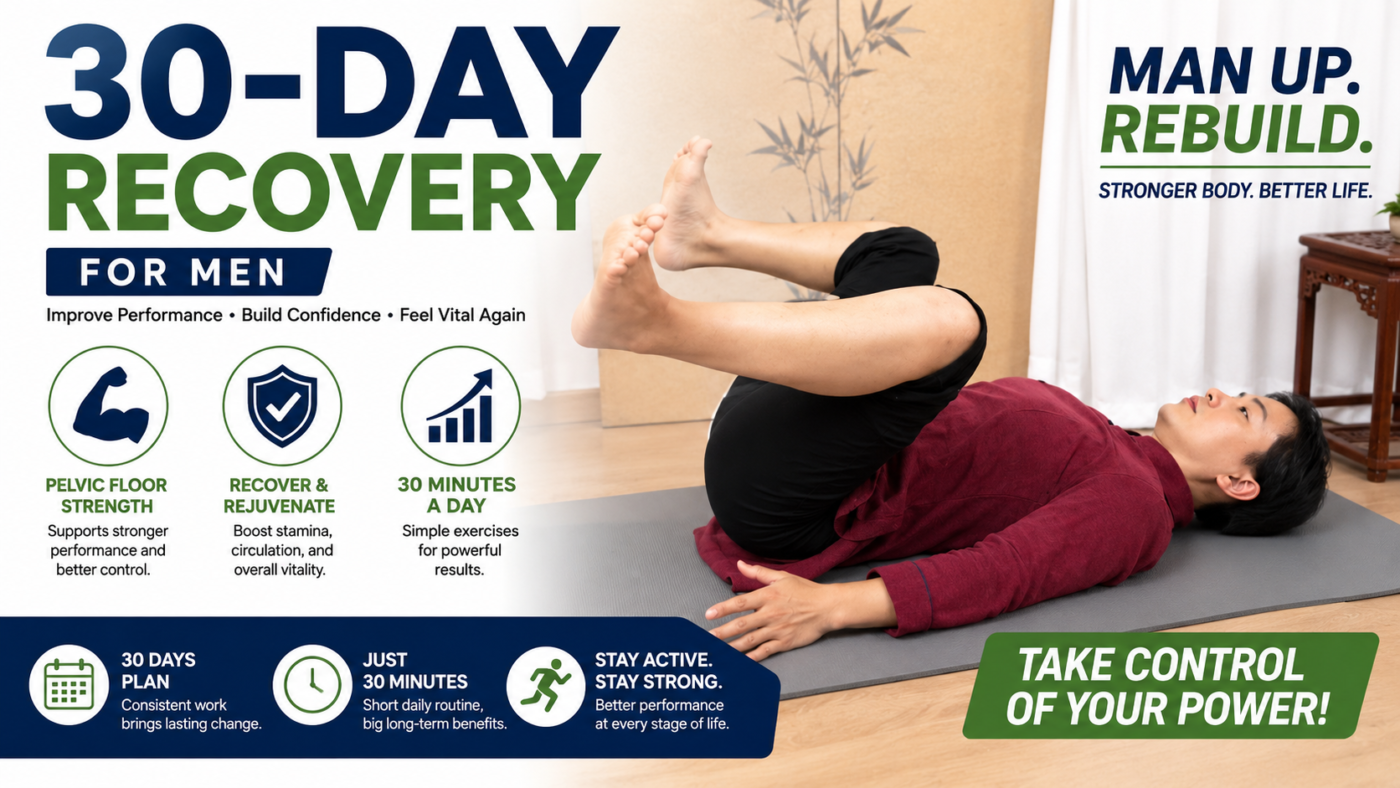
There is no need to repeatedly lift both legs toward your chest in order to train the pelvic floor.
Adding leg raises substantially changes the exercise and increases the demand on the hip flexors and abdominal muscles.
For someone simply learning Kegels, that extra movement is unnecessary.
What About Bridge Exercises?
A glute bridge can be useful for strengthening the hips and glutes.
Lie on your back with your knees bent.
Press through your feet.
Lift your hips gently.
Lower with control.
This can be combined with normal pelvic floor awareness.
But again, stronger is not always better.
You do not need to hold a maximal pelvic floor contraction for twenty seconds while simultaneously clenching every muscle.
Learn the components separately before combining exercises.
Breathing Is Essential
Never turn pelvic floor training into a breath holding competition.
Breathe naturally throughout the exercise.
Exhaling gently during a contraction may make it easier for some people to coordinate the movement.
Holding your breath unnecessarily increases pressure inside the abdomen and makes it more difficult to learn refined muscular control.
If your face is turning red while performing a Kegel, you are probably working much harder than necessary.
What Pelvic Floor Exercises Can Do for Women
Women also have pelvic floor muscles.
Pelvic floor muscle training is commonly used for urinary incontinence and may be particularly relevant during certain stages of life, including after pregnancy and childbirth.
These exercises may also influence sexual function for some women.
But claims that Kegels can return the vagina to a virgin state are medically inaccurate and inappropriate.
Virginity is not an anatomical condition that can be restored by exercising a muscle.
Pelvic floor training should be discussed in terms of strength, continence, function, coordination and symptoms rather than unrealistic ideas about sexual purity or permanent tightness.
When Kegels Are Not the Answer
Some people have pelvic floor dysfunction characterized by excessive muscle tension rather than weakness.
Possible symptoms can include:
Pelvic pain
Pain during sex
Difficulty starting urination
Incomplete bladder emptying
Constipation
Painful bowel movements
Persistent genital or perineal discomfort
For these people, repeatedly performing strong Kegels without evaluation may be counterproductive.
Treatment may involve learning to relax rather than strengthen the muscles.
This is one reason pelvic floor physical therapists can be extremely valuable.
When to See a Healthcare Professional
Talk with a healthcare professional if you have persistent urinary leakage.
Difficulty starting urine flow.
Weak urine stream.
Blood in the urine.
Persistent pelvic pain.
Erectile dysfunction that continues over time.
Painful erections.
Significant ejaculatory problems.
Numbness.
New bowel control problems.
Symptoms after prostate surgery.
A pelvic floor physical therapist can also evaluate whether you are contracting the correct muscles.
Many people unknowingly perform Kegels incorrectly.
Frequently Asked Questions
Can You Tell a Man’s Kidney Function From His Hands?
No.
Finger shape, skin fullness and palm lines are not validated tests of kidney function.
Kidney health requires appropriate medical evaluation.
Can You Tell Whether a Man Has Erectile Dysfunction From His Fingers?
No.
Hand appearance cannot reliably diagnose erectile dysfunction.
Persistent erection difficulties should be evaluated based on cardiovascular, metabolic, hormonal, neurological and psychological factors.
Are Kegel Exercises Good for Men?
Yes, pelvic floor exercises can be useful for many men.
They are particularly established for bladder control and may also support bowel and sexual function.
How Do I Know Which Muscle to Contract?
Imagine trying to stop passing gas and gently lift the muscles around the anus and pelvic floor.
You should feel an internal lifting sensation rather than a large visible body movement.
Should I Stop My Urine Every Time I Practice?
No.
Interrupting urine flow can be used briefly to identify the muscles, but it should not become your regular exercise method.
How Many Kegels Should I Do a Day?
There is no universally correct number.
Beginners can start with around 10 controlled repetitions per session and gradually progress according to professional guidance and how the muscles respond.
Do I Need to Do 300 Kegels a Day?
No.
There is no general medical requirement to perform 300 contractions every day.
Excessive training can produce fatigue or difficulty relaxing the pelvic floor.
Can Kegels Cure Erectile Dysfunction?
They may improve erectile function in some men, particularly when pelvic floor weakness contributes to the problem.
They are not a universal cure.
Can Kegels Help With Premature Ejaculation?
Some research suggests pelvic floor rehabilitation may help certain men improve ejaculatory control.
The evidence does not support guaranteeing success for everyone.
Should I Tighten My Buttocks and Abs During Kegels?
Try to avoid strongly clenching the buttocks, thighs or abdomen.
The goal is to identify and train the pelvic floor muscles with as little unnecessary tension as possible.
How Long Should I Hold Each Contraction?
A beginner can start with approximately three seconds.
The hold can gradually increase as control improves.
There is no need to immediately attempt extremely long maximal contractions.
Bottom Line
Pelvic floor training deserves much more attention in men’s health.
These small muscles contribute to urinary control, bowel function and sexual function.
Learning how to contract them correctly may help some men with urinary leakage, post urination dribbling and aspects of sexual performance.
But effective health education requires separating useful exercises from exaggerated promises.
You cannot diagnose a man’s kidneys by looking at his fingertips.
You cannot determine erectile function from the length of his little finger.
Palm lines do not diagnose premature ejaculation.
A fleshy thumb web does not prove superior sexual performance.
And hundreds of daily Kegels cannot guarantee lifelong erections.
The evidence based approach is simpler.
Learn the correct muscles.
Contract them gently.
Continue breathing.
Relax fully between repetitions.
Start with a manageable amount.
Progress gradually.
Avoid training while urinating.
Do not overtrain.
And seek professional evaluation when urinary, pelvic or sexual symptoms persist.
Pelvic floor muscles are trainable.
That is already a meaningful health advantage without turning them into a miracle cure.
Affiliate Disclosure
This article may contain affiliate links. If you purchase through one of these links, we may earn a commission at no additional cost to you. Affiliate relationships do not influence our editorial standards or health recommendations.
Medical Disclaimer
This article is for educational and informational purposes only and is not medical advice. Pelvic floor symptoms and sexual dysfunction can have many possible causes. Pelvic floor exercises are not appropriate for everyone, especially people with an overactive or painful pelvic floor. Consult a qualified healthcare professional, urologist or pelvic floor physical therapist for persistent urinary, pelvic or sexual symptoms.
This article is for general education and does not replace individualized care from a qualified health professional. Seek appropriate advice for persistent, severe, or concerning symptoms.
Read the full medical disclaimer