Constipation can make even an ordinary day uncomfortable.
You may feel bloated, heavy, or unable to completely empty your bowels. Some people have hard stools, strain during bowel movements, or simply notice that they are going much less often than usual.
Constipation becomes more common with age, but it can affect adults at any stage of life.
Constipation may involve having fewer than three bowel movements per week, hard or dry stools, difficulty passing stool, or a feeling of incomplete evacuation.
The good news is that many cases of occasional constipation can improve with a combination of dietary fiber, appropriate hydration, regular physical activity, and better toilet habits.
Movement is only one part of the picture, but it may be useful.
Research has found an association between greater physical activity and a lower likelihood of constipation, although researchers still do not know exactly how much exercise is needed or which specific exercises work best.
The five movements below are best viewed as gentle mobility exercises rather than a guaranteed treatment.
They may help you move more, activate your abdominal and lower body muscles, reduce prolonged sitting, and build a daily routine that supports digestive health.
Why Movement May Help With Constipation
Your digestive system is influenced by much more than food.
Daily activity, medications, stress, hydration, pelvic floor function, medical conditions, and your normal bowel habits can all affect how easily stool moves through the digestive tract.
Long periods of inactivity are associated with constipation, particularly in older and less mobile adults.
Gentle physical activity may increase overall body movement, reduce prolonged sitting, support abdominal and trunk mobility, improve lower body strength, encourage a more regular daily routine, and support healthy gastrointestinal function.
Exercise should not be thought of as a way to mechanically push old waste out of the body.
There is also no medically recognized condition called toxic stool buildup or stored black stool in an otherwise healthy colon simply because a person does not have a bowel movement every day.
The goal is normal bowel function, not intestinal cleansing.
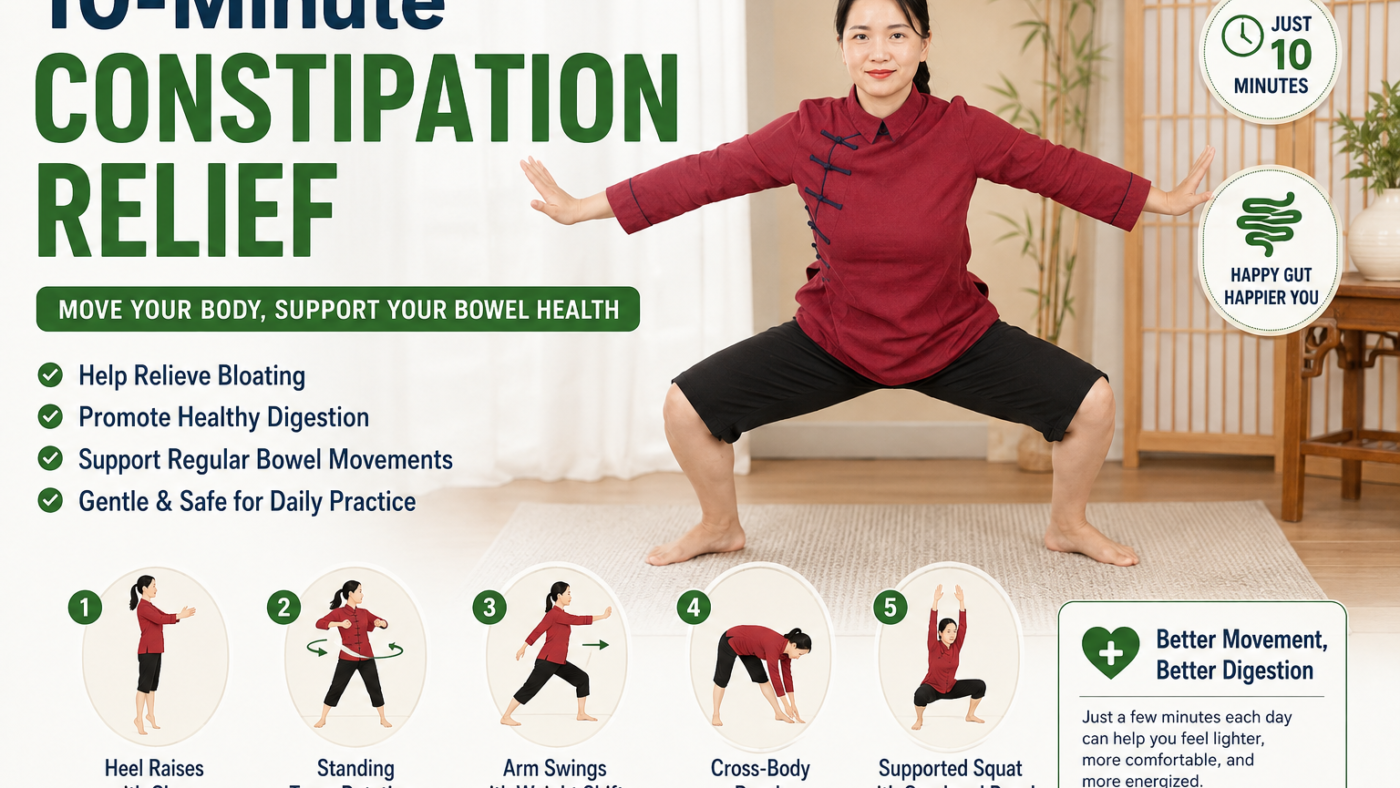
Here are five gentle movements you can try.
Exercise 1: Heel Raises With Front and Back Claps
This first movement combines gentle calf raises with coordinated arm movement.
How to Do It
Stand upright with your feet approximately hip width apart.
Bring your hands together and clap once in front of your body.
As you clap in front, slowly raise both heels so that you come onto the balls of your feet.
Then lower your heels back toward the floor while moving your arms behind your body.
If comfortable, gently bring your hands toward each other behind you.
Continue alternating the movement for about 30 to 60 seconds.
Move at a comfortable pace.
Why It May Help
The main benefit is not that the movement stimulates a particular digestive meridian.
Instead, heel raises repeatedly contract the calf muscles while the arm movement engages the shoulders and upper body.
Together, these movements increase whole body activity and may be a useful way to break up long periods of sitting.
Heel raises can also help strengthen the calves and challenge balance.
Safer Option for Older Adults
Stand beside a wall, sturdy chair, or kitchen counter.
Keep one hand lightly supported if you are concerned about losing your balance.
You do not need to lift your heels very high.
Exercise 2: Gentle Standing Torso Rotations
This movement adds controlled motion through your trunk.
How to Do It
Stand with your feet approximately shoulder width apart.
Keep your knees relaxed rather than locked.
Bend your elbows and hold your arms loosely in front of your chest.
Slowly rotate your upper body toward the left.
Return to the center.
Then rotate toward the right.
Continue moving from left to center and then right to center.
Aim for approximately 30 to 60 seconds.
The movement should feel smooth and comfortable.
What to Focus On
Do not try to achieve the largest possible rotation.
Comfort and control are more important than range of motion.
Your hips and feet can move slightly if necessary. There is no need to rigidly lock the lower body in position.
Why It May Help
Torso rotation mobilizes the muscles surrounding the abdomen, spine, ribs, and pelvis.
There is not strong evidence that twisting directly squeezes stool through the colon, but gentle trunk movement can be part of an overall activity program for someone who has been sedentary.
Some people also find mild abdominal movement relaxing.
Modify This Exercise if You Have Back Problems
Use a much smaller range of motion if you have chronic back pain, limited spinal mobility, osteoarthritis, or balance problems.
Stop if twisting produces sharp pain, numbness, weakness, or dizziness.
Exercise 3: Relaxed Arm Swings With Weight Shifts
This movement combines the arms, legs, balance, and gentle trunk motion.
How to Do It
Stand with one foot slightly in front of the other.
Keep enough space between your feet to feel stable.
Allow your arms to swing gently forward and backward.
As your arms move forward, shift a small amount of body weight toward the front foot.
As your arms move backward, gradually shift your weight toward the rear foot.
Your trunk can rotate slightly with the movement.
Continue for approximately 30 to 60 seconds.
Then switch which foot is in front and repeat.
Keep the Movement Relaxed
Do not force your arms as far backward as possible.
Your shoulders should remain comfortable.
The goal is rhythmic whole body movement rather than an aggressive stretch.
Why It May Help
This movement involves several muscle groups at once.
It encourages shoulder mobility, trunk movement, lower body activity, balance, and coordination.
For someone who spends hours sitting every day, simply replacing some sedentary time with repeated periods of gentle movement may be useful.
Exercise 4: Cross Body Reach
This movement adds a gentle hip hinge and stretches the back of the legs.
How to Do It
Stand with your feet slightly wider than hip width apart.
Slowly hinge forward from your hips.
Reach your left hand toward your right leg.
Return to standing.
Then reach your right hand toward your left leg.
Continue alternating sides for approximately 30 to 60 seconds.
You do not need to touch your feet.
Choose the Right Depth for Your Body
Some people can comfortably reach their ankles or feet.
Others may only reach the knee, upper shin, or middle of the shin.
All of these options are acceptable.
Do not force yourself deeper simply because someone else can reach the floor.
Why It May Help
Cross body reaching mobilizes the hips, hamstrings, back, shoulders, and trunk.
The forward movement also changes abdominal position temporarily.
However, there is not enough evidence to claim that compressing the abdomen in this way directly causes stool to move through the colon.
Think of it primarily as a mobility exercise.
When to Skip It
This movement may not be appropriate if you have significant acute lower back pain, serious spinal problems, severe osteoporosis, vertigo, or recent hip or spinal surgery.
Ask a healthcare professional or physical therapist for an individualized alternative when necessary.
Exercise 5: Supported Squat With Overhead Reach
The final exercise combines lower body strengthening with an overhead arm movement.
How to Do It
Stand with your feet slightly wider than shoulder width apart.
Turn your toes slightly outward if that feels natural.
As you inhale, stand tall and raise your arms overhead.
As you exhale, slowly bend your knees and hips into a comfortable partial squat while lowering your arms.
Then return to standing.
Continue for approximately 30 to 60 seconds.
Protect Your Knees
Your knees should generally move in the same direction as your toes.
You do not need to squat deeply.
A shallow squat is completely acceptable.
If needed, place a sturdy chair behind you and perform a controlled sit to stand movement instead.
Why It May Help
Squats activate large muscles in the thighs, hips, glutes, and core.
This makes them an efficient way to increase physical activity while also maintaining strength needed for healthy aging.
The benefit for constipation is likely related more to overall activity and physical function than to any specific digestive pathway.
A Simple 5 to 10 Minute Routine
You do not have to perform every exercise.
A beginner can try heel raises with arm movements for one minute, torso rotations for one minute, arm swings and weight shifts for two minutes, cross body reaches for one minute, and supported squats for one minute.
Rest whenever necessary.
You can also choose only one or two movements and perform them several times during the day.
Consistency matters more than intensity.
Someone who currently spends most of the day sitting may benefit more from getting up and moving regularly than from doing one intense workout followed by another ten hours in a chair.
Exercise Alone Is Usually Not Enough
If you regularly experience constipation, exercise should not be your only strategy.
Lifestyle approaches commonly recommended for constipation include increasing dietary fiber gradually, drinking appropriate amounts of fluid, responding to the natural urge to have a bowel movement, maintaining regular physical activity, and avoiding excessive straining.
Gradually Increase Fiber
Adults generally benefit from a fiber rich diet, although the appropriate amount varies with age, sex, health, and individual tolerance.
Useful sources include oats, whole grains, beans, lentils, chickpeas, berries, pears, apples, vegetables, nuts, and seeds.
Increase fiber gradually.
A sudden large increase can sometimes cause bloating and gas.
Drink Appropriate Amounts of Fluid
Fiber works better when adequate fluid is available.
Water needs vary considerably, especially in people with kidney disease, heart disease, or other medical conditions.
There is no single amount of water that is ideal for everybody.
Respond to the Urge to Go
Regularly ignoring the urge to have a bowel movement may contribute to constipation.
Some people find it helpful to establish a regular bathroom routine, particularly after meals.
The natural digestive response after eating can stimulate movement in the colon.
Avoid Excessive Straining
Repeated heavy straining is not a good strategy.
It can contribute to problems such as hemorrhoids and may be particularly undesirable for people with cardiovascular or other medical problems.
If stool is consistently difficult to pass, address the underlying constipation rather than repeatedly forcing it.
What About Laxatives?
There is a common belief that using any laxative automatically makes the bowel dependent on medication.
That statement is too simplistic.
Different laxatives work in different ways, and several treatments have substantial clinical evidence behind them.
Evidence based treatments for chronic constipation may include fiber supplementation, polyethylene glycol, magnesium oxide in appropriate patients, short term or rescue use of certain stimulant laxatives, senna, and prescription medications for people who do not respond adequately to over the counter treatment.
Medication choice should depend on your symptoms, medical conditions, current medicines, and the reason for your constipation.
Do not stop necessary medication simply because you hope exercise will replace it.
Constipation in Older Adults
Constipation is especially common later in life.
Age itself is only part of the explanation.
Other contributors may include lower physical activity, reduced fluid intake, lower fiber intake, certain medications, diabetes, neurological disorders, pelvic floor problems, and changes in daily routine.
Older adults should be particularly careful with exercises involving balance, deep bending, and rapid direction changes.
Holding a chair or counter for support is perfectly reasonable.
When Constipation Needs Medical Attention
Occasional constipation is common.
Persistent or unusual constipation deserves more attention.
Contact a healthcare professional if constipation does not improve with reasonable self care or repeatedly returns.
Seek medical advice promptly when constipation occurs with rectal bleeding, blood in the stool, persistent or severe abdominal pain, significant abdominal swelling, unexplained weight loss, vomiting, fever, or a major unexplained change in bowel habits.
Sudden constipation accompanied by severe abdominal pain, vomiting, or inability to pass gas can require urgent medical evaluation.
Frequently Asked Questions
Can Exercise Make You Have a Bowel Movement Immediately?
It can happen, but it should not be expected.
Some people feel an urge to use the bathroom after walking or exercising, while others notice no immediate change.
Available evidence supports physical activity as part of a healthy lifestyle for bowel function, not as a guaranteed instant laxative.
Is Walking Good for Constipation?
Walking is one of the easiest activities to try.
Regular walking reduces sedentary time and may support digestive function, cardiovascular health, mobility, and overall fitness at the same time.
How Long Should I Exercise for Constipation?
There is no proven 10 minute constipation cure.
For beginners, even several short periods of gentle movement during the day are a reasonable place to start.
Long term regular activity is more meaningful than expecting one exercise session to completely solve chronic constipation.
Do Twisting Exercises Massage the Colon?
Your abdominal organs naturally move slightly when you bend, breathe, and rotate.
However, there is not strong clinical evidence that a particular standing twist manually pushes stool through the colon.
The exercise is better viewed as gentle trunk mobility.
Does Constipation Cause Toxins to Build Up in the Body?
Ordinary constipation should not be described as a buildup of mysterious toxins or old toxic stool.
Your liver, kidneys, digestive system, lungs, and other organs continuously manage metabolic waste.
Chronic constipation is worth treating because it can cause real symptoms and complications, but detoxification claims are unnecessary.
Can Older Adults Perform These Exercises?
Many older adults can perform modified versions.
Use a chair, wall, or countertop for balance and reduce bending, twisting, or squatting as necessary.
People with significant heart disease, severe osteoporosis, recent surgery, neurological problems, recurrent falls, or major joint disease should ask a healthcare professional about appropriate activity.
Bottom Line
Gentle movement is not a miracle cure for constipation, but it can be a useful part of a healthier bowel routine.
Heel raises, torso rotations, arm swings, cross body reaches, and supported squats provide a simple way to break up sedentary time and move several major muscle groups without specialized equipment.
For lasting improvement, combine appropriate physical activity with enough dietary fiber, suitable fluid intake, regular bathroom habits, and medical treatment when necessary.
Most importantly, do not judge digestive health by whether you have a bowel movement every single day.
Normal bowel frequency varies considerably from person to person.
The goal is comfortable, predictable bowel function without excessive straining, pain, or a persistent feeling that you cannot completely empty your bowels.
Affiliate Disclosure
This article may contain affiliate links. If you purchase through one of these links, we may earn a commission at no additional cost to you. Affiliate relationships do not influence our editorial standards or health recommendations.
Medical Disclaimer
This article is for educational and informational purposes only and is not medical advice. It is not intended to diagnose, treat, cure, or prevent any disease. Constipation can have many causes, including medications and underlying medical conditions. Consult a qualified healthcare professional if symptoms are persistent, severe, new, or accompanied by concerning symptoms.
This article is for general education and does not replace individualized care from a qualified health professional. Seek appropriate advice for persistent, severe, or concerning symptoms.
Read the full medical disclaimer