A Spondylolisthesis Diagnosis Does Not Mean You Have to Stop Moving
Imagine going to your doctor because of persistent low back pain, having an X-ray, and then hearing the word spondylolisthesis.
One vertebra has shifted forward relative to the vertebra below it.
For many people, that description immediately creates fear.
Should you stop exercising?
Could walking make the vertebra slip farther?
Do you need surgery?
Should someone try to push the bone back into place?
Fortunately, the situation is usually more nuanced.
Low-grade spondylolisthesis is often managed without surgery, particularly when there is no progressive neurological deficit and symptoms can be controlled with conservative care.
The goal is generally not to physically push a vertebra back into position. Instead, rehabilitation commonly focuses on improving movement tolerance, trunk strength and endurance, hip function, and the body’s ability to control the spine during everyday activities.
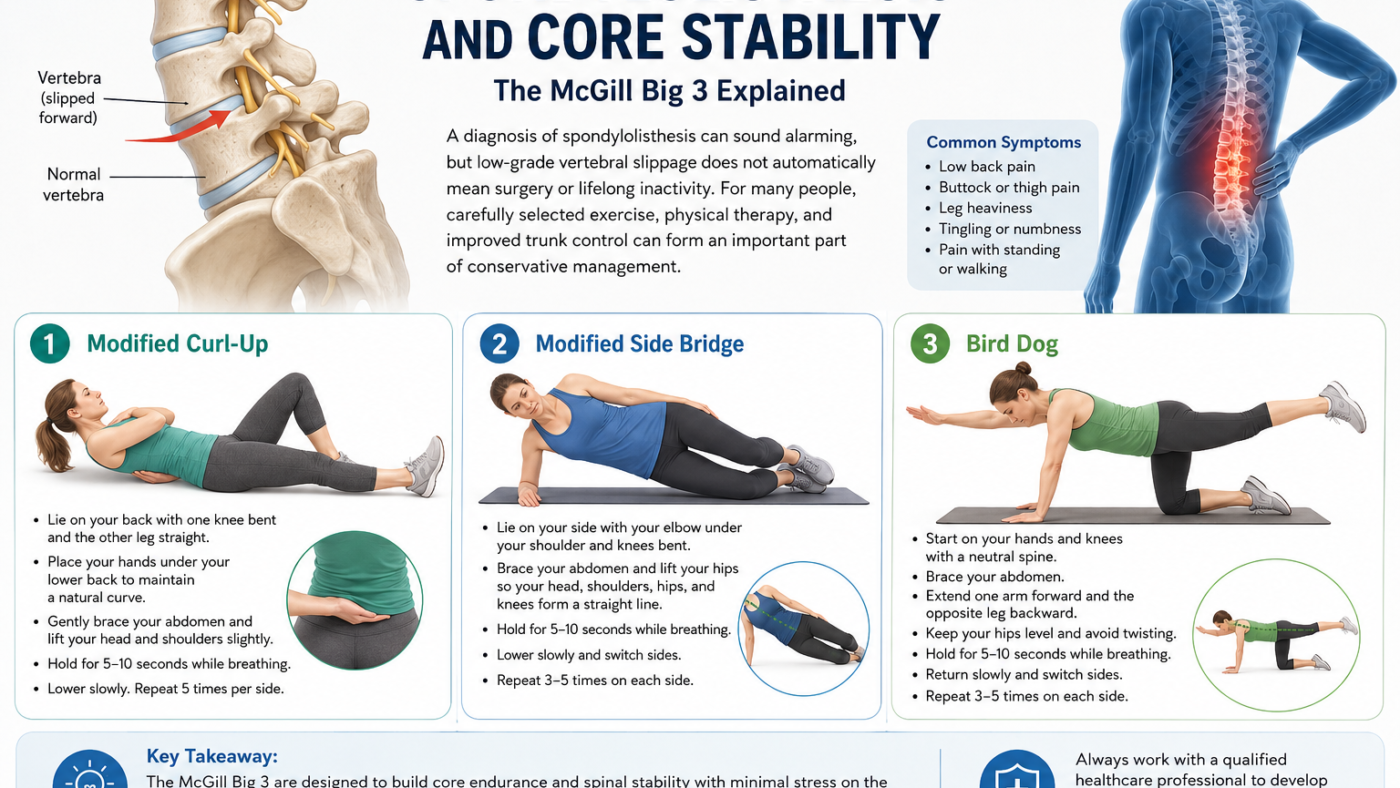
One approach often used for building low-load trunk endurance is a group of exercises popularized by spine biomechanics researcher Stuart McGill. They are commonly known as the McGill Big 3.
The three exercises are the modified curl-up, side bridge, and bird dog.
These exercises are not a cure for spondylolisthesis, and they are not appropriate for every person with back pain. When selected appropriately and performed correctly, however, they may be useful components of a broader rehabilitation program.
What Is Spondylolisthesis?
Spondylolisthesis occurs when one vertebra moves forward relative to the vertebra beneath it.
It most commonly affects the lower lumbar spine.
Different types exist.
Isthmic spondylolisthesis may develop when there is a defect or stress injury in a part of the vertebra called the pars interarticularis.
Degenerative spondylolisthesis becomes more common with age as discs, facet joints, and other spinal structures undergo degenerative changes.
The amount of vertebral translation can be classified using a grading system.
Grade I means up to 25 percent slippage.
Grade II means 26 to 50 percent slippage.
Grade III means 51 to 75 percent slippage.
Grade IV means 76 to 100 percent slippage.
A higher grade does not automatically determine treatment. Symptoms, neurological findings, spinal stability, age, activity demands, and progression all matter.
Some people have visible spondylolisthesis on imaging with surprisingly few symptoms.
Others experience significant pain despite relatively modest structural changes.
This is why an X-ray should never be interpreted in isolation from the person experiencing the symptoms.
Does Spondylolisthesis Always Require Surgery?
No.
Many people with low-grade spondylolisthesis are initially treated conservatively.
Depending on the individual, treatment may include temporary modification of aggravating activities, physical therapy, gradual strengthening, trunk endurance training, hip and leg strengthening, mobility work, walking or other tolerable aerobic activity, pain-management strategies, medication when recommended by a clinician, and in selected cases, injections.
Surgery may be considered when there is severe or progressive slippage, significant nerve compression, progressive neurological impairment, or disabling symptoms that have not responded adequately to appropriate conservative treatment.
The decision should be made with a qualified spine specialist rather than based on an X-ray alone.
Why Can Standing and Walking Hurt?
Some people with lumbar spondylolisthesis notice that symptoms become worse after prolonged standing or walking.
Symptoms may include low back aching, buttock pain, thigh discomfort, leg heaviness, tingling, numbness, or a feeling of fatigue and pressure in the lower back.
There is no single posture that explains every case.
However, repeated or sustained positions that increase an individual’s symptoms may place greater demand on sensitive spinal tissues.
Some people are particularly sensitive to excessive lumbar extension. Others may have associated spinal stenosis, nerve irritation, hip weakness, limited endurance, or altered movement strategies.
Rehabilitation should therefore focus on symptom-guided movement control rather than forcing the spine into one supposedly perfect posture.
The objective is not to keep your back rigid all day.
It is to develop enough strength, endurance, and coordination to tolerate normal movement safely.
Why Core Endurance Matters
The core is much more than the visible abdominal muscles.
It includes a coordinated system involving the abdominal wall, back muscles, diaphragm, pelvic floor, and muscles around the hips and pelvis.
These tissues work together when you walk, stand, lift groceries, carry a suitcase, climb stairs, exercise, get out of a chair, and perform household tasks.
For someone with an irritable lower back, repeatedly bending or twisting the lumbar spine under load may temporarily aggravate symptoms.
A useful early rehabilitation strategy can therefore be to challenge the surrounding musculature while keeping lumbar movement relatively small.
This is the basic principle behind the McGill Big 3.
They are designed primarily as trunk endurance and motor-control exercises, not as a way of repositioning the vertebrae.
Exercise 1
Modified Curl-Up
This is very different from a traditional sit-up.
The objective is not to repeatedly bend the lumbar spine.
Lie on your back.
Keep one leg straight and bend the other knee, placing that foot on the floor.
Place your hands beneath the natural curve of your lower back. The purpose is to help maintain a comfortable lumbar position rather than aggressively flattening your back into the floor.
Gently brace your abdominal muscles.
Keep your neck relatively neutral.
Slightly lift your head and upper shoulders away from the floor without deliberately curling your lower back.
The movement should be small.
Hold for approximately 5 to 10 seconds while continuing to breathe.
Lower yourself slowly.
A reasonable starting point is about 5 repetitions per side.
If this is comfortable, volume can gradually increase.
Quality is more important than performing large numbers of repetitions.
Do not pull your head forward.
Do not hold your breath.
Do not turn the movement into a traditional sit-up.
Do not aggressively press or flatten the lumbar spine.
Stop if the exercise increases back pain, radiating leg pain, numbness, or tingling.
Exercise 2
Modified Side Bridge
The side bridge challenges the muscles along the side of the trunk, including the abdominal wall and other muscles responsible for resisting unwanted sideways movement.
For beginners or people recovering from back pain, a knee-supported version may be easier to control.
Lie on your side.
Position your elbow beneath your shoulder.
Bend your knees comfortably.
Brace your abdomen gently.
Press your forearm and knees into the floor and lift your hips.
Your head, shoulders, hips, and knees should form a relatively straight line.
Avoid allowing the shoulder to collapse toward your ear.
Continue breathing.
Hold for approximately 5 to 10 seconds.
Lower slowly.
Repeat on the other side.
A reasonable starting point is 3 to 5 short holds on each side.
As endurance improves, you may gradually progress toward a full side bridge from the feet, provided the exercise does not provoke symptoms.
Do not advance simply because the beginner version looks easy. Good control matters more than difficulty.
Exercise 3
Bird Dog
The bird dog trains your trunk to remain controlled while the arms and legs move.
That pattern is relevant to walking, lifting, carrying, and many other daily activities.
Begin on your hands and knees.
Place your hands beneath your shoulders and your knees beneath your hips.
Find a comfortable neutral spinal position rather than forcing the back into an exaggerated arch or rounded position.
Gently brace the abdomen.
Press the supporting hand into the floor.
Slowly extend one arm forward while extending the opposite leg backward.
For example, extend the right arm and left leg.
Keep your pelvis facing the floor.
Avoid twisting your trunk or excessively arching your lower back.
Hold the position for approximately 5 to 10 seconds while breathing normally.
Return slowly to the starting position.
Switch sides.
A reasonable starting point is 3 to 5 repetitions per side.
If the full bird dog is too difficult, start with only one limb.
You can lift one arm, slide one foot backward while keeping the toes on the floor, or extend one leg without lifting the opposite arm.
Progress only when you can maintain good control.
Three Exercise Mistakes Worth Avoiding
A diagnosis of spondylolisthesis does not mean that certain movements are permanently forbidden.
During a painful or irritable phase, however, some exercises may need modification.
Traditional Sit-Ups
High-volume traditional sit-ups repeatedly move the lumbar spine while creating substantial muscular demand.
If they reproduce your symptoms, there is little reason to force them simply because you want a stronger core.
Core endurance can be trained in other ways.
Aggressive Back Extension
Some people with spondylolisthesis are sensitive to lumbar extension.
Forceful backbends, repeated hyperextension, or aggressively pushing into exercises such as a deep cobra position may aggravate symptoms in these individuals.
This does not mean lumbar extension is universally dangerous.
It means exercises should be selected according to your diagnosis, symptoms, and response.
Loaded Twisting
Rotational movement is a normal part of human life.
The goal is not to become afraid of rotation.
However, repeatedly twisting the lumbar spine under substantial load may be poorly tolerated during an irritable phase.
A rehabilitation program can first establish basic trunk control and then progressively reintroduce appropriate rotation and functional movement when tolerated.
What the McGill Big 3 May Help With
These exercises may help improve trunk muscular endurance, core coordination, movement confidence, control of unwanted lumbar movement, tolerance of everyday activities, and the ability to progress toward more demanding exercise.
What the McGill Big 3 Cannot Do
They cannot physically push a slipped vertebra back into place.
They cannot guarantee that spondylolisthesis will not progress.
They cannot decompress every irritated nerve.
They cannot replace an individualized medical evaluation.
They cannot guarantee that surgery will never be needed.
They cannot cure every type of low back pain.
The McGill Big 3 should therefore be viewed as one possible tool within a larger rehabilitation strategy, not as a universal treatment.
How Often Should You Perform the McGill Big 3?
There is no single prescription suitable for everyone.
A conservative beginner routine can consist of short and technically precise sets rather than long exhausting holds.
For the modified curl-up, begin with approximately 5 short holds per side.
For the modified side bridge, begin with approximately 3 to 5 short holds per side.
For the bird dog, begin with approximately 3 to 5 short holds per side.
Most holds can remain around 5 to 10 seconds.
The objective is to accumulate quality repetitions without allowing technique to deteriorate.
Depending on your condition, a physical therapist may change the exercises, repetitions, range of motion, or frequency substantially.
Pain should not be treated as evidence that an exercise is working.
What Should You Feel?
You may feel abdominal tension, muscular effort around the trunk, gluteal activation, and mild muscular fatigue.
You should not intentionally push through increasing sharp back pain, new or worsening leg pain, progressive numbness, progressive tingling, new weakness, or loss of coordination.
If an exercise repeatedly causes neurological symptoms, stop and seek professional guidance.
When to Seek Urgent Medical Care
Most episodes of back pain are not emergencies.
However, some neurological symptoms require immediate medical assessment.
Seek urgent medical care if back pain is accompanied by new difficulty starting urination, inability to urinate, new loss of bladder control, new loss of bowel control, numbness around the genitals or inner thighs, severe or rapidly worsening weakness in one or both legs, major loss of sensation in the legs, or rapidly worsening neurological symptoms.
These symptoms may indicate significant nerve compression, including possible cauda equina syndrome.
Do not attempt to treat these symptoms with home exercises.
When You Need More Than Three Exercises
If your back pain repeatedly returns despite doing core exercises, the answer may not be to simply perform more repetitions.
Persistent symptoms can involve multiple factors, including hip strength, hip mobility, walking mechanics, training load, work demands, lifting technique, sleep, general conditioning, nerve irritation, spinal stenosis, fear of movement, previous injuries, and overall activity level.
A physical therapist can assess how your entire body moves rather than focusing exclusively on the vertebra seen on an X-ray.
Your rehabilitation program may eventually include walking, hip strengthening, squatting, hinging, carrying, resistance training, and other functional movements.
The Big 3 can be a starting point.
They do not have to be the finish line.
Frequently Asked Questions
Can exercise make spondylolisthesis worse?
Exercise is not automatically dangerous for someone with spondylolisthesis.
Appropriately selected activity is often part of conservative treatment.
However, exercises that repeatedly provoke significant back or neurological symptoms should be modified or stopped until you have been properly evaluated.
Can the McGill Big 3 reverse spondylolisthesis?
No.
These exercises are intended to improve muscular endurance and trunk control. They should not be promoted as a method for physically reversing vertebral slippage.
Can a chiropractor or massage therapist push the vertebra back into place?
Spondylolisthesis should not be viewed as a bone that simply needs to be pushed back into position.
Massage may help some people with muscular discomfort, and manual therapy may sometimes be included in a broader treatment program, but claims that an external manipulation can simply put the slipped vertebra back should be treated cautiously.
Is walking good for spondylolisthesis?
Walking can be a useful form of physical activity when tolerated.
Some people, especially those with associated spinal stenosis or extension-sensitive symptoms, may experience increasing discomfort with prolonged walking.
Start with a tolerable duration and increase gradually rather than forcing long distances through worsening symptoms.
Should I stop exercising after being diagnosed?
Usually, complete long-term inactivity is not the goal.
Your activity may need temporary modification, but excessive fear and avoidance can contribute to loss of strength, endurance, and confidence.
The safest approach is to identify activities you can tolerate and progressively build capacity.
How long does it take to improve?
Recovery varies considerably.
Age, type and grade of spondylolisthesis, nerve involvement, physical conditioning, activity demands, sleep, general health, and adherence to rehabilitation can all influence progress.
Think in terms of progressive rehabilitation rather than searching for a single exercise that immediately fixes the spine.
Bottom Line
Being diagnosed with spondylolisthesis does not automatically mean surgery, permanent disability, or a lifetime of avoiding exercise.
For many people with low-grade spondylolisthesis, conservative management is appropriate.
The goal is not to force a vertebra back into place.
Instead, rehabilitation can help you build a body that is stronger, better conditioned, and more capable of controlling movement.
The McGill Big 3 include the modified curl-up, side bridge, and bird dog. They provide one relatively low-load way to develop trunk endurance while limiting unnecessary lumbar movement.
They are not a cure and they are not appropriate for every patient.
When combined with individualized physical therapy, gradual activity progression, and appropriate medical evaluation, they may become useful building blocks for returning to comfortable movement and everyday life.
A finding on an X-ray is only one part of your story.
The long-term goal is not to become afraid of your spine.
It is to progressively restore the strength, confidence, and physical capacity needed to use it.
Affiliate Disclosure
Some links on Health, Beauty and Longevity may be affiliate links. If you purchase through one of these links, we may earn a commission at no additional cost to you. Affiliate relationships do not determine our editorial conclusions or health recommendations.
Medical Disclaimer
This article is provided for educational purposes only and is not medical advice, diagnosis, or treatment.
Spondylolisthesis varies considerably between individuals, and exercises that are appropriate for one person may not be appropriate for another.
Consult a qualified physician, physical therapist, or other licensed healthcare professional before beginning a new exercise program, particularly if you have diagnosed spinal disease, persistent pain, leg symptoms, weakness, numbness, osteoporosis, recent trauma, or previous spinal surgery.
Seek urgent medical care for new bowel or bladder dysfunction, urinary retention, saddle-area numbness, rapidly worsening leg weakness, or other significant neurological changes.
This article is for general education and does not replace individualized care from a qualified health professional. Seek appropriate advice for persistent, severe, or concerning symptoms.
Read the full medical disclaimer