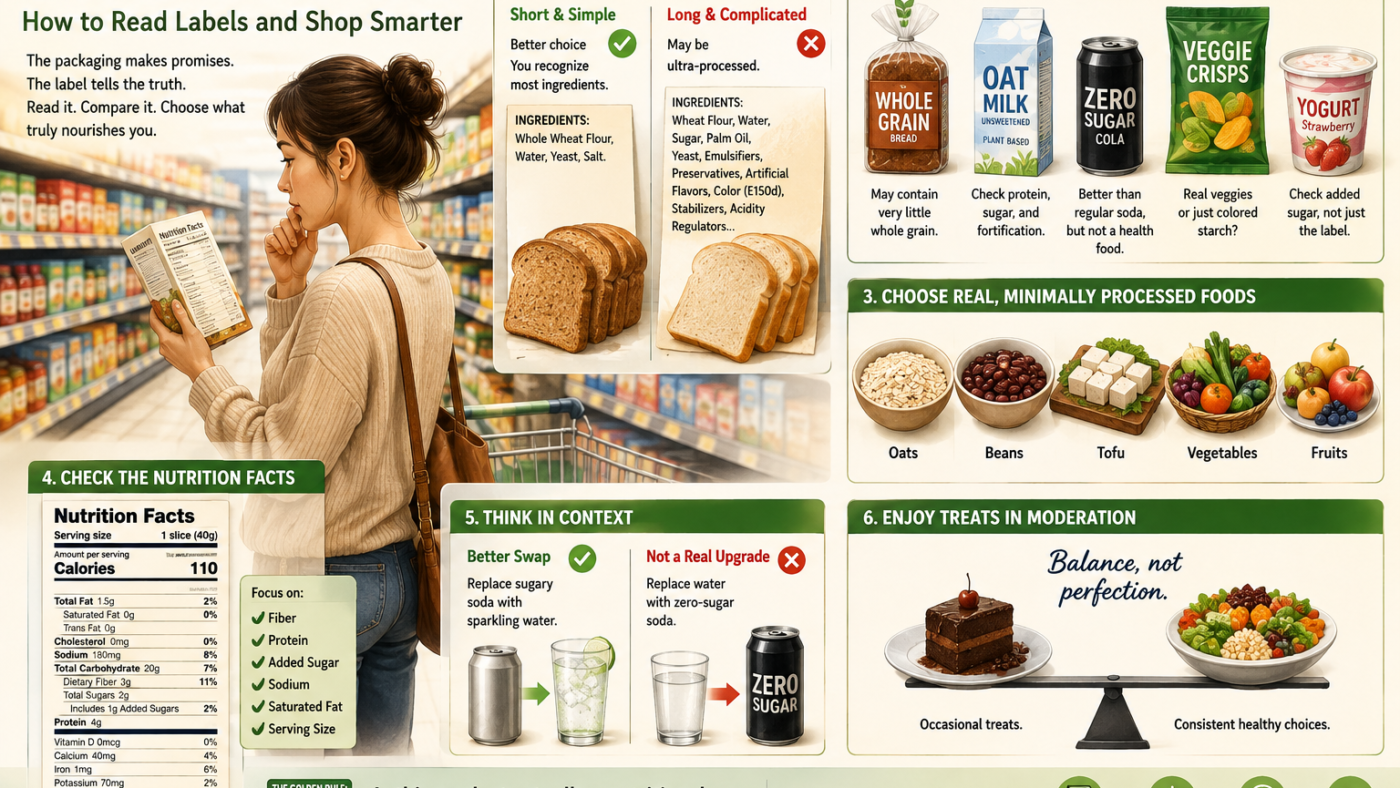
You choose brown bread instead of white bread. You replace dairy milk with oat milk. You pick the bottle marked “zero sugar,” reach for vegetable crackers instead of potato chips, and pay extra for foods labeled plant-based, natural, whole grain, or healthy.
It feels like you are making better choices.
Sometimes you are.
But sometimes the biggest difference is the packaging.
Modern supermarkets are filled with what nutrition researchers often call a health halo. Words such as whole grain, sugar-free, plant-based, low-fat, natural, and organic can make a product appear healthier than it really is.
That does not mean packaged foods are automatically unhealthy. It also does not mean every processed food should be avoided.
A much more useful question is this:
Is this product actually a nutritional improvement over the food it replaced?
That simple question can completely change the way you shop.
Brown Bread Is Not Automatically Whole-Grain Bread
Bread is a perfect example of why appearance can be misleading.
A darker loaf may contain whole grains, but color alone does not tell you how much whole grain it contains, how much fiber it provides, or how much added sugar and sodium have been included.
A whole grain contains three main parts: the bran, germ, and endosperm.
The bran provides fiber and several nutrients.
The germ contains vitamins, minerals, and healthy fats.
The endosperm is primarily starch.
Refined flour removes much of the bran and germ, leaving mainly the starchy endosperm.
Whole-grain foods generally provide more fiber and nutrients than refined grains, but not every brown loaf on the supermarket shelf is nutritionally identical.
Instead of judging bread by color, turn the package around.
Look at the ingredient list and Nutrition Facts panel.
Whole wheat or another whole grain should ideally appear near the beginning of the ingredient list.
Then check fiber, added sugar, and sodium.
A darker color by itself tells you very little.
Does Whole-Wheat Bread Affect Blood Sugar Just Like White Bread?
Not necessarily.
The blood sugar response to bread depends on several factors, including the type of grain, how finely the flour is ground, the fiber content, the fermentation process, portion size, and what you eat with it.
Some whole-wheat breads are made from very finely milled flour and may be digested relatively quickly.
Other breads containing intact grains, seeds, higher fiber levels, or traditional fermentation may produce a different response.
Sourdough fermentation may help reduce the post-meal glucose response in some situations, but the word sourdough on a package does not automatically make a loaf healthier.
The overall nutritional profile matters more than one marketing word or one glycemic-index number.
Plant-Based Milk Is Not Automatically Healthier
The plant-milk aisle is another place where the health halo is powerful.
Oat milk, almond milk, soy milk, pea milk, and other alternatives can all fit into a healthy diet.
They may be especially useful for people who avoid dairy because of lactose intolerance, milk allergy, dietary preferences, or personal taste.
But they are not nutritionally identical.
Some products contain very little protein.
Others contain added sugars.
Some are fortified with calcium and vitamin D, while others are not.
Unsweetened fortified soy milk usually provides considerably more protein than most almond or oat beverages and can be nutritionally closer to dairy milk.
Oat milk generally contains more carbohydrate.
Almond milk is often relatively low in calories, but it may provide very little protein.
None of these facts makes one beverage universally good or bad.
The best choice depends on what you actually need.
What Should You Check on Plant-Based Milk?
Instead of relying on the front of the carton, compare the nutrition label.
Pay attention to protein, added sugar, total carbohydrate, calcium, vitamin D, saturated fat, sodium, and calories.
If plant-based milk is replacing dairy milk in your diet every day, protein and nutrient fortification become more important.
If you only use a small amount in coffee, the nutritional differences may matter much less.
The key is context.
Is Oat Milk Really Liquid Sugar?
Calling oat milk “liquid sugar” is too extreme.
During production, some manufacturers use enzymes that break down oat starch into smaller carbohydrates. This can make the drink taste sweeter even when table sugar has not been added.
But brands vary substantially.
Some oat milks contain more carbohydrates and sugars than others.
Some are unsweetened.
Some contain added oil.
Some are fortified with vitamins and minerals.
Rather than fearing oat milk, compare the labels.
Look at total carbohydrate, total sugar, added sugar, protein, and serving size.
For most healthy people, oat milk can be part of a balanced diet.
For someone carefully managing blood sugar or calorie intake, comparing brands may be more important.
What About Zero-Sugar Drinks?
Zero-sugar drinks are another example of why nutrition is rarely black and white.
If someone drinks several sugar-sweetened sodas every day, replacing some of them with zero-calorie versions can reduce added sugar and calories.
That can be useful.
But a zero-sugar soda should not automatically be viewed as a health food.
It is better understood as an alternative to a sugary beverage.
For long-term everyday hydration, water, sparkling water, and unsweetened tea remain simple choices.
Another useful strategy is gradually reducing your preference for intensely sweet drinks rather than constantly searching for a sweeter product with fewer calories.
Processing Is Not Automatically Bad
Almost everything we eat has been processed in some way.
Frozen vegetables are processed.
Plain yogurt is processed.
Tofu is processed.
Canned beans are processed.
Whole-grain bread is processed.
Pasteurized milk is processed.
Processing can improve food safety, convenience, shelf life, and accessibility.
The important issue is not whether a food has been processed at all.
The more useful question is how much processing has changed the food and what the final product contributes to your diet.
What Are Ultra-Processed Foods?
Ultra-processed foods are generally industrial formulations made from refined ingredients and substances designed to modify flavor, texture, appearance, convenience, or shelf life.
Examples may include some packaged snacks, sweetened breakfast products, soft drinks, confectionery, instant meals, and certain meat or plant-based products.
However, this category is very broad.
Not every food placed in the ultra-processed category has exactly the same nutritional value.
That is why it is better not to judge a product only by whether the ingredient list contains an unfamiliar word.
Look at the complete nutritional picture.
Why Ultra-Processed Foods Still Matter
Although the classification is imperfect, research suggests that diets dominated by ultra-processed foods deserve attention.
In a controlled National Institutes of Health study, adults were offered either a highly processed diet or a minimally processed diet.
Participants were allowed to eat as much as they wanted.
When eating the ultra-processed diet, they consumed roughly 500 more calories per day and gained weight over the two-week period.
When eating the minimally processed diet, they lost weight.
This does not mean every ultra-processed food automatically causes weight gain.
But it suggests that certain highly processed foods may make overeating easier.
Many are soft, rapidly eaten, highly palatable, and easy to consume in large amounts before fullness catches up.
A Long Ingredient List Is Not Automatically Dangerous
One common mistake is assuming that every unfamiliar ingredient is harmful.
That is not a reliable rule.
Some long ingredient lists contain vitamins, minerals, herbs, seeds, grains, or ingredients used to maintain food safety and texture.
Likewise, a short ingredient list does not guarantee that a product is nutritionally ideal.
A product made from sugar, butter, and refined flour has a very short ingredient list.
That does not automatically make it an everyday health food.
Instead of simply counting ingredients, examine what the food actually provides.
Plant-Based Meat: Healthy Upgrade or Just Different?
Plant-based eating can be extremely nutritious.
Beans, lentils, tofu, tempeh, nuts, seeds, vegetables, and whole grains can provide valuable protein, fiber, vitamins, and minerals.
But the words plant-based do not automatically make every burger, sausage, or imitation meat product healthier.
Some commercial meat substitutes contain substantial sodium.
Some contain coconut or palm-derived fats that can raise saturated-fat levels.
Others may contain useful amounts of protein and fiber and less saturated fat than the meat product they replace.
Again, the comparison matters.
For everyday meals, less processed plant protein sources such as beans, lentils, tofu, tempeh, and edamame are often simple and nutritious choices.
Processed Meat Deserves Separate Attention
Processed meat is a different issue because the evidence linking frequent consumption with health risks is stronger.
Processed meats include many types of bacon, sausage, hot dogs, ham, and certain deli meats.
These foods may contain high levels of sodium and compounds formed or added during processing.
Regular consumption of processed meat has been associated with a higher risk of colorectal cancer.
This does not mean eating one slice of bacon will suddenly cause disease.
Health risk is influenced by how much you eat, how often you eat it, and the overall pattern of your diet.
An occasional serving is very different from making processed meat your main protein source every day.
Vegetable Chips Are Still Snack Foods
Green packaging can be persuasive.
A bag may show spinach, tomatoes, sweet potatoes, or broccoli.
But pictures of vegetables do not necessarily mean the food provides the same nutritional value as actual vegetables.
Some vegetable chips and crackers are primarily made from potato starch, corn starch, oil, and salt with a small amount of vegetable powder.
There is nothing wrong with enjoying them as a snack.
The mistake is treating them as a replacement for vegetables simply because the package is green.
Flavored Yogurt and Probiotic Drinks
Yogurt can be a useful source of protein, calcium, and fermented cultures.
But flavored products vary considerably.
Some contain large amounts of added sugar.
Others are relatively low in sugar and high in protein.
The same applies to probiotic drinks.
The word probiotic should not stop you from checking the nutrition label.
Plain yogurt with fresh fruit can be a simple option for people who want more control over sweetness.
Dried Fruit Is Not Candy, but Portion Size Matters
Dried fruit is often unfairly described as unhealthy.
Removing water makes fruit smaller and more energy-dense by volume.
That means it is easy to eat the equivalent of several pieces of fruit very quickly.
But unsweetened dried fruit can still provide fiber, vitamins, minerals, and plant compounds.
The bigger concern is often portion size and whether additional sugar has been added.
Candied fruit is different because it may contain substantial amounts of added sugar.
If you enjoy dried fruit, a modest portion can fit comfortably into a healthy diet.
The Supermarket Label Check
You do not need a chemistry degree to shop well.
Before buying a packaged food, ask yourself a few practical questions.
What is this product mainly made from?
How much protein does it provide?
How much fiber does it provide?
How much added sugar does it contain?
How much sodium and saturated fat does it provide?
Is the serving size realistic for the amount I normally eat?
Does it provide useful vitamins or minerals?
And most importantly:
What food is this product replacing?
That final question changes everything.
Replacing sugary soda with a zero-sugar drink may reduce sugar intake.
Replacing water with a zero-sugar drink is not the same nutritional comparison.
Replacing bacon with lentils is different from replacing a minimally processed lean protein with a very salty plant-based imitation meat.
Nutrition should always be considered in context.
Do Not Let Healthy Eating Become Food Anxiety
The purpose of reading labels is not to become afraid of food.
You can enjoy birthday cake.
You can have chips at a party.
You can drink a soda occasionally.
You can use convenient packaged foods.
A single meal does not determine your health.
Your long-term eating pattern matters much more.
The real problem is not the obvious treat you intentionally enjoy once in a while.
The bigger issue can be foods you consume every day because packaging has convinced you that they are automatically healthier than they really are.
Frequently Asked Questions
Are all ultra-processed foods unhealthy?
No.
Ultra-processed foods are a broad category, and products within that category vary considerably.
Your overall dietary pattern matters more than declaring every processed product equally harmful.
Is whole-wheat bread always healthier than white bread?
Not always, but whole-grain bread can provide more fiber and nutrients than refined bread.
Compare whole-grain content, fiber, added sugar, sodium, and serving size instead of judging by color alone.
Is oat milk unhealthy?
No.
Oat milk can fit into a healthy diet.
Protein, carbohydrate, sugar, calories, and nutrient fortification vary from one brand to another, so compare labels if you drink it regularly.
Is soy milk a good alternative to dairy milk?
Fortified unsweetened soy milk can be a good alternative because it generally provides more protein than many other plant beverages and may be fortified with calcium and vitamin D.
Are zero-sugar drinks healthier than regular soda?
They can be a useful replacement for sugar-sweetened soda because they reduce added sugar and calories.
However, water and unsweetened beverages remain better everyday hydration choices for most people.
Is plant-based meat healthier than beef?
It depends on the products being compared.
Check saturated fat, sodium, protein, fiber, and total nutrition rather than relying on the plant-based label.
Bottom Line
A food does not become healthy because the package is brown, green, plant-based, sugar-free, low-fat, or covered in pictures of vegetables.
But a food does not automatically become unhealthy because it comes in a package or has been processed.
Look beyond the health halo.
Read the nutrition label.
Check the ingredients.
Compare protein, fiber, added sugars, sodium, saturated fat, and portion size.
Most importantly, ask whether the product is actually an improvement over the food it replaced.
Good nutrition is rarely found in one magic label.
It is built from the choices you make most often.
Medical Disclaimer
This article is for educational and informational purposes only and is not intended as medical advice, diagnosis, or treatment. Individual nutritional needs vary. People with diabetes, food allergies, kidney disease, gastrointestinal conditions, or other medical concerns should discuss major dietary changes with a qualified healthcare professional.
This article is for general education and does not replace individualized care from a qualified health professional. Seek appropriate advice for persistent, severe, or concerning symptoms.
Read the full medical disclaimer