Prostate and urinary health are important concerns for many men.
Frequent urination, urinary urgency, waking several times during the night to urinate, difficulty starting urination, weak urine flow, or pain while urinating can significantly affect sleep, work, and quality of life.
However, one important point should be understood first.
Frequent urination and urgency are not always caused by the prostate, and they cannot simply be treated by strengthening the lower back or rubbing the waist.
Urinary Symptoms Can Have Many Causes
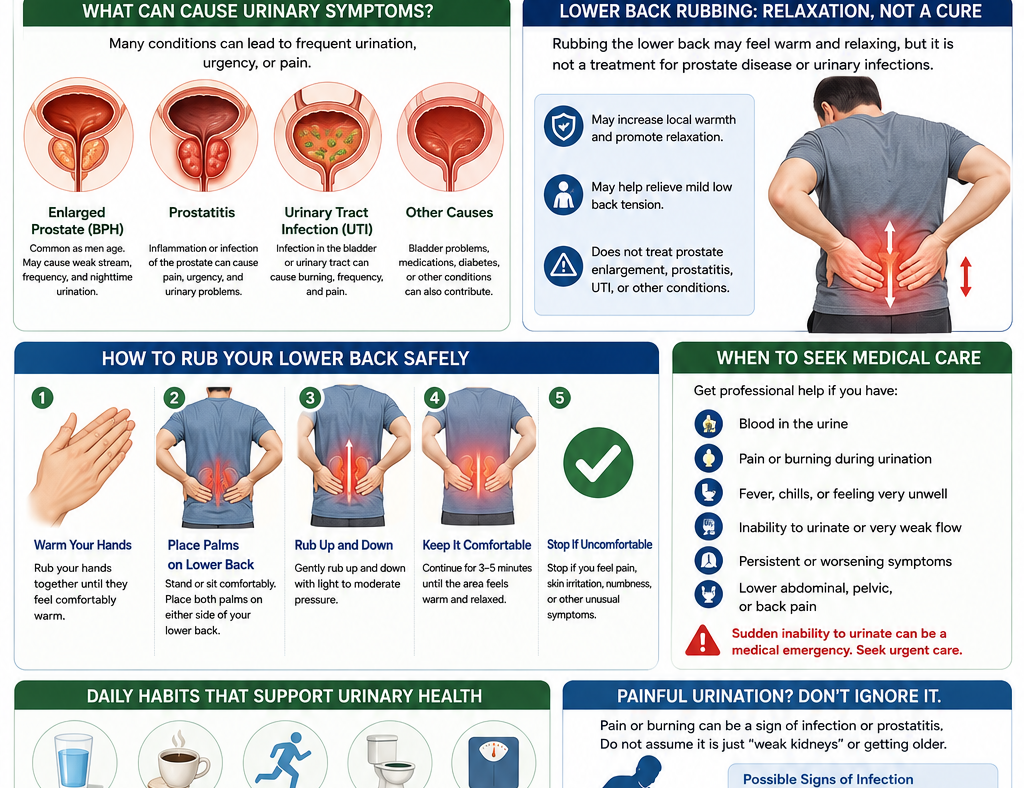
Frequent urination, urgency, and other changes in urination can be caused by a variety of urinary tract conditions.
As men get older, benign prostatic hyperplasia, commonly known as an enlarged prostate, may contribute to symptoms such as difficulty starting urination, a weak or interrupted urine stream, dribbling after urination, a feeling that the bladder has not completely emptied, and frequent urination during the night.
Prostatitis can also cause urinary frequency, urgency, burning or pain during urination, and discomfort in the lower abdomen, groin, pelvic area, or lower back.
Urinary tract infections may produce similar symptoms, including a strong and sudden need to urinate, frequent urination, burning or pain during urination, cloudy urine, blood in the urine, lower abdominal discomfort, back pain, or fever.
Bladder conditions and other urinary disorders can also cause similar problems.
For this reason, urinary frequency or urgency alone cannot tell you whether the prostate is the cause.
Can Rubbing the Lower Back Treat Urinary Frequency?
A traditional self-care practice involves warming the hands and rubbing the lower back with both palms until the area feels warm.
The most obvious effect of this practice is local warmth created by friction.
Gentle rubbing may also feel relaxing and may temporarily reduce a sense of stiffness or tension in the lower back.
If the movement is comfortable and does not irritate the skin, it can be used as a simple relaxation practice.
However, relaxation should not be confused with medical treatment.
There is no strong evidence that rubbing the lower back for several minutes can treat benign prostatic hyperplasia, prostatitis, urinary tract infections, or persistent urinary frequency and urgency.
Likewise, a warm sensation in the lower back should not be interpreted as proof that a medical condition has been corrected.
How to Try Gentle Lower Back Rubbing Safely
If you enjoy this type of relaxation practice, keep it gentle.
Stand or sit in a comfortable position.
If your hands are cold, rub them together first until they feel comfortably warm.
Place your palms on both sides of the lower back.
Move your hands gently up and down using light to moderate pressure.
There is no need to rub aggressively or continue until the skin becomes very red or painful.
A comfortable feeling of warmth is enough.
Stop if you develop skin irritation, pain, numbness, or other unusual symptoms.
If you already have significant lower back pain, a recent injury, or another known medical condition, do not use massage as a substitute for appropriate evaluation or treatment.
Pay Attention to Changes in Urination
Occasionally urinating more often after drinking a large amount of fluid is not necessarily a sign of disease.
However, persistent changes in urination deserve attention.
These may include waking repeatedly during the night to urinate.
The urine stream becoming noticeably weaker.
Difficulty starting urination.
A urine stream that repeatedly starts and stops.
Feeling that the bladder has not completely emptied.
Sudden and difficult-to-control urinary urgency.
Pain or burning during urination.
These symptoms may be related to the prostate, bladder, urinary tract, or another condition.
If they persist, professional assessment can help determine the cause.
Do not avoid seeking medical care simply because urinary symptoms feel embarrassing.
These problems are common, and healthcare professionals routinely evaluate them.
A proper assessment may include a review of symptoms, physical examination, urine testing, and other investigations when appropriate.
Different urinary conditions can cause very similar symptoms, which is why self-diagnosis based on symptoms alone can be unreliable.
More Practical Ways to Support Urinary Health
Healthy urinary habits are generally more useful than searching for one special exercise that promises to solve frequent urination.
Drink enough fluid to stay well hydrated, but there is usually no need to consume excessive amounts of water in an attempt to flush the prostate.
If nighttime urination is a problem, consider whether you are drinking large amounts of fluid close to bedtime.
Some people notice that coffee, strong tea, alcohol, and other beverages worsen urinary frequency or urgency.
If you observe a clear connection, reducing or adjusting these drinks may help.
Regular physical activity and maintaining a healthy body weight support overall health and may also benefit long-term urinary and metabolic health.
Avoiding prolonged periods of sitting may also be useful for general comfort and circulation.
Most importantly, persistent urinary symptoms should be properly evaluated rather than repeatedly covered up with massage or home remedies.
Painful Urination Should Not Be Ignored
Pain or burning during urination deserves particular attention.
It should not automatically be explained as weakness, aging, or a lack of internal energy.
Prostatitis and urinary tract infections can both cause painful urination, often together with frequency and urgency.
If painful urination is accompanied by fever, chills, significant fatigue, pelvic pain, lower abdominal pain, or back pain, medical evaluation becomes even more important.
In these situations, continuing to massage the lower back is not an appropriate substitute for identifying the cause.
When Should You Seek Medical Care?
Certain urinary symptoms should be assessed promptly.
Seek urgent medical care if you suddenly cannot urinate at all, especially if the lower abdomen or bladder feels painfully full.
Acute urinary retention can be a medical emergency.
You should also seek professional evaluation if you experience blood in the urine, significant pain during urination, persistent urinary frequency or urgency, fever or chills, worsening pelvic or lower back pain, increasingly weak urine flow, or a persistent feeling that the bladder cannot empty properly.
Symptoms that continue to worsen should not simply be accepted as a normal part of aging.
The Most Important Principle
Male urinary health cannot be reduced to whether the lower back feels strong or whether a particular area feels warm after massage.
Frequent urination, urgency, painful urination, weak flow, and incomplete emptying are symptoms, not diagnoses.
The same symptom can be caused by the prostate, bladder, urinary tract, or another medical condition.
Gentle lower back rubbing may feel pleasant and relaxing.
But it should remain a relaxation technique, not a substitute for diagnosis or treatment.
A more reliable approach is to pay attention to changes in urinary patterns, maintain healthy lifestyle habits, and seek professional assessment when symptoms persist, worsen, or occur together with pain, fever, blood in the urine, or inability to urinate.
When it comes to men’s health, identifying the real cause of a urinary problem is far more useful than relying on a single so-called miracle technique.
Medical Disclaimer
This article is intended for general health education and informational purposes only. It is not intended to diagnose, treat, cure, or prevent any medical condition and should not replace individualized advice from a physician, urologist, or other qualified healthcare professional.
If you experience persistent urinary frequency or urgency, painful urination, blood in the urine, fever, severe lower abdominal pain, worsening urinary symptoms, or inability to urinate, seek appropriate medical care promptly.
This article is for general education and does not replace individualized care from a qualified health professional. Seek appropriate advice for persistent, severe, or concerning symptoms.
Read the full medical disclaimer