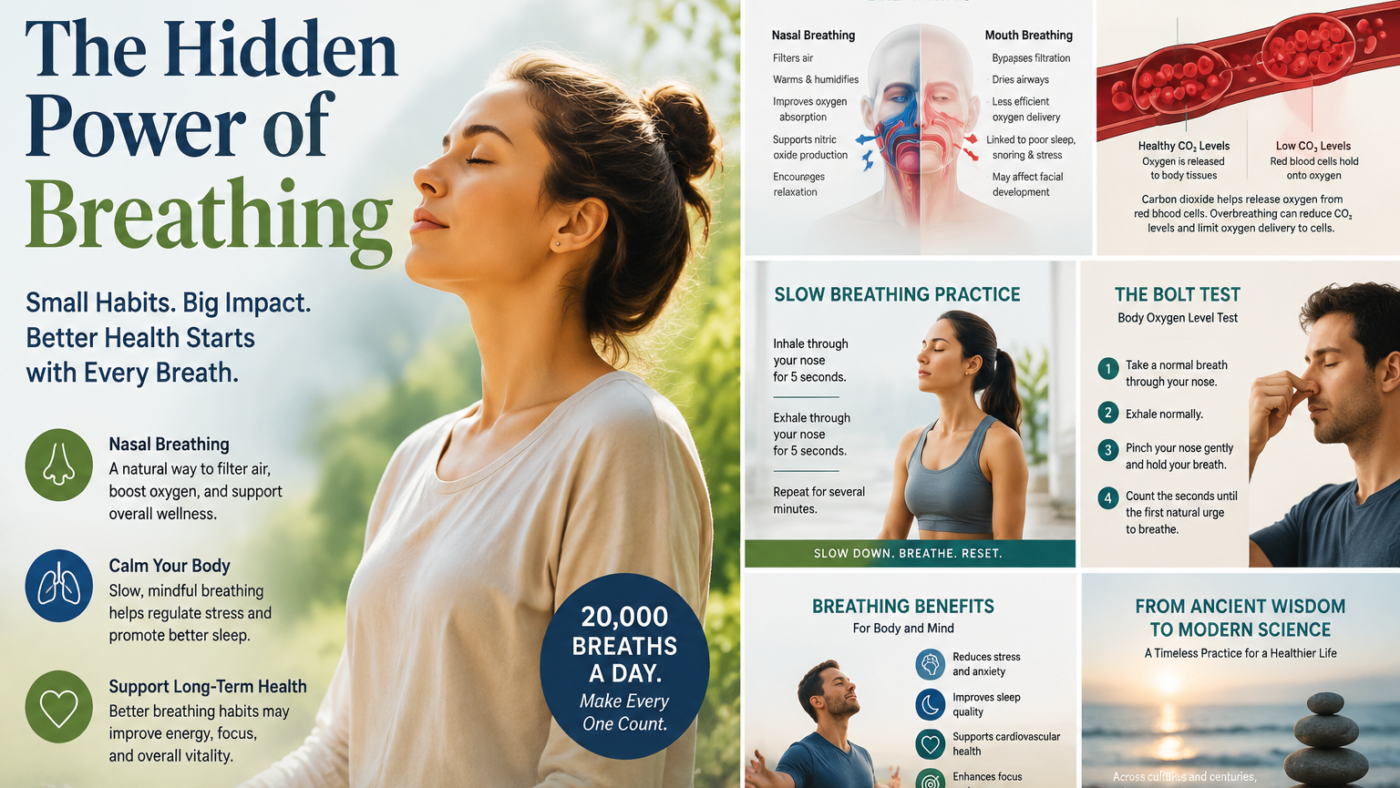
Breathing: The Health Habit We Practice 20,000 Times a Day
Every day, most people take around 20,000 breaths without consciously thinking about them. Breathing is one of the few body functions that works automatically while also allowing us to influence it intentionally.
Unlike heartbeat, digestion, or hormone production, breathing is something we can adjust at any moment.
This unique connection between automatic function and conscious control makes breathing one of the most accessible tools for supporting relaxation, resilience, and overall wellness.
Although we breathe thousands of times every day, many people rarely pay attention to their breathing patterns.
The way we breathe may influence sleep quality, stress regulation, physical performance, and daily energy levels.
Why Nasal Breathing Matters
Modern lifestyles have changed many aspects of human health, including breathing habits.
Long-term mouth breathing, especially during childhood development, has been associated with changes in facial growth, dental alignment, airway development, and sleep quality.
Researchers studying ancient human skulls have observed differences between ancient populations and many modern individuals, including broader dental arches, better tooth alignment, larger airway spaces, and fewer signs of dental crowding.
Some researchers suggest that lifestyle factors, including diet, posture, and breathing patterns, may contribute to these differences.
The nose is not simply an air passage. It helps filter particles, warm and humidify incoming air, regulate airflow, and produce nitric oxide, a molecule involved in blood vessel function and circulation.
Compared with mouth breathing, nasal breathing naturally encourages slower and more regulated airflow.
How Breathing Affects Oxygen Delivery
Many people believe that deeper breathing always means receiving more oxygen.
However, efficient oxygen delivery depends on a delicate balance between oxygen and carbon dioxide levels in the body.
This relationship is partly explained by the Bohr Effect, discovered by Danish physiologist Christian Bohr in 1904.
The Bohr Effect describes how carbon dioxide levels influence the ability of red blood cells to release oxygen to tissues.
When breathing becomes excessively rapid or excessive in volume, carbon dioxide levels may decrease, which can affect oxygen release.
The goal is not to breathe as much as possible.
The goal is to breathe efficiently.
Breathing and the Stress Response
Breathing patterns are closely connected with the nervous system.
Fast, shallow, or irregular breathing is often associated with stress and heightened alertness.
Slow, controlled breathing may help support the body’s relaxation response by encouraging parasympathetic nervous system activity.
Long-term stress and elevated cortisol levels may influence sleep quality, immune balance, metabolism, and inflammation.
Because breathing happens continuously throughout life, improving breathing habits may become a meaningful part of a healthy lifestyle.
A Simple Daily Breathing Practice
A simple breathing exercise can help develop better awareness.
Sit comfortably and relax your shoulders.
Keep your mouth gently closed.
Breathe slowly through your nose.
Try inhaling for about five seconds and exhaling for about five seconds.
Continue for several minutes.
Many traditional practices, including meditation, yoga, and Eastern wellness traditions, have used slow rhythmic breathing for centuries.
Modern research continues to explore how these practices may support stress management and overall well-being.
Understanding the Buteyko Breathing Method
Dr. Konstantin Buteyko developed a breathing approach in the mid-20th century based on the idea that many people habitually overbreathe.
The Buteyko method emphasizes nasal breathing, reducing unnecessary breathing volume, and improving awareness of breathing patterns.
Some studies have explored its potential benefits, especially for people with asthma symptoms. However, breathing exercises should complement professional medical care rather than replace it.
The BOLT Breathing Awareness Test
The Body Oxygen Level Test, commonly known as the BOLT test, is designed to help people become more aware of their breathing comfort and carbon dioxide tolerance.
A general approach involves taking a normal breath through the nose, exhaling normally, gently holding the breath, and noticing the first natural urge to breathe.
The purpose is not to compete or force yourself.
It is simply a way to understand your current breathing habits.
Breathing Is a Skill We Can Improve
Modern health discussions often focus on exercise, nutrition, supplements, and lifestyle choices.
However, breathing is something we practice every moment of our lives.
Simple habits can make a difference:
Practice nasal breathing when comfortable.
Slow down rushed breathing.
Maintain good posture.
Include relaxation and breathing exercises in your daily routine.
Breathing is automatic, but the way we breathe is also a skill that can be improved.
Every breath is an opportunity to reconnect with your body and support a healthier lifestyle.
This article is for educational and wellness purposes only. It does not provide medical advice, diagnosis, or treatment recommendations. If you experience breathing difficulties, persistent snoring, sleep problems, asthma symptoms, or other health concerns, please consult a qualified healthcare professional.
This article is for general education and does not replace individualized care from a qualified health professional. Seek appropriate advice for persistent, severe, or concerning symptoms.
Read the full medical disclaimer