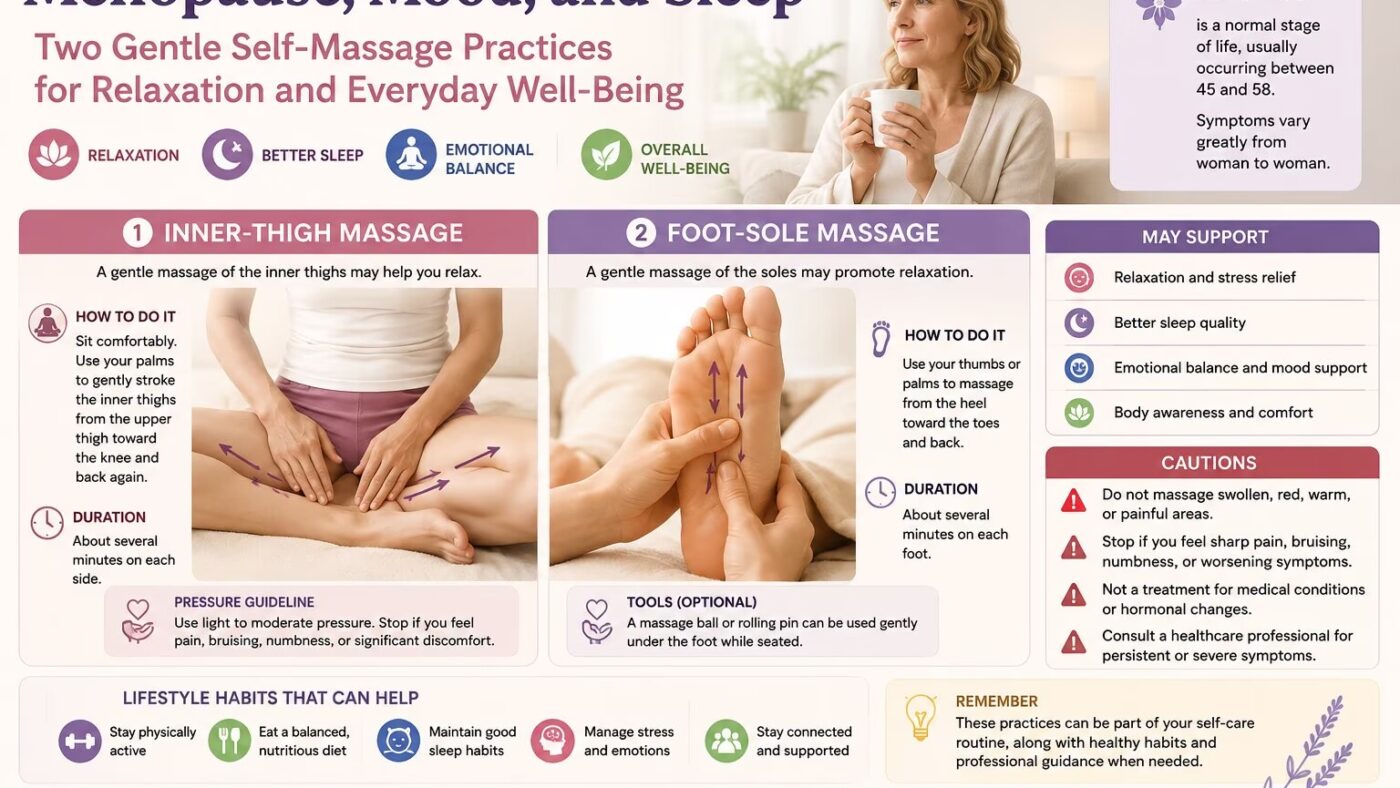
Menopause is a normal stage of life, but the transition can feel very different from one woman to another.
Some women experience only mild changes, while others notice hot flashes, night sweats, sleep difficulties, irritability, anxiety, changes in mood, vaginal dryness, or other symptoms that interfere with everyday life.
One important correction to traditional descriptions is that menopause does not automatically begin at age 49. Menopause is medically defined as having gone 12 consecutive months without a menstrual period. In the United States, the average age is about 52, and it commonly occurs between approximately 45 and 58. The years leading up to menopause are known as perimenopause or the menopausal transition.
Traditional Chinese wellness practices sometimes recommend massage along the inner thighs and soles of the feet during this stage of life.
These techniques can be approached as gentle relaxation and body-awareness practices.
They should not, however, be presented as a way to “unblock the Liver meridian,” correct hormonal changes, or treat menopause itself.
Why Mood and Sleep Can Change Around Menopause
Hormone levels fluctuate during the menopausal transition, and women may experience changes in menstrual patterns, temperature regulation, sleep, mood, and sexual health. Night sweats and hot flashes can disrupt sleep, while emotional changes may also make restful sleep more difficult.
Menopause itself is not a disease. It is a normal biological transition, although symptoms can sometimes become significant enough to affect quality of life.
It is also misleading to suggest that irritability automatically means a woman has a particular “blocked meridian.”
Mood changes during midlife may be influenced by hormone fluctuations, sleep disruption, work and family pressures, previous mental-health history, physical symptoms, and many other factors.
Menopause and Long-Term Health
The original material also suggests that menopause directly causes a range of “blood-vessel diseases.”
That needs a more balanced explanation.
Cardiovascular risk does change as women age, and some biological changes after menopause may contribute to shifts in cholesterol and cardiovascular risk. But heart disease develops through many interacting factors, including blood pressure, cholesterol, diabetes, smoking, physical activity, weight, genetics, and age.
Massaging the legs or feet should therefore never be presented as a cardiovascular disease prevention strategy.
Practice One: Gentle Inner-Thigh Massage
Traditional Chinese medicine describes several meridian pathways along the legs, including a pathway traditionally associated with the Liver meridian.
For a modern self-care routine, there is no need to claim that these invisible pathways must be physically “opened.”
Instead, gentle massage of the inner thighs can simply be used as a calming sensory practice.
Sit comfortably on a bed, mat, or supportive surface.
Allow the legs to relax into a position that does not strain the hips or knees.
Using the broad surface of your palm, gently stroke or massage the inner thigh.
Move slowly rather than using aggressive friction.
You may work from the upper thigh toward the knee and then return gently.
The pressure should feel comfortable.
The goal is relaxation—not pain.
Do Not “Rub Until the Pain Goes Away”
One of the most important safety corrections is the original instruction to find very painful points and rub them aggressively until they stop hurting.
That is not a good general rule.
Pain is not proof that a meridian is blocked.
A tender area may simply reflect muscular sensitivity, irritation, bruising, inflammation, or another medical issue.
Never assume that stronger pain means a stronger therapeutic effect.
If massage produces sharp pain, significant tenderness, bruising, numbness, or worsening discomfort, stop.
Be Particularly Careful With Unexplained Leg Pain or Swelling
Do not aggressively massage an inner thigh or leg that is unexpectedly swollen, warm, red, or painful—particularly when symptoms affect one leg.
Those can be symptoms of deep vein thrombosis, or DVT, which requires medical evaluation. DVT symptoms may include swelling, tenderness or pain, warmth, and skin discoloration.
Sudden shortness of breath or chest pain together with possible DVT symptoms can indicate a pulmonary embolism and requires urgent medical care.
This is why “just massage the painful point harder” is not appropriate health advice.
Practice Two: Gentle Foot-Sole Massage
The second traditional practice focuses on a firm band that can sometimes be felt along the sole when the big toe is extended.
Traditional wellness teachings may call this area the “dijin,” sometimes translated loosely as an “earth tendon.”
This is not a standard anatomical structure in modern medicine.
Depending on exactly where a person is touching, the firm tissue felt under the foot may include plantar fascia and other connective or tendinous structures.
For everyday self-care, precise terminology is less important than using gentle, comfortable pressure.
Sit comfortably and support one foot.
Using your thumb or palm, slowly massage the sole from the heel toward the forefoot.
You can then reverse direction.
Keep the pressure moderate.
A massage ball or similar smooth object may also be rolled gently beneath the foot while seated.
The goal is relaxation and sensory comfort—not trying to “break up” hard tissue.
Does an Irritable Personality Make Foot Tendons Hard?
No established medical evidence shows that anger or irritability causes a specific tendon in the sole to become rigid.
Muscular and connective-tissue stiffness can vary with activity, footwear, injury, mobility, age, loading patterns, and other factors.
Traditional Chinese medicine sometimes links emotional patterns with particular organ systems or meridians.
Those concepts are part of the traditional framework, but they should not be presented as established anatomical mechanisms.
Feeling a tight area in the foot does not diagnose emotional imbalance.
Can These Two Practices Treat Menopause Symptoms?
There is not sufficient evidence to say that inner-thigh massage or rubbing the sole of the foot treats menopause-related insomnia, irritability, hot flashes, dry mouth, or hormonal changes.
Complementary mind-body approaches have been studied for menopausal symptoms, and NCCIH notes that practices such as acupuncture, yoga, meditation, and hypnosis may help some women with certain symptoms. However, evidence varies considerably by treatment and symptom, and complementary practices should not replace appropriate healthcare.
A responsible interpretation of these massage techniques is therefore:
They may be used as relaxing self-care rituals, but they are not established treatments for menopause.
Make the Routine More Useful by Adding Slow Breathing
One simple way to make self-massage more relaxing is to combine it with comfortable breathing.
While massaging the thigh or foot, allow the shoulders and jaw to relax.
Breathe slowly without forcing unusually deep breaths.
Notice the sensation of your hands touching the body rather than concentrating on whether you are hitting an exact acupuncture pathway.
This turns the routine into a quiet pause rather than a medical treatment.
For many people, several comfortable minutes are enough.
There is no requirement to massage each area for exactly 10 minutes.
What Actually Helps With Menopause Symptoms?
Women do not have to simply endure severe symptoms.
For hot flashes and night sweats, practical approaches can include temperature control, layered clothing, identifying individual triggers, and discussing prescription options when symptoms interfere with daily life.
Menopausal hormone therapy can help relieve hot flashes and some other symptoms in appropriate women, although it has risks and should be individualized based on age, health history, symptoms, and personal risk factors.
Vaginal dryness and discomfort also have evidence-based treatment options, including moisturizers, lubricants, and—in appropriate patients—local vaginal estrogen or other prescription therapies.
The important point is that women have options.
Self-massage can coexist with these treatments, but it should not replace them.
A Better Menopause Wellness Routine
Instead of depending on one “meridian-clearing” technique, think of menopause care more broadly.
A practical routine can include regular physical activity, maintaining muscle strength, consistent sleep habits, balanced nutrition, stress-management practices, supportive relationships, appropriate cardiovascular and bone-health screening, and medical treatment when symptoms warrant it.
If gentle thigh or foot massage helps you unwind in the evening, it can fit comfortably into that larger routine.
But the benefit does not depend on pushing through pain.
When Sleep Problems Need More Attention
Occasional poor sleep is common.
But repeated insomnia can affect energy, concentration, mood, and quality of life.
Hot flashes, night sweats, and mood changes can all contribute to sleep problems around menopause.
If sleep difficulties persist for weeks or significantly interfere with daily functioning, it is worth discussing them with a healthcare professional rather than relying only on foot massage.
Sometimes improving hot flashes or mood symptoms also helps improve sleep.
When Mood Changes Deserve Professional Support
Irritability and emotional ups and downs can occur during the menopausal transition, but persistent anxiety, depression, panic symptoms, loss of interest in normal activities, or major changes in functioning deserve attention.
Menopause should not be used as an explanation for every emotional problem.
A healthcare professional can help determine whether symptoms relate primarily to the menopausal transition, sleep disruption, mental health, medications, thyroid disease, other medical conditions, or several factors at once.
Menopause Is Not Something Women Have to “Pass Through” Alone
The language around menopause is sometimes unnecessarily negative.
It is often described as a dangerous “barrier” or a period in which the body inevitably declines.
That is not an accurate or helpful picture.
Menopause is a normal life stage, and every woman experiences it differently. Some have few symptoms, while others benefit considerably from lifestyle adjustments, medical treatment, counseling, sleep management, or other forms of support.
The goal is not simply to “survive menopause.”
The goal is to maintain health, comfort, confidence, and quality of life throughout midlife and beyond.
A Simple Evening Self-Care Routine
If you enjoy the traditional approach in the original practice, a safer version can be very simple.
Sit somewhere comfortable.
Gently massage each inner thigh using broad, light-to-moderate strokes.
Avoid any painful, swollen, bruised, or unusually warm areas.
Then massage the soles of the feet with your hands or gently roll them over a smooth massage ball.
Breathe slowly.
Keep the pressure comfortable.
Stop when you feel relaxed.
There is no need to perform a fixed number of repetitions or continue for exactly 20 minutes.
And there is certainly no requirement to make a painful area hurt more before it can improve.
The Traditional Chinese Medicine Perspective
Traditional Chinese medicine has historically connected menopause, emotional health, Liver meridian theory, qi movement, and the balance of yin and yang.
These concepts are part of a longstanding traditional health system and can be presented respectfully as cultural and historical perspectives.
But modern health education should distinguish traditional theory from established physiological evidence.
Inner-thigh massage does not have proven ability to “clear the Liver meridian.”
Foot massage does not have proven ability to correct menopausal hormone changes.
And painful tissue should not automatically be interpreted as stagnant qi.
Traditional practices are most useful when they are incorporated safely into broader, evidence-informed self-care.
The Bottom Line
Gentle inner-thigh and foot massage can be pleasant self-care practices for women going through the menopausal transition.
They may offer:
relaxation,
a calming sensory focus,
body awareness,
and a few quiet minutes of personal care.
What they cannot reliably be expected to do is:
restore hormone balance,
treat insomnia,
eliminate hot flashes,
prevent cardiovascular disease,
or cure menopausal symptoms by “opening meridians.”
Menopause is a normal biological transition, not a disease and not a fixed event that begins automatically at age 49.
The most useful approach combines comfortable self-care, healthy daily habits, realistic expectations, and evidence-based treatment when symptoms interfere with quality of life.
This article is provided for general educational and wellness purposes only. It is not intended to diagnose, treat, cure, or prevent menopause symptoms or any other medical condition.
Gentle self-massage may be used as a complementary relaxation practice. Do not aggressively massage a leg that is swollen, red, warm, or unusually painful. Seek medical evaluation for persistent or severe menopausal symptoms, unexplained bleeding after menopause, significant depression or anxiety, or other concerning changes. Postmenopausal bleeding or spotting should be medically evaluated.
This article is for general education and does not replace individualized care from a qualified health professional. Seek appropriate advice for persistent, severe, or concerning symptoms.
Read the full medical disclaimer