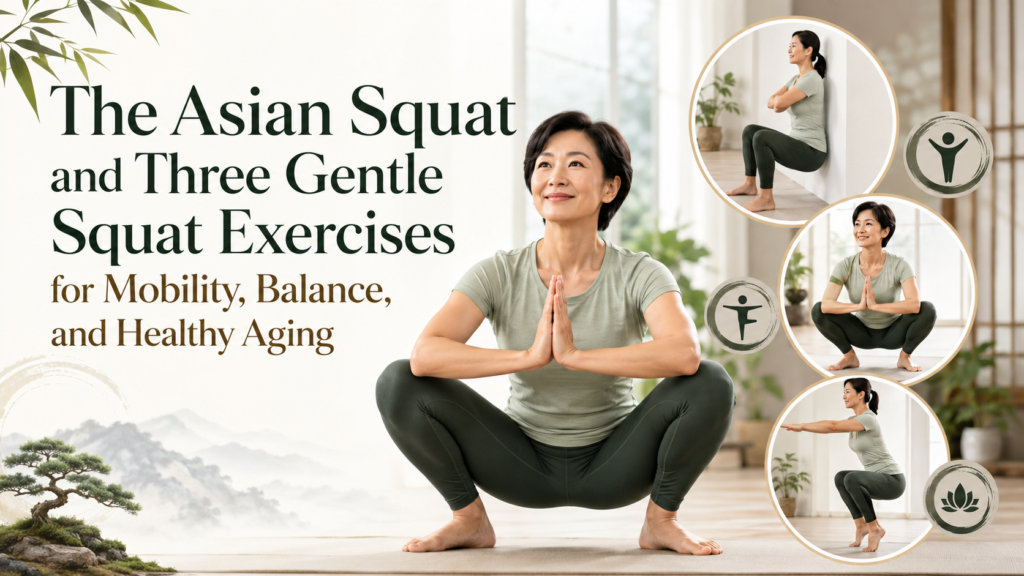
The Asian squat is a deep, relaxed squatting position in which the hips lower close to the ground while the feet remain supported and, when mobility allows, the heels stay comfortably in contact with the floor. Although the popular term “Asian squat” reflects how commonly this posture has been observed in many Asian communities, deep squatting is not unique to Asia. It is a natural human movement pattern that has historically been used for resting, working, eating, gardening, and performing everyday tasks in many parts of the world.
For people who regularly squat from childhood, the position may feel effortless. For adults who spend most of the day sitting in chairs, however, a deep squat can feel surprisingly difficult. Limited ankle mobility, reduced hip flexibility, lower-body weakness, balance challenges, and simply a lack of practice may all influence how comfortably someone can squat.
That does not mean everyone needs to force the body into an extremely deep position. A better goal is to gradually maintain or improve the range of motion, strength, coordination, and confidence needed for everyday movement.
Squatting can be one useful part of that process.
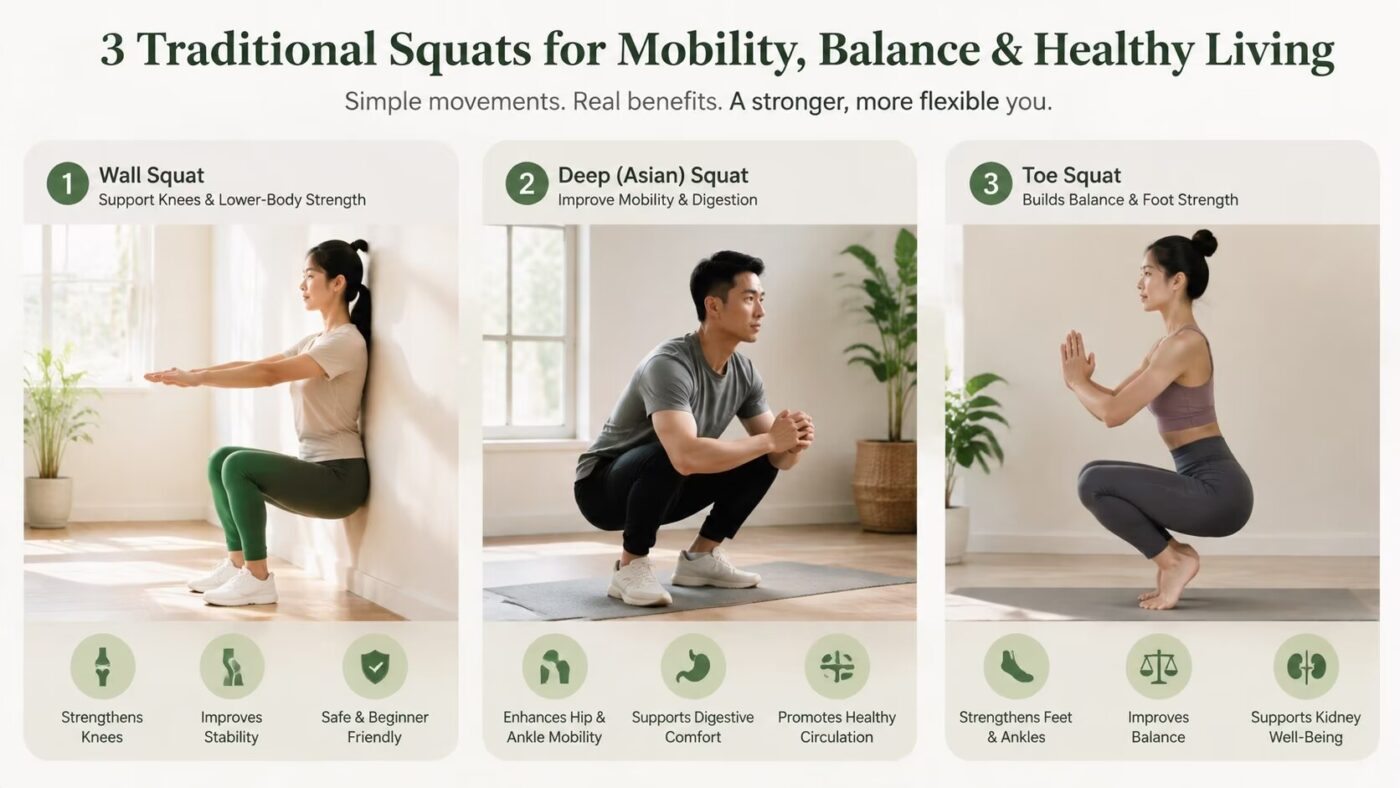
The following three squat variations progress from a supported strength exercise to a deeper mobility position and then to a more challenging balance exercise. They can be adapted to different ability levels and incorporated into a broader healthy movement routine.
Why Squatting Matters for Everyday Movement
Squatting involves coordinated movement through the ankles, knees, hips, trunk, and feet. Even if you never intentionally perform a deep squat during daily life, similar movement patterns appear whenever you sit down, stand up, lower yourself toward the floor, pick something up, garden, or rise from a low position.
As people become less active, these movements may gradually become more difficult. Long periods of sitting do not automatically cause poor mobility, but a lifestyle that rarely challenges the hips, knees, ankles, and lower-body muscles can reduce opportunities to maintain comfortable movement through a broad range of motion.
A well-chosen squat exercise can therefore serve several purposes. Depending on the variation, it may challenge the muscles of the thighs and hips, encourage ankle and hip mobility, train balance, and improve confidence when lowering and raising the body.
For healthy aging, these qualities matter because maintaining lower-body strength and functional movement helps people continue performing everyday activities independently.
1. Wall Squat: Building Lower-Body Strength and Stability
The wall squat is the most supported of the three exercises and is a good starting point for many beginners.
Because the wall provides external support, you can concentrate on developing strength and control without needing as much balance as you would during a free-standing squat.
The exercise primarily challenges the quadriceps at the front of the thighs, while the gluteal muscles, calves, and trunk also contribute to maintaining the position.
How to Practice a Wall Squat
Stand with your back against a stable wall.
Place your feet approximately shoulder-width apart and a comfortable distance in front of you.
Keep your feet pointing generally forward or slightly outward according to what feels natural for your hips.
Slowly slide your back down the wall while bending your knees.
Stop at a depth that feels controlled and comfortable. You do not need to reach a perfect 90-degree knee angle.
Keep your feet firmly supported on the floor.
Maintain relaxed, steady breathing.
Hold briefly, then slowly slide back upward.
A beginner might start with a 10- to 20-second hold, rest, and repeat if comfortable.
As strength improves, the hold can gradually become longer or the position slightly deeper.
There is no benefit in forcing yourself into pain simply to reach a particular depth or duration. The objective is controlled muscular effort.
2. Deep Squat or “Asian Squat”: Exploring Mobility and Body Control
The deep squat requires considerably more mobility than the wall squat.
To lower the hips close to the floor while maintaining balance, the body must coordinate movement at the ankles, knees, hips, feet, and trunk. Ankle dorsiflexion—the ability of the knee to move forward over the foot while the heel remains supported—is particularly important for many people.
Some adults can naturally sit in a deep squat with little effort. Others may need a wider stance, slightly turned-out feet, heel support, or a chair in front of them.
Individual differences are normal.
How to Practice a Deep Squat
Stand with your feet approximately hip-width to shoulder-width apart.
Allow the toes to point slightly outward if that feels more comfortable.
Slowly bend your knees and hips while lowering your body toward the floor.
Keep the entire foot supported whenever possible.
Allow the knees to travel naturally in the same general direction as the toes.
Keep your trunk controlled rather than attempting to force the back into an unnaturally rigid position.
Lower only as far as you can while maintaining balance and comfort.
If necessary, lightly hold a stable chair, countertop, railing, or other secure support.
Once you reach your comfortable depth, breathe normally and remain there briefly.
Beginners might start with approximately 10 to 30 seconds rather than immediately attempting a long hold.
Stand up slowly and with control.
As mobility and confidence improve, the squat may gradually become deeper or more comfortable.
What If Your Heels Lift?
Heel lifting is common when someone lacks sufficient ankle mobility for a very deep squat, although body proportions, stance width, previous injuries, and individual anatomy also influence squat technique.
Do not force the heels downward while pushing aggressively into discomfort.
Instead, try a slightly wider stance, reduce the depth, practice ankle mobility separately, or hold a stable support.
A temporary small heel elevation may also make the position more accessible, but the long-term goal does not need to be identical for everyone. Comfortable, controlled movement is more important than copying another person’s squat.
3. Toe Squat: A More Challenging Balance Variation
The third variation increases the balance requirement.
In this exercise, the heels rise and more body weight shifts toward the balls of the feet. That changes the demands placed on the feet, ankles, calves, thighs, and balance system.
For this reason, the toe squat should not be treated as the automatic next step for everyone. It is an optional variation for people who already have reasonable balance and lower-body control.
Older adults or anyone who feels unsteady should practice beside a stable support or choose one of the first two exercises instead.
How to Practice a Toe Squat
Stand near a stable chair, countertop, or railing if you need support.
Slowly lower into a comfortable squat.
Gradually raise the heels so the weight shifts toward the balls of the feet.
Keep the toes and forefeet in contact with the floor.
Maintain an upright but relaxed trunk.
You may extend your arms forward or lightly hold a stable support.
Remain in the position only while you can maintain control.
Begin with a short hold of around 5 to 15 seconds.
Slowly lower the heels and return to standing.
This variation should feel like a balance and muscular-control challenge rather than a test of endurance.
If you experience forefoot, ankle, knee, or other joint pain, stop the exercise.
You Do Not Need a Perfect Asian Squat
One of the biggest mistakes people make when exploring deep squatting is turning it into a flexibility competition.
Human anatomy varies.
Femur length, torso length, hip structure, ankle mobility, training history, body size, previous injuries, footwear, and habitual movement patterns can all influence what a squat looks like.
One person may comfortably squat with the feet relatively close together. Another may naturally need a wider stance and more outward rotation of the feet.
Neither position automatically indicates better health.
The goal is not to reproduce a photograph perfectly.
The goal is to develop useful movement capacity for your own body.
How Often Should You Practice?
There is no universal amount of squat practice that every person needs.
For mobility practice, short and comfortable sessions performed regularly may be more useful than occasionally forcing a very long deep squat.
For example, a beginner could practice a few comfortable repetitions or short holds several times during the week.
Someone primarily interested in strength may incorporate wall squats, chair squats, or conventional bodyweight squats into a structured resistance-training routine.
Someone interested in mobility may spend more time gradually exploring a comfortable deep squat.
The appropriate frequency depends on your current fitness, health, mobility, recovery, and the rest of your exercise program.
Squatting and Knee Health
Deep squats are sometimes described as inherently harmful to the knees, but that statement is too simplistic.
The forces acting on the knee change throughout a squat, and deeper knee flexion changes joint loading. However, current research does not support the idea that properly performed deep squatting automatically damages healthy knees.
That does not mean every person with knee pain or a previous injury should immediately perform maximum-depth squats.
Exercise should be matched to the individual.
If a shallow squat feels comfortable but a deep squat produces pain, there is no reason to force additional depth. Strength, range of motion, and exercise selection can be progressed gradually.
People recovering from surgery or managing significant knee conditions should follow guidance appropriate to their individual situation.
Squatting and Healthy Aging
Healthy aging is not about achieving extreme flexibility.
It is about maintaining enough strength, balance, mobility, endurance, and confidence to keep participating in everyday life.
Actions such as standing up from a chair, climbing stairs, carrying groceries, lowering yourself toward the floor, getting out of a car, and recovering balance all depend on physical capacities that can change with age.
Exercises involving the legs and hips can contribute to maintaining those capacities.
Squatting is therefore useful not because it is a magical anti-aging movement, but because it can train several qualities involved in functional independence.
For older adults, squat exercises work best as part of a broader program that also includes aerobic physical activity, muscle-strengthening exercise, and balance training.
A supported chair squat may be more useful for one person than a deep Asian squat. Another person may already have excellent squat mobility and benefit more from progressive resistance training.
The exercise should serve the person, not the other way around.
How to Practice Squats Safely
Move Within a Comfortable Range
You do not have to squat deeply to benefit from squat-based exercise.
Start with a range of motion that you can control.
Progress Gradually
Avoid suddenly increasing squat depth, hold duration, repetitions, or resistance.
Allow your body time to adapt.
Use Support When Needed
A chair, countertop, railing, or wall can make squat practice much safer while you develop strength and balance.
There is no disadvantage in using support when it helps you practice with better control.
Breathe Normally
Avoid unnecessary breath holding during gentle mobility work.
Slow, relaxed breathing can also make longer squat holds more comfortable.
Distinguish Effort From Pain
Muscular effort, mild stretching sensations, and fatigue may occur during exercise.
Sharp, sudden, worsening, or persistent pain is different.
Stop and reassess the exercise if you experience significant pain, dizziness, instability, numbness, or other concerning symptoms.
Consider Your Individual Health
People with significant knee, hip, ankle, foot, back, cardiovascular, neurological, or balance problems may need modified exercises.
Anyone recovering from surgery or dealing with an injury should seek individualized guidance before attempting unfamiliar squat variations.
A Simple Beginner Sequence
If all three movements are appropriate for you, a simple practice sequence might look like this:
Begin with a wall squat for approximately 10 to 20 seconds.
Rest until comfortable.
Practice a supported deep squat for approximately 10 to 30 seconds.
Stand slowly and rest.
If your balance is already good, optionally finish with a brief supported toe squat of approximately 5 to 15 seconds.
One or two rounds may be enough when starting.
These numbers are examples rather than targets. The exercise should be adjusted according to your own ability.
Final Thoughts
The Asian squat is often presented online as a test of flexibility, youthfulness, or physical health. It is better understood as one version of a natural human movement pattern.
Being unable to perform a perfect deep squat does not mean your body is unhealthy, and being able to remain in one for several minutes does not automatically mean you are exceptionally fit.
What matters more is maintaining useful movement capacity throughout life.
Wall squats can help develop lower-body strength and confidence. Deep squats can provide an opportunity to explore ankle and hip mobility while practicing body control. Toe squats can add a greater balance challenge for people who are ready for them.
Practiced progressively and appropriately, these movements can become useful components of a broader exercise routine designed to support mobility, balance, strength, and healthy aging.
Small amounts of movement practiced consistently can add up over time. The goal is not perfection. It is to keep the body capable, adaptable, and confident in the movements that make everyday life possible.
Frequently Asked Questions
What are the main Asian squat benefits?
The Asian squat can challenge hip, knee, and ankle mobility while requiring coordination and balance. Practicing an appropriate deep squat may help maintain comfort in deep-flexion movement, but it should be considered one component of a broader fitness program rather than a complete exercise solution.
Why can some people perform an Asian squat easily while others cannot?
Squat depth is influenced by several factors, including ankle and hip mobility, body proportions, strength, balance, previous movement habits, injuries, and individual anatomy. People who have regularly used deep squatting positions throughout life may also remain more accustomed to the movement.
Do my heels have to stay on the floor?
A classic relaxed deep squat is often performed with the heels supported, but not everyone can comfortably reach that position. If your heels rise, reduce the depth, change your stance slightly, or use support rather than forcing the movement.
Is the Asian squat bad for the knees?
Deep squatting is not automatically harmful to healthy knees. However, joint loading changes with squat depth, and people with pain, injuries, recent surgery, or specific medical conditions may need modifications. Pain should not be ignored simply to achieve a deeper squat.
Are squats good for people over 60?
Appropriately selected squat variations can help train the lower-body muscles and functional movements involved in sitting, standing, and everyday mobility. Older adults should choose a version appropriate to their ability and combine strength work with aerobic and balance activities.
How long should I hold a deep squat?
There is no required duration. Beginners may start with only 10 to 30 comfortable seconds, using support if necessary. Longer is not automatically better. Quality, comfort, and control are more important than setting a time record.
A Note on Health Information
This article is intended for general educational and wellness purposes. Exercise ability varies considerably between individuals, and no single movement is appropriate for everyone. The information presented here should not be interpreted as diagnosis, treatment, rehabilitation, or individualized medical advice.
If you have persistent pain, significant balance problems, a recent injury or operation, or a medical condition that may affect your ability to exercise safely, consider consulting an appropriately qualified healthcare or exercise professional before starting a new movement program.
Medical Disclaimer
The information provided by Health, Beauty & Longevity is for general educational purposes only and is not a substitute for professional medical advice, diagnosis, or treatment. Always seek appropriate professional guidance regarding questions about a medical condition, injury, rehabilitation program, or exercise limitation. Stop exercising and seek appropriate care if you develop severe or unusual symptoms.
This article is for general education and does not replace individualized care from a qualified health professional. Seek appropriate advice for persistent, severe, or concerning symptoms.
Read the full medical disclaimer