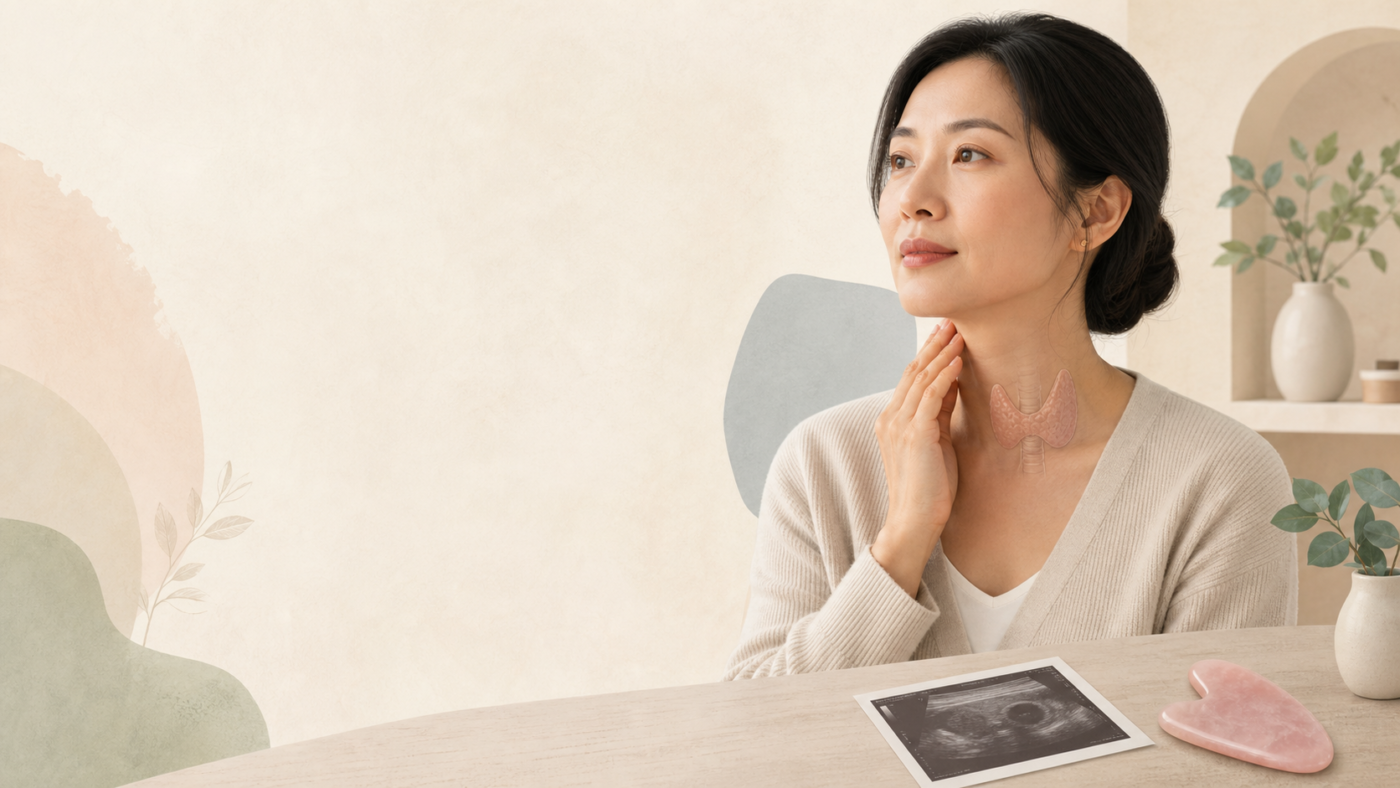
Thyroid nodules are extremely common, especially as people get older. Many are discovered accidentally during a physical examination, ultrasound, CT scan, or another imaging test performed for an unrelated reason. According to the American Thyroid Association, about half of people have a detectable thyroid nodule by age 60, and more than 90% of these nodules are benign. American Thyroid Association: Thyroid Nodules
Although that statistic is reassuring, a newly discovered thyroid nodule should not be ignored or treated solely with home remedies. A small proportion of nodules are cancerous, while others may produce excess thyroid hormone, grow over time, or become large enough to affect swallowing or breathing. The purpose of medical evaluation is not to assume that every nodule is dangerous, but to identify the minority that require biopsy, treatment, or closer monitoring.
One online claim suggests that scraping the skin below the elbow with a gua sha tool can improve thyroid nodules within approximately three days. The method usually involves holding a scraping tool at an angle and repeatedly stroking the same area until red or purple marks appear.
There is currently no robust clinical evidence showing that scraping the arm reduces the size of a thyroid nodule, changes its ultrasound features, treats thyroid cancer, or improves thyroid function. Major thyroid-nodule guidelines do not recommend gua sha as a diagnostic or therapeutic option.
Gua sha is a traditional East Asian practice in which a smooth-edged tool is drawn across the skin. It has mainly been studied for musculoskeletal pain and tension rather than diseases of the thyroid gland. Even within pain research, the evidence has been limited by small trials and poor study quality. One systematic review concluded that the available controlled evidence was insufficient to establish gua sha as an effective pain treatment. Systematic review of gua sha for musculoskeletal pain
This does not mean that every traditional practice is without personal or cultural value. Some people find gentle massage or gua sha relaxing. The important distinction is between feeling temporarily relaxed and treating a structural change inside the thyroid gland. A nodule is a defined area of tissue or fluid within the thyroid. Scraping a distant area of skin does not provide a demonstrated biological mechanism for removing that tissue.
The red or purple marks produced during body gua sha are caused by changes in superficial blood vessels and bleeding beneath the skin. They do not show that inflammation, “toxins,” or a thyroid nodule has been drawn out of the body. Producing more visible marks does not mean that the treatment is working better.
Claims of improvement after three days are also difficult to interpret. Most thyroid nodules cause no noticeable symptoms, so a person cannot reliably determine whether a nodule has changed by how the neck or body feels. Nodule size and characteristics are assessed with thyroid ultrasound, not by the amount of redness created on the arm. A change in anxiety, muscle tension, or general comfort should not be confused with a measurable change in the nodule itself.
The recommended evaluation usually begins with a medical history, examination, thyroid-function testing and a thyroid ultrasound. Ultrasound provides information about the nodule’s size, composition, shape, margins, echogenicity and calcifications. Systems such as ACR TI-RADS and EU-TIRADS use these features to estimate risk and help determine whether a nodule requires monitoring or fine-needle aspiration. American College of Radiology TI-RADS 2023 European Thyroid Association guidelines
Fine-needle aspiration is not necessary for every thyroid nodule. Whether it is recommended depends on the ultrasound risk pattern, nodule size, medical history and other clinical findings. Some small, low-risk nodules require no routine follow-up, while others are monitored with repeat ultrasound. Nodules with suspicious features may need a biopsy even when they do not cause symptoms.
Blood tests are useful for assessing thyroid function, but normal results do not prove that a nodule is benign. The American Thyroid Association notes that thyroid-function tests are often normal even when cancer is present. This is why blood tests and ultrasound answer different questions and are often considered together.
A biopsy-confirmed benign nodule may only require observation. Treatment can become appropriate when a benign nodule grows, produces excess thyroid hormone, causes significant discomfort, or interferes with breathing or swallowing. Depending on the individual case, medically supported options may include continued monitoring, medication for a related thyroid disorder, surgery, or an image-guided procedure such as thermal or ethanol ablation. These choices should be based on the diagnosis and the person’s symptoms—not on a universal home-treatment schedule.
It is also important not to use “thyroid inflammation” as a general label for every thyroid problem. Thyroid nodules and thyroiditis are not the same condition. Thyroiditis can result from autoimmune disease, infection, medication, pregnancy-related changes or other causes. Different forms of thyroiditis require different approaches, and some resolve without treatment while others require medical management. Scraping the arm for three days has not been shown to treat these conditions.
Gua sha can also cause soreness, skin irritation, petechiae and bruising. Forceful scraping may break the skin and increase the risk of infection. Extra caution is necessary for people taking anticoagulant or antiplatelet medication, those with bleeding disorders, fragile skin, an active skin infection or reduced sensation. A shared scraping tool should never be used without appropriate cleaning because contact with damaged skin can create an infection risk.
Anyone who discovers a new lump in the neck should arrange an appropriate medical assessment rather than attempting to determine its nature at home. Faster evaluation is particularly important when a lump grows rapidly or is accompanied by unexplained hoarseness, difficulty swallowing, shortness of breath, enlarged neck lymph nodes or a persistent change in voice. These signs do not automatically mean cancer, but they deserve prompt attention. NICE identifies rapid growth, hoarseness, swallowing difficulty and breathing problems as warning symptoms associated with thyroid enlargement. NICE thyroid-disease guidance
Most people with thyroid nodules will ultimately receive reassuring results. The safest response is therefore neither panic nor false reassurance. It is to complete the recommended assessment, understand the ultrasound risk category, follow the monitoring plan and report meaningful changes.
Gua sha may remain a personal relaxation practice when performed gently and safely, but it should not be presented as a treatment for thyroid nodules or thyroid inflammation. Redness on the arm is not evidence that a thyroid nodule is shrinking, and the absence of improvement after three days does not determine which treatment is needed. Evidence-based evaluation offers something a scraping tool cannot: a reliable understanding of what the nodule is and whether it requires any action.
This article provides general educational information and does not replace medical diagnosis or individualized care. Anyone with a new or changing neck lump should consult a qualified healthcare professional.
This article is for general education and does not replace individualized care from a qualified health professional. Seek appropriate advice for persistent, severe, or concerning symptoms.
Read the full medical disclaimer